

China is delivering more innovative drugs and treatments to the world than ever before, a potential new growth driver for our Healthcare ETF the KraneShares MSCI China All Shares Health Care 10/40 Index ETF (Ticker: KURE).
Cross-border outbound licensing deals from China-based biotech firms surged to $137.7 billion in total disclosed value in 2025, a nearly tenfold increase from only $13.9 billion in 2021.1 The acceleration has continued into 2026. In the first five months of the year, 39 agreements had already been announced, with a total disclosed value approaching $60 billion and average deal size jumping 76% year-over-year (YoY) to approximately $1.3 billion.2
Three headline transactions illustrate the trend:
AstraZeneca agreed to license an obesity drug candidate from CSPC Pharmaceutical* in a deal worth up to $18.5 billion.2
AbbVie signed a cancer-focused agreement with RemeGen* valued at up to $5.6 billion.2
Pfizer and China’s Innovent Biologics* entered into a global licensing and collaboration agreement worth up to $10.5 billion to develop 12 early-stage cancer medicines.3
A lot has changed in China’s healthcare sector since over the past decade. In 2017, most international pharmaceutical deals were for foreign-developed drugs and treatments to be made available in China. In 2025, the bulk of deals were out-licensing deals, i.e., for China-developed drugs and treatments to be made available in the rest of the world.
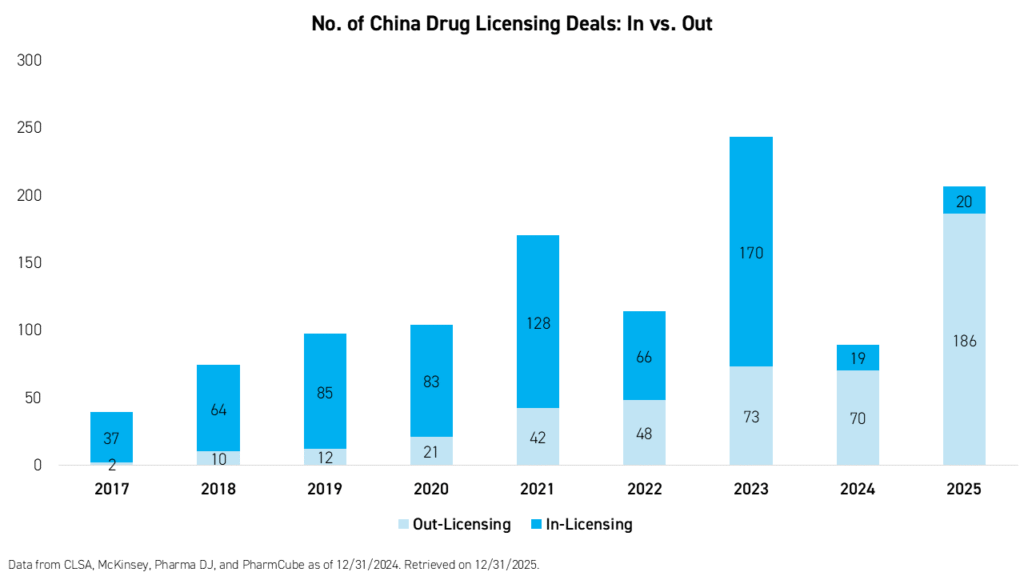
The 2025 surge was driven by a perfect storm of global pharmaceutical companies staring down the barrel of losing multiple significant patents at once, and recent reforms in China that help foreign regulators and companies accept its clinical trial data, and vice versa.
Patent expirations across major pharmaceutical companies are creating urgency. Global drugmakers face what the industry calls a “patent cliff,” with billions of dollars in revenue at risk as blockbuster drugs lose exclusivity.4 Rather than build from scratch, many are turning to Chinese firms that have already advanced drug candidates through early-stage trials.
China accounted for approximately one-third of global industry licensing spending in 2025, with roughly one-quarter of all licensed drug assets now originating from the region, according to data cited at the 2026 J.P. Morgan Healthcare Conference.2 Next-generation antibodies, particularly for oncology, dominated China-originated licensing in 2025, accounting for roughly half of recorded cross-border deals.
China’s recent regulatory overhaul expanded the acceptance of global clinical data in China, improved the standards for local clinical trials, and strengthened intellectual property protections for drug developers.6 The reforms position China as a potential first-wave launch market for innovative medicines, rather than a secondary market where drugs arrive years after initial approval elsewhere. The reforms also well as support China’s rising status as an innovator in the healthcare field. Nearly three-quarters of the outbound cross-border deals from 2026 involved assets in preclinical or Phase 1 testing, signaling growing global confidence in China-generated clinical data.2
Outbound cross-border deals with multinational pharmaceutical companies can generate significant attention hype for the China-based firms involved. For example, China-baseed Innovent Biologics gained over 10% the day after announcing its deal with Pfizer.5
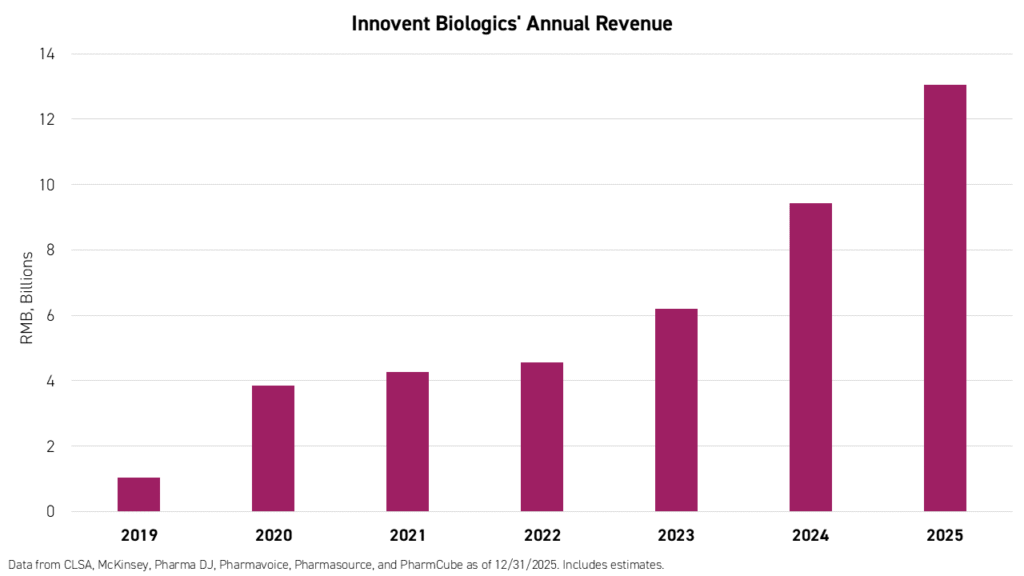
In the long run, stronger, more globalized distribution pipelines for China’s biotech firms could drive significant revenue growth and help expand KURE’s exposure to global demand. KURE currently consists of 37% biotech firms.
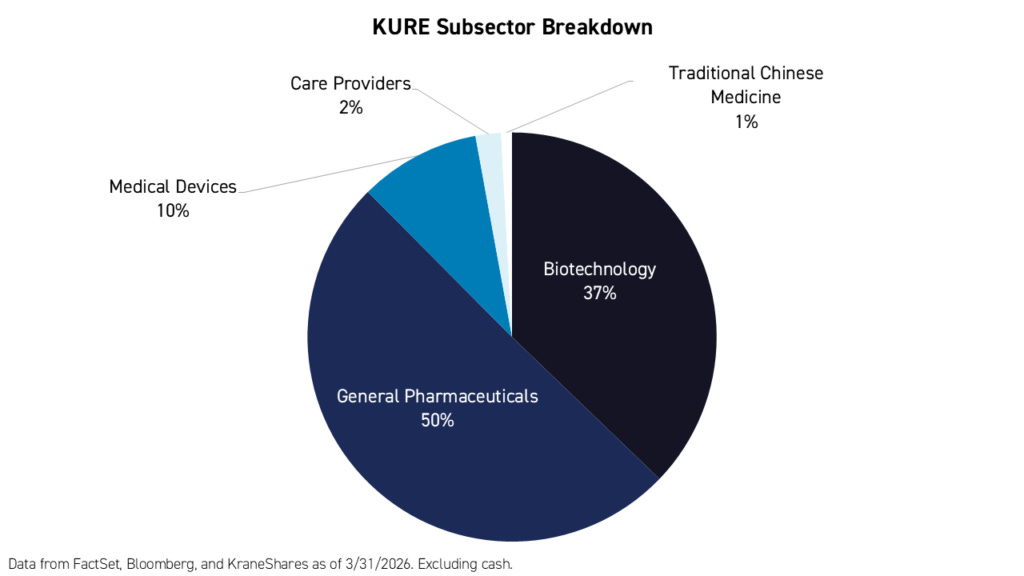
China represents the world’s second-largest healthcare market and, due to its rapidly aging population and rising incomes, per capita health expenditure is expected to grow at a compound annual growth rate (CAGR) of between 8% and 27%.6 This massive expected increase in demand for products and services from China’s health care firms is now being augmented by surging revenues from outbound licensing deals, supported by China’s strong healthcare innovation capacity and improving regulatory frameworks for clinical trials. Our healthcare ETF the KraneShares MSCI All China Healthcare Index ETF (Ticker: KURE) provides comprehensive exposure to firms capitalizing on both local demand in China as well as foreign demand for innovative drugs and treatments.
For KURE top ten holdings, risks, and standard performance, please click here.
*Innovent Biologics was held in KURE at a weight of 8.356%. CSPC Pharmaceutical was held in KURE at a weight of 3.86% as of 6/3/2026. Remegen Co. was held in KURE at a 2.03% weight as of 6/3/2026.
Citations:
“China biotech licensing boom to hit record in 2026 as pipeline swells,” Reuters. February 13, 2026.
“China Biopharma Out-Licensing Surges to Record $137.7B in 2025,” PharmaSource. February 20, 2026.
“Pfizer and Innovent Biologics Enter Global Strategic Collaboration to Accelerate Development of Innovative Oncology Medicines,” Pfizer Press Release. May 28, 2026.
Bilodeau, Kelly. “How Big Pharma is navigating a $300 billion patent cliff,” Pharma Voice. January 30, 2026.
Data from Bloomberg as of 5/29/2026.
Data from KraneShares, Pew Research Center, and OECD as of 12/31/2025. Retrieved on 3/31/2026. Assumes constant CNY/USD exchange rate, 1% average annual inflation, that health expenditure doubles for ages 65+, and equivalent scaling of out-of-pocket expenditure and covered costs.
Carefully consider the Funds’ investment objectives, risk factors, charges and expenses before investing. This and additional information can be found in the Funds’ full and summary prospectus, which may be obtained by visiting www.kraneshares.com. Read the prospectus carefully before investing.
Risk Disclosures:
Investing involves risk, including possible loss of principal. There can be no assurance that a Fund will achieve its stated objectives. Indices are unmanaged and do not include the effect of fees. One cannot invest directly in an index.
This information should not be relied upon as research, investment advice, or a recommendation regarding any products, strategies, or any security in particular. This material is strictly for illustrative, educational, or informational purposes and is subject to change. Certain content represents an assessment of the market environment at a specific time and is not intended to be a forecast of future events or a guarantee of future results; material is as of the dates noted and is subject to change without notice.
A-Shares are issued by companies in mainland China and traded on local exchanges. They are available to domestic and certain foreign investors, including QFIs and those participating in Stock Connect Programs like Shanghai-Hong Kong and Shenzhen-Hong Kong. Foreign investments in A-Shares face various regulations and restrictions, including limits on asset repatriation. A-Shares may experience frequent trading halts and illiquidity, which can lead to volatility in KURE’s share price and increased trading halt risks. The Chinese economy is an emerging market, vulnerable to domestic and regional economic and political changes, often showing more volatility than developed markets. Companies face risks from potential government interventions, and the export-driven economy is sensitive to downturns in key trading partners, impacting KURE. U.S.-China tensions raise concerns over tariffs and trade restrictions, which could harm China’s exports and KURE. China’s regulatory standards are less stringent than in the U.S., resulting in limited information about issuers. Tax laws are unclear and subject to change, potentially impacting KURE and leading to unexpected liabilities for foreign investors. Fluctuations in currency of foreign countries may have an adverse effect to domestic currency values.
KURE may invest in derivatives, which are often more volatile than other investments and may magnify KURE’s gains or losses. A derivative (i.e., futures/forward contracts, swaps, and options) is a contract that derives its value from the performance of an underlying asset. The primary risk of derivatives is that changes in the asset’s market value and the derivative may not be proportionate, and some derivatives can have the potential for unlimited losses. Derivatives are also subject to liquidity and counterparty risk. KURE is subject to liquidity risk, meaning that certain investments may become difficult to purchase or sell at a reasonable time and price. If a transaction for these securities is large, it may not be possible to initiate, which may cause KURE to suffer losses. Counterparty risk is the risk of loss in the event that the counterparty to an agreement fails to make required payments or otherwise comply with the terms of the derivative.
KURE may invest in Initial Public Offerings (IPOs). Securities issued in IPOs have no trading history, and information about the companies may be available for very limited periods. In addition, the prices of securities sold in IPOs may be highly volatile. In addition, as KURE increases in size, the impact of IPOs on KURE’s performance will generally decrease. Narrowly focused investments typically exhibit higher volatility. KURE’s assets are expected to be concentrated in a sector, industry, market, or group of concentrations to the extent that the Underlying Index has such concentrations. The securities or futures in that concentration could react similarly to market developments. Thus, KURE is subject to loss due to adverse occurrences that affect that concentration. In addition to the normal risks associated with investing, investments in smaller companies typically exhibit higher volatility. KURE is non-diversified.
ETF shares are bought and sold on an exchange at market price (not NAV) and are not individually redeemed from the Fund. However, shares may be redeemed at NAV directly by certain authorized broker-dealers (Authorized Participants) in very large creation/redemption units. The returns shown do not represent the returns you would receive if you traded shares at other times. Shares may trade at a premium or discount to their NAV in the secondary market. Brokerage commissions will reduce returns. Beginning 12/23/2020, market price returns are based on the official closing price of an ETF share or, if the official closing price isn’t available, the midpoint between the national best bid and national best offer (”NBBO”) as of the time the ETF calculates the current NAV per share. Prior to that date, market price returns were based on the midpoint between the Bid and Ask price. NAVs are calculated using prices as of 4:00 PM Eastern Time.
The KraneShares ETFs and KFA Funds ETFs are distributed by SEI Investments Distribution Company (SIDCO), 1 Freedom Valley Drive, Oaks, PA 19456, which is not affiliated with Krane Funds Advisors, LLC, the Investment Adviser for the Funds, or any sub-advisers for the Funds.
Comments
Nothing yet. Say the first thing.
Sign in to join the conversation.