
It has been well over a year since AI ETF AGIX, the KraneShares Public Private AI & Technology ETF, added private-company exposure to its portfolio.
AGIX first added Anthropic in February of 2025, and later that year, added xAI. Since then, SpaceX merged with xAI, and the combined entity went public on June 12th, 2026.1
Meanwhile, Anthropic grew its annualized run-rate revenue (ARR), which is an annualized estimate of revenue based on current revenue levels, from approximately $1 billion in early 2025 to $47 billion in May of 2026.2 Additionally, on June 1st, 2026, Anthropic announced that it “confidentially submitted a draft registration statement on Form S-1 to the U.S. Securities and Exchange Commission for a proposed initial public offering of common stock.”3
Within AGIX, we generally prefer capitalization table exposure to private companies through funding rounds or through buying shares from existing holders. Now, AGIX has a new class of direct investments in several exciting private AI companies.
AGIX’s private exposure has centered on Anthropic (2.82% of AGIX as of 7/31/20264) and xAI (now part of SpaceX) as core ways to access frontier AI development and the infrastructure that supports it.
AGIX’s newest private holdings (Polymarket, Apptronik, Ayar Labs, and Nuro) share a common theme: they operate in specialized corners of the emerging AI economy that we believe are underrepresented in public markets.
Polymarket is a New York-based online prediction market where people trade on the outcomes of real-world events ranging from elections to sports to technology themes, with prices reflecting what the public believes will be the most likely outcome.
Those prices turn complex human opinions into clean probability numbers that update as new information comes in, creating a live data feed that AI models can use to reason about future scenarios and uncertainty, rather than relying on static surveys.
Polymarket capitalizes on its unique data by offering a dedicated application programming interface (API) suite, including its Gamma API for events and markets, CLOB API for real‑time prices and order‑book depth, and a Data API for historical and analytics views. These APIs are already being used by customers like Perplexity, which integrates Polymarket odds into its AI‑powered search experience via a commercial API agreement.5
Polymarket has attracted backing from investors including the Intercontinental Exchange (ICE), Founders Fund, and 1789 Capital6, and recently struck a major data-distribution and tokenization partnership with ICE, the parent company of the New York Stock Exchange.7
Apptronik, based in Austin, Texas, is building Apollo, a humanoid robot designed to work in warehouses, factories, and logistics centers performing heavy, repetitive tasks. Apollo relies on AI to understand and interpret its surroundings and coordinate its movements, which may enable it to work alongside people and other machines, turning AI from something that lives on a screen into a physical co‑worker.
Before the company was created, Apptronik’s founders were selected to help build NASA’s Valkyrie humanoid robot for the DARPA Robotics Challenge. Since Apptronik’s creation in 2016, it has worked with NASA through multiple Small Business Innovation Research contracts to develop Apollo for both Earth and potential space applications.8 We believe that decade‑long collaboration has shaped Apollo’s design and has helped differentiate Apptronik from peers that are newer to real‑world deployment.
Apptronik has drawn strategic investors, including Google, Mercedes-Benz, John Deere, AT&T Ventures, and Qatar Investment Authority, and has operational partnerships with Mercedes-Benz, GXO Logistics, and Jabil.6,9
Ayar Labs is a California-based photonics company that replaces traditional copper wires inside servers with tiny optical links that move data using light instead of electricity. For AI, moving large amounts of data quickly between thousands of graphics processing units (GPUs) is just as important as the chips themselves. Traditional copper wiring is becoming a bottleneck, and Ayar’s photonic connections are designed to unlock much higher bandwidth at lower power costs so data centers can run more powerful and faster AI models.
Ayar Labs has raised capital from Neuberger Berman and the Qatar Investment Authority and has strategic backers like AMD Ventures, NVIDIA, MediaTek, Intel, and Globalfoundries.6
Recently, we wrote a more in-depth piece covering Ayar Labs, how photonics work, and why they are an important part of the AI ecosystem.
Nuro is a California-based company that builds software to let cars drive themselves. Nuro’s commercial strategy is centered on licensing its self-driving technology, called Nuro Driver™, to carmakers and mobility platforms; essentially an AI “brain” that is designed to see the road, predict what might happen next, and decide how the vehicle should respond in real time. By operating on a software licensing model, Nuro avoids the capital-intensive burden of manufacturing its own vehicles. We view this as a central competitive advantage for Nuro, which we covered in more detail when we announced AGIX’s direct investment in the company.
Nuro’s technology has attracted partners including Walmart, Domino’s, and FedEx10, and investors such as Uber, NVIDIA, and SoftBank.6
Together, Nuro, Polymarket, Ayar Labs, and Apptronik represent four specialized but important pieces of the emerging AI ecosystem.
Now, let’s dive into the numbers.
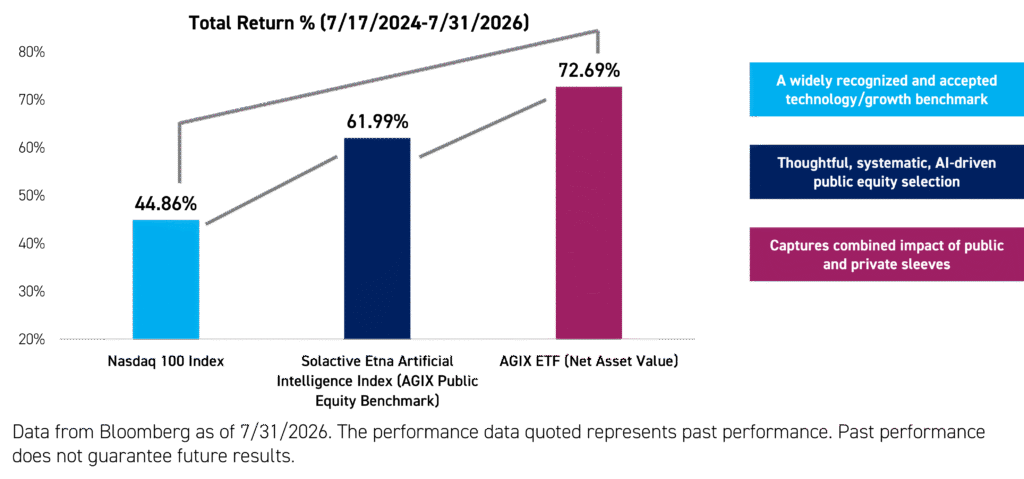
As shown in the chart below, AGIX (since it’s inception on 7/17/2024) has outperformed both its public market benchmark and the Nasdaq 100 Index, which is a widely recognized and accepted technology benchmark.4
Over the past year, the fund is up +32.72%, with a +17.01% year‑to‑date (YTD) return4, even as AGIX has moved through several distinct phases of AI-related volatility.
We believe that, in addition to delivering strong returns, it is important to understand how AGIX is built to be dynamic.
AGIX is an actively managed strategy led by AI-native investors. By drawing on industry expertise in AI narrative shifts and translating it into a dynamically adjusting portfolio, it seeks to avoid locking into a static view of who the “AI winners” should be. Additionally, AGIX has a three‑bucket framework (AI Hardware, AI Infrastructure, and AI Applications) that is designed to sit on top of the evolving AI story and capture value across the entire AI ecosystem.
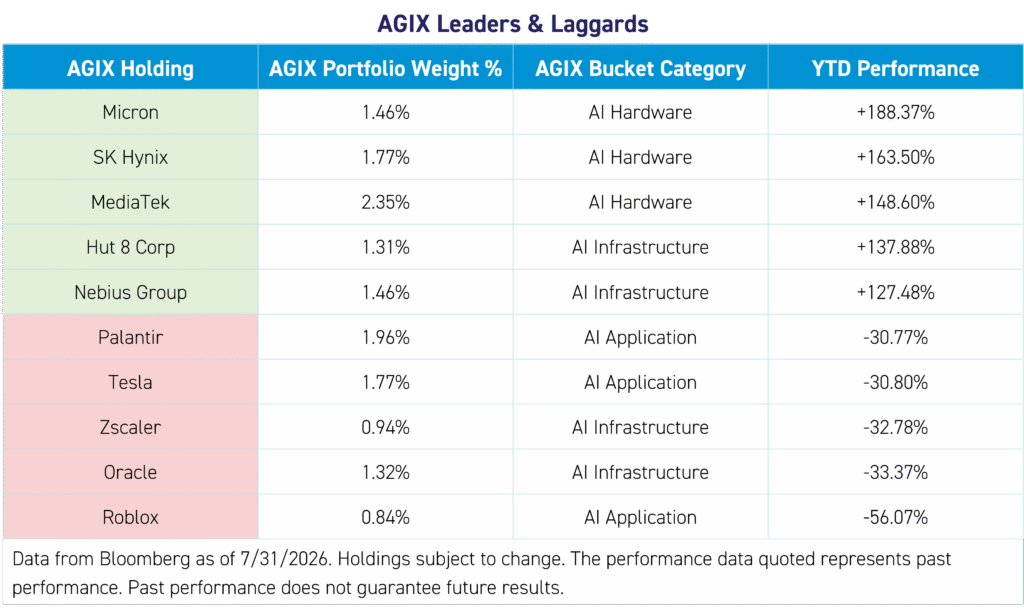
In AI Hardware, the memory chip boom has produced some of AGIX’s biggest individual winners, but also sharp ups and downs as expectations for AI demand, pricing, and supply have changed. The PHLX Semiconductor Sector Index (SOX Index), a popular AI Hardware benchmark tracking the 30 largest U.S.-traded semiconductor design, manufacturing, and sales companies, is up +60.21% YTD but lost -20.58% in July.4 Meanwhile, in July, AGIX only fell -9.19% amid volatility in AI Hardware names.4
In AI Infrastructure, major cloud platforms have delivered mixed signals. The five largest hyperscalers (Amazon, Microsoft, Google, Meta, and Oracle) have committed over $660 billion in 2026 capital expenditures (CapEx), which has offset strong AI initiatives with concerns about near‑term spending patterns and margins.11 We believe that investor caution on AI Infrastructure spending (which began as early as 2025) has shifted to “CapEx fatigue” and a broader AI downdraft. Additionally, we believe it may have contributed to the sharp July drop in AI Hardware names, as investors began pricing in heightened CapEx expectations and sentiment throughout the month, ahead of hyperscalers’ earnings in late July.
Finally, in AI Applications, we believe the “SaaSpocalypse” has forced investors to rethink which application‑layer businesses are genuinely enhanced by large language models (LLMs) and which are more at risk of being rewired. In January of 2026, when volatility in the software sector occurred, the S&P North American Expanded Technology Index (SPNASEUT Index) closed the month down -14.63%.12 During that same timeframe, AGIX only fell -2.89% amid volatility in AI Software names.12
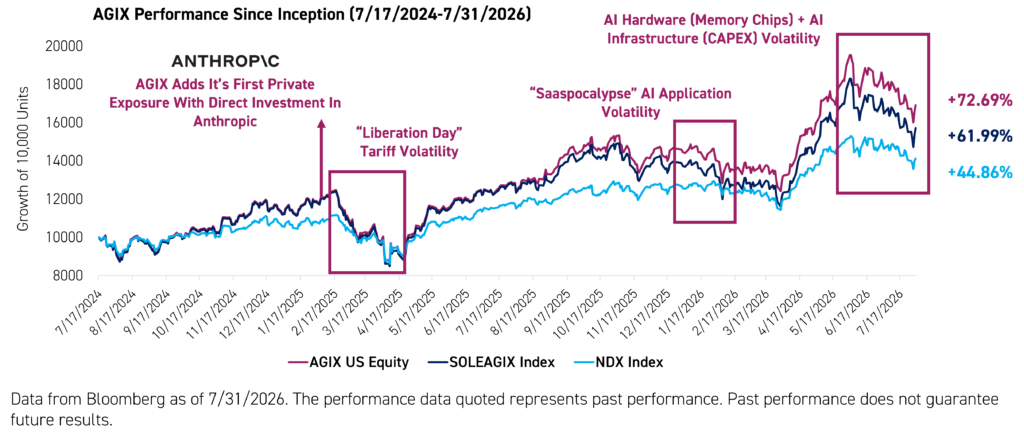
The goal is not to eliminate volatility, but to use an active approach to keep the portfolio aligned with where AI adoption and economics are actually showing up. AI ETF AGIX is designed to move with the theme. Even through the volatility events of 2026, AGIX has returned +17.01% YTD.4
AGIX’s evolution over the past year illustrates what makes the fund structurally distinct: its private company class is not static. What began as two high-conviction bets on frontier AI development, Anthropic and xAI, has grown into a differentiated portfolio of companies operating across autonomous driving software, prediction markets, photonics infrastructure, and physical AI. Each represents a corner of the emerging AI economy that we believe public markets have yet to fully price in.
Holdings are subject to change.
For AGIX standard performance, top 10 holdings, risks, and other fund information, please click here.
Citations:
xAI Company Website, “xAI joins SpaceX,” as of 2/2/2026, and Bloomberg as of 6/12/2026.
Anthropic Company Website, “Anthropic raises $65B in Series H funding at $965B post-money valuation,” as of 5/28/2026.
Anthropic Company Website, “Anthropic confidentially submits draft S-1 to the SEC,” as of 6/1/2026.
Data from Bloomberg as of 7/31/2026.
Tech Crunch, “Prediction marketplace Polymarket partners with Perplexity to show news summaries,” as of 8/12/2024.
Data from PM Insights as of 7/31/2026.
ICE Company Website, “ICE Announces Strategic Investment in Polymarket,” as of 10/7/2025.
Nasa Spinoff, “Humanoid Robots Assist Assembly Lines,” as of 1/6/2026.
Apptronik Company Website, “Apptronik Closes Over $935 Million Series A,” as of 2/11/2026.
Business Insider, “Nuro’s head of partnerships breaks down how the self-driving startup is helping transform the world of delivery,” as of 12/21/2021.
Crosley, Blake. “The AI Memory Supercycle: How HBM Became AI’s Most Critical Bottleneck,” Introl, as of 1/3/2026.
Data from Bloomberg as of 1/31/2026.
Definitions:
Annualized Run-Rate Revenue (ARR): A company’s current recurring revenue pace expressed as an estimated annual amount.
Capital Expenditures (CapEx): Spending by a company on long-lived assets such as data centers, factories, equipment, or infrastructure.
Capitalization Table (Cap Table): A record of a private company’s ownership, showing its shareholders, securities, and ownership percentages.
Direct Investment: An investment made directly in a company’s securities rather than through another fund or intermediary.
Net Asset Value (NAV): The per-share value of a fund’s assets minus liabilities, generally calculated once each trading day.
Index Definitions:
Nasdaq-100 Index (NDX): A market-capitalization-weighted index of 100 of the largest technology companies listed on the Nasdaq exchange.
PHLX Semiconductor Sector Index (SOX Index): An index designed to track major U.S.-listed companies involved in semiconductor design, manufacturing, and sales.
S&P North American Expanded Technology Index (SPNASEUT Index): An index measuring a broad group of North American technology-related companies.
Solactive Etna Artificial Intelligence Index (SOLEAGIX Index): AGIX’s public-equity benchmark, designed to represent companies selected for AI-related exposure.
Carefully consider the Funds’ investment objectives, risk factors, charges and expenses before investing. This and additional information can be found in the Funds’ full and summary prospectus, which may be obtained by visiting www.kraneshares.com. Read the prospectus carefully before investing.
Risk Disclosures:
Investing involves risk, including possible loss of principal. There can be no assurance that a Fund will achieve its stated objectives. Indices are unmanaged and do not include the effect of fees. One cannot invest directly in an index.
This information should not be relied upon as research, investment advice, or a recommendation regarding any products, strategies, or any security in particular. This material is strictly for illustrative, educational, or informational purposes and is subject to change. Certain content represents an assessment of the market environment at a specific time and is not intended to be a forecast of future events or a guarantee of future results; material is as of the dates noted and is subject to change without notice.
AGIX may invest in derivatives, which are often more volatile than other investments and may magnify AGIX’s gains or losses. A derivative (i.e., futures/forward contracts, swaps, and options) is a contract that derives its value from the performance of an underlying asset. The primary risk of derivatives is that changes in the asset’s market value and the derivative may not be proportionate, and some derivatives can have the potential for unlimited losses. Derivatives are also subject to liquidity and counterparty risk. AGIX is subject to liquidity risk, meaning that certain investments may become difficult to purchase or sell at a reasonable time and price. If a transaction for these securities is large, it may not be possible to initiate, which may cause AGIX to suffer losses. Counterparty risk is the risk of loss in the event that the counterparty to an agreement fails to make required payments or otherwise comply with the terms of the derivative.
AI-exposed companies face profitability challenges due to high research costs, competition, IP reliance, and regulatory risk. Product failures or safety concerns could be detrimental. Identifying AI companies accurately is complex. Tech firms face risks of product failure, obsolescence, regulatory impact, and uncertain profitability due to technological advancements and government policies. Certain tech investments may lack current profitability and future success is uncertain. AGIX is subject to non-U.S. issuers risk, which may be less liquid than investments in U.S. issuers, may have less governmental regulation and oversight, are typically subject to different investor protection standards than U.S. issuers, and the economic instability of the non-U.S. countries. Fluctuations in currency of foreign countries may have an adverse effect to domestic currency values. AGIX may invest in Initial Public Offerings (IPOs). Securities issued in IPOs have no trading history, and information about the companies may be available for very limited periods. In addition, the prices of securities sold in IPOs may be highly volatile. In addition, as AGIX increases in size, the impact of IPOs on AGIX’s performance will generally decrease.
Large capitalization companies may struggle to adapt fast, impacting their growth compared to smaller firms, especially in expansive times. This could result in lower stock returns than investing in smaller and mid-sized companies. In addition to the normal risks associated with investing, investments in smaller companies typically exhibit higher volatility. AGIX is new and does not yet have a significant number of shares outstanding. If AGIX does not grow in size, it will be at greater risk than larger funds of wider bid-ask spreads for its shares, trading at a greater premium or discount to NAV, liquidation and/or a trading halt. AGIX may invest in privately-issued and private company securities, which are generally not registered, may carry resale restrictions, and often lack active markets. These investments can be less liquid, harder to value, and subject to larger price swings, which may result in delays or higher costs when buying or selling. Private companies may have limited operating histories, smaller or less established businesses, fewer financial resources, and less available information. They may be more vulnerable to competition, market conditions, or economic downturns. A liquid market for their securities may never develop, and IPOs, if they occur, can be volatile and may negatively affect AGIX’s investment.
Narrowly focused investments typically exhibit higher volatility. AGIX’s assets are expected to be concentrated in a sector, industry, market, or group of concentrations to the extent that the Underlying Index has such concentrations. The securities or futures in that concentration could react similarly to market developments. Thus, AGIX is subject to loss due to adverse occurrences that affect that concentration. A large number of shares of AGIX are held by a single shareholder or a small group of shareholders. Redemptions from these shareholders can harm Fund performance, especially in declining markets, leading to forced sales at disadvantageous prices, increased costs, and adverse tax effects for remaining shareholders. AGIX is non-diversified.
ETF shares are bought and sold on an exchange at market price (not NAV) and are not individually redeemed from the Fund. However, shares may be redeemed at NAV directly by certain authorized broker-dealers (Authorized Participants) in very large creation/redemption units. The returns shown do not represent the returns you would receive if you traded shares at other times. Shares may trade at a premium or discount to their NAV in the secondary market. Brokerage commissions will reduce returns. Beginning 12/23/2020, market price returns are based on the official closing price of an ETF share or, if the official closing price isn’t available, the midpoint between the national best bid and national best offer (”NBBO”) as of the time the ETF calculates the current NAV per share. Prior to that date, market price returns were based on the midpoint between the Bid and Ask price. NAVs are calculated using prices as of 4:00 PM Eastern Time.
The KraneShares ETFs and KFA Funds ETFs are distributed by SEI Investments Distribution Company (SIDCO), 1 Freedom Valley Drive, Oaks, PA 19456, which is not affiliated with Krane Funds Advisors, LLC, the Investment Adviser for the Funds, or any sub-advisers for the Funds.
Comments
Nothing yet. Say the first thing.
Sign in to join the conversation.