
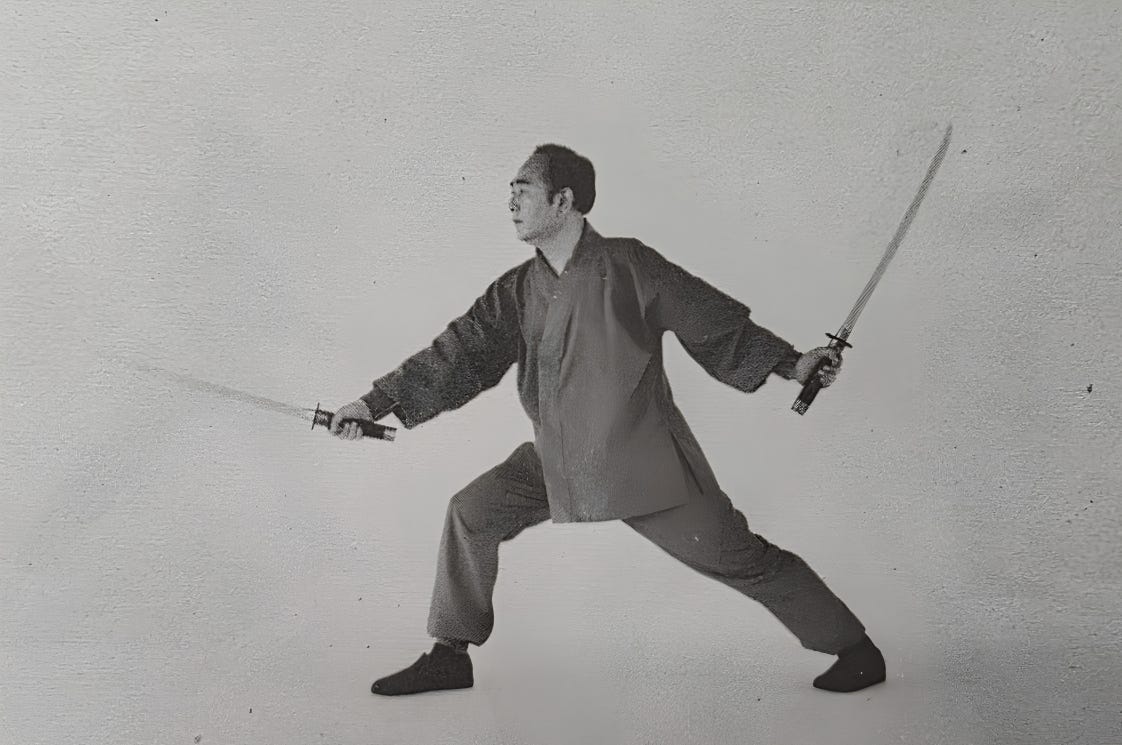
Recently, I offered a distance-learning tutorial on Ssangsudo, the two-handed saber, through our online dojang. A companion to the book I published on the form some years ago. Together, they are not the only routes by which students reach material like this outside the regular class structure; foreign students regularly come to train with me privately and intensively for a week at a time, and I sometimes send students on to train with my juniors in Korea.
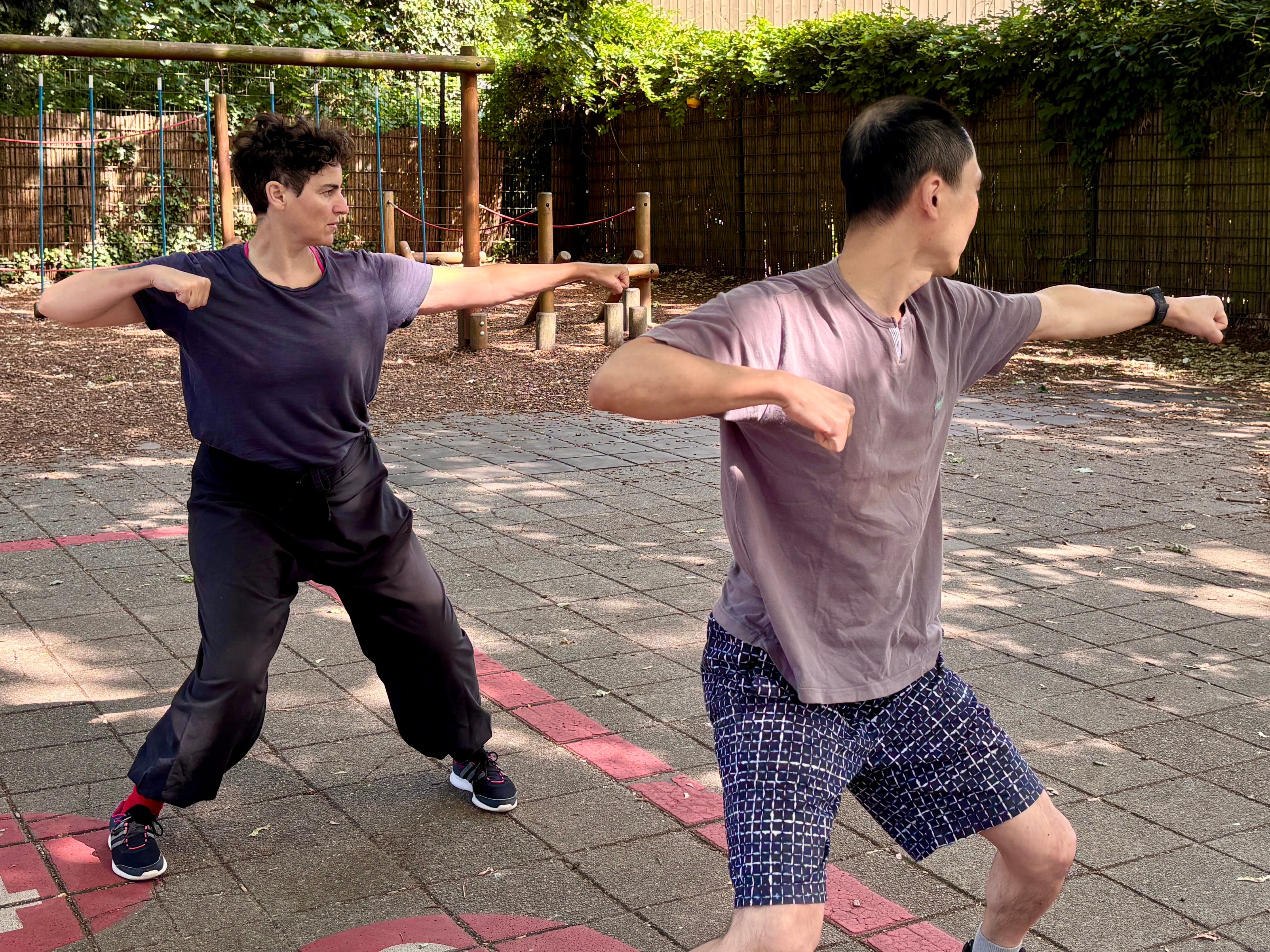
Because Ssangsudo belongs to the black-belt curriculum in our Sibpalki school, an interesting question arose among some of my students: if someone learns a black-belt form through any of these routes (online, through my book, during a week of intensive private lessons, or during an intensive training visit to Korea with one of my juniors) does that place the person on the same level as a black belt?
It is a reasonable question.
Martial arts curricula are usually organised by grade. Certain techniques and forms are introduced to beginners, while others are reserved for more advanced students. It is therefore easy to assume that learning an advanced form means reaching the level associated with that form.
But this assumption confuses two different kinds of progress.
Learning more techniques represents a horizontal expansion of one’s repertoire. Improving the quality of one’s movement represents vertical development.
The dan and geup system should primarily measure the second.
A practitioner does not reach a higher level simply by accumulating a larger collection of forms. The more important question is whether the practitioner’s posture, balance, coordination, power generation, timing, control and understanding have developed to a higher level.
Suppose someone learns the Ssangsudo sequence from beginning to end.
That person may reasonably say:
“I have learned the Ssangsudo form.”
But it does not necessarily follow that the person can perform it at black-belt level. Here, “black-belt level” refers not simply to knowing material listed in a black-belt syllabus, but to the broader level of physical and technical development that the rank is intended to represent.
Learning the form does not mean that the practitioner has acquired all the qualities associated with the black belt.
A form organises techniques, directions, transitions and tactical ideas into a sequence that can be practised repeatedly. An advanced form gives the practitioner more complex material through which to develop.
But the form itself is not a certificate.
Knowing which movement comes next is different from understanding how that movement should be produced. Remembering the choreography is different from possessing the body mechanics that give the choreography meaning.
A practitioner may quickly learn that the sword moves upward, downward, to the left or to the right. It takes much longer to understand how the feet, legs, waist, torso, shoulders and hands must work together to produce that movement.
Where is the centre of gravity? How is force transmitted from the ground into the weapon? When should the body expand, and when should it contract? How should unnecessary tension be released? How are distance, direction and timing judged in relation to an opponent?
These qualities cannot be acquired merely by memorising a sequence.
An advanced form does not create an advanced practitioner. It gives a developing practitioner new material through which advanced qualities can be expressed and refined.
This principle is not unique to Sibpalki. Even in a highly standardised system such as Kukkiwon Taekwondo, basic movements and poomsae are treated as related but distinct aspects of assessment. Performing the required poomsae is part of an examination; it is not the complete meaning of the rank.
A dan grade should not be understood as a reward for accumulating techniques.
Ideally, it represents a stage in the development of the practitioner’s body and understanding.
By martial body mechanics, I mean the ability to organise the entire body into coordinated action. The hands and feet should not move as disconnected parts. Posture, weight transfer, breathing, intention, timing and power should work together.
A beginner is mainly occupied with reproducing the visible shape of a movement:
Where should the foot be placed? Which hand moves first? What is the correct direction? What movement comes next?
As the practitioner develops, attention gradually shifts from the external shape to the internal organisation behind it.
Is the body properly aligned? Does the movement begin from the ground? Are the upper and lower body connected? Can power be issued without disturbing balance? Can the practitioner stop, change direction or continue into the next technique without losing control? Is unnecessary muscular tension interfering with speed and coordination?
The outward technique may remain the same, but its quality changes.
This is why the same basic punch performed by a beginner and by an experienced practitioner is not really the same punch. The external shape may look similar, but the coordination, efficiency, timing and intention behind it can be entirely different.
Rank should recognise this qualitative transformation, not merely the reproduction of an external shape.
My understanding of grading was strongly shaped by my teacher, Grandmaster Kim Kwang-suk. His life and his connections with many important figures in the modern Korean martial arts community deserve a separate article.
For the present discussion, however, one aspect of his teaching is particularly relevant.
When I took my first-dan examination under him, I performed material from gwonbeop, staff and sword. His attention, however, was directed especially towards a set of fundamental exercises that we call dangwon.
Dangwon consists of relatively simple combinations of basic movements. One exercise might contain three punches. Another might combine a kick and a punch. Another might consist of three consecutive hammer-fist strikes.
On the surface, these exercises do not look impressive. They are certainly less spectacular than a long sword form or an elaborate sequence with a polearm.
Yet they reveal almost everything.
Through a short combination, a teacher can observe the student’s stance, alignment, weight transfer, coordination, balance, rhythm and control. It becomes clear whether the arms are connected to the torso, whether the torso is connected to the lower body, and whether the limbs move harmoniously as parts of one integrated structure.
There is very little room to hide.
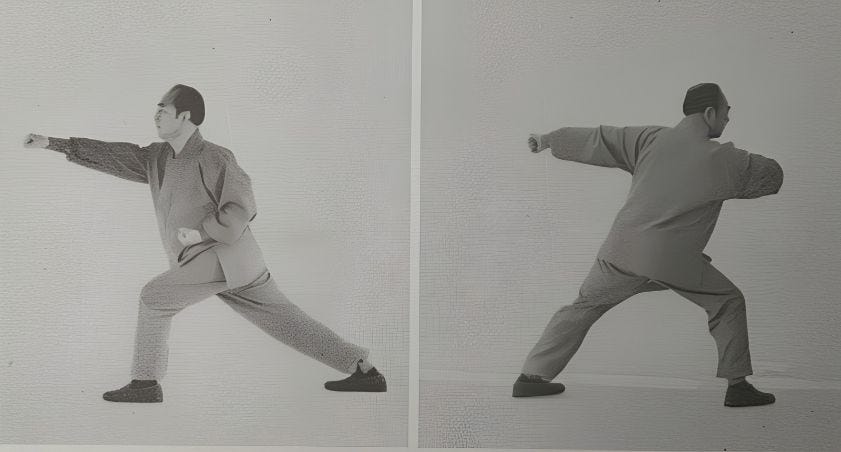
A long and visually impressive form can sometimes conceal weaknesses behind its variety. The viewer’s attention may be drawn towards the changing techniques and directions. In a short basic combination, however, every unnecessary movement and every break in coordination becomes visible.
Dangwon contains the essential principles of Sibpalki body movement. When these fundamentals are deeply understood, they can be transferred to gwonbeop, staff, sword, spear and other weapons.
That is why proficiency in dangwon remains important not only for first dan, but also for second, third, fourth dan and beyond.
The combinations do not necessarily have to become longer or more decorative at every grade. Instead, the quality with which they are performed must continue to develop.
The material may remain simple while the practitioner becomes increasingly refined.
Even now, as I prepare for my eighth-dan examination in Korea this October, I continue to practise and refine the same fundamental material.
For some it may seem returning to beginner training but this reveals the superficiality of the beholder. A more experienced eye can appreciate this is advanced training through the fundamentals.
Performing a black-belt form as a black belt—or as a second, third or fourth dan—does not mean that the form has been mastered. Grandmaster Kim never claimed to have mastered a single form. Even at the highest level, he continued to regard himself as a student who had simply travelled a little farther along the same path.
A first-dan practitioner and a fourth-dan practitioner may perform exactly the same basic combination.
The difference is not simply that the fourth dan has memorised more movements.
The difference should be visible in the movement itself: better structural alignment, more efficient weight transfer, greater unity between the upper and lower body, clearer intention, more appropriate relaxation and tension, and more precise control over speed and power.
As the practitioner develops, the movement often becomes simpler rather than more complicated.
Unnecessary effort gradually disappears. Separate actions become connected. What initially required considerable conscious effort begins to function as one integrated whole.
In this sense, the dan system is not merely asking:
“What new technique have you learned?”
It is asking:
“What has changed in the way your body performs the technique?”
That is a much more demanding question.
It is also why advanced practitioners repeatedly return to basic stances, punches, kicks and transitions. They are not simply repeating the same practice. They are revisiting it with a body that has changed and with a deeper ability to recognise what was previously invisible.
The modern dan and geup system is essentially linear. A student moves from one grade to the next, with each grade representing a stage along a prescribed educational path.
Traditional approaches to martial assessment were not always organised around this kind of fixed progression.
In historical Korean martial practice, particularly in military and close-combat training, evaluation often focused on the observable quality of performance at a particular moment. A practitioner might be assessed according to the stability of the stance, the effectiveness of power generation, the coordination of the body and the ability to maintain control.
Such an assessment did not necessarily function as a permanent personal identity. It reflected the ability demonstrated at that time—an ability that could improve through training or decline through neglect.
The emphasis was therefore on demonstrated skill, not merely on having passed through a predetermined sequence of lessons.
This perspective closely resembles what we observe through fundamental exercises such as dangwon. A simple combination can immediately reveal whether a practitioner has internalised the principles of balance, connection, timing and power.
The assessment does not depend on how many techniques the practitioner has encountered, but on how well those techniques are performed.
This traditional perspective reminds us of an important principle:
A grade should refer to demonstrated ability, not merely to material previously encountered.
The name of the technique does not determine the level.
The quality of its execution does.
When students submit examination footage to the Hanguk Muyewon, the Korean Martial Arts Headquarters, the number of forms they have learned is not the decisive factor.
Naturally, examinees must know the required curriculum. They must remember the movements and perform the prescribed material.
But that is only the beginning of the assessment.
What matters most is how well the practitioner understands and embodies the underlying principles. This can often be seen most clearly in dangwon, basic stances, kicks and fundamental transitions.
Can the student maintain structure while moving? Do the hands and feet arrive as parts of the same action? Is power produced through the coordinated movement of the whole body, or merely through the local strength of the arms and legs? Does the practitioner remain balanced before, during and after the technique? Is the movement controlled, intentional and repeatable?
These qualities matter more than the sheer quantity of material learned.
A practitioner may know ten forms and perform all ten with the same structural weaknesses. Another may know only three but demonstrate a much deeper understanding of movement.
The first practitioner has accumulated more material.
The second may have reached the higher martial level.
Technical standards are important, but martial arts organisations also have to recognise that practitioners do not all begin from the same physical circumstances.
Older practitioners and practitioners with disabilities may require adapted criteria. The purpose should not be to abandon the principles of the art, but to evaluate how successfully each person understands and expresses those principles within their actual physical capacity.
Some organisations also confer honorary ranks in recognition of exceptional service or contribution. Such awards serve a different purpose from ordinary technical promotion and should be understood in that context.
These different pathways should not become reasons for practitioners to make superficial comparisons.
Saying, “I move better than that black belt,” tells us very little unless we understand the person’s age, physical condition, training history, contribution and the criteria under which the rank was awarded.
A more meaningful question is:
Am I becoming better than the person I was yesterday?
Inner development is more valuable than the external comparison that appears so frequently in martial arts communities.
This brings us back to the Ssangsudo tutorial.
Learning through an online course can be valuable. It can introduce the historical structure of a form, explain its sequence, clarify its techniques and provide a method for continued practice.
A short period of intensive training in Korea can be equally valuable. It may give the student direct contact with another teacher, a different training environment and perspectives that would otherwise be unavailable.
These are genuine forms of learning.
But they should be understood accurately.
Completing an online tutorial or learning a form during a short period of intensive training means gaining access to new training material. It does not, by itself, mean that the practitioner has acquired all the physical qualities associated with the rank at which that form normally appears.
This distinction does not diminish the value of the experience.
On the contrary, it protects its value by placing it in the proper context.
The student has not completed the journey. The student has been shown a new path to explore.
Real development takes place afterwards through repetition, correction and integration with the fundamentals.
None of this means that advanced forms must always be withheld from students below a particular grade.
There may be good reasons to introduce them.
A seminar may allow participants to experience the distinctive qualities of a weapon. An online tutorial may support students who live too far away to attend regular classes. A short course may inspire someone to pursue a deeper study of Korean martial arts.
Exposure to advanced material can broaden a student’s understanding and strengthen motivation.
The problem does not lie in learning the form.
It lies in confusing access to the form with attainment of the level.
A beginner can learn from an advanced form. A coloured-belt student can begin practising Ssangsudo. But the form should be approached as material for continued development, not as evidence of a status already achieved.
The same principle applies when a practitioner learns during a short period of intensive training in Korea.
A teacher showing a student an advanced form is not the same as that teacher assessing and certifying the student’s overall level. Hospitality, encouragement and instruction should not be mistaken for formal evaluation.
A new form is an opportunity to train, not a licence to assign oneself a rank.
Martial artists naturally enjoy learning new things.
A new form is exciting. A new weapon presents unfamiliar challenges. Adding another item to one’s repertoire creates a visible sense of progress.
Basic training is less dramatic.
A more stable centre, a cleaner transfer of weight or a stronger connection between the hand and the rear foot may attract little attention.
Yet these changes are what make genuine advancement possible.
Without them, every new form becomes another sequence performed through the same undeveloped habits.
With them, even the simplest movement begins to contain greater depth.
Techniques are like the vocabulary of a language. Learning more vocabulary expands what we can express, but vocabulary alone does not produce fluency. Fluency also requires grammar, structure, rhythm, context and the tacit understanding that develops through sustained use.
In martial arts, techniques are the vocabulary.
Integrated body mechanics are the grammar.
The dan and geup system works best when it helps students develop both, while making clear that the number of techniques learned is not the same as the level of martial understanding achieved.
This becomes particularly important when a practitioner studies forms from several martial arts.
Each art possesses its own grammar: its own internal logic of posture, movement, power generation, timing and tactical intention. Cross-training can be highly valuable when the practitioner understands these differences and studies them with sufficient depth.
Without that depth, however, the practitioner may simply place several systems of movement side by side without fully internalising any of them. What remains may be an assortment of recognisable forms without a coherent bodily foundation.
Breadth can enrich depth.
It cannot replace it.
No.
It means that you have learned material associated with black-belt training.
That may be a meaningful achievement. It may inspire years of study or open a new direction in your martial development.
But rank should represent more than access to material.
It should reflect what years of practice have done to the practitioner’s movement, understanding and control.
It is revealed in the quality and understanding with which even the most basic movement is performed.
Advanced training is not simply the practice of advanced techniques. It is the practice of fundamental principles at an increasingly advanced level.
I would like to hear how this lands outside Sibpalki as well.
If you practise another martial art, what does your own grading system actually measure: the forms you have collected, or the way you move?
And if you have ever taken a shortcut into advanced material, through a book, a seminar or an online tutorial, what did you discover once you tried to make it truly your own?
I read every comment, and I would be glad to hear your experience. Yours truly,
BKC
Comments
Nothing yet. Say the first thing.
Sign in to join the conversation.