
Many people had a close relationship with Jane Goodall. She knew how to connect with people – and animals – instantly and reach to the bottom of their heart. Jane and I have known each other for thirty years. As each year passed, we grew ever closer and here I want to share some memories of a wonderful person and very dear friend. I wrote this essay on 4 October 2025, World Animal Day, just a few days after Jane had passed away. At the end, you’ll also find a little video compilation, in celebration of her 92nd birthday tomorrow.
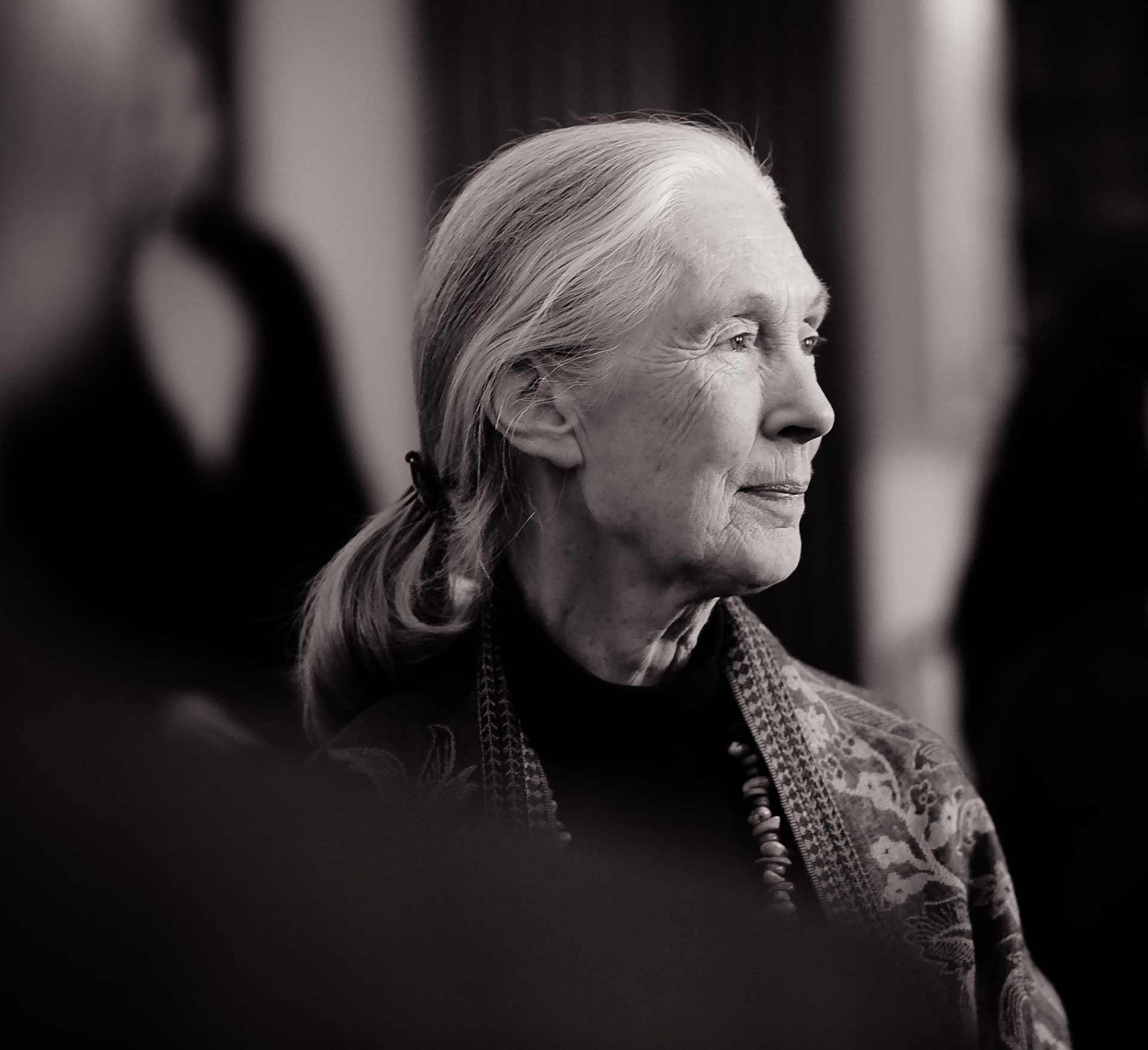
Dr Jane Goodall (3 April 1934 - 1 October 2025) (Jo-Anne McArthur / We Animals)
In a beautiful interview with Time CEO Jessica Sibley in Davos in 2024, Jane made the distinction between normal, little Jane and Iconic Jane.1 Indeed, iconic Jane has grown over the decades like a tree – initially made famous by National Geographic and other media. She was the first to study chimpanzees in the wild from 1960 onwards. She described them as individuals with unique personalities and rich emotional lives, breaking through an academic taboo. She became an animal advocate during the 1980s. She became a UN Messenger of Peace, travelling the world to bring her message of hope. She lectured to millions of people, moving audiences deeply with her heartfelt stories. She founded the Jane Goodall Institute and Roots & Shoots, her youth movement – a grassroots initiative where young people help animals, nature and people. It was a privilege to volunteer for iconic Jane, but let me share here some personal experiences with normal Jane too.
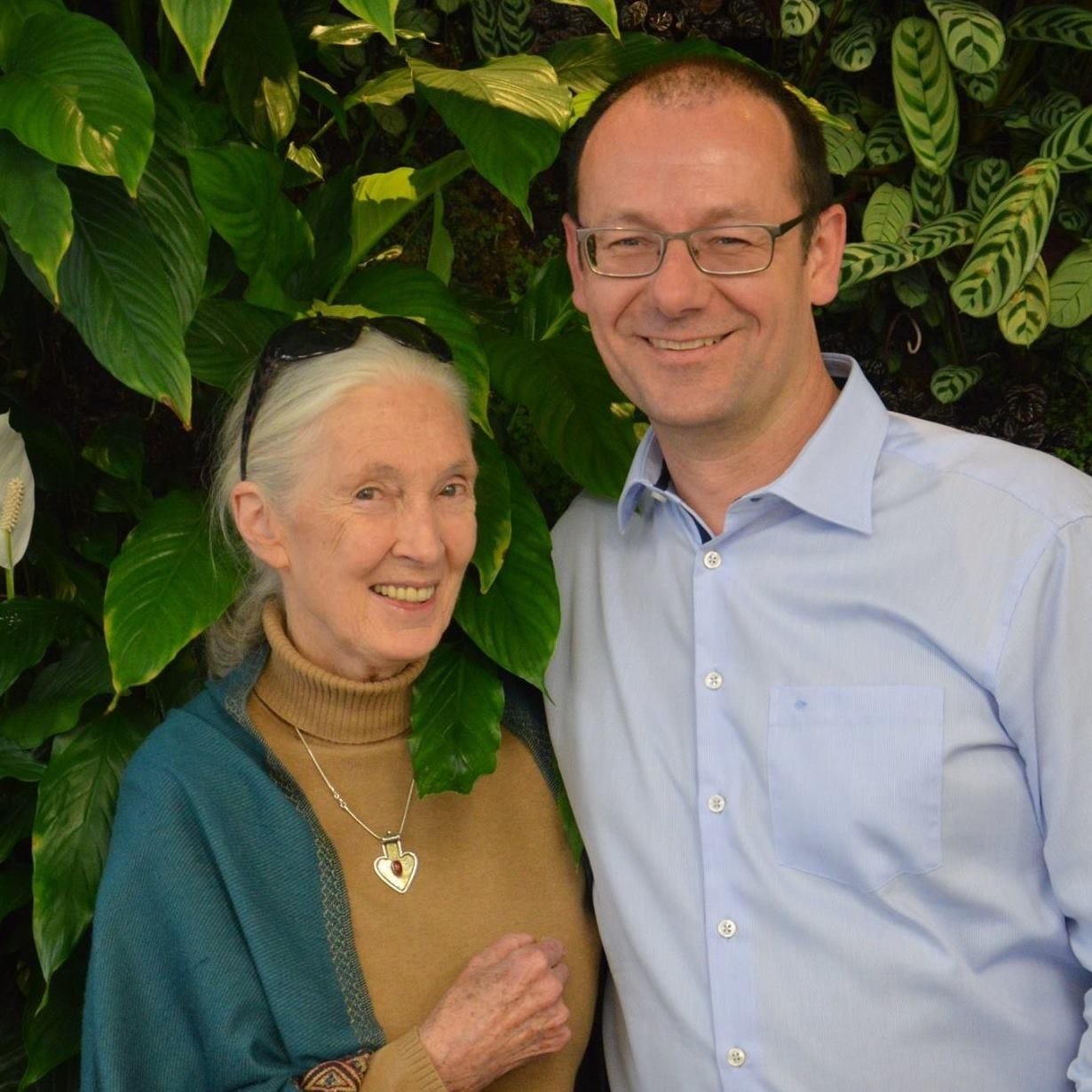
Jane and Koen at a Board meeting of JGI Belgium (May 2016) (Koen Margodt)
During the early 1990s, I wrote as a young student in philosophy a thesis about the ethics of keeping animals in zoos. I learned about the sad living conditions of lions, bears, chimpanzees, elephants and many other animals in various substandard zoos in Belgium and elsewhere. I wanted to make an impact by seeking collaboration with Jane Goodall. I had been pondering about this for months. I learned in Through a Window that Vanne, Jane’s mother, lived in Bournemouth. Perhaps I could ask her for an address to write Jane in Africa?
There was no internet at that time, neither email. I was a very shy person, but simultaneously passionate about animals. So, I got myself together and dialed the public phone services in the UK from my parents’ house. Against all odds, they shared the phone number of Vanne Goodall. I dialed the number. “Hello”, said a soft-spoken voice. To my utter surprise, it turned out I had Jane on the line at once. I stumbled my way through the call, introducing myself as a philosopher who wanted to help chimpanzees.
There was another reason why I reached out to Jane. Apart from helping chimpanzees, I liked her approach of talking with people, entering in dialogue with those she disagreed with. I sent Jane a report with pictures and a video tape of chimpanzees in three substandard zoos. Months later we were sitting together in her hotel suite in Brussels. We talked for nearly two hours. When she had to leave for dinner with the prince and scientists, she gave me a kiss on my cheek in the corridor. I was nailed to the ground, while she ran down the stairs, with a smile on her face and a mischievous twinkle in her eyes.
We made our first difference together in a little zoo near Ghent. I prepared a letter, she adjusted it, sent it to the zoo director, I called him, and he agreed to meet with me. I gave him a Dutch copy of Through a Window, signed by Jane. We sat together over coffee, and he explained that Toto’s friend had died years earlier. He agreed that his tiny, dark enclosure was unsuitable and wanted to make adjustments. I shared with him enrichment information, coming from ChimpanZoo friends and researchers at Antwerp Zoo. Later, he proudly showed me the newly built chimpanzee enclosure. It was much larger, with a few trees, ropes and windows – not perfect, but much better and no more darkness. Most importantly, he had obtained a companion friend for Toto from a circus.
Jane and I worked together on many other projects. I learned a few things along the go. My wife Iris and I went on honeymoon to Spain in 1998. We redirected our plans and together we searched for two chimpanzees who had disappeared from the notorious Zwartberg Zoo in Belgium. After a long search, we found them back in a tiny cage at the messy home of a taxidermist, in the middle of nowhere in the Provence. We literally felt like entering the criminal underworld. During my visit, Iris was waiting outside in the car with the motor on, ready to leave any moment for the police. When informing Jane’s assistant Dilys MacKinnon from a public phone cell, she begged me to finally go on our honeymoon and to forget about chimpanzees for two weeks. The Belgian animal protection organization Veeweyde stepped in and built a larger enclosure for the former Zwartberg chimpanzees.
In 2000, she became a scientific advisor for my PhD research towards the moral status of great apes at Ghent University, where I’m still connected as a guest professor. We met during conferences and lectures, often organized by a chapter of the Jane Goodall Institute. I noticed how many people surrounded Jane. I saw how many people understandably tried to involve Jane as a catalyst to turn their projects into a success –animal advocates, zoo directors, politicians, sanctuary people, CEOs, leading scientists among others. Jane remained calm but had to navigate things carefully. I learned from this and decided to help her rather than thinking mainly about my own agenda. I tried to understand her aims and priorities. We started working together for goals we defined together. She never pressured me, neither did I try to pressure her. I believe this helped to build a foundation for our long-term, close friendship.
Many of the things involving animal ethics are grim. We were always guided by the question – “What is most important for each of the individuals involved?” Over the years, we would lift each other up with light messages. We both loved photography. Out of the blue, Jane would send a little movie or picture. Sometimes she would send it simultaneously over email to several friends, never using BCC. Never mind if they were family or a famous scientist, politician or actor, such as Leonardo DiCaprio. I usually would start the subject of my email with a picture to her with ‘Light moment’; she very much enjoyed these messages and often I got responses within minutes.
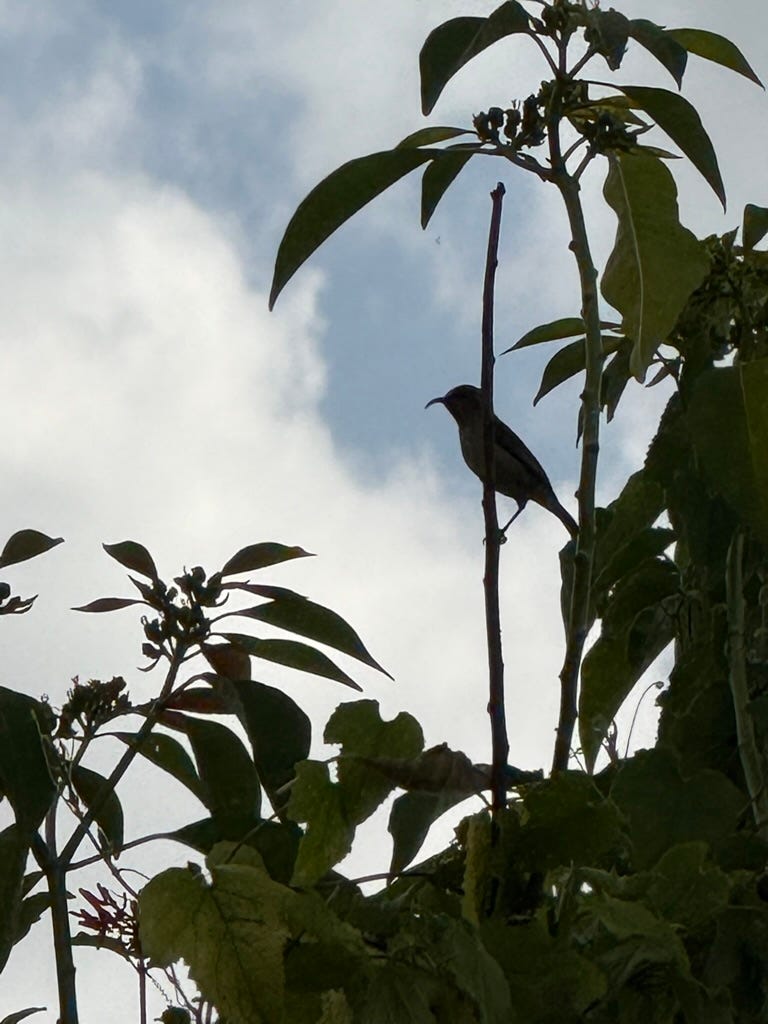
A picture of a bird in Tanzania, taken and sent by Jane for Koen’s birthday in July 2025
(Dr Jane Goodall)
This was also Jane – she continued working very hard. I could send her a message in Bournemouth after midnight, but she often would still reply. She literally could lose sleep over specific topics, like when Paul Watson was in prison upon the request of the Japanese authorities. They wanted to have him extradited for his – non-violent – whale advocacy. I reached out for Jane to the Danish PM and she did all she could to help Paul, who fortunately was released in the end.
Over the last decade, we have written several statements and essays together. For example, she was keen on doing something around factory farming and plant-based diets. I drafted the first version and asked if she wanted to add her name. Jane responded that she only would add her name if she did her fair share of the work. She listed around fifteen bullets and asked if I agreed she would work on these. She did so during the five days she was at home in Bournemouth, between Christmas and New Year. She sent her version literally from the air, while flying from Dubai to her home in Dar es Salaam, Tanzania. Peter Singer, whose book Animal Liberation, turned both Jane and I in vegans, commented that it was one of the most powerful essays he had ever read on ending factory farming and shifting to plant-based diets.2
I was fortunate to meet numerous other people through Jane. One of them was Vanne, Jane’s mother. When I visited at The Birches in Bournemouth during the late 1990s, a frail old lady shuffled with her walker and took a seat in the sofa besides me. Learning that I was a philosopher, her eyes led up and she explained that Aristotle was her favorite philosopher and dove into an explanation of his virtue ethics. I was stunned! You could see where Jane’s passion was coming from, growing up in a house full of women – her mother, sister Judy and their aunts.
Jane inspired – and inspires – so many people, encouraging them to make a difference through small or large steps of hope. Early on, Jane explained to me she couldn’t limit her voice to helping only chimpanzees. There were many others to be helped – gibbons, pangolins, dogs, rats, pigs. Preserving habitats and helping communities in Africa, Europe, Asia, the Americas... If her voice could make a difference, why restrict herself to chimpanzees?
And a difference she makes. Helping animals in laboratories, circuses, zoos, shelters, sanctuaries and factory farms. Encouraging the planting of millions of trees around the globe. Setting up Roots & Shoots groups. Like many others, our little family would go through the village to collect garbage. There are larger stories, like American youth arranging for their community and authorities to restore a polluted river and reintroduce wild salmon. Or native Americans planting small vegetable gardens in reserves, dominated by poverty, suicide and alcoholism. She would visit them, listen to them and share her views, also with those who disagreed. She addressed politicians in the American Congress, the management of a primate laboratories, oil companies or authorities in North-Korea. Shining small rays of hope, this was Jane’s approach.
Jane was utterly busy, but somehow always managed to keep in touch. When my mother passed away a few years ago, I would receive several messages. When our eldest daughter struggled to overcome health issues, Jane followed up closely, even checking recently if all was still all right. (Yes, she has fully recovered for two years now.) Those who faced a challenge were always her priority – walking the line of her view that every individual matters.
Thanks to Jane, I’ve had the privilege of building friendships with many people. Two stand out for me. One is the zoologist and animal advocate Marc Bekoff. Jane introduced me to Marc some 25 years ago. For many years we have been co-chairs of the JGI Global Ethics Committee. We’ve worked so nicely together to edit Jane Goodall at 90, a collection of ninety wonderful essays by some of Jane’s family and friends.3 Ninety virtual candles for her birthday cake of last year. The hardest part was selecting who we would ask, and not ask, to be part of this project. We knew from the outset that we would disappoint various people, as we couldn’t compose an encyclopedia!
And then there’s our friend Melody ‘Mel’ Horrill from Australia. Jane told me she had read this book The Dolphin Who Saved Me by someone who went through the trauma of domestic abuse and overcame her problems through her friendship with a dolphin named Jock, and other animals. Jane was keen for us to get into contact. I was a bit skeptical, concerned that she would be a kind of spiritual New Age dolphin guru or so. How wrong was I, how right was Jane! Her dolphin book is one of the very best animal books I’ve ever read, as it was for Jane.4 And our friendship has become one of the most authentic I’ve ever developed in my life, as did Jane treasure Mel’s friendship. Upon Jane’s suggestion, the three of us launched together a dolphin committee with sea mammal experts from around the world. Our mission is to facilitate bringing dolphins from captive tanks to seaside sanctuaries, where dolphins will be able to live more natural lives in semi-freedom. As we’re one person down, we’ll need to work a bit harder now.
The killing of young and healthy animals by European zoos was the last topic I could discuss with Jane. We exchanged emails on the topic and held our last Zoom call in August. The topic kept her awake at night. She wished zoos would respect animals as individuals, but also kindly encouraged me to see the benefits of ‘good zoos’ in terms of positive educational impact on visitors and their efforts for conservation of animals in the wild. We knew we were not entirely on the same page regarding zoos but held a warm exchange of thoughts.5 Briefly before leaving on her lecture tour to the Americas, she sent one of her very last emails to me and wrote “Love you – am so glad we have met and can walk these difficult paths together.” She taught me to remain humble and always to approach others with gentleness.
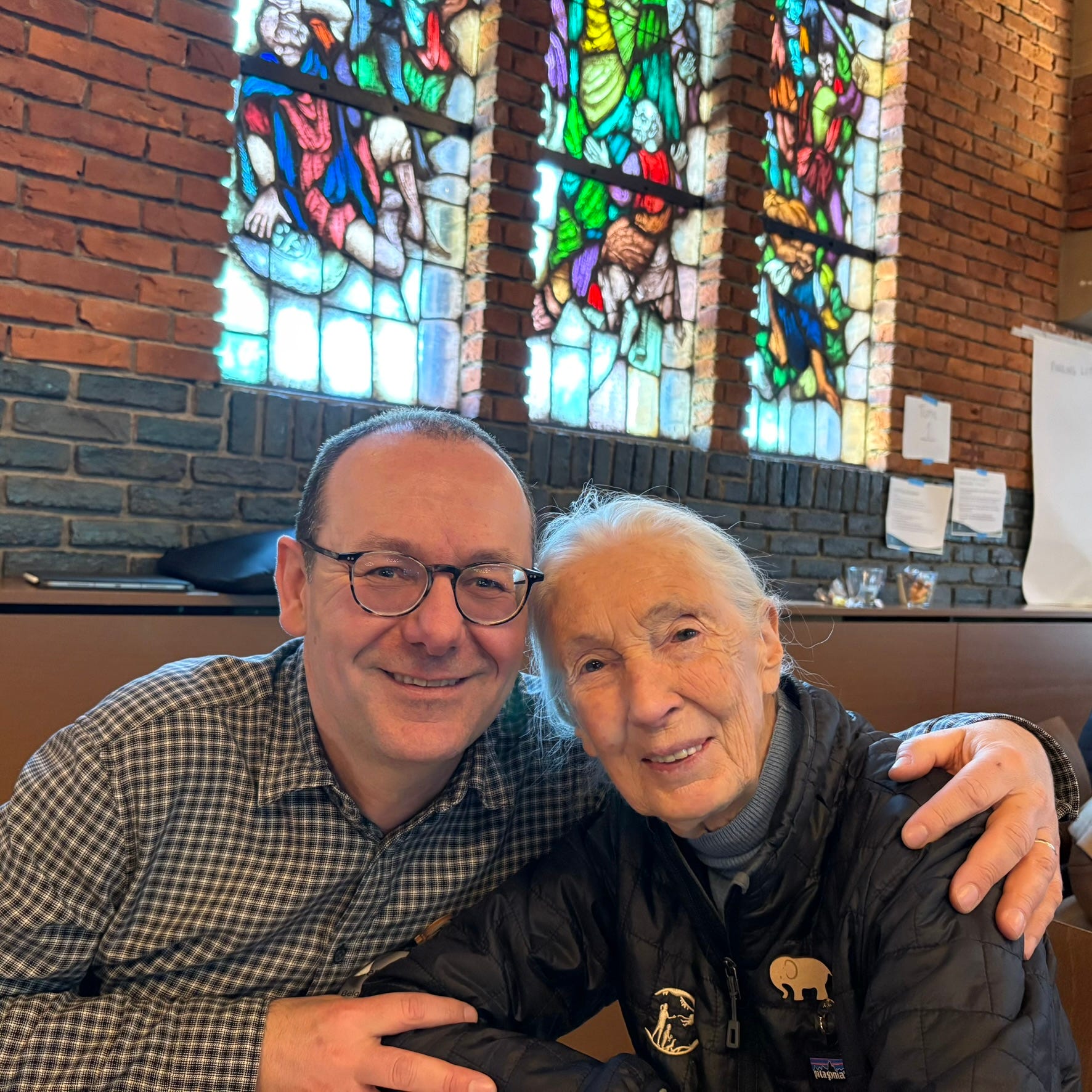
The last picture of Jane and Koen together (7 March 2025) (Koen Margodt)
Yesterday, Jane’s right hand and close friend Mary Lewis joined a video call with Patrick Van Veen, Susana Pataro and I – all JGI volunteers. Mary dialed in from Jane’s home at The Birches. She looked tired from giving numerous interviews, responding to hundreds of messages and arranging the practicalities for Jane’s funeral with Jane’s sister Judy and the rest of the family. She told us that Jane had become more and more peaceful over the last months. Jane felt proud to see how things with JGI chapters and Roots & Shoots groups around the world were moving in the right direction. The evening before her passing away, she was pleased to assure funding for a major conservation project. She passed away peacefully in her sleep in a private home in Los Angeles, hours before she would address thousands of students.
Some people ask me who will take over from Jane. No single individual can ever replace iconic Jane Goodall, nor can anyone replace little, normal Jane. The trail she has left is unique in history. I sincerely believe that the world has lost its most influential animal advocate, environmentalist and humanitarian ever. Going forward, we’ll all need to do our part. There shouldn’t be any Us versus Them, only Us. Let’ s do this together, there’s so much that remains to be done.
Written on 4 October 2025, World Animal Day.
A video to celebrate Jane and her love for animals, people and nature. She had a great sense of humor and did not only spread a message of hope, but also lots of joy. Music: Spiegel im Spiegel, Arvo Pärt
Dr. Koen Margodt is an ethicist and guest professor at the universities of Ghent (UGent) and Brussels (VUB) in Belgium. He has performed extensive research towards the ethics of keeping animals in zoos. He was the first to argue that zoos should be converted into sanctuaries. He is co-chair of the Jane Goodall Institute’s Global Ethics Committee, with Dr. Marc Bekoff, and the Jane Goodall Institute’s Cetacean Committee, with Melody Horrill, which aims to stop keeping dolphins and other cetaceans in captive tanks and move these to enclosed seaside sanctuaries. Website www.koenmargodt.com.
No posts
Comments
Nothing yet. Say the first thing.
Sign in to join the conversation.