
Een Nederlandse vertaling (door mij gemaakt, niet door AI!) van dit artikel kun je hier lezen.
Loyal readers will know that, while taking a summer break, this accidental behavioural economist tries to leave observing behaviour in the closet – usually in vain: before long, the urge cuts back in. This year, it started early – when we were barely an hour underway, on the motorway to be precise. But as the journey went on, something struck me. What I observed (and, to be honest, exhibited) shared a common characteristic. Not only did it tend to sort drivers into two distinct camps, but I could also see a good case for either choice. In fact, I felt myself torn between the two, and I was likely not the only one. That may explain what I experienced and observed, but the ubiquitous tension between two plausible but diametrically opposed choices, isn’t that odd?
Not long after we set off, we found ourselves slowing down for a lane closure owing to roadworks. As long ago as 1999, research established that, except when traffic is very light, late “zipper” merging is both more efficient and safer than joining the open lane as soon as possible. But this is problematic in more than one way… It goes against a strong natural intuition – even I, who (naturally) know that late merging is better, feel a certain tendency to merge early anyway. Usually, a majority of drivers follow this intuition, either unaware of the superiority of the alternative, or in the belief that others will do so, and they don’t want to violate the prevailing implicit norm. This phenomenon is known as pluralistic ignorance: people believe that their own belief is a minority, swamped by an opposing view. (The effect has been vividly described in the Abilene paradox **, in which a Texas family collectively decide to take a trip to this small town in Texas, despite nobody actually wanting to go there, because everyone thinks the others do.) The technically right choice is socially wrong, and vice versa – and drivers are torn.
And for good reason. Drivers who opt to merge early, even if they know the alternative is better, will see everyone who decides to merge late as cheats taking advantage of the empty blocked lane to get ahead. This can evoke resentment, and inflame a tendency towards costly punishment, “to teach the violator a lesson” – a deep-rooted impulse aimed at reinforcing social norms. I remember, on a previous occasion, a lorry straddling across the two lanes to force everyone to merge behind him, but often it’s simply drivers queuing in the open lane sticking within inches of the car in front, to prevent the ‘cheat’ joining in, all the way to forcing them to run into the roadwork barriers. Costly? Well yes: we run the risk of colliding with either the car in front or the offender’s, and the stress and outrage might give us ulcers. The ignoramuses and the cheats have it easy: they are certain about what is right (for them). It’s the enlightened ones that have the hardest time: it’s a genuine heads you win, tails I lose situation.
Excuses for me, but not for thee
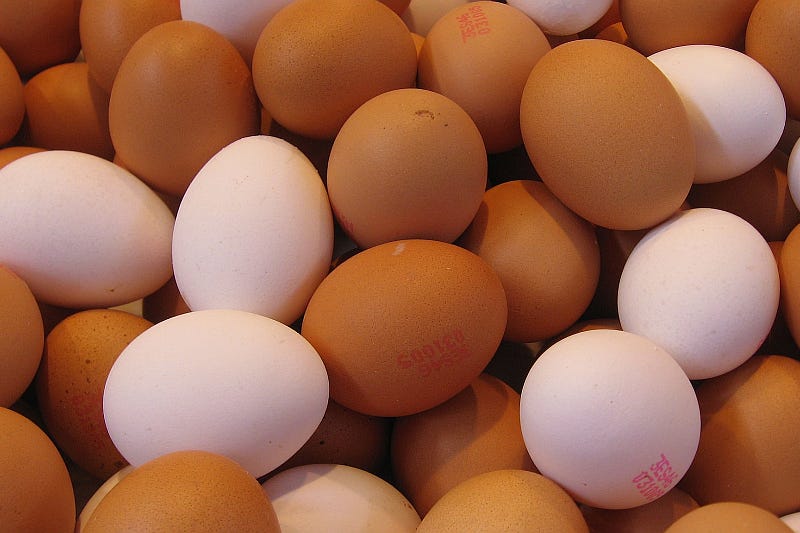
Anyway, we got through the roadworks without so much as an angry honk, but 60 miles further: traffic slowing down again. A lorry on the other carriageway had shed a cargo of eggs, coating some nearby vehicles but most of all the road in ‘eggshell’. Now here, every driver knows, or ought to know, there shall be no rubbernecking. But the temptation is palpable – have you tried not to look sideways at a spectacle across the central reservation? Three dented cars on our carriageway’s hard shoulder illustrated the perils of gawping when the car in front suddenly brakes. One reason why crashes are such an attention pull is that they awaken our morbid curiosity, an instinctive tendency evolutionary psychologists associate with a need to learn about possible threats. But even if it is only a shed load of paint, scanning the situation feels like compensation for the time lost – and of course there is the herd instinct: we look where others look. Still, that doesn’t stop us cursing all the others for disregarding the warning not to rubberneck (especially if they run into the back of our car), while somehow justifying our own ogling the display of workers frantically scraping the road.
As we got closer to the ferry port, there were a good few drivers who clearly had not included enough slack to accommodate roadworks and spilled paint, and who were now rushing to catch their booked crossing. To the others, they were mad, impatient tailgaters, but to someone in a hurry, everyone in their way looks like a dawdling lane-hogger. The motives are in the eye of the beholder. But does frantically speeding really help as much as it seems? When you’re 20 miles from your destination, at an average speed of 70mph, getting there will take a little over 17 minutes. At 80mph, you’ll arrive just two minutes earlier. That is not the way it feels, though – when we overtake another vehicle travelling at 70 mph doing 80mph, a minute later we are 270m ahead of them, but we gained only about 9 seconds. At motorway speeds, distance is a poor proxy for time (a legacy of thousands of years as pedestrians, where 270m at a brisk walking pace corresponded with a good three minutes). Here again, what we feel is in conflict with physical reality, and the trade-offs we might make by speeding when we’re running late – risk of being caught or of an accident by tailgating – may be poorly thought through.
Thanks for reading Koenfucius’s Substack! This post is public so feel free to share it.
Our experiences on this short trip reveal how traffic situations lay bare a tug-of-war between three competing psychological forces: factual reasoning (which we can cunningly bend to serve our purposes), intuitions rooted in habit and bias as much as in learning, and ancient instincts, the non-negotiable, sometimes uncontrollable urges beneath both. Which one wins in any given moment is highly circumstantial. A random trigger can give our instinct the upper hand before reasoning even gets a word in — and whichever does, we feel it as simply right, and then justify it accordingly. That is why better awareness buys so little: being in a hurry doesn’t reliably predict when we’ll speed, any more than boredom or just a whim. We don’t really understand how these three forces combine; we can only notice that they do, explain ourselves after the fact – and keep condemning everyone else for arriving, by a logic no less robust than our own, at a different choice.
My consolation is that I am not alone with my wistful resignation: even one of the luminaries of behavioural science, Nobel laureate Daniel Kahneman, reached an almost identical verdict. Near the end of Thinking, Fast and Slow, he confesses that his intuitive thinking is just as prone to overconfidence, extreme predictions, and the planning fallacy as it was before he started studying these matters. The one exception: some effects he puts down to age.
For my part, I like to believe I am not quite so impulsive as I used to be. The question is: is that a sign of emerging wisdom, or just the years blunting the sharp edges of my emotions?
No posts
Comments
Nothing yet. Say the first thing.
Sign in to join the conversation.