
In a certain region on our planet, there is a single cause of death that kills tens of thousands of people every year. We might expect that to draw the attention of policymakers and the general public, but no. Attempts to address it tend to come to nothing. In a different region on our planet, there is a different cause of death, that also kills tens of thousands of people every year. And likewise, policymakers and public opinion seem uninterested. Yet the people in the first region are outraged about the situation in the second one, and vice versa. Isn’t that odd?
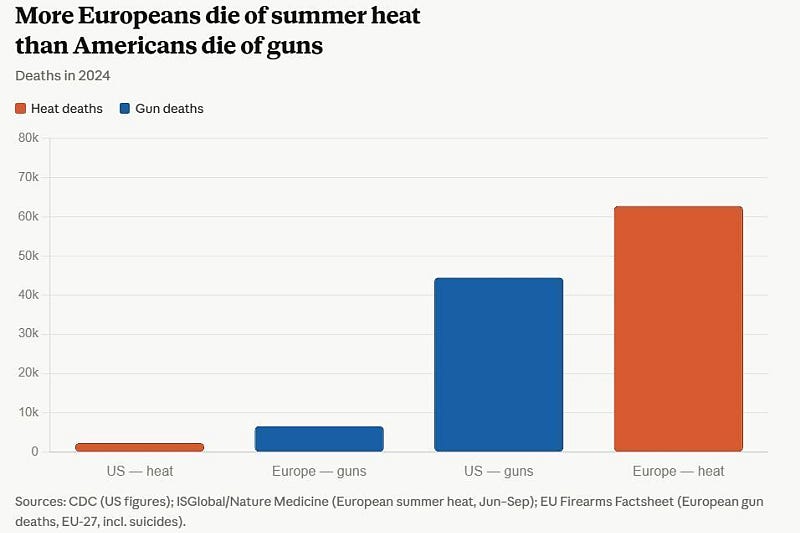
Let me clarify (if you have not already guessed it): the first region is the US, and the cause of death in question is gun violence; region two is Europe (somewhat vaguely defined), and the cause of death is hot weather. Recently, a chart circulated on social media, illustrating this intriguing discrepancy by comparing both causes of death in both regions. Despite some methodological differences (e.g., how ‘heat deaths’ are defined), the figures make directional sense: many more people die as a result of firearms in one region, and many more die from heat-related causes in the other. What might be behind the difference in attitude towards what, ultimately, are just deaths?
An obvious difference is that one kind of death has a perpetrator (someone has fired a gun), while the other is the consequence of, well, natural causes (weather, even if you argue that the climate is changing as a result of human intervention, the link is much weaker than that with firearms). Being able to blame a specific person for a death makes it easier to see it as both more serious and preventable, while the weather is a diffuse phenomenon, with nobody to pinpoint as the culprit. However, that doesn’t help us understand the difference in perception or indignation between the regions. A related angle is what, in behavioural terms, is described as commission versus omission. A gun death is commission (someone actively pulled a trigger); a heat death is omission (the weather just happened, and nothing was done to prevent the death). Omission bias was coined first by Ilana Ritov and Jonathan Baron in 1990. It describes the tendency to favour inaction over action, and judge harm resulting from commission as more negatively than harm following from omission, which might explain why we see firearm deaths as worse. But look closer, and that asymmetry collapses: nothing is done to stem gun deaths – it is a policy matter. If both are policy omissions, the bias that supposedly distinguishes them applies equally to both — so it cannot be what explains why we react so differently.
Could it all be driven by tribal ingroup/outgroup rivalry? In order to assert our own tribe’s superiority, castigating the others as somehow inferior is a good way to rally our people and bolster their confidence. Regardless what the Americans themselves feel about gun deaths, Europeans can look down on them. Similarly, Americans can condemn the Europeans for their lack of ubiquitous air conditioning and lack of care for the vulnerable. This perspective would seem to be on the right track, but what it misses is that indifference precedes rivalry: we don’t become blind to local problems because we are busy criticizing others, we failed to see them properly in the first place.
The hypothesis that addresses the phenomenon fully builds on the tribal perspective, but ties it to our cultural habitus. As we grow up, we tend to absorb the immediate surroundings of our cradle as if they were the entire world — not only as it is, but as it should be. That stretches from home rules (“finish your greens or no pudding!”) and school rules (when the bell goes, you form a two-by-two row) to societal rules (renting a home is what you do in anticipation of buying one). Even before we consciously adopt a sense of right and wrong, we associate what is familiar with what is right. To me, born and bred in Belgium, the identity card was not remotely controversial: you showed it to a police officer if they asked for it, or you used it at the municipal swimming pool to get the local resident discount. I remember being quite proud to get one before the mandatory age of 12, as I was spending Christmas with a friend who had relocated to Germany – and quite baffled when I later discovered how controversial the idea was in other countries, including just across the border: the Netherlands harbours a deep-rooted aversion to identity papers, which kept ID taboo until as recently as 2005.
Americans are born in a culture where firearms are nothing out of the ordinary, and generally think nothing much of seeing someone walking by carrying a gun. In the UK, even the vast majority of police officers do not carry a gun. Until 2017, the number of gun violence victims in the US, while unsurprisingly higher than in Europe, was lower than the number of deaths from road traffic accidents. In the US, air conditioning in cars and buildings has been widespread for decades, but in Europe it was exceedingly rare until the end of the 20th century. While now common in cars, it is still far from the rule in residential dwellings and many places of work. Some European countries like France and Switzerland even heavily regulate the use of air conditioning. Both “carrying guns is fine” and “we don’t need no air conditioning” firmly fall in the “this is the kind of thing we do/we don’t do round here” category of cultural norms and traditions. Like David Foster Wallace’s goldfish joke (“Morning, boys! How’s the water?” “What the hell is water?”) we tend to stop seeing what is common, normal and part of life in our society, and zoom in on what, to our eyes, is uncommon and out of the ordinary in another society. If it causes harm, it will produce outrage among those outside the community, but within it, it is treated as a standard cost of doing business.
<cradle.jpg>
[The birthplace of the world as we see it (image: Marie/Flickr CC BY NC ND 2.0)]

That we treat the environment in which we grow up as representative of the world is hardly surprising. Even today, many of us at most sporadically venture into foreign lands, so it mostly makes good sense to generalize from what we know – and what we know is local. We tend to embrace all the familiar patterns we perceive and experience from an early age, whether they are beneficial or detrimental. But when we are confronted with patterns from another habitus that appear alien to our own milieu, we question and perhaps challenge them, especially if they look like inexplicable deliberate choices.
Thanks for reading Koenfucius’s Substack! This post is public so feel free to share it.
Our intuition drives both an indifference around the consequences of our environment (they’re natural and inevitable) and a defensiveness of our traditions and customs, and disapproval of different patterns elsewhere, especially if they go against what we are used to. Yet, cultural idiosyncrasies could, on the one hand, be a cue to explore rather than to dismiss, and to cultivate understanding and tolerance of different societal choices, and on the other, inspire us to adopt perspectives and approaches that might improve or complement our habitus.
But for that to happen, we need to realize that the things that strike us as odd in other societies are precisely the things that are invisible to their members, and that the reason we see other people’s blind spots so well is that we have our own. The oddness is not theirs – it’s ours… and everyone’s.
No posts
Comments
Nothing yet. Say the first thing.
Sign in to join the conversation.