
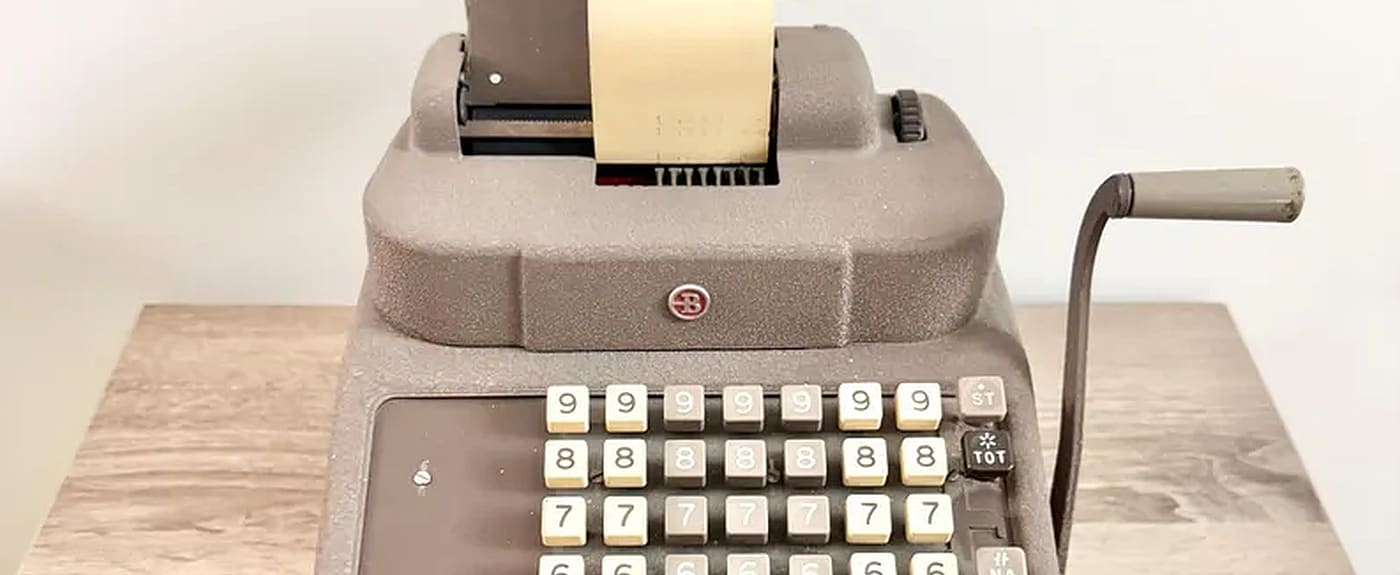
When I was about 8 years old, one quiet summer day, I accompanied my father to his workplace. He proudly showed me the new computers they used, but I was much more interested in the mechanical calculator on his desk. He planted me down in front of it, and the first idea that came up in my mind was to work out what I could buy, were I to win a million francs in the national lottery (about 200.000 euros in today’s money). Having typed in my hypothetical win, I subtracted the cost of my fictitious purchases one by one, every time cranking the handle of the device which then, with a satisfying rattle, neatly printed the deduction in red, and the total remaining in black.
At lunchtime, I still had a good deal of my million left, but he had to take me to a medical consultation, and I never found out whether my prize money would run out. I was reminded of this exercise when I recently spotted a chart showing the result of a YouGov poll, in which people were asked for their preference between instantly receiving £50,000, or a 50/50 chance of winning £1 million (with an expected value of $500,000). My eight-year-old self would have needed all morning to work out what these sums represented, but as an adult, I intuitively figured which option was best in no time – and with unwavering confidence. Isn’t that odd?
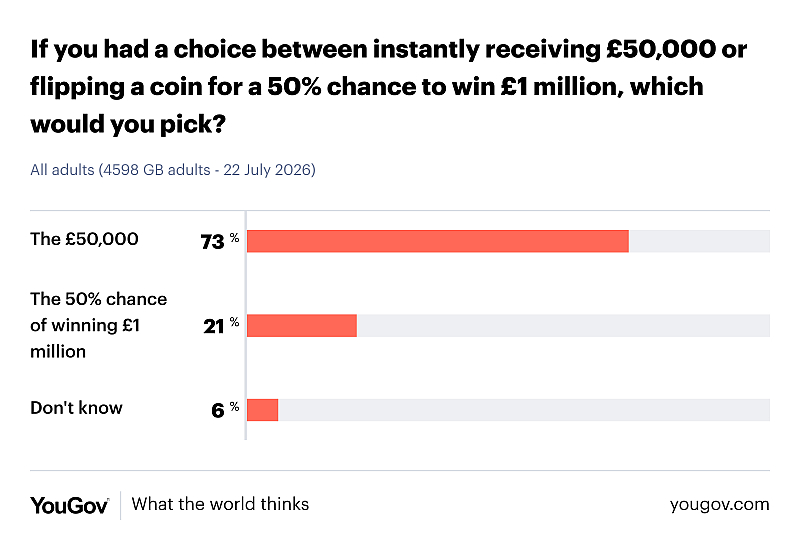
As economist Jessica Riedl pointed out on Twitter, this is a case of Prospect Theory, developed by Daniel Kahneman and Amos Tversky. The two options would be equally attractive if winning a million made us exactly twice as happy as receiving £50,000 outright (twice, since we only have a 50/50 shot at it). For many people, however, the certainty of the smaller amount might make it considerably more attractive – quite likely more than a 50% chance of gaining a million. Furthermore, the guaranteed option means a £50k gain is our point of reference, which makes a bad outcome of the coin flip feel like a loss of £50k, not just failing to gain a million. Such a loss would be truly painful for many, even if it was money they had only just acquired. This explains why the survey shows that over 2/3 of respondents prefer the certainty of the smaller amount.
Might most people just be risk averse, and prefer certainty to gambling, regardless of the amounts involved? Interestingly, a few years ago, a Twitter user ran a multi-question poll with very similar questions (his 50% chance amount was 50 times the certain one, as opposed to 20 times in the YouGov poll). It covered a scale ranging from $0.01 vs 50% chance of $0.50, in steps of two orders of magnitude at a time all the way to $ 1 trillion vs 50 trillion. About 1,500 people answered all questions, and though this is a convenience sample and not representative, it shows a pattern contradicting the idea that most people simply never choose to gamble. 96% would take the gamble to win 50 cents rather than a certain 1 cent, and almost everyone (98%) would gamble to win $50 instead of taking a dollar. However, the risk appetite then declines to less than 10% at the near-astronomical sums. The aggregate tipping point lies somewhere between the choice of either a firm $100k or 50% chance of 5 million (where 2/3 still prefers to gamble), and the choice of either one million for sure or 50% chance of 50 million (where 2/3 takes the instant prize). What is interesting isn’t where exactly that average tipping point falls — it is that there is a tipping point at all, and that once people switch from gambling to certainty, they don’t switch back.
And that switching, like the choices themselves, is intuitive – it doesn’t take much deliberation. But intuition is not, or certainly not always, a mysterious feeling in our gut that we cannot pinpoint or comprehend. It can also be well-informed and honed over time, offering us a good balance between speed and accuracy. This would seem to be precisely what happens here. One way of modelling how we respond to such challenges is that we have a classification of amounts at the ready, with a rapid shortcut to the corresponding emotions should our wealth increase or decrease by a sum of a particular order. One penny? Trivial, not worth pondering over. A few pounds? Although we would probably bend down to pick up a £5 note, most people would not lose any sleep over losing that sum. £10,000 is already substantial, and from £50,000 onwards, depending on our financial circumstances, we’re talking more and more life-changing amounts that would pay off the mortgage or fund a new kitchen, whether gain or loss. Beyond £10 million, the sums become abstract – more than we can possibly spend.
This categorization works so well (and so quickly) for two reasons: it is rooted in the emotions we would experience when we gain or lose a certain sum, and we are able to simulate mentally the actual experience by hypothesizing it happens to us (which is how we so effortlessly adopt the guaranteed amount as our reference point: it is ‘ours’ already). Together, these mechanisms harness our evolutionary ‘fast’, intuitive cognitive processes, enhancing their accuracy by constructing a sense of meaning for particular sums of money – the kind of activity I got engaged in at my dad’s desk decades ago. Informed intuition rocks.

Thanks for reading Koenfucius’s Substack! This post is public so feel free to share it.
The poll questions are plainly contrived: they’re not choices we expect to face in real life, but they do model how we weigh up certainty and uncertainty. When the outcome begins to matter, we become risk averse and veer towards guarantees. This makes us averse to investing and stick to saving, which is not necessarily in our interest. Instruments with capital protection address that reluctance by offering a guarantee that eliminates the downside risk, and thus give the more risk averse saver an opportunity to benefit from long-term stock market capital growth (my first actual investment action was buying one of these). This can be seen as a variant of the house money effect, a concept coined by Richard Thaler and Eric Johnson, which describes how the perceived security of a windfall reduces risk aversion.
What about ‘expected value’ – the average outcome when a random event is repeated many times? It is a useful concept for casinos, insurers and others in situations where a transaction is repeated often enough for the average to assert itself. But if that is how we reasoned, we would give the same answer to every question in the Twitter survey: take the gamble, since the EV is 25 times the value of the guaranteed payout option throughout. Yet we don’t. We judge opportunities against our own circumstances and preferences, and those are not invariant, quite the contrary.
Our individual tipping points, above which we opt for the safety of the guaranteed win, are as variable as all of humanity itself.
No posts
Comments
Nothing yet. Say the first thing.
Sign in to join the conversation.