

BASE Network’s most visible narrative was never the real story.
What most people focused on throughout 2025 was loud, obvious, and easy to understand. It was designed that way. While everyone was debating content coins, creator tokens, and whether every moment of your life should be tokenized, something far more important was being built quietly in the background.
The attention was directed one way. The real work was happening somewhere else.
For most of 2025, the dominant conversation around Base revolved around Zora. Creator coins, social tokens, and the idea of “coining everything” became the defining narrative. Jesse Pollak leaned into it publicly, pushing the idea that content itself could be turned into financial primitives.
Then came the July rebrand. Coinbase Wallet became the Base App, transforming into what looked like a SocialFi super app with Zora’s token infrastructure embedded directly into the user experience.
The results were immediate.
Base surpassed Solana in daily token creation. Zora surged and crypto Twitter split into camps arguing whether this was the future of the internet or just another speculative bubble. Jesse Pollak gained industry recognition and visibility. From the outside, it looked like the entire ecosystem was centered around content monetization, but that wasn’t the real story.
At the same time all of this was happening publicly, Coinbase and a tightly connected group of partners were building something far more foundational. Not another token, or another app… They were building infrastructure.
Quietly, without the same level of promotion, they were assembling the components for what looks like a machine-driven financial system:
Open payment protocols
Identity systems for AI agents
Trustless commerce frameworks
Integrations with companies like Amazon Web Services, Google, Stripe, Visa, Anthropic, and Cloudflare
This wasn’t experimental crypto infrastructure, it was production-level architecture for a system designed to operate at global scale. And almost none of it received the same attention as Zora.
To understand the contrast, you have to look at what was happening on the surface.
Zora wasn’t just another project that happened to live on Base. It was deeply connected to Coinbase from the beginning. It was co-founded by a former Coinbase product manager, and Coinbase Ventures participated in multiple funding rounds, including a $50 million raise at a $600 million valuation.
In April 2025, Zora launched its token, $ZORA, on Base rather than its own chain. The timing raised immediate questions.
Just days earlier, Pollak had promoted a “coin everything” experiment that resulted in a token briefly reaching a $16.9 million market cap before collapsing over 90% within hours. Then came the Zora token launch, and to many observers, it looked coordinated.
Roughly 45% of the token supply was allocated to insiders and contributors. The token itself had no governance rights. Even the team described it as something closer to a meme coin than a functional protocol asset.
Despite that, it became a central part of Base’s identity.
By July, with the Base App rollout, token creation exploded:
Daily tokens increased from ~4,000 to over 15,000
Peaks reached 38,000 per day
Base overtook Solana in token issuance
From the outside, it looked like explosive innovation, but underneath that growth, there were cracks:
Most users were speculators, not creators
The “creator economy” narrative didn’t match actual behavior
Governance was effectively nonexistent
The relationship between Coinbase, Zora, and Base raised questions
So what was really going on? It may not have been a pump or a mistake. But we believe it may have been a distraction.
While Zora captured attention, Coinbase engineering was shipping something far more significant. In May 2025, Coinbase introduced x402. This wasn’t just another crypto product. It was a fundamental change to how payments could work on the internet. x402 revived an old HTTP status code—“402 Payment Required”—and turned it into a native payment layer for the web. The idea was simple but powerful:
Every request on the internet could carry a payment.
No subscriptions
No API keys
No accounts
Just pay-per-use
Transactions could settle instantly, even at sub-cent levels. This wasn’t built for humans, it was built for machines.
From there, Coinbase moved things rather quickly:
September 2025: Coinbase and Cloudflare launched the x402 Foundation. Members included Visa, Stripe, Circle, Google Cloud, AWS, Anthropic
October 2025: Payments MCP enabled AI systems to trigger payments integrating x402 with Claude Desktop, Google Gemini, OpenAI Codex, and Cherry Studio.
December 2025: x402 processed over 100 million payments in just six months.
February 2026: Agentic Wallets launched for AI-native financial activity
March 2026: Sam Altman’s World launched AgentKit on top of x402, adding cryptographic proof-of-human identity to AI agents.
At this point, a pattern becomes clear. This wasn’t random innovation, it was coordinated infrastructure development.
This is where things shift from narrative to structure. While Zora was driving engagement and attention, the team behind x402 was building something far more foundational—a three-layer system of open standards for the entire agent-driven economy.
Layer 1: x402 (Payments)
This is the payment layer—how agents actually send and receive money. Built by Coinbase and launched in May 2025, it’s already handling over 100 million transactions and has been integrated by players like Stripe, Visa, AWS, Google Cloud, Anthropic, and Cloudflare.
Layer 2: ERC-8004 (Identity & Reputation)
This layer defines who agents are and whether they can be trusted. Co-authored in August 2025 by contributors from Coinbase, MetaMask, the Ethereum Foundation, and Google, it went live on Ethereum mainnet in January 2026. It gives each AI agent an on-chain identity (as an NFT), along with a reputation system and validation framework—essentially forming the backbone of “Know Your Agent” (KYA), the counterpart to KYC.
Layer 3: ERC-8183 (Agentic Commerce)
This is the transaction layer—how agents interact and complete work without needing trust upfront. Co-authored by Virtuals Protocol and the Ethereum Foundation’s dAI team, it was submitted on March 10, 2026. It introduces an escrow-style “hire–deliver–settle” system, where two agents can safely exchange services and payment, with a third-party evaluator (another agent, a smart contract, or a DAO) ensuring fairness.
One simple way to think about it:
x402 answers how payments happen
ERC-8004 answers who you’re dealing with and if they’re reliable
ERC-8183 answers how to transact safely with them
Put together, these three layers form a complete operating system for a machine-to-machine economy. And across all of them, the same key players keep showing up: Coinbase, the Ethereum Foundation, and Virtuals Protocol.
That last one is worth paying attention to.
Virtuals Protocol first launched on Base in October 2024 as an AI agent platform—a place to create, deploy, and tokenize autonomous agents. By January 2025, its token, VIRTUAL, had surged to a market cap above $4.5 billion. By almost any standard, it was the breakout project on Base and one of the biggest AI-crypto plays in the market.
And yet, Coinbase didn’t list it.
The omission stood out. In February 2025, Kraken listed VIRTUAL on Solana after Virtuals expanded to another chain. Meanwhile, Coinbase—the very company behind the blockchain Virtuals originated on—still hadn’t added it. The crypto community noticed, and criticism followed.
Other exchanges moved quickly. Binance, Bybit, OKX, and Gate. io all listed VIRTUAL one after another. Despite the token being native to its own ecosystem, driving major volume and attention, Coinbase continued to hold off.
It wasn’t until around October 2025—eight or nine months after its peak and long after other exchanges had listed it—that Coinbase finally added VIRTUAL. Jesse Pollak then publicly praised the project, calling it one of the most important ecosystems on Base, as if the long silence beforehand hadn’t happened.
During that same stretch, Coinbase was heavily pushing Zora—integrating it into the Base app, running coordinated campaigns, and positioning content coins as the centerpiece of the ecosystem. So while the leading AI agent project on Base went unlisted, the company was actively turning its platform into a distribution engine for Zora.
The typical explanations point to regulatory caution, listing delays, or compliance processes—and those may well be factors. But there’s another way to read the situation—one that ties back to Coinbase’s earliest and most influential investor.
To understand why, you have to look at Ribbit Capital.
Founded by Micky Malka (ranked #2 on the Forbes Midas List), Ribbit is one of the most influential fintech investors in the world. They were early investors in Coinbase, along with companies like Robinhood, Nubank, Revolut, Brex, and Affirm. They manage over 12 billion in assets and have built one of the strongest portfolios in modern finance.
Ribbit has also backed a number of major players across crypto and infrastructure — including Uniswap, Bridge, and Privy (the wallet infrastructure company alongside Sequoia, Paradigm, and Coinbase). They’ve also invested in Crossmint, which connects fiat and digital assets for AI agents, as well as Persona, which recently raised $200M at a $2B valuation to build what they’re calling the verified identity layer for an AI-driven world. They’ve also taken part in Tempo’s (Stripe’s blockchain) $500M raise at a $5B valuation. They are not loud, they are strategic and deeply connected to everything being built.
Ribbit has invested across the entire stack:
Coinbase
Identity infrastructure companies
Payment rails
AI-related financial systems
And then something unusual happened. A token called TIBBIR appeared that is “Ribbit” spelled backwards. It launched quietly on Virtuals Protocol with no announcements or marketing, just a stealth deployment.
And the signals connecting it back to Ribbit were subtle—but consistent. The deploying wallet was funded by an address linked to Micky Malka’s personal ENS domain, “mickym.eth,” a 7+ year-old Ethereum wallet.
But the breadcrumbs don’t stop there. Even before the token was released, Malka had already set up legal structures—Tibbir Trust and Tibbir Holdings LLC—that showed up in SEC filings alongside his Robinhood holdings. When Tibbir’s official X account launched, Ribbit’s entire core team immediately followed it. Around the same time, Micky Malka updated his profile picture to something hinting at the token’s launch date, and the Ribbit Capital website was revamped with mirrored typography, including a reversed “R” that spells out “Tibbir.”
At no point did they deny any of it—and they still haven’t, even after more than a year.
TIBBIR’s core idea, “better money makes life better,” closely reflects what Malka has been emphasizing for years. The token itself launched on Virtuals Protocol—an AI agent launchpad that Coinbase held off listing for months—built on Base, the blockchain developed by Coinbase.
In June 2025—about five months after TIBBIR quietly launched—Ribbit sent a 41-page letter to its limited partners. It wasn’t about raising a new fund or announcing an IPO. It was entirely focused on tokens.
The letter, called “The Token Revolution,” made the case that every company is evolving into a kind of “token factory.” It suggested that the most valuable digital assets people will own are the memory-based tokens they share with AI agents, that the line between data and money is fading, and that whoever controls the systems for creating, verifying, and moving these tokens could capture trillions in value over the next decade.
Ribbit’s core idea is that tokens will carry the data AI agents need, powering what Micky Malka describes as “agentic commerce.” In this world, smart contracts would hold funds and release them based on decisions made by AI agents. Individuals might operate dozens—or even hundreds—of agents, while companies deploy agents alongside every employee. As a result, identity verification events would grow dramatically.
Their boldest prediction is that “Know Your Agent” (KYA) will become just as critical as KYC. The company that builds the trust layer for this agent-driven economy—figuring out which agents are real, reliable, and proven—could become as influential as Visa or Mastercard.
Take that in for a moment: KYA at the scale of global payment networks.
Now compare that to what TIBBIR’s community researchers believe is being built: onchain, permissionless infrastructure for verifying agents—essentially turning a major challenge into a business opportunity. Then consider what ERC-8004 introduces: mechanisms for agent identity, reputation, and validation—the exact building blocks needed for KYA. Add to that the fact that ERC-8004 was co-authored by Erik Reppel from Coinbase—the same person behind x402 and the Coinbase Developer Platform. And finally, ERC-8183 was co-authored by Virtuals Protocol—the very platform TIBBIR launched on—working alongside the Ethereum Foundation.
Put it all together, and the connections line up with striking precision.
Here’s the full web of connections—because once it clicks, it’s hard to ignore.
Ribbit Capital—Coinbase’s earliest backer with $12B AUM—quietly launched $TIBBIR in January 2025 on Virtuals Protocol, built on Base (Coinbase’s own chain). The project centers on agent-based trust and the idea of KYA.
A few months later, in May 2025, Coinbase introduced x402, a payments layer designed for AI agents. By August, Erik Reppel from Coinbase co-authors ERC-8004, which focuses on identity and trust for agents. Then in March 2026, Virtuals Protocol teamed up with the Ethereum Foundation to co-author ERC-8183, aimed at enabling agent-driven commerce.
At the same time, Ribbit is backing key pieces of this ecosystem:
Coinbase itself (x402, AgentKit, agent wallets, Base)
Privy (wallet infrastructure, alongside Sequoia, Paradigm, and Coinbase)
Crossmint (on/off-ramps connecting fiat and crypto for agents)
Persona (raising $200M to build identity verification for an AI-driven world)
Tempo (Stripe’s blockchain initiative, focused on machine payments)
Lightspark (bringing Lightning Network payments to agents)
While all of this is being built behind the scenes, Coinbase’s public strategy looks very different. The focus is on Zora—pushing content coins inside the Base app, running campaigns around “tokenizing everything,” driving engagement, and fueling speculation about a potential Base token airdrop. The narrative stays centered on SocialFi.
Meanwhile, Virtuals Protocol—despite becoming one of the most important projects on Base and getting listed on other major exchanges—doesn’t appear on Coinbase for months. Not until October 2025. By then, x402 has already handled 100 million payments, ERC-8004 is nearing mainnet deployment, and much of the agent-focused infrastructure is already in place. Only at that point does Jesse Pollak publicly express support for Virtuals.
Coinbase, Ribbit Capital, and the companies in their orbit spent 2025 quietly putting together the core infrastructure for an agent-driven economy. They built the payment rails (x402), the identity layer (ERC-8004), the commerce standard (ERC-8183), the wallet stack (AgentKit and agentic wallets), and the trust framework around KYA. It wasn’t loud or flashy—it was intentional, step-by-step, and mostly out of the spotlight.
Meanwhile, Zora played the role of a distraction. It’s a real product, but also a very visible one—pulling attention, driving engagement, and shaping the narrative around content coins and SocialFi. That noise kept the broader crypto audience focused on the surface, while the more important pieces were being developed underneath.
The delay in listing Virtuals Protocol likely wasn’t accidental or due to red tape—it reads more like calculated timing. Listing it too early would have drawn a spotlight to the AI agent ecosystem on Base before it was fully built out—the same ecosystem Ribbit was quietly entering, Coinbase was equipping with payments and identity tools, and the Ethereum Foundation was helping standardize. That kind of attention would have come too soon.
So they held off. They kept building. And by the time Virtuals was publicly acknowledged—when Jesse Pollak praised it in October 2025—the groundwork was already in place. x402 was live and handling volume. ERC-8004 was close to mainnet. AgentKit was already in developers’ hands, and agentic wallets were on the horizon.
And right in the middle of all this sits TIBBIR—still operating quietly more than a year later. It was launched by Coinbase’s earliest backer, built on a platform now helping define Ethereum standards, and deployed on the chain emerging as the hub for agent-driven commerce. Its focus lines up exactly with what Ribbit’s own thesis identifies as the biggest opportunity: trust in an agentic world.
I pulled TIBBIR’s holder data using the Nansen API—not just a sample, but the full set of the top 1,000 wallets. I broke it into four groups: all holders, smart money, whales, and exchange wallets.
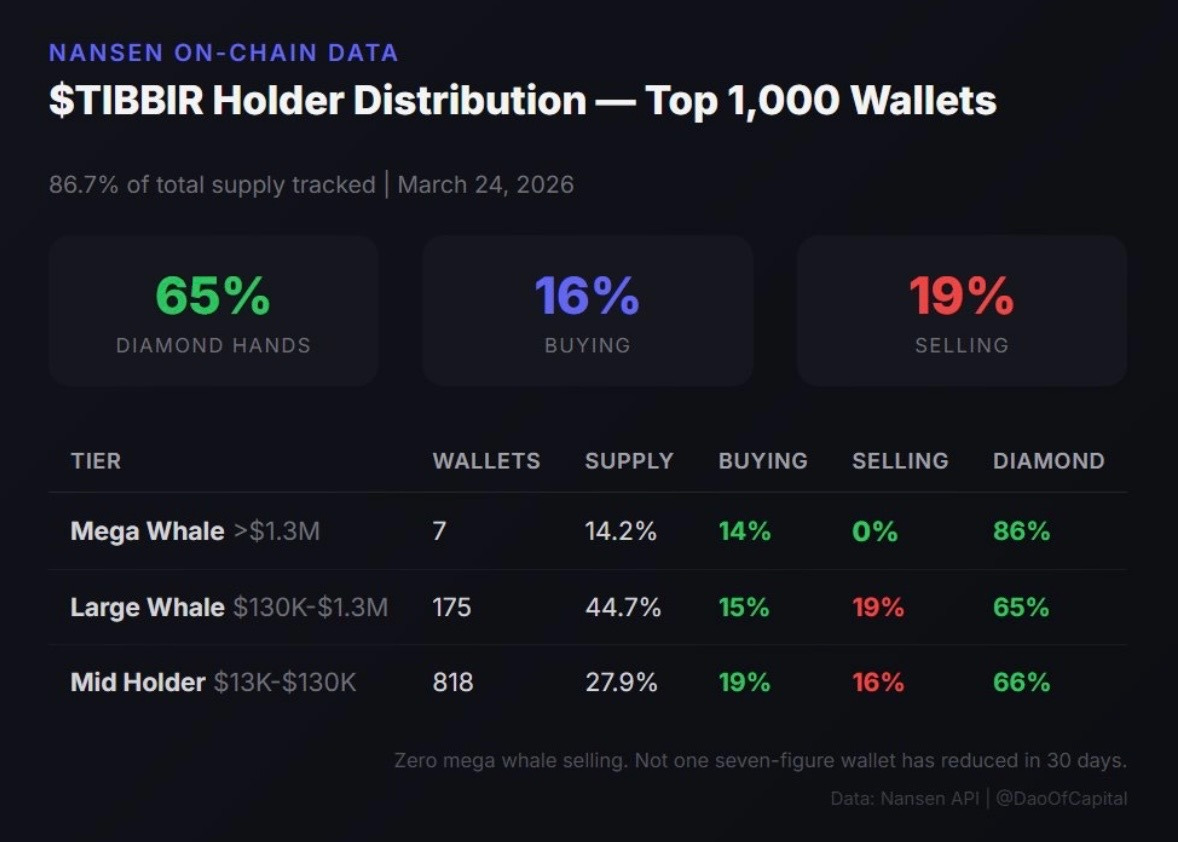
What stands out immediately: 86.7% of the total supply is concentrated in those top 1,000 wallets. And the behavior across them is strikingly consistent.
At the top, seven mega whales—each holding more than $1.3M—control 14.2% of the supply. Over the past 30 days, 86% of their activity has been holding, 14% buying, and 0% selling. Not a single seven-figure wallet has sold anything in a month—even with BTC below $70K, during peak uncertainty and global tension. They’re not budging.
Then you have 175 large whales (positions between $130K and $1.3M) controlling 44.7% of supply. About two-thirds of them haven’t moved at all.
Below that, 818 mid-sized holders ($13K–$130K) control another 27.9%, showing the same pattern.
Overall, 65% of all meaningful holders haven’t made a single move in the last 30 days. This is with the token down 70% from its all-time high, in one of the toughest risk environments of the year. Two out of every three wallets are simply holding.
That’s not indifference—that’s a holder base that’s been through volatility, drawdowns, and macro fear, and hasn’t shaken out.
Now, looking at the wallets that are active:
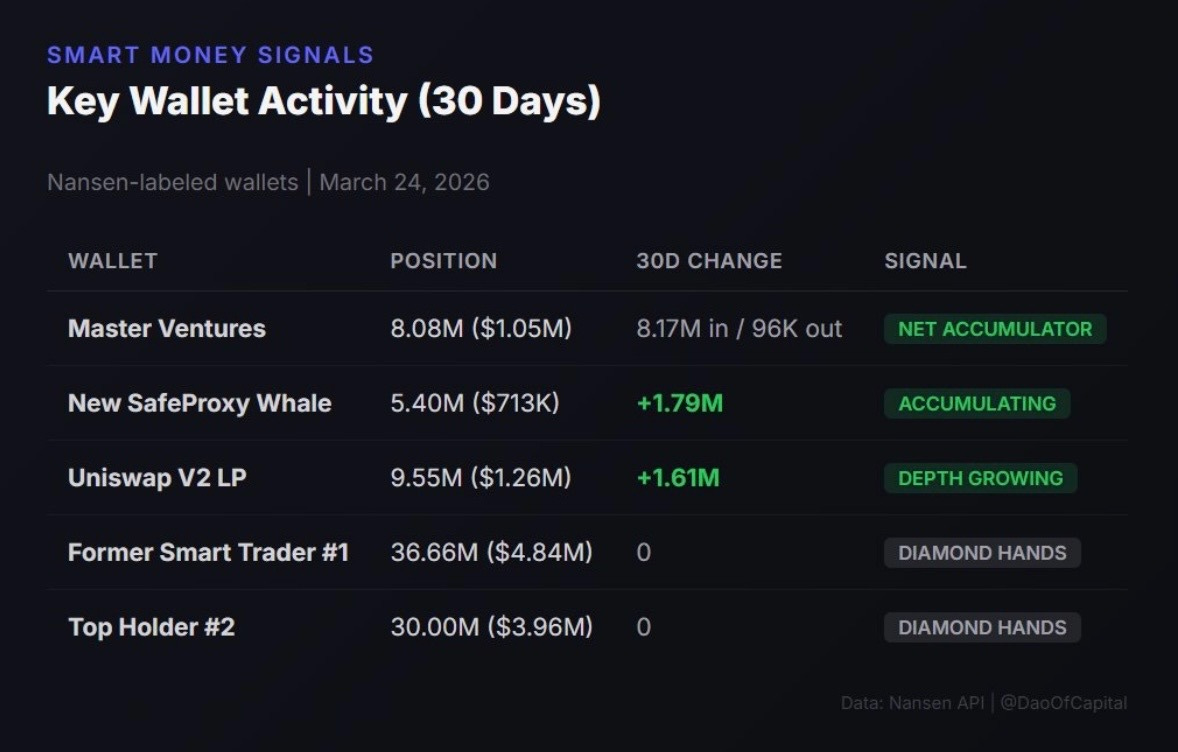
Master Ventures holds 8.08 million TIBBIR—about a $1.05M position—identified by Nansen as a professional fund. That’s a serious allocation for a $130M market cap asset.
There’s also a newly created SafeProxy wallet that built a position of over 1.79 million tokens (more than $700K), jumping straight into the top 30 holders. That’s fresh capital entering while the broader market is struggling.
Meanwhile, the top two holders remain completely unchanged:
#1 wallet: 36.66M tokens (~$4.84M) — no movement
#2 wallet: 30M tokens (~$3.96M) — no movement
These are multi-million dollar positions sitting still despite a 70% drawdown from peak.
On the sell side, activity is minimal—one wallet reduced about 1M tokens, another trimmed roughly 4M. Compared to 175 large wallets where most haven’t moved at all, that selling barely registers.
The takeaway is pretty clear: circulating supply is tighter than it looks, conviction among holders is high, and the actual float available to buy is limited. At a $130M market cap with around $4M in daily volume, any meaningful demand is likely to run into a supply wall of holders who simply aren’t selling.
As of this week in March 2026, everything is starting to come together—and fast.
ERC-8183 was submitted just nine days ago. Tempo went live two days ago. World rolled out its AgentKit three days ago. On that same day, Visa introduced its own AI agent payment tool. And just yesterday, AWS released a reference setup for x402 on Amazon Bedrock.
At this point, the agent-driven economy isn’t just an idea anymore—it’s actively being deployed. Much of the infrastructure behind it was quietly built throughout 2025, while most of the attention stayed fixed on content coins and SocialFi.
Ribbit’s “Token Factory” thesis essentially called this trajectory ahead of time. So the real question now isn’t whether this shift is happening—it’s who ends up controlling the trust layer that everything depends on.
And that answer might already be right in front of us… just not in the way you’d expect.
If you’ve made it this far, you already see where things are heading—and more importantly, how early this still is.
Knowit OwlZ isn’t just another community. We’re an elite group focused on DeFi, Web3, and AI—built for people who want to actually understand the systems being created, not just speculate on them.
We run 8-week cohorts where we break down everything—from onchain infrastructure and token design to AI agents, automation, and the future of digital economies. This is hands-on, high-signal learning designed to give you a real edge.
We still have a few scholarships left, but they’re going fast.
👉 Apply here: Knowitowlz.xyz/cohort
If you’re not ready for the cohort yet, you can still plug in:
The people who understand this shift early won’t just follow it—they’ll help shape it.
No posts
Comments
Nothing yet. Say the first thing.
Sign in to join the conversation.