

For most of our lives, investing has been relatively straightforward. If you believed in a company, you bought its stock. If the company grew revenues, increased profits, expanded market share, and executed well, shareholders generally benefited. There were obviously exceptions and nuances, but the basic framework was simple. Companies created value. Investors bought equity. Equity holders participated in the upside.
But I believe we’re entering a period where that framework is going to break down. Over the next decade, investors are going to face a new challenge that previous generations never had to deal with: What happens when a company has both a stock and a token?
More importantly, what happens when those two assets represent different pieces of the same ecosystem? I don’t think most investors are prepared for this shift yet. In fact, I think it’s going to become one of the defining investment questions of the blockchain era. And it all starts with regulation.
For years, one of the biggest barriers preventing blockchain companies from fully integrating with traditional financial markets has been regulatory uncertainty. Founders didn’t know what rules they were operating under. Investors didn’t know how assets would be classified.
Regulators often disagreed with each other. Companies were forced to build in an environment where the rules seemed to change depending on who was asking the questions. That uncertainty has slowed innovation, delayed investment, and pushed many projects offshore. But that may be starting to change.
The CLARITY Act recently advanced through the Senate Banking Committee, representing another step toward establishing a formal regulatory framework for digital assets in the United States. While the bill still has several hurdles before becoming law, its significance shouldn’t be underestimated. The legislation is attempting to answer a question that has haunted the industry for years:
Who regulates what? For a long time, many digital assets existed in a gray area between securities and commodities. This created ongoing disputes between regulators, companies, investors, and courts. The CLARITY Act aims to establish clearer boundaries regarding which assets fall under SEC oversight and which fall under CFTC oversight. The specifics matter, but the bigger picture matters more.
Markets thrive on certainty. Investors deploy capital when they understand the rules. Companies build aggressively when they know the framework they’re operating within. And public markets become more comfortable embracing new industries when regulatory uncertainty begins to fade. That’s why we believe regulatory clarity is not simply a legal milestone. It’s an economic catalyst.
If you look throughout history, the largest companies in the world have generally reflected the dominant technologies of their era. In the early industrial age, railroads became some of the most valuable companies on earth.
As industrialization accelerated, manufacturing giants emerged. During the energy boom, oil companies became economic powerhouses. Banks grew alongside increasingly sophisticated financial systems. The leaders changed because the underlying technology changed.
The market rewarded the companies that controlled the most important infrastructure of the time. Then the internet arrived. Suddenly the world’s most valuable companies weren’t necessarily those producing physical goods. Instead, value shifted toward companies that controlled digital infrastructure, software, information, networks, and distribution. Today, many of the largest companies in the world are technology companies. Observe the chart to see the transition.
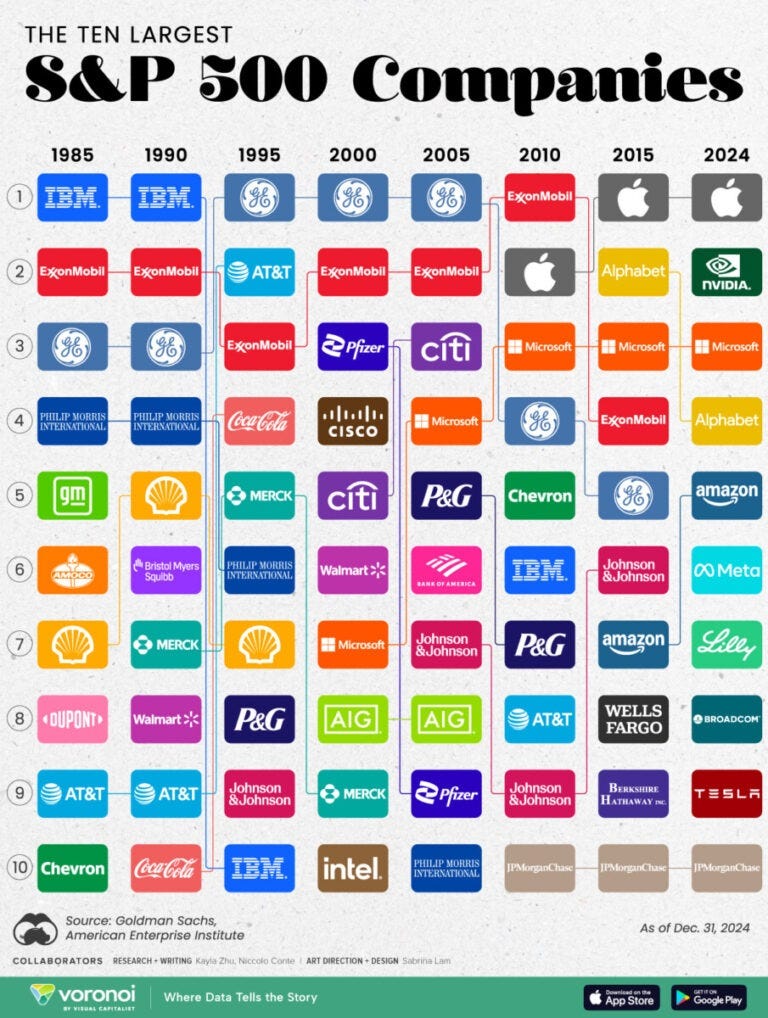
Companies like Apple, Microsoft, Nvidia, Amazon, Alphabet, and Meta dominate public markets because they sit at the center of the digital economy. They’re not simply companies but actual infrastructure our society relies on daily… Including what you’re using to read this. They became the roads, bridges, railways, and utilities of the information age. And we believe blockchain is beginning a similar transition.
One of the biggest mistakes people make when evaluating blockchain is comparing it to individual technologies. People compare it to social media, mobile apps and cloud computing. We think those comparisons miss the point. Blockchain is better understood as a general-purpose technology, which are technologies that impact virtually every sector of the economy.
The steam engine was a general-purpose technology.
Electricity was a general-purpose technology.
The internet was a general-purpose technology.
These technologies didn’t simply improve one industry, they transformed all industries.The internet digitized information while blockchain digitizes ownership. That distinction sounds small, but it’s incredibly important. For the first time in history, ownership itself can move across the internet with the same efficiency that information moves today.
Money, assets, contracts, identity, governance rights, intellectual property, securities, and ownership interests can all potentially become native digital objects. That means blockchain doesn’t compete with one industry.
It potentially touches every industry.
Finance.
Gaming.
Supply chains.
Real estate.
Insurance.
Media.
Healthcare.
Identity systems.
Capital formation.
Virtually every sector that relies on ownership, coordination, trust, or value transfer could eventually be affected. That’s why we believe some of the most important public companies of the next twenty years may very well be blockchain companies.
For years, crypto investing has primarily occurred through token markets. Investors bought Bitcoin, Ethereum, ecosystem tokens, governance tokens and utility tokens. But public equity markets largely remained separate. But now that separation is beginning to disappear as we already have publicly traded crypto-related companies.
Coinbase is perhaps the most prominent example but we also have public Bitcoin miners, custody providers and infrastructure companies. Not to mention firms building tokenization platforms and tablecoin issuers entering mainstream finance. With all that said, we still believe this is just the beginning.
As regulatory frameworks mature, we expect we’ll see an increasing number of blockchain-native businesses enter public markets. Some will be entirely new companies while others will be existing crypto firms that eventually pursue public listings.
Still others may be traditional companies that successfully integrate blockchain technology into their business models. This transition is inevitable given broad blockchain business and personal benefits. But it also introduces a completely new investing challenge.
Historically, if you believed in a company, you bought the stock…Pretty straight forward. In crypto, things become much more complicated. Let’s consider a hypothetical future blockchain company.
The company itself generates revenue.
The protocol generates network activity.
The token facilitates ecosystem participation.
The treasury accumulates assets.
The community governs certain decisions.
Now ask yourself: where is the value actually accruing? You’ll quickly see that the answer isn’t always obvious. In traditional markets, revenue growth often benefits shareholders. In blockchain ecosystems, value may flow through entirely different channels. Network usage might increase dramatically while shareholders see little benefit.
Alternatively, company revenues might grow while token holders receive none of the upside. This creates an entirely new analytical challenge. Investors must determine which asset captures value most effectively. The company, the protocol, the token, or some combination of all three. This is a question that traditional equity analysis was never designed to answer.
One of the biggest misconceptions in crypto is the belief that buying a token means owning part of a company,when in most cases, it doesn’t. When you buy stock, you typically acquire equity ownership in a corporation.
You may receive voting rights.
You may have legal protections.
You may benefit from company growth and profitability.
Tokens are usually different, as most tokens are designed around network participation rather than corporate ownership.
They may grant governance rights.
They may facilitate staking.
They may provide access to network functionality.
They may serve as economic incentives within an ecosystem.
But they generally do not represent legal ownership in the company itself. This separation exists for both practical and regulatory reasons. Many blockchain projects intentionally separate their corporate structures from their token ecosystems. As a result, multiple entities often exist simultaneously.
A corporation may build software while the foundation may oversee ecosystem development. A token may facilitate network activity while a DAO may govern community decisions. Each component serves a different purpose. This structure creates flexibility, but it also creates complexity for investors.
Venture capital firms often participate in crypto projects very differently than retail investors. Many early-stage crypto investments have historically been structured through agreements known as SAFTs, or Simple Agreements for Future Tokens.
These arrangements allowed investors to provide capital before a token launched. In many cases, institutional investors also received equity ownership in related corporate entities. As a result, early investors sometimes gain exposure to both sides of the ecosystem.
They may own part of the company and a part of the token supply. Retail investors usually only see the token. This distinction matters because different assets can capture value in different ways. As blockchain companies increasingly enter public markets, investors may finally gain access to both sides of the equation, and that changes everything.
Coinbase offers an interesting glimpse into where things could be heading. Today, investors can buy Coinbase stock. At the same time, Coinbase operates at the center of a much larger blockchain ecosystem. The company is deeply connected to Base, one of the fastest-growing Ethereum Layer 2 networks. Now imagine a future where more public companies operate major blockchain ecosystems. Investors may be forced to ask questions that didn’t exist before.
If blockchain activity grows, who benefits?
The shareholders?
The network participants?
The token holders?
The validators?
The treasury?
The answer could be different in every ecosystem. That means future investors may need to analyze not just companies but entire economic systems.
The Coinbase/BASE Network dynamic is a particularly fascinating example that may already be developing right in front of us.
While Coinbase itself is a public corporation accountable to shareholders, Base exists as an Ethereum Layer 2 network that was incubated and launched by Coinbase. Although Base is closely associated with Coinbase and benefits from the company’s resources, brand, distribution, and infrastructure, it operates as a blockchain network rather than as a publicly traded company. This distinction becomes extremely important when thinking about the future of investing.
For years, Coinbase investors have had a relatively straightforward way to gain exposure to the growth of the company: buy the stock. But what happens if a major blockchain ecosystem connected to a public company develops its own native asset?
It’s worth noting that Coinbase has stated in its writings that they want the BASE Network to become a DAO. In order to have a DAO you have to have governance tokens for people to accumulate and use to operate the DAO via voting, staking, utility and other economic coordination functions. The BASE team also announced at their Basecamp event that they will be “ Experimenting with a network token”.
When/if a Base token were ever introduced, Coinbase could become one of the first major examples of a publicly traded company existing alongside a large-scale blockchain economy with its own native asset.
At that point, investors would face an entirely new set of questions. If Base becomes one of the dominant Layer 2 networks in crypto, where does the value accrue? Does it primarily benefit Coinbase shareholders because more users enter the Coinbase ecosystem? Does it benefit token holders because the network becomes more valuable and more heavily utilized?
Do both assets appreciate together, or does one capture significantly more value than the other?
The answer may not be obvious because on one hand, Coinbase’s enormous user base, regulatory infrastructure, capital resources, and brand recognition could help accelerate adoption of Base. Millions of users already trust Coinbase. The company has the ability to onboard developers, attract applications, and drive activity toward the network in a way that few organizations can.
On the other hand, if a hypothetical Base token became the primary mechanism through which network value accrued, much of the upside from ecosystem growth could potentially flow toward token holders rather than shareholders. This is where the analysis becomes far more complicated than traditional investing.
Imagine a scenario where Base experiences explosive growth. Transaction volume surges. Developers flood into the ecosystem. New applications launch every day. User activity reaches all-time highs. Should investors buy Coinbase stock to gain exposure to that growth? Or should they own the asset that directly benefits from network activity?
Conversely, imagine Coinbase dramatically increases revenue through institutional services, custody, subscriptions, and exchange activity while Base ecosystem growth slows. In that situation, shareholders could outperform network participants despite both being connected to the same broader ecosystem. What’s particularly interesting is that these assets may reinforce each other while simultaneously competing for value capture.
A stronger Coinbase could drive more adoption toward Base, while a stronger Base ecosystem could increase the strategic importance of Coinbase. Success in one layer could create positive feedback loops for the other. Yet investors may still need to determine which asset captures the majority of the economic upside. This is a completely different problem than investors have historically faced.
When Apple succeeds, investors generally buy Apple stock.
When Amazon grows, investors generally buy Amazon stock.
But in blockchain ecosystems, success may be distributed across multiple stakeholders simultaneously: shareholders, token holders, validators, developers, treasury participants, and users. The emergence of these hybrid ecosystems may force investors to stop thinking in terms of individual companies and start thinking in terms of value networks. The challenge will no longer be identifying which company wins. The challenge will be determining which layer of the ecosystem captures the value when it does.
A potential future example is Ripple and XRP. In many ways, it represents the reverse of the Coinbase and Base scenario. Coinbase went public first and then BASE – an affiliated company – will potentially launch a token after. Ripple, on the other hand, already operates alongside XRP, one of the largest and most established digital assets in the industry, while reports suggest the company is exploring the possibility of going public.
Imagine a scenario where Ripple eventually becomes publicly traded while XRP continues to operate as a major digital asset. Investors would immediately face a difficult decision. Should they own Ripple stock, XRP, or both? Each asset could respond differently to the same underlying developments.
A major partnership announcement might benefit one asset more than the other. Network growth might favor XRP. Corporate profitability might favor shareholders. The relationship between the two may not be straightforward and Ripple likely won’t be the only example. Over time, many blockchain ecosystems could create similar dynamics.
For decades, fundamental analysis has revolved around a relatively consistent set of metrics. Investors evaluate a company’s revenue growth, profitability, margins, cash flow, balance sheet strength, and overall financial performance to determine whether it is a worthwhile investment. While those metrics will remain important, the rise of blockchain-based businesses introduces an entirely new layer of complexity.
As more crypto-native companies enter public markets and blockchain ecosystems continue to mature, investors will likely need to evaluate far more than traditional corporate financials. Understanding a company’s revenue and earnings may no longer be enough. Investors may also need to analyze tokenomics, treasury management, governance structures, validator incentives, network activity, developer growth, staking participation, protocol revenues, user retention, and community engagement. More importantly, they will need to understand how these variables interact with one another and how value ultimately flows through the ecosystem.
A company may be performing exceptionally well while its associated token struggles. Conversely, a blockchain network could be experiencing explosive growth while the company connected to it captures only a fraction of the economic upside. Determining where value accrues, and whether that value benefits shareholders, token holders, network participants, or some combination of all three, may become one of the defining challenges of modern investing.
This is why we don’t believe blockchain should simply be viewed as another sector alongside technology, healthcare, or energy. It represents an entirely new analytical framework. Investors who learn how to evaluate both traditional businesses and decentralized networks will likely have a significant advantage in the years ahead. As blockchain ecosystems become more integrated with public markets, the ability to analyze entire economic systems—not just companies—may become one of the most valuable investing skills of the next decade.
One of the most fascinating possibilities to consider is that the distinction between stocks and tokens may eventually begin to blur. Today, they largely exist as separate asset classes. Stocks represent ownership in a company and provide shareholders with certain legal rights, while tokens typically serve functions within a blockchain ecosystem such as governance, utility, staking, or network participation. However, as blockchain technology becomes increasingly integrated into global financial markets, it is reasonable to expect new financial structures to emerge that combine elements of both worlds.
We are already seeing early signs of this evolution through the tokenization of traditional assets, blockchain-based capital markets, and the growing interest from financial institutions in bringing real-world assets on-chain. As these trends continue, future companies may experiment with entirely new ways of aligning the interests of shareholders, token holders, and network participants. Equity could become tokenized and traded on blockchain networks. Tokens could potentially be designed to provide certain economic rights tied to the growth of an ecosystem. Shareholders might gain access to governance or participation mechanisms within a blockchain network, while token holders could receive benefits traditionally associated with company ownership.
To be clear, it is impossible to know exactly what these models will look like. The regulatory, legal, and technical frameworks are still evolving, and many of these ideas remain largely theoretical. However, history suggests that financial innovation rarely stops at its first iteration. The stock market itself has evolved dramatically over the past century, and blockchain technology is still in its early stages. The structures that seem innovative today may eventually be viewed as the primitive building blocks of a much more sophisticated financial system. Ten years from now, investors may look back on the strict separation between stocks and tokens the same way we look back on paper stock certificates—an important step in the evolution of finance, but far from the final destination.
There are several reasons to be optimistic about the continued evolution of crypto companies entering public markets. One of the most important is that public listings bring a higher level of transparency and structure to an industry that has often been criticized for opacity. Public companies are required to publish audited financial statements, adhere to regulatory reporting standards, and operate under stricter accountability frameworks. This level of oversight can help increase trust among both retail and institutional investors.
Another key benefit is broader investor access. When crypto companies become publicly traded, exposure to the industry is no longer limited to those comfortable interacting directly with blockchain networks, managing wallets, or navigating decentralized exchanges. Instead, investors can gain exposure through traditional brokerage accounts, making participation significantly more accessible.
Public markets also provide access to much larger pools of capital. This can be especially important for blockchain companies that require substantial funding to scale infrastructure, expand globally, and support rapidly growing ecosystems. The ability to raise capital through established financial channels can accelerate innovation and adoption across the entire industry.
Finally, the emergence of public crypto companies creates new pathways for investors who prefer regulated financial environments over direct cryptocurrency ownership. For many market participants, this hybrid structure offers a more familiar and regulated entry point into an otherwise complex and rapidly evolving space. Over time, this may help bridge the gap between traditional finance and blockchain-based systems, enabling broader participation in the growth of the industry.
At the same time, this evolution introduces meaningful risks that shouldn’t be overlooked. Public companies operate under constant pressure from shareholders to deliver financial performance, and that pressure can sometimes come into conflict with the original values that attracted many people to blockchain technology in the first place, particularly around decentralization, openness, and user-owned systems. As more crypto-native companies enter public markets, there is also the possibility of increasing centralization, where large corporations accumulate outsized influence over ecosystems that were originally designed to be distributed and permissionless.
Regulatory obligations may further complicate this dynamic by limiting experimentation or constraining how blockchain systems evolve over time. Perhaps most importantly, new forms of conflict could emerge between shareholders and token holders within the same ecosystem. If a blockchain network generates significant value, it may not always be clear where that value should ultimately accrue. Should it flow primarily to the company’s shareholders, to token holders, or be shared across both groups in some structured way?
These questions do not have straightforward answers, and in many cases the incentives of each group may not align perfectly. As these systems mature, navigating these tensions may become one of the defining governance challenges for the next generation of blockchain-based networks and publicly traded crypto companies.
The most important takeaway from all of this is not simply that crypto companies are going public. The more meaningful shift is that the nature of investing itself is beginning to change. For more than a century, investors have primarily focused on analyzing individual companies through a relatively consistent framework centered on financial performance, competitive positioning, and growth potential. That framework still matters, but it may no longer be sufficient on its own.
Going forward, investors may increasingly need to evaluate entire ecosystems rather than standalone companies. Instead of looking at a single balance sheet or income statement in isolation, they may need to understand how multiple layers interact at once: companies, protocols, tokens, treasuries, communities, governance systems, and incentive structures all operating simultaneously within the same economic environment. Value creation in these systems is often distributed across different participants, and understanding where that value ultimately accrues is becoming a far more complex analytical challenge.
This represents both a challenge and an opportunity. Just as investors in the 1990s had to learn how to evaluate internet businesses before the rest of the market fully understood them, the next twenty years may require investors to develop a new mental model for understanding blockchain-based economies. Those who are able to adapt early and think in terms of interconnected systems rather than isolated entities may find themselves better positioned for one of the most significant transformations in capital markets since the rise of the internet itself. And in many ways, we are still at the very beginning of that transition.
This is exactly where Knowit Owlz comes in.
Knowit Owlz is built for the next generation of investors, builders, and thinkers who want to understand where technology, finance, and culture are converging before it becomes obvious to the broader market. Our goal is to make high-level, institutional-quality research accessible in a way that is clear, practical, and easy to understand—even for someone who is just beginning their journey in crypto and investing. We focus on breaking down complex systems into simple mental models so that anyone, regardless of background, can understand how these ecosystems actually work beneath the surface.
The reality is that in fast-moving industries like blockchain, timing and understanding matter. Being early to understand structural shifts like the one described in this article can create outsized advantages over time. Knowit Owlz exists to help people stay ahead of that curve by providing consistent insights into emerging trends, new financial models, and the deeper mechanics behind how value is created and captured in digital economies.
Our community is designed for people who don’t just want to observe these changes, but actively position themselves within them—whether as investors, builders, or participants in the ecosystem.
If you found this breakdown valuable and want to go deeper, you can join the Knowit Owlz community for free, explore more research on our website, and connect with others who are actively learning and building in this space.
You can:
Visit us at
https://knowitowlz.xyz
Apply for a cohort scholarship program (limited spots available)
Subscribe on YouTube for deep-dive videos and breakdowns
Follow us on Instagram for short-form insights and updates
Follow us on X (Twitter) for real-time commentary on markets and crypto trends
The next financial era is already forming. The only question is who understands it early enough to take advantage of it.
No posts
Comments
Nothing yet. Say the first thing.
Sign in to join the conversation.