
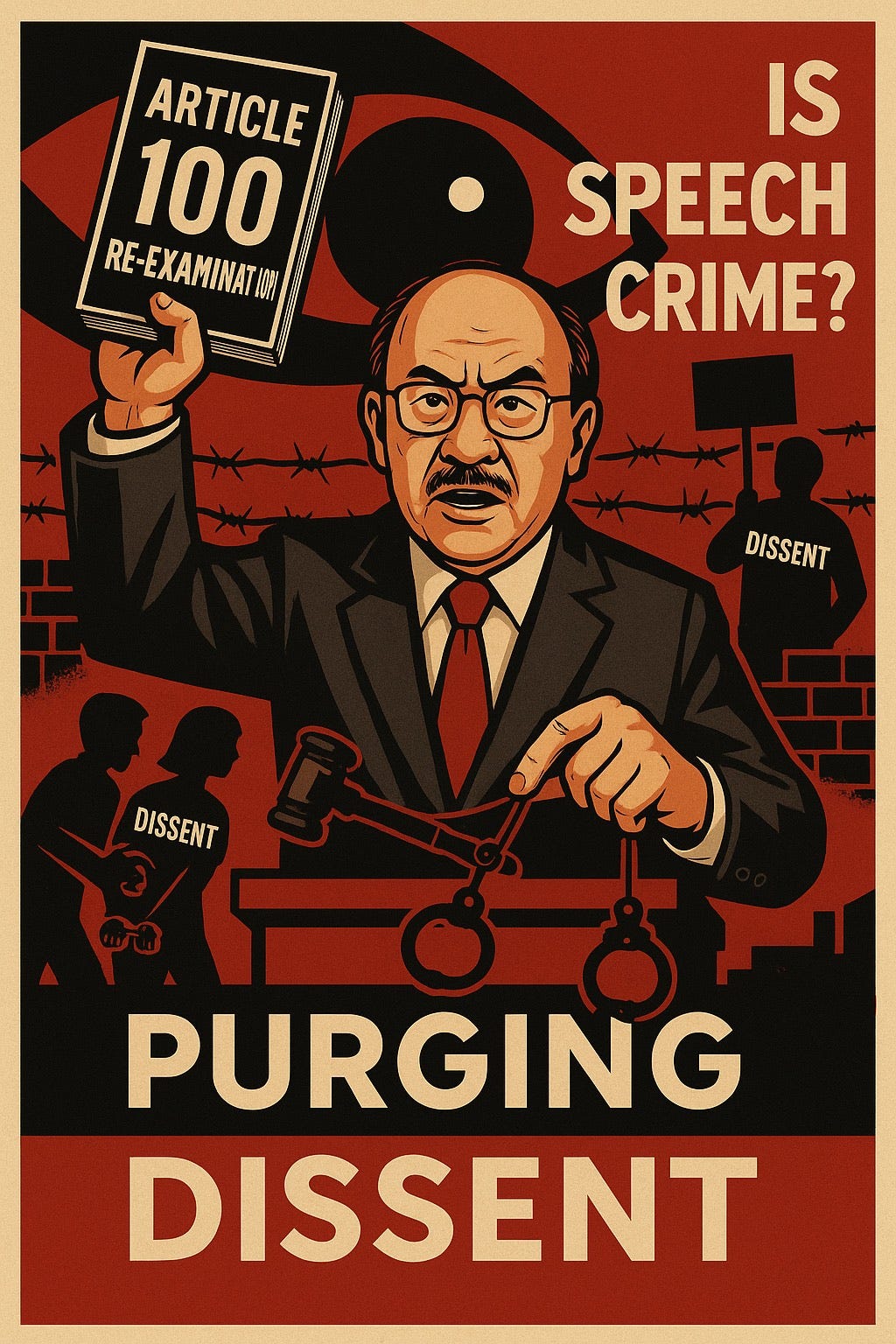
In the lead-up to Taiwan’s high-stakes legislative recall vote on July 26, the minority leader of the Legislative Yuan, Mr. Ker Chien-ming (DPP), made a controversial statement: he suggested that Article 100 of the Criminal Code — a long-dormant law — could be reinstated to prosecute opposition legislators after the vote. This remark has raised serious concerns about the DPP's direction as a ruling party. A law once sidelined in the name of democratic reform may now be revived not to protect the state, but to suppress political opposition.
1. Article 100: From Legal Ambiguity to a Milestone in Democratic Reform
Originally enacted to punish those who sought to “overthrow the government or harm the state,” Article 100 of Taiwan’s Criminal Code was historically part of the legal framework designed to safeguard national security. However, its broad and imprecise language gave rise to debate over the potential for overreach, particularly regarding its impact on political expression.
In step with Taiwan’s evolving democratic aspirations, on May 15, 1992, the Legislative Yuan passed a major amendment to Article 100, adding a critical condition: only those who employ “violence or coercion” would be subject to prosecution. This reform was a defining moment in Taiwan’s democratic development. It clearly distinguished violent acts from peaceful dissent and helped lift the constraints that had long clouded freedom of speech.
Rather than being a repudiation of any particular political party, the amendment marked a broader societal consensus: that democracy requires both national security and robust civil liberties. Since then, Article 100 has faded from legal practice, and Taiwan’s democracy has matured under a more open, pluralistic system.
2. DPP’s Shift: From Reformist to Enforcer?
It is especially ironic that the DPP — which once strongly opposed Article 100 as a threat to democracy — is now openly considering its revival. As an opposition party in the 1990s, the DPP championed the abolition of laws it saw as suppressive. It built its identity around defending freedom of expression and opposing state overreach.
Today, facing a loss of legislative control and increasing challenges to its agenda, the same party appears to be reversing course. By invoking national security to justify legal action against opposition lawmakers, the DPP risks undermining the very democratic principles it once fought for.
This shift raises a fundamental question: Has the DPP, now in power, begun to prioritize political survival over constitutional integrity?
3. Risks of Reviving Article 100: A Step Backward for Democracy
Should the government move forward with reactivating Article 100, several grave consequences could follow:
Legalizing political retaliation under the guise of “national security”
Eroding judicial neutrality as prosecutors risk becoming political instruments
Weakening legislative oversight by silencing the opposition
Damaging Taiwan’s international image as a model democracy in Asia
In any democracy, political contention — even sharp disagreement — is normal. What is not acceptable is the criminalization of dissent and the use of vague laws to suppress opposing voices. Taiwan’s democratic strength lies in its openness and tolerance, not in silencing disagreement through the courts.
4. What Should International Observers Pay Attention To?
Taiwan has long garnered support from democratic nations for its commitment to freedom, transparency, and open governance. In light of recent developments surrounding the possible revival of Article 100, international observers may wish to closely monitor several key areas that are relevant to democratic health and institutional balance:
The Legal Framing and Justification
Watch how the government articulates its reasoning for potentially reintroducing Article 100. Is the focus clearly on credible threats to national security, or are vague and politically charged definitions being used?
Judicial Independence and Due Process
It will be important to observe whether Taiwan’s legal institutions continue to operate independently and resist political pressure. Transparent, fair legal standards and procedural safeguards are critical to maintaining public trust.
Balance Between Government and Legislature
With tensions between the executive branch and the opposition-led legislature rising, how both sides engage in institutional negotiation — or resort to confrontation — will be a key indicator of democratic resilience.
Civil Society and Media Environment
Taiwan’s vibrant civil society and free press have long been pillars of its democracy. How freely journalists, academics, and NGOs are able to discuss and critique these developments will signal the strength of democratic norms.
Reactions to the July 26 Recall Vote
The political response following the recall vote — especially any use of legal or administrative measures targeting opposition legislators — will warrant close attention. The way the government manages the aftermath will offer insight into its democratic maturity.
This is not about interfering in Taiwan’s internal politics, but rather about upholding shared democratic values. As Taiwan continues to play a prominent role in the global democratic community, its internal conduct remains essential to its credibility and moral standing on the world stage.
Conclusion: Power Should Not Outweigh Principle
The DPP’s consideration of reinstating Article 100 — a law it once fought to reform — raises serious questions about the direction of Taiwan’s democracy. In a time of global polarization between democracy and authoritarianism, Taiwan must lead by example — not by silencing dissent, but by upholding the principles of pluralism, legal restraint, and civil liberty.
True democracy is not defined solely by elections, but by how those in power treat their critics. Taiwan must not allow the instruments of repression — once discarded — to be rearmed under a new flag.
No posts
Comments
Nothing yet. Say the first thing.
Sign in to join the conversation.