
NOTE TO MY READERS: I would like to thank all the readers who contributed previous month—July—to reaching and exceeding the eight hundred euro goal needed to cover the work involved in researching and writing the articles on my Substack newsletter. I also encourage you once again—if you appreciate what I write and publish here—to contribute to supporting my work.
A pontifical warning regarding the coming of the Anti-Christ
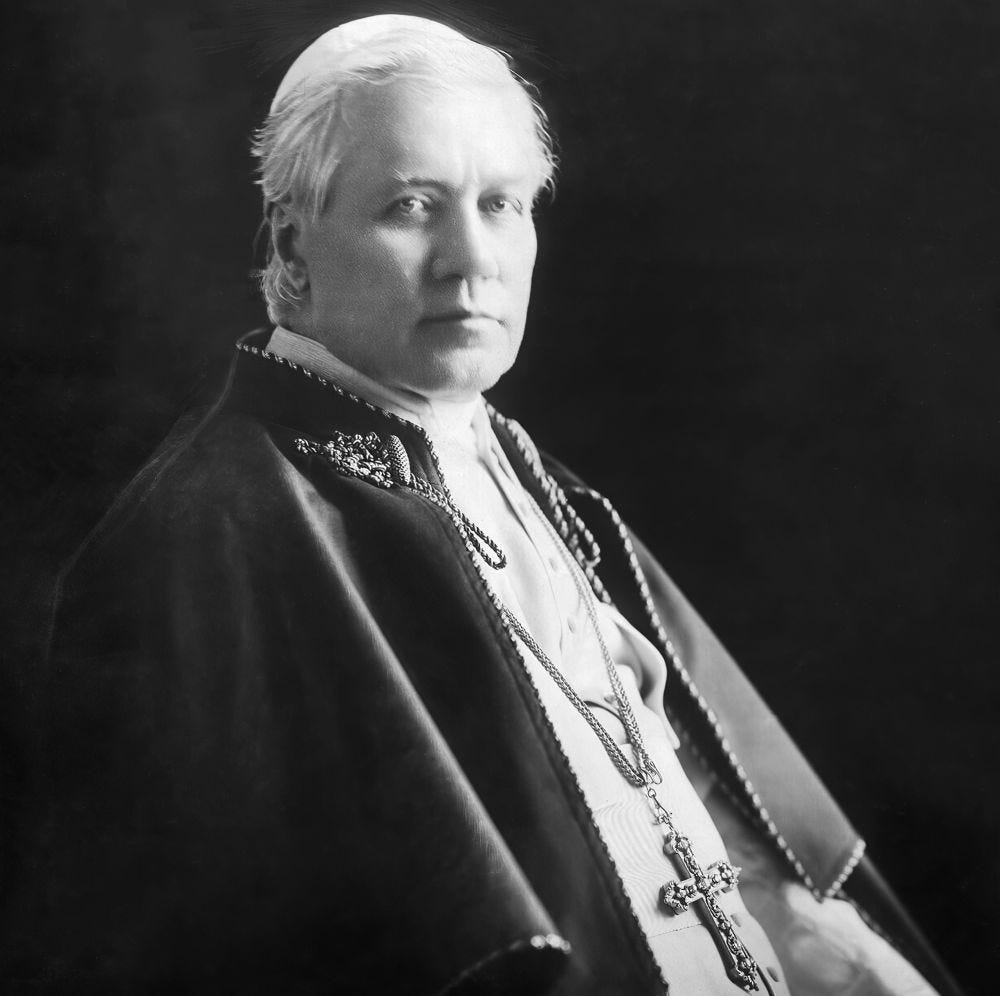
More than 120 years ago, on August 4, 1903, the pontificate of Pope Saint Pius X began. Two months later, on October 4, his first encyclical, E Supremi,1 was published in order to describe the pontifical program represented by the motto “Instaurare Omnia in Christo” (“To restore all things in Christ”), used as a subtitle for the text. Revolving around the first verse of the second Psalm of King David, the beginning of the document was dedicated to the situation of the Church in the modern world:
The nations have raged and the peoples imagined vain things” (Psalm 2: 1) against their Creator, so frequent is the cry of the enemies of God: “Depart from us” (Job 21: 14). And as might be expected we find extinguished among the majority of men all respect for the Eternal God, and no regard paid in the manifestations of public and private life to the Supreme Will—nay, every effort and every artifice is used to destroy utterly the memory and the knowledge of God.
What can be read in the next paragraph is quite rare—if not truly unique—for a pontifical text. Pope Pius X himself wonders if perhaps the Antichrist, the great final enemy of Jesus Christ, was not already present in history during his time:
When all this is considered there is good reason to fear lest this great perversity may be as it were a foretaste, and perhaps the beginning of those evils which are reserved for the last days; and that there may be already in the world the “Son of Perdition” of whom the Apostle speaks (II Thessalonians 2: 3 - my emphasis: Robert Lazu Kmita). Such, in truth, is the audacity and the wrath employed everywhere in persecuting religion, in combating the dogmas of the faith, in brazen effort to uproot and destroy all relations between man and the Divinity! While, on the other hand, and this according to the same apostle is the distinguishing mark of Antichrist, man has with infinite temerity put himself in the place of God, raising himself above all that is called God; in such wise that although he cannot utterly extinguish in himself all knowledge of God, he has contemned God's majesty and, as it were, made of the universe a temple wherein he himself is to be adored. “He sitteth in the temple of God, showing himself as if he were God” (II Thessalonians 2, 2).
Echoing the teachings of the Apostle Paul, the Holy Father reminds us of what we have noticed in the writings of Saint Hildegard: the main activity of the “Son of Perdition” is the spreading of that perverse doctrine (doctrinam perversam) which opposes the Christian Gospel with a multitude of heresies that contradict both dogmatic teachings and, especially, traditional moral teachings (particularly those related to sexuality). But what caught my attention is the interpretation of one of the prophecies of the Savior Christ mentioned in chapter 24 of the Gospel according to Matthew (verses 15 to 20):
When therefore you shall see the abomination of desolation, which was spoken of by Daniel the prophet, standing in the holy place: he that readeth let him understand. Then they that are in Judea, let them flee to the mountains: And he that is on the housetop, let him not come down to take any thing out of his house: And he that is in the field, let him not go back to take his coat. And woe to them that are with child, and that give suck in those days. But pray that your flight be not in the winter, or on the sabbath.
I will emphasize, first of all, the enigma placed at the core of the prophecy: instead of telling us what the “abomination of desolation” mentioned in the book of the prophet Daniel2 is, our Lord points to it and then indicates how to act. But when should Christians act if they do not know precisely what the “abomination of desolation” is? Finding the answer has troubled both the rabbis who interpreted the Old Testament and the Holy Fathers and Doctors of the Church. A multitude of explanations revolve around sacrilegious actions committed against the Temple in Jerusalem.
What is the “abomination of desolation”?
Comments
Nothing yet. Say the first thing.
Sign in to join the conversation.