
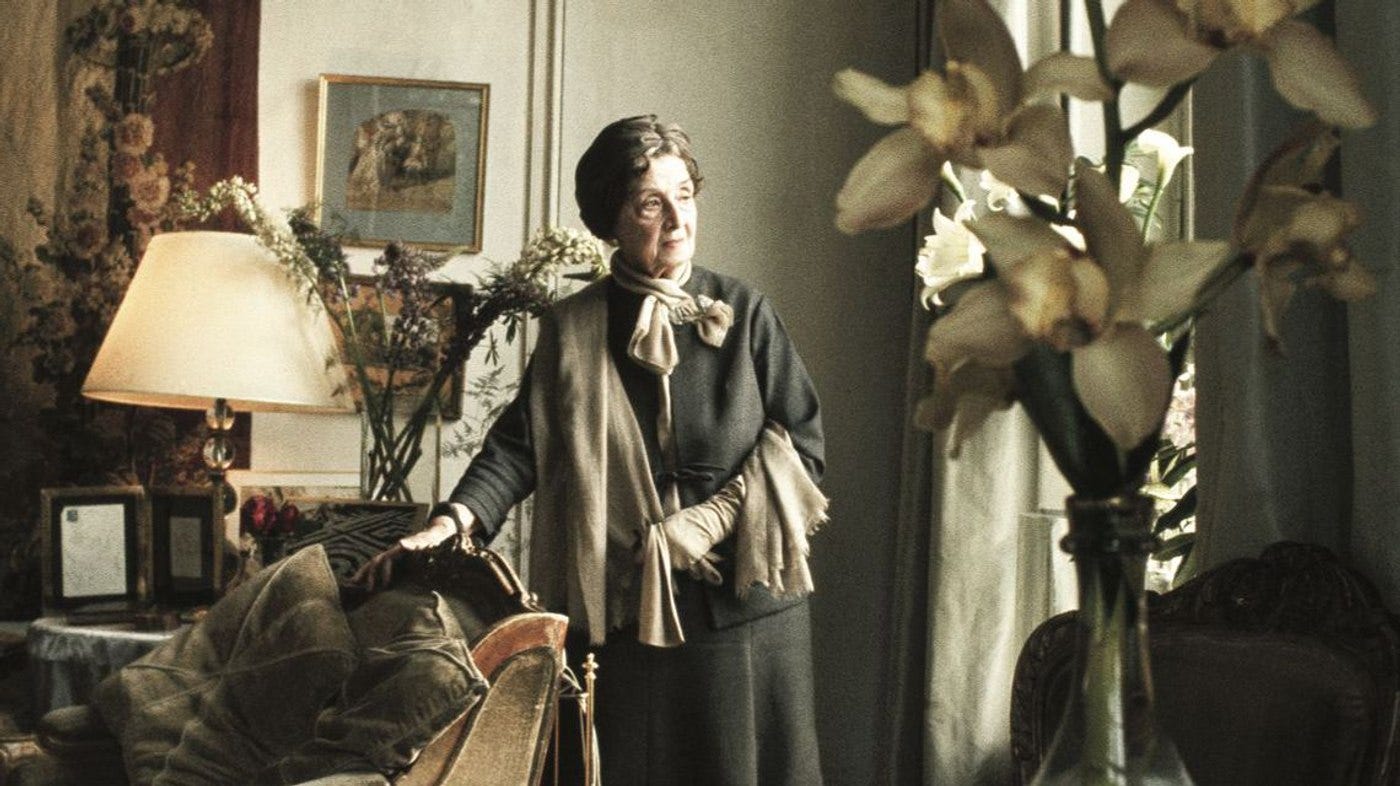
Without any doubt, Marie Arthur Lucien Théodore François Xavier Mugnier (1853–1944), better known in the Parisian artistic circles of the early 20th century as the abbot Mugnier (l’abbé Mugnier), had the extraordinary privilege of witnessing many conversions to the Catholic faith. The list is impressive: the countesses Anne Mathieu de Noailles (1873–1933) and Laure de Chevigné (1859–1936), the troubled writer, director, playwright, and painter Jean Cocteau (1889–1963), and, above all, the decadent novelist—unreservedly admired by Oscar Wilde—Joris-Karl Huysmans (1848–1907). To this substantial list belongs an admirably French writer of Greek-Romanian descent, Princess Marthe Bibesco (1886–1973).
Daughter of the Romanian aristocrat and diplomat John Lahovary (1844–1915), who was married to Princess Emma Mavrocordato (1860–1920) of Greek (Phanariot) descent, Marthe Lucie Lahovary (the future Princess Bibesco) received at home the finest classical education imaginable. She spoke fluently at least six languages—French, English, Romanian, German, Italian, and Greek. From all the pieces of this remarkable linguistic treasure, her favorite language was the one used by Shakespeare to create his masterpieces.
This personal preference explains not only the diary pages she wrote in English, but also the friendships with British figures such as Winston Churchill, Christopher Thomson, and Ramsay MacDonald. Her prestige was so great that in 1934 the President of the United States, Franklin D. Roosevelt, and his wife, Eleanor Roosevelt, invited her to visit them. General Charles de Gaulle, President of France and an admirer of her writings, also invited Princess Bibesco to a reception in 1963.
Although she was involved in many diplomatic missions, her constant passion was always literature. Awarded in 1908 by the French Academy with its highest prize, she later received two more French literary awards: Marcelin-Guérin (1909) and Gustave Le Métais-Larivière (1966). In 1962 she was made a Chevalier de la Légion d’honneur, and in 1955 Princess Bibesco was received as a full member of the Royal Academy of French Language and Literature of Belgium (Académie royale de langue et de littérature françaises de Belgique).
Her literary qualities attracted, from the very beginning, the attention of the French public. The novels she wrote, usually inspired by historical and romantic themes, are filled with discreet yet precise biographical references. This passion, which pushed her to record the details of an exceptional life, generated an enormous number of diaries: over 65 volumes containing daily, chronological notes.1 Both the originality and the charm of texts led important authors to describe her as a poet in disguise who wrote in prose. Some of her most original novels, such as the superb Isvor, le pays des saules (Isvor, the Land of Willows), published in Paris in 1923, seem to be autobiographical writings. Personally, I consider this particular work one of the most interesting literary masterpieces published in the twentieth century.
Mircea Eliade (1907–1986), the renowned historian of religions at the University of Chicago, delivered an unforgettable presentation of her work before the Royal Academy of French Language and Literature of Belgium, in which he emphasized the almost mythological value of Princess Bibesco’s writings. Eliade did not fail to mention her friendship with Father Mugnier, the Catholic priest who had the privilege of witnessing her conversion to the Catholic Church:
Happily we have access to three large annotated volumes of her correspondence with Abbé Mugnier, La vie d’une amitié,2 in which Princess Bibesco constantly refers to the structures and intent of her magnum opus. It is moreover in this admirable correspondence that one discovers Princess Bibesco’s true personality in all its complexity, and that one is able to grasp the exemplary value of her destiny. Since this descendant of Byzantium and of a Napoleonic general, this practicing Catholic raised in the tradition of the Eastern Church, this rich princess who lived half her life among the poor and the peasants, this linguist who wished to learn all the languages spoken by her ancestors and their adversaries, anticipates in a certain sense an exemplary model for the European of the future.3
Unfortunately, the conversion of Princess Marthe Bibesco to the Catholic Church is omitted in the vast majority of writings dedicated to her in France or Romania. However, her “official” biography, written by Ghislain de Diesbach, a Swiss aristocrat, succinctly describes the crucial moment of her reception into the Catholic Church.
Comments
Nothing yet. Say the first thing.
Sign in to join the conversation.