
Hey,
Open any profile in your Klaviyo account right now. Click into someone you acquired three months ago. What does it actually know about that person?
Email address. First name. Maybe a purchase from nine months ago. The custom properties tab? Empty. The preferences section? Empty. You have 75,000 of these profiles. Technically subscribers. Functionally strangers.
I see this in almost every account I audit. A massive list built through a 10%-off popup, with zero structured information about who any of these people actually are. Then the founder asks me why their segmentation isn’t moving revenue.
It can’t. Klaviyo’s segmentation engine is one of the most powerful in the industry. But it can only segment on data it actually has. If quiz_skin_type doesn’t exist on the profile, building a “Sensitive Skin Welcome Series” isn’t difficult — it’s literally impossible.
The fix is one piece of infrastructure: a product recommendation quiz, mapped natively to Klaviyo as custom properties. Today I’m going to walk you through exactly what to build, the 4-7 question sweet spot, the tool that fits your stack, and the conditional split that turns five quiz answers into five segments that didn’t exist yesterday.
Want to know what data your Klaviyo profiles are missing — and what quiz or preference flow would fill the gap? We’ll map it out for your specific business. No Klaviyo access required.
→ Get Your Free Email Strategy Report
Most Klaviyo lists were built to minimize friction. Generic popup. 10% off. Email goes in. That’s the entire data capture event. You designed it for conversion, not context.
The result: profiles with behavioral data (purchase history, opens, clicks) but zero preference data. And behavioral data is a lagging indicator. It tells you what someone bought eight months ago. It doesn’t tell you what they want now or what they’ll buy next.
Three concrete failure modes I see every week:
The non-purchasers (70-80% of most lists). No purchase history to infer from. Highest-opportunity segment, completely opaque.
The gift buyers. Someone bought Vitamin C Serum as a Christmas gift. She’s now in your “brightening” segment forever. Every send to her erodes engagement metrics.
The segment ceiling. Without preference data, you can run recency/frequency segments. That’s it. Anything more sophisticated requires properties that don’t exist on the profile.
Here’s the kicker: only 16% of marketers actively collect and use zero-party data, while 85% say it’s essential for personalization (Supermetrics 2025, via Envive). The gap between “I know this matters” and “I have a system collecting it” is enormous. Which means it’s a competitive opening.
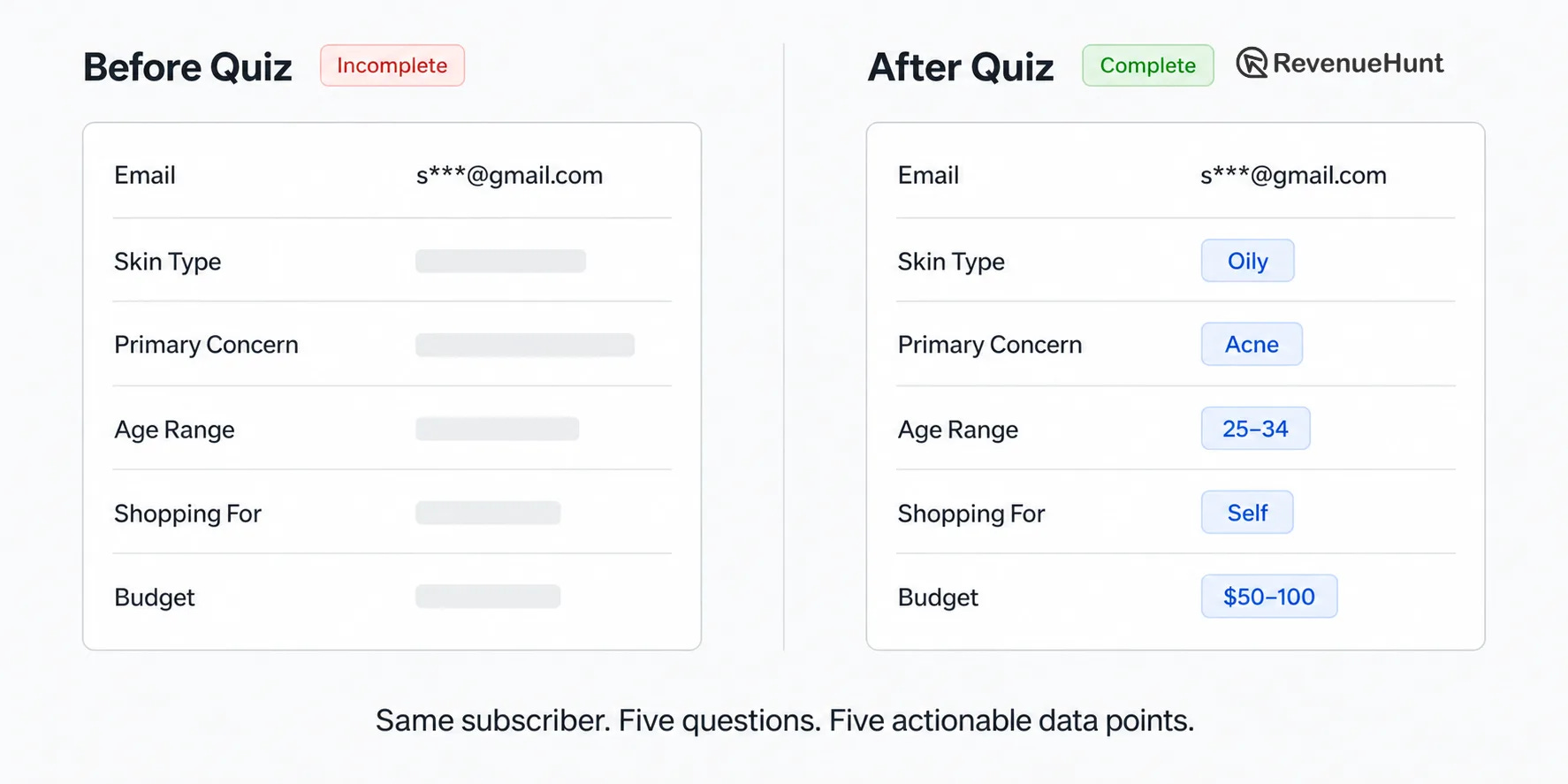
Zero-party data = information a customer intentionally and proactively shares. Not behavioral inference. Not purchase history. Direct answers to direct questions: preferences, goals, skin type, dietary requirements, gift vs. self, budget range.
A quiz is the only structured mechanism that captures this at scale. Here’s why I keep recommending it over forms, surveys, or “tell us about yourself” emails:
It’s a structured data instrument. Every answer maps to a Klaviyo custom property in real time.
It gives the customer immediate value back (a personalized recommendation), so they have a reason to answer honestly.
The engagement numbers aren’t comparable to passive forms. Interact benchmarks: 40.1% of quiz starters become leads. ASICS hit 90% completion. e.l.f. Cosmetics hit 84%.
The mapping is the part most brands underthink. Each question → one property → one segment:
What’s your skin type? → Klaviyo property:
quiz_skin_type→ Sample value: oilyWhat’s your primary concern? → Klaviyo property:
quiz_primary_concern→ Sample value: acneShopping for yourself or a gift? → Klaviyo property:
quiz_shopping_for→ Sample value: giftWhat’s your budget? → Klaviyo property:
quiz_budget→ Sample value: $50-100Experience level with this category? → Klaviyo property:
quiz_experience_level→ Sample value: beginner
Five questions. Five properties. Five segments that didn’t exist yesterday — and a welcome flow that can branch on any of them.
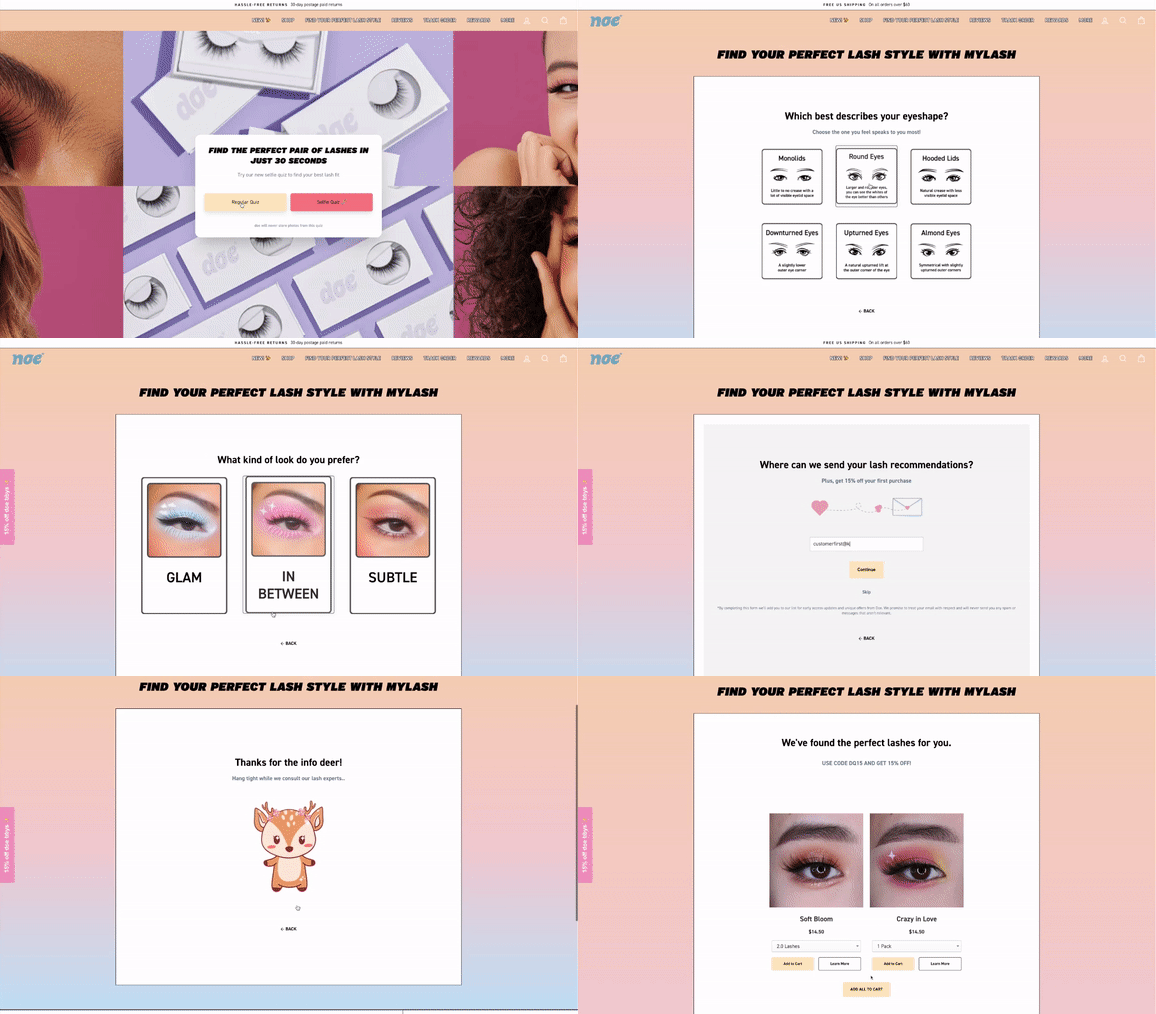
Doe Lashes built an Octane AI lash quiz asking about eye shape, lash experience, and style preference. Synced as Klaviyo properties → personalized welcome series by eye shape. Results: 3x more email opt-ins than their old popup, 44% of all new subscribers now come from the quiz, 24% of total revenue runs through it, 20% conversion rate on the welcome series. The bigger discovery: 35% of quiz takers had never worn lashes before — invisible in purchase data, immediately actionable in flows. They built a “lash education” sequence the next week.
Hunter & Gather, a UK keto/paleo food brand, ran an Octane AI quiz capturing dietary goal (keto, paleo, gut health, energy). Rebuilt the welcome series with conditional splits on quiz_primary_goal. Results: +258% Klaviyo flow revenue, +82% campaign revenue YoY, 51% of owned revenue now comes from automated flows. Marketing strategist Carmen Alldred at Blend Commerce put it plainly: the quiz was the unlock, not the email program itself.
IGK Hair launched two Digioh quizzes (shampoo finder + color shade finder). The color quiz asks about current tone, treatment history, and hair type. Results: +30% color sales, +19% AOV, conversion rate from 3.5% to 8.3% (a 137% lift), $150K in new attributed revenue.
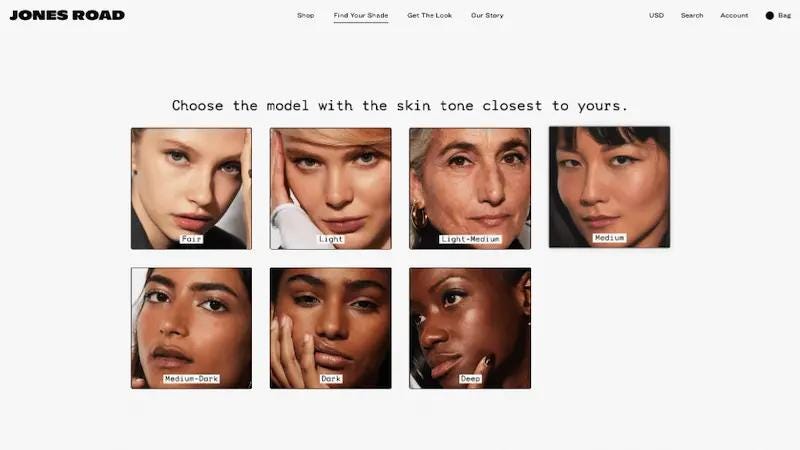
Jones Road Beauty is the most aggressive example I’ve seen. Cody Plofker, Director of Ecommerce, made the shade-finder quiz the landing page for TikTok ads. Not the homepage. Not the PDP. The quiz. Result: 800,000+ email leads — 80% of their entire list. 124,000 emails from a single TikTok campaign. AOV up more than 50%. Seven figures in additional profit. This is the reframe most brands miss: the quiz isn’t a homepage widget. It can be the destination.
And one composite scenario I want to share because it’s the pattern I see most often in audits. Skincare brand, 60,000 profiles, all from a generic popup. Campaign RPR sitting at $0.06. They launched a “Find Your Perfect Routine” quiz. Over 90 days, 8,000 profiles got enriched with five custom properties each. Welcome series rebuilt with conditional splits on quiz_primary_concern. Campaigns started using dynamic content blocks based on quiz_skin_type.
The enriched segment — 13% of the list — started generating 40%+ of email revenue. RPR on enriched profiles: $0.22. A 267% lift on the same account, same products, different data.
The hidden insight: 38% of subscribers had picked “gut health” as their primary goal — a category the brand barely emailed about. The new “Gut Health Journey” flow became the highest-performing flow in the account within 60 days. That signal was completely invisible in purchase data.
Step 1: Pick your quiz platform.
Here’s the honest landscape. The four tools I’d actually recommend, and what each is best for:
Octane AI — Klaviyo integration: Native, real-time property sync. Best for: Beauty/apparel/CPG on Shopify wanting a full acquisition quiz funnel. Starting price: ~$50/mo
Typeform — Klaviyo integration: Native (launched Q1 2025); flexible formats. Best for: Brands wanting survey + quiz formats, embeds in email/SMS. Starting price: Free; paid from ~$29/mo
Digioh — Klaviyo integration: Native + 550+ brand track record; deep branching logic. Best for: Beauty/wellness/pet brands with complex catalogs needing guided selling. Starting price: Custom/enterprise
RevenueHunt — Klaviyo integration: One-click OAuth; built for Klaviyo property mapping. Best for: DTC skincare/supplement brands wanting setup under 30 minutes. Starting price: Freemium; paid from ~$39/mo
If you’re on Shopify selling beauty/apparel/CPG and want one tool to run the whole acquisition funnel: Octane AI. If you have a complex catalog and need branching logic: Digioh. If you want fast setup and your team isn’t technical: RevenueHunt. If you already use Typeform for surveys and want quiz format flexibility: Typeform.
The single question that separates a usable integration from a useless one: “Do you sync individual answer values as custom properties, or just a tag like ‘quiz_completed: true’?” If the answer is “just tags,” the integration is useless for conditional splits. You need property values.
Step 2: Build the quiz — 4 to 7 questions, no more.
Under 4 questions = not enough data for meaningful segments. Over 7 = completion rates drop sharply.
Ask:
Primary goal or problem
Key constraint (sensitivity, dietary, material)
Usage context (daily/occasional, self/gift)
Budget range (if relevant — unlocks price-tier segments)
Experience level (beginner vs. experienced — huge for education flow routing)
Do NOT ask:
Age as a number (use ranges)
Anything with more than 6-7 answer options
Questions whose answers won’t change the recommendation
Consecutive text-entry questions (completion killer)
Use image-based answers wherever possible. Tap, don’t type. And gate the email opt-in behind a teaser result: “Based on your answers, your skin sounds like it could benefit from…” then “See your full personalized routine →”.
Step 3: Map answers to Klaviyo custom properties.
In Octane AI: Settings → Integrations → Klaviyo → enter API key → choose properties to sync (sync all of them).
Naming convention matters. Be consistent: quiz_skin_type, not SkinType or skin-type. Conditional splits will fail silently on inconsistent casing.
Once the first quiz completion syncs, the property shows up on the profile under Profile → Properties → Custom Properties. From there it’s available everywhere: segments, flow filters, conditional splits, dynamic content blocks.
Step 4: Build the conditional split in your welcome flow.
In the Klaviyo flow builder:
Open your welcome flow.
After the first email (the welcome confirmation), add a Conditional Split component.
Set the condition: Properties about someone →
quiz_primary_concernequalsacne.YES path → acne-focused emails with targeted recommendations.
NO path → add additional splits for
anti-aging,brightening,hydration.Inside each email, use dynamic content blocks to swap product imagery based on
quiz_skin_type.
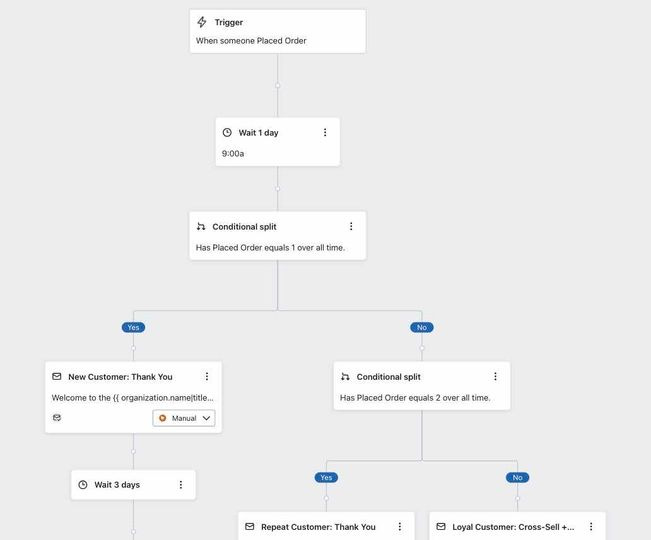
One technical gotcha that breaks more flows than I can count: if the welcome flow triggers before the quiz data has finished syncing to the profile, the conditional split evaluates against empty properties — and every profile defaults to the NO path. Fix: add a 5-15 minute time delay before the first conditional split. That window lets the Klaviyo profile catch up.
Step 5: Build campaign segments from the new properties.
This is where most brands stop too early. They build the flow, they don’t rebuild the campaigns.
A few segments worth setting up the day quiz data starts flowing in:
quiz_skin_type = oilyANDquiz_primary_concern = acne→ Acne-Prone Oily Skinquiz_shopping_for = gift→ Gift Buyers (completely different messaging needed — don’t push routines)quiz_experience_level = beginner→ New to Category (lead with education, not the premium SKU)quiz_budget = $100+→ Premium Budget (show bundles, hero products)
The data captures fine. The execution falls apart. The seven I see most:
Collecting quiz data and never using it. The quiz runs for six months, properties fill on thousands of profiles, the welcome series remains unchanged. Build the conditional splits before you launch the quiz.
Asking too many questions. Every question past the 7th trades completion rate for data you probably won’t use. If you can’t name the property and the segment it powers, don’t ask it.
No teaser reward before the opt-in gate. If the quiz feels like an extraction exercise, opt-in rates collapse. Show the preview. Earn the email.
Treating quiz completers like generic popup subscribers. Different segment. Different flow. Don’t waste the enrichment by routing them into the same welcome series as a 10%-off signup.
Tag-only integrations. I already mentioned this but it’s worth repeating: tags are binary, properties have values. Tags can’t power conditional splits.
One quiz, sitewide, forever. Progressive profiling matters. Quiz on the homepage. A short post-purchase quiz at day 14 to capture secondary goals. A win-back quiz at 90+ days: “Have your needs changed?”
Forgetting the 70-80% who never took the quiz. Run a campaign to legacy subscribers inviting them to take the quiz: “We want to know you better — 60 seconds, then we’ll build your personalized routine.” Retroactively enriches the old list.
If I could only fix one of these, it would be #1. The data sitting unused is the most expensive failure mode — you paid the engineering cost, the strategy cost, the customer’s attention cost, and you got zero behavior change in return.
Your Klaviyo account already has the segmentation engine. Most accounts I open don’t have the fuel. A 4-7 question quiz, mapped to custom properties, native sync, with the conditional split wired into your welcome flow — that’s the unlock.
Doe Lashes: 24% of revenue. Hunter & Gather: +258% flow revenue. Jones Road: 800,000 leads, 7 figures in profit. The pattern repeats because the mechanics work the same way every time. Ask the right questions. Sync them as properties. Branch the flow on them.
Go open one Klaviyo profile right now. If the custom properties tab is empty, you know what to build next.
Want us to look at your Klaviyo account and tell you exactly what preference data you’re missing? We’ll map out the quiz questions, the property structure, and the conditional split logic that fits your business — no Klaviyo access needed for the strategy report.
→ Request Your Free Email Strategy Report
Talk Monday.
— Sahil
No posts
Comments
Nothing yet. Say the first thing.
Sign in to join the conversation.