
Hey,
A $90,000 email marketing hire doesn't cost you $90,000.
Load in payroll tax and benefits, factor that they'll run at ~38% productivity for their first five months, and price in the roughly 1-in-4 chance they quit inside a year — and that hire actually costs somewhere between $150,000 and $190,000. Before they've sent a single email.
Most founders budget the base salary and stop there. Which is exactly how the "cheap" option quietly becomes the expensive one.
Here's the thing I've learned running an email agency: there's no universally right price for email marketing. There's a right price for your revenue stage. Pick the wrong model for your size and you overpay no matter what the invoice says — sometimes by six figures a year.
So this one isn't a pitch. It's the honest version of a conversation I have almost every week — including the part where I tell founders their stage doesn't call for an agency yet. By the end you'll know what each model actually costs in 2026, the revenue number where the math flips toward hiring in-house, and the hidden costs that never make it into the budget.
Not sure which side of that line you're on? We'll walk through your revenue stage, what you're spending now, and where the money's actually leaking — no pitch, just the math.
🔗 Book a free strategy session →
Before comparing them, let's put real 2026 numbers on the table.
In-house hire. A single dedicated Email/CRM/Lifecycle Marketing Manager runs $75K–$140K base in the US. ZipRecruiter's national average is $87,236/yr; Glassdoor puts the general average at $102,514. Then add ~30% for payroll tax and benefits, and one person's fully-loaded cost lands at $100K–$180K+/year.
Want an actual team — a marketing lead, an email specialist, a designer, a paid-media person? Fully loaded, that's $550K–$710K/year (Seal Global's model for a $2M–$10M Shopify brand), or ~$587K for a comparable 4.5-person build (Darkroom). Before ad spend. Before Klaviyo's own bill.
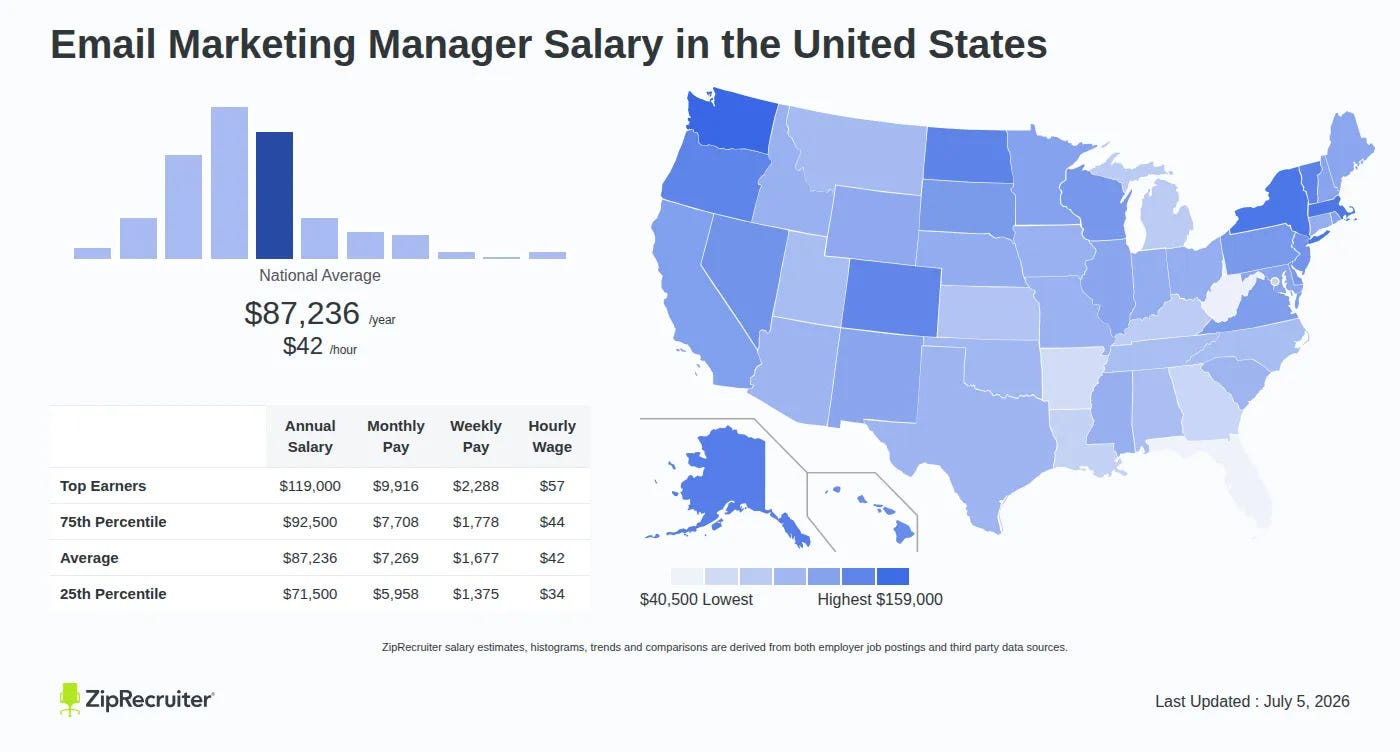
What the market actually pays an in-house Email Marketing Manager in 2026 — before benefits, tools, or turnover risk. (Source: ZipRecruiter)
Full-service / boutique agency. Email and SMS retention specialists run $3K–$10K/month (Darkroom's 2026 rate card). Klaviyo-specific agencies span $3K–$25K/month, with most mid-market DTC brands landing in the $6K–$12K range (MarketerHire's survey of 11 vetted agencies). Smaller retainers fit sub-$3M brands needing 4–6 core flows; enterprise retainers fit $20M+ brands running SMS plus complex segmentation.
Annualized, that's roughly $36K–$144K/year for most brands — and in Darkroom's side-by-side, an agency came in at $312K vs. $587K for an equivalent in-house team. About 47% cheaper for the same scope.
Freelancer / fractional expert. Marketplace rates run wide: Upwork $15–$40/hr, ZipRecruiter's freelance-Klaviyo average $47.71/hr, Fiverr $40–$150/hr. A more senior fractional expert — a semi-dedicated senior IC working 20–30 hrs/week, month-to-month — runs $4K–$10K/month. Best for brands under ~$3M, or as supplemental muscle at any size when your bottleneck is execution speed, not long-term strategy.
Here's the whole thing in one view. Screenshot this one.
Typical monthly cost — In-House: $8,300–$15,000 fully loaded (one specialist). Agency: $3,000–$12,000 (most brands); up to $25,000 enterprise. Freelancer/Fractional: $500–$5,000 part-time; $4,000–$10,000 fractional.
What you get — In-House: One person's full attention + deep brand knowledge — but a single point of failure across flows, campaigns, design, deliverability, strategy. Agency: A team: strategist, builder, designer, copywriter, deliverability — plus cross-brand pattern recognition. Freelancer/Fractional: Execution on a defined scope; strategy usually stays with you.
Best-fit stage — In-House: ~$15M–$30M+ ARR, or hybrid above $10M–$20M. Agency: Under $10M–$20M is the sweet spot. Freelancer/Fractional: Under $3M as primary, or supplemental at any size.
Ramp time — In-House: 60–90 days per hire; 3–6 months for a full team. Agency: 2–4 weeks. Freelancer/Fractional: 48 hours to 2 weeks.
Biggest risk — In-House: Turnover, coverage gaps (PTO during BFCM week), founder time spent managing. Agency: Underpriced retainers get staffed with juniors. Freelancer/Fractional: Inconsistent availability, no bench depth if they vanish.
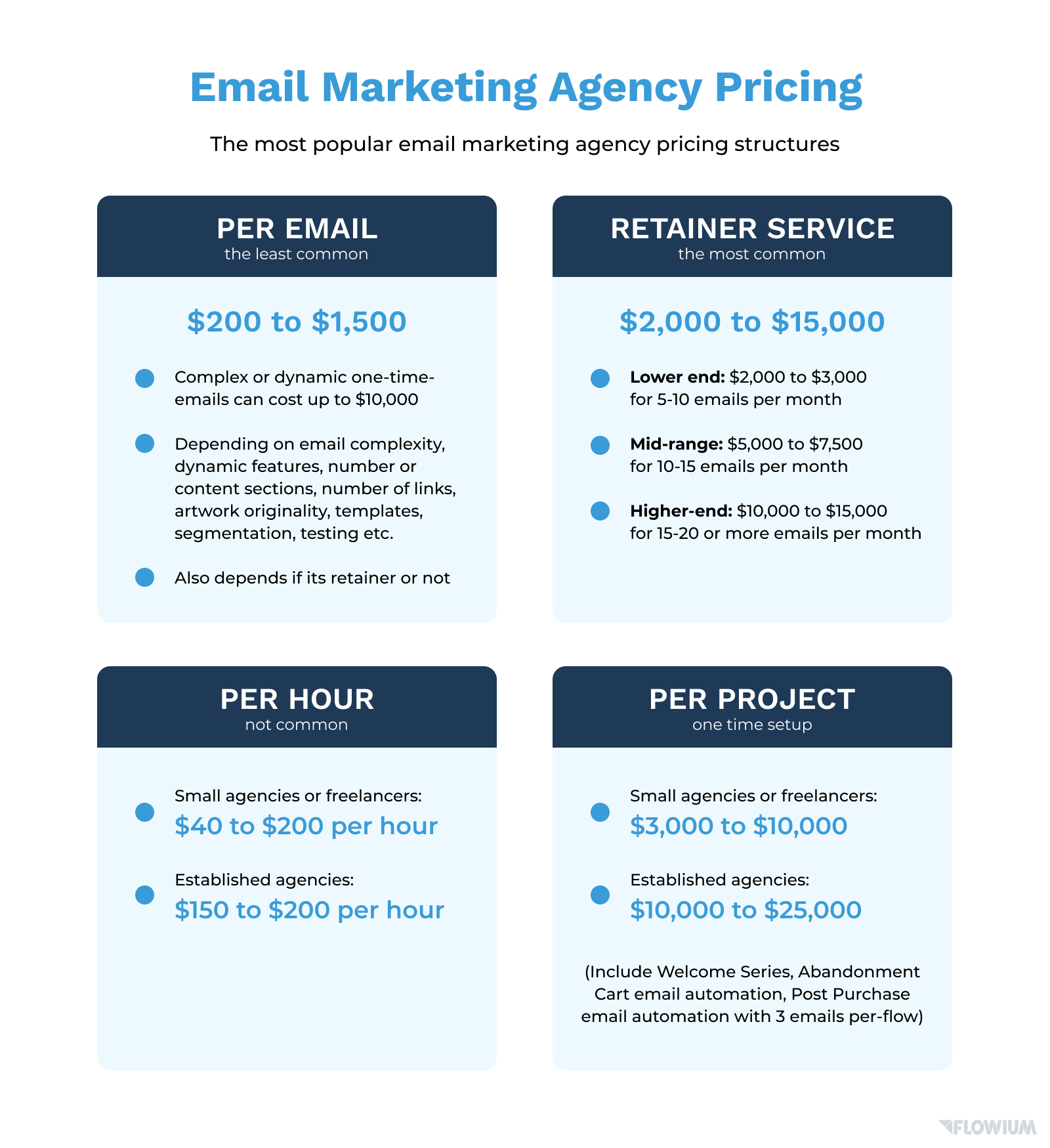
The four ways email agencies actually price their work — and why "retainer" dominates for a reason. (Source: Flowium)
One thing worth saying plainly here, since I'm on the agency side of this table: I'm based in India, and a lot of our cost advantage as an agency comes from top talent at a structure US-only shops can't match. I'm not going to pretend that's neutral. Read the numbers, not my logo.
Everyone wants a single revenue number. There isn't one — and anyone who gives you an exact figure is guessing with confidence.
But two independent 2026 cost models land close together. Seal Global puts the crossover around $20M ARR — below $10M, in-house "almost always underperforms" in their analysis, because the team's too small to cover every discipline, turnover kills momentum, and the founder ends up managing marketers instead of running the company. Darkroom's broader model puts it nearer $30M, with $10M–$30M as hybrid territory.
So the honest answer is a range: somewhere between $15M and $30M ARR. Under it, the agency math almost always wins. Over it, in-house starts to pencil out.
And here's the part nobody tells you: even past the crossover, most brands don't go fully in-house. They run hybrid — an internal strategist owns direction, an agency or fractional expert owns execution. MarketerHire's Klaviyo pricing tiers map to this almost exactly: "small retainer" for sub-$3M, "mid-market" for $3M–$20M, "enterprise" for $20M+. Even the $20M+ brands are still paying an agency. Just a bigger one.
This is where the "cheap" option gets expensive. Four line items that never make the spreadsheet:
Turnover. US voluntary turnover sits around 23.4% (BLS JOLTS); marketing-agency turnover specifically runs closer to ~30%; Seal Global models in-house marketing teams at ~25%. Pick any of those and you're budgeting roughly one full replacement cycle every 3–4 years per hire. Replacement itself costs 50%–200% of salary (SHRM) — the position sits vacant ~2 months, the new hire runs at ~38% for five, and lost productivity alone is 52% of the total. For a $75K hire, one detailed model puts the all-in replacement cost near $79,000.
Ramp time. New hires need 60–90 days to hit productivity (Harvard Business School research cited by Staffcost says 12+ weeks even with strong onboarding). Build a team over a year and that's real months you're paying for output you're not yet getting.
The Klaviyo bill. Every model carries this, and almost nobody models it honestly. Across 11+ real accounts, bills range from ~$150/month (sub-$1M, email only) to ~$3,500/month (larger brands on email + SMS + reviews), averaging ~$1,500. The trap: Klaviyo auto-upgrades your billing tier as your list grows but never auto-downgrades. Brands overpay for months after a Black Friday spike because nobody manually walks it back down. One documented cleanup — suppressing ~20K–30K dead profiles — saved a client $450/month. That's $5,400 a year, from one afternoon of list hygiene.
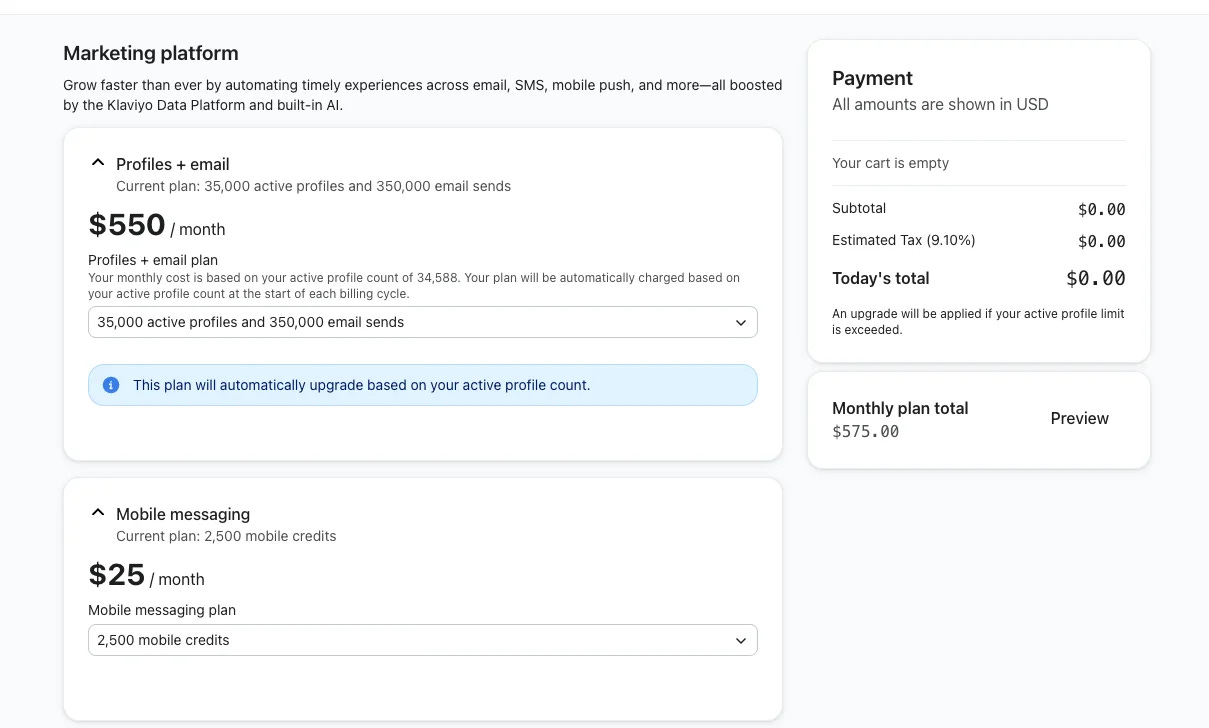
Whichever model you choose, the Klaviyo bill is a real, controllable cost — this account pays $575/month all-in for 35K profiles. (Source: BS&Co)
Founder time. Someone senior — usually you — spends an estimated 8–12 hours/week managing an in-house team. That's the most expensive time in the company, because it's time not spent on product or growth. Even conservative estimates peg founder opportunity cost at $100–$150/hr; at 10 hrs/week, that's $52K–$78K/year of your attention absorbed by work a $3K/month freelancer could handle. Treat that as directional, not gospel — but don't treat it as zero, which is what the budget usually does.
The counterintuitive stuff — the myths and mistakes I watch brands walk into:
The cheapest agency is usually the most expensive. Flowium flags $300–$900/month email agencies as too-good-to-be-true, and they're right. That tier can't afford senior strategists, so you get template execution with no segmentation — then pay again to fix it. If an agency's fee is under 10–15% of the revenue it influences, that's a corner-cutting signal, not a deal.
In-house feels free because the cost hides in payroll, not an invoice. A $90K salary reads as "we're not paying an agency." The fully-loaded, ramp-adjusted, turnover-adjusted number is $150K–$190K — and because it never appears on a single line item, it never gets scrutinized the way a monthly retainer does. This is the whole newsletter in one sentence, honestly.
"Full-service" agencies quietly shortchange email. A generalist running paid + SEO + email treats email as 10–20% of scope. But for a well-run Klaviyo brand, email should drive 25–40% of total revenue (MarketerHire). That's the case for a specialist over a generalist, whatever the price point.
The Klaviyo bill is controllable no matter who runs your account. In-house, agency, or freelancer — if nobody's managing list hygiene and billing tiers, you're overpaying Klaviyo itself by hundreds a month. Independent of strategy.
The ROI number should anchor the whole decision. Email returns roughly $36–$42 for every $1 spent — one of the only channels where the math is this favorable before optimization. When you're agonizing over a $6K retainer, that's the number to hold it against. The question isn't "can we afford this." It's "can we afford to run this badly."
And the biggest mistake underneath all five: hiring in-house too early. Below ~$3M–$5M, one person can't credibly own flows, campaigns, design, deliverability, and strategy. You've built a single point of failure — and when they leave (1-in-4 odds), the program stalls for months while a replacement ramps.
The brands that overpay for email aren't the ones spending the most. They're the ones who picked the wrong model for their size, then got blindsided by the costs that never hit the invoice. Under ~$15M–$20M, the agency or fractional math almost always wins. Past ~$30M, in-house starts to earn its keep — usually alongside an agency anyway. Wherever you sit, run the fully-loaded number, not the sticker price.
Whichever model you land on — in-house, agency, or freelancer — the fastest way to know if you're overpaying (or under-resourced) is a second opinion. Grab 30 minutes with us. We'll tell you honestly where you stand, even if the answer is "you don't need an agency yet."
🔗 Book your free strategy session →
Run your own numbers this week. The loaded ones, not the sticker ones.
— Sahil
No posts
Comments
Nothing yet. Say the first thing.
Sign in to join the conversation.