
I had a dream one day. It was like a scene from Narnia with the lamppost in the snow. I was walking with Christ, and I saw a building in the distance. This was not the magical wardrobe, but a more prestigious building. As we drew closer, I was amazed to find that it had no walls. It had a roof and a solid floor, but you could enter inside at any point around it. Jesus explained, “The Church has no walls.” It was one of those dreams that stays with you and needs further reflection. What did he mean that the Church has no walls? How can it stand up and have a covering? It was symbolic, of course, but the reality of the Risen Lord held it below and above. The NT states that Christ breaks down walls (Eph 2:14) where “he is the peace between us.” All of this is signified so powerfully in the splitting of the curtain over the Holy of Holies freeing grace to flow to every corner of the world, all through time (cf. Mark 15:37-39). There are no more walls.
The New Testament states that there is neither male, nor female, Jew or Gentile, slave or free in Christ (Gal 3:28). It is an open ticket. There are no hierarchies of belonging; first class, second class and so on. Anyone with faith in Christ belongs and is already inside. Compare this to the old joke about St Peter showing new arrivals around heaven and someone asks who lives behind the wall. It was where the Catholics lived because they thought that they were the only ones there! (Replace “Catholic” with Evangelical, Orthodox or anyone else.) As we all share a common baptism, we are sisters and brothers, whatever brand of Church or set of doctrinal beliefs we might hold. There are still differences, though, and honest charity needs to recognise these and not try to paper over cracks, or blend and pretend. My own position is that of a long pilgrimage which began in an evangelical conversion in the Sixth Form many years ago, experienced charismatic renewal in the 70s in a hotchpotch ecumenical group of students moving around each other’s churches. Catholics were included, and I recall three gentle, welcoming charismatic Carmelite Sisters in particular. I lived in a House Church community for a couple of years while at University, met my wife in a Baptist Church, and then went forward for Anglican ordination. After about 20 years of ministry, I became a Catholic and am now a priest. That is quite a long list! I have been around the proverbial block, but I am so grateful for what I have learned along the way. I reject nothing that is genuinely Christlike and spiritual in any of these traditions. It has left me open and thoroughly ecumenical. I have come to appreciate what is now referred to as receptive ecumenism where we do not just enter dialogue but are open to receiving from one another. It is not only a question of trying to clear up any misunderstandings (though this is important) but realising that the other group has something to share with us to our benefit. This can take place even when there are still differences and even strong disagreements, so long as all parties are Trinitarian, affirm the divinity of Christ and share the Creeds. An encouraging example in the USA is new monasticism. This is a lay movement of various traditions, single as well as married, forming communities. Some live communally, some close by. There is common worship, but members are also free to attend their own traditions on Sundays. They have published Common Prayer: A Liturgy for Ordinary Radicals, which is a prayerful and accessible series of daily devotions drawing upon various traditions. One of its authors is Shane Claibone, an Evangelical involved in the peace movement, who spent a year with Mother Teresa and the Sisters of Charity in Calcutta. Catholics also find a place, and one who had been a worship leader at Willow Creek found his own way back to the Church of his childhood. There was no great fanfare of conversion, just mutual acceptance and affirmation.
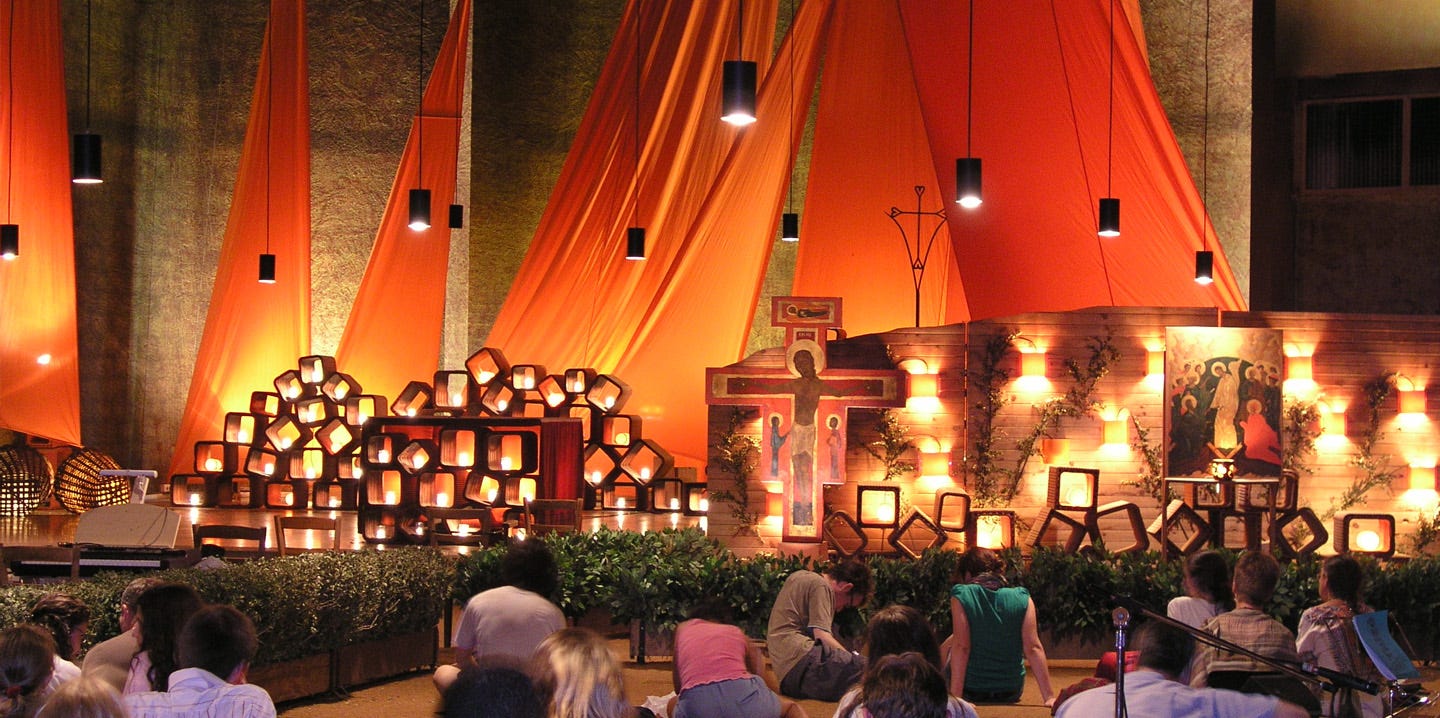
I had an enriching experience of such reception when I spent several weeks at Taizé as part of my Anglican formation. Taizé is an ecumenical community founded by two Swiss Reformed Pastors after WWII to work for reconciliation. It sits on a hill in the Burgundian countryside and draws crowds of young pilgrims each summer. All traditions are welcome, and small group Bible discussions are peppered about the place during the day, with three times of communal prayer. There is silence, flickering candlelight, the gentle, rolling chants in many languages such as “Laudate”, “O Lord, hear my prayer” and “O Christe, Domine Jesu.”’ Scriptures of the day are read and lead into silent contemplation. The experience is international and inspiring. This is receptive ecumenism, not just in sharing ideas, doctrines and Scriptures, but person-to-person encounter, whatever the race, language or faith tradition. There is a calm buzz about the place, a presence of grace. God is there.
I am reminded, too, of a trip to the Russian Orthodox Cathedral in London for Anglican ordinands. Two Evangelical students stood by the door afterwards in surprised awe. I overheard them say, “I don’t get it. I just don’t get it, but God is here!” He shouldn’t have been, of course, what with all the images, holy smoke and fancy robes.
I encourage people to go deeper, though. I have coined the term “raw ecumenism.” The person to person, seeing the face so that the other is no longer Other, opens our spirit to the presence of Christ and the Holy Spirit in a fresher, more searching manner, one that is truly humbling. I can give a few examples, one that was related to me, one recorded by an Orthodox priest who imprisoned for his faith and one that I was involved in. The first concerned the early days of the charismatic renewal. A Protestant pastor had a word of knowledge that a Catholic priest would be there that night. Sure enough, he came into the gathering. Not only that, but he walked right up to the pastor near the front of the hall and said, “Please forgive what my people did to your people.” With tears in their eyes, they embraced. Blood had been shed, there were martyrs on both sides with brutal killings, Catholic to Protestant, and vice versa. The point, here, is that in the past, Catholics were forbidden from praying with Protestants. You can’t worship alongside heretics! The Catholic Church underwent sweeping changes in the 1960s during the Second Vatican Council. Non-Catholics were now ‘separated brethren’ by virtue of sharing one, common baptism. Thus, the priest’s actions were new and daring for him. The Reformed pastor had to face a breaking down of walls, too. You don’t pray with Catholics because they are heretics and have distorted the gospel. Guess what, we are all Christians!
Fr Nicholae Steinhardt was imprisoned in Ceausescu’s Romania. In his book, The Journal of Joy, he describes a remarkable and moving gathering for prayer in a cell. Orthodox, Lutherans, Catholics and some sects stood together. “Thin silhouettes dressed in prison stripes, the shorn heads, the pale faces, and the words and songs murmured (so the guards don’t hear) forge an atmosphere that in its intensity and enthusiasm-provoking energy rivals the most sumptuous ceremonies in the most sumptuous cathedrals in the world … The words of the Lord – where two or three are gathered in My name, there I will be – apply. No, nothing can reproduce, explain, or communicate the incomparable beauty of these services of ecumenical brotherhood.” My own experience followed on from the beatification of martyrs of the Reformation by Pope John Paul II. The thanksgiving service in Oxford was ecumenical and various church leaders came. It was very formal and lacked spirit. A small group of us arranged a more personal reconciliation service at our theological college to honour both sets of martyrs. We invited a Jesuit who was involved in the Anglican / Roman Catholic dialogues of the time (ARCIC - the Anglican Roman Catholic International Commission). He had been to many ecumenical events, but this one brought a tear to his eye as he read about the martyrdom of Cranmer. We offered our personal prayers of repentance for any prejudices that we held, and lit candles as symbolic of our intercessions and hopes. A young mother played the piano as we sang “Jesus stand among us at the meeting of our lives.” She had been brought up Catholic but had a conversion at university and was a charismatic Evangelical. She wept floods of tears. The presence of the Spirit was palpable. That was raw ecumenism. Thinking about ideas, debating theology, comes later. It is then based upon Christ in each other and between one another. We can look someone in the eye and say, “You are my sister, you are my brother.”
How and why I ended up in the Catholic Church is another story, but I have never thrown away many things I have learned along the way. It was about belonging and finding that I could believe and worship without having to argue and debate. I was in my tribe. There are still disagreements, of course, and I must be honest that attitudes to the Eucharist were part of this. I came to a more sacramental form of worship as I have “a symbolic heart” as one preacher once said to me. I came to sense a sacredness of the bread and the wine after their consecration that I hold very dear. Despite those feelings, I do not disparage or belittle others. They are my sisters, they are my brothers.
Fr Kevin O’Donnell is an author, a priest of the diocese of Arundel and Brighton, and an auxiliary chaplain at the basilica of Notre Dame de Pontmain in France.
You can get this and other beautifully designed issues in print from Amazon, or you can find downloadable versions of our past issues on the KLC website.
No posts
Comments
Nothing yet. Say the first thing.
Sign in to join the conversation.