
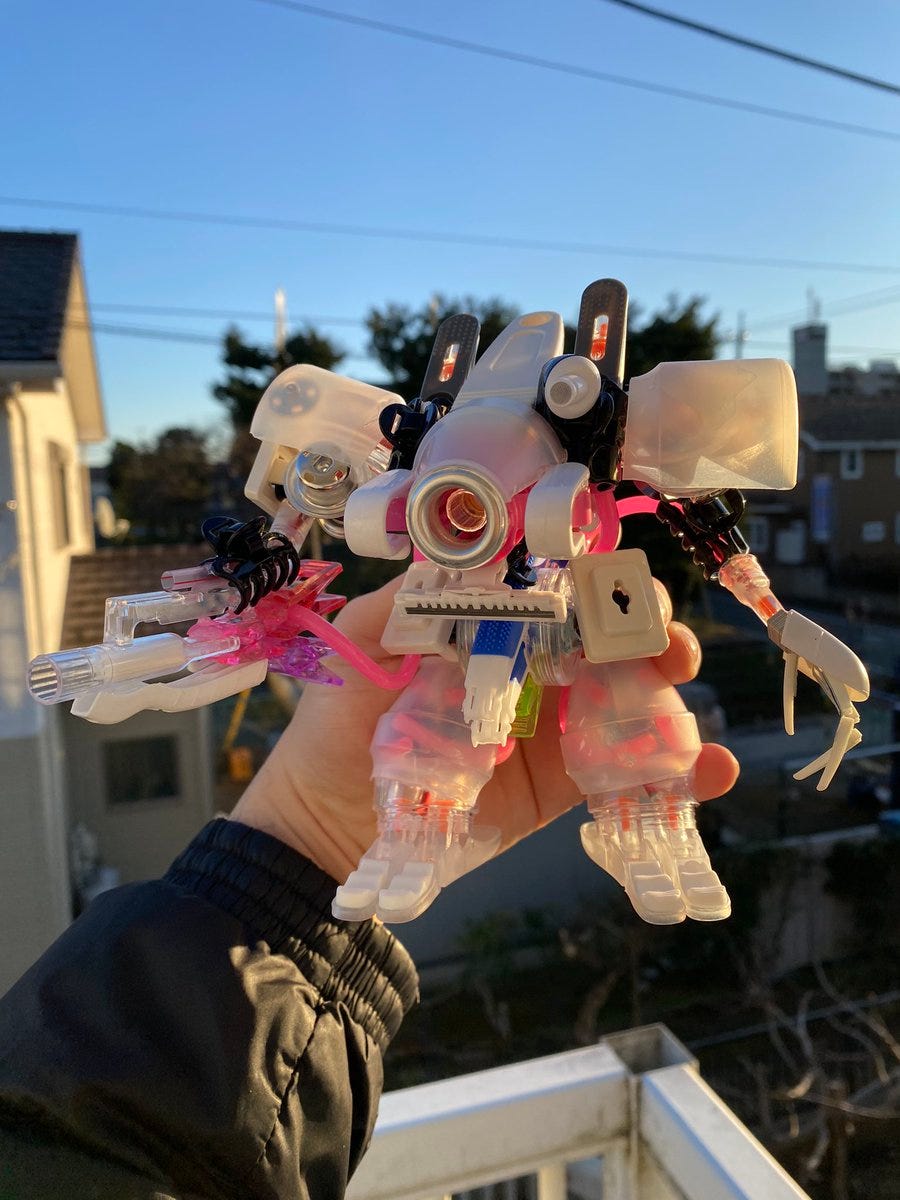
Hello, and welcome. This is the first of many posts — let me introduce myself, and the strange, junk-built world I first dreamed up back in 2011.
Nice to meet you. My name is Teppei Hayashi, and I build plastic model kits for a living — mostly Gundam models, or Gunpla, as they’re known in Japan.
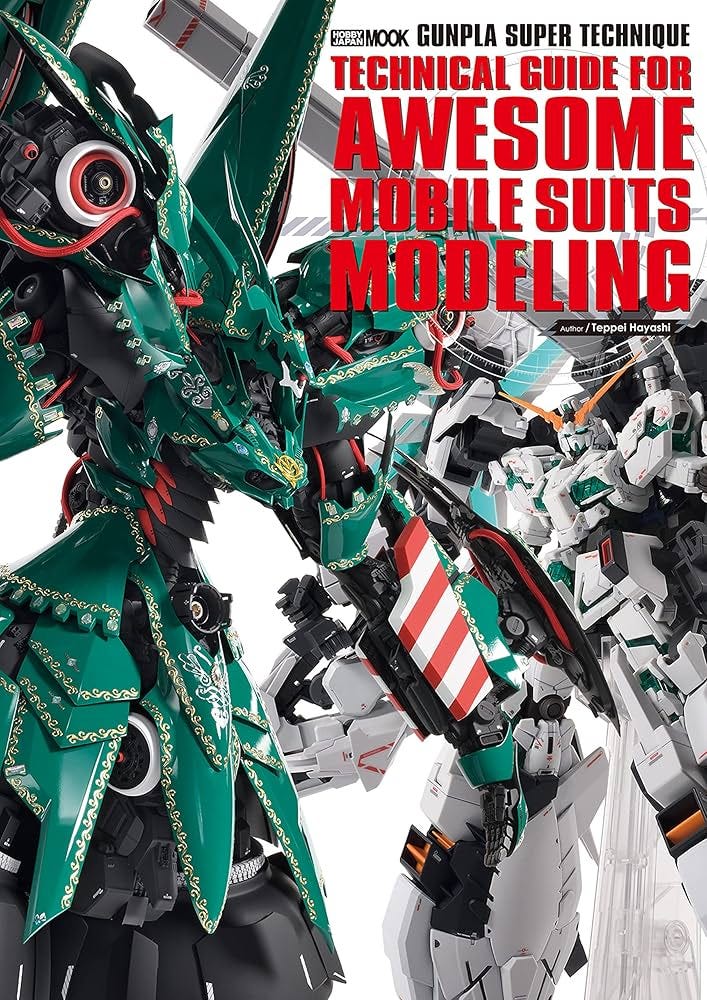
A quick word on words: in Japan, plastic assembly kits are called puramodel (プラモデル) — a homegrown contraction of “plastic model” — and someone who builds them professionally is a pro modeler (プロモデラー). (Elsewhere you’d usually just say “model kits.”) “Pro modeler” is about as common a job title as “professional dragon-slayer,” I know, so for now just think of me as a guy who’s gotten pretty good at building Gundam kits. I’ve been doing this for a living for over twenty years. I write for Hobby Japan, the country’s leading hobby magazine, and I’m the author of six how-to books for Hobby Japan, published in Japanese and translated into English, Traditional Chinese, and Korean. One of them, Gunpla Super Technique: Technical Guide for Awesome Mobile Suits Modeling, you can read in English.
Gundam is my main beat, but I build military subjects and other scale models too — and across every genre, this craft has produced genuine masters: people like Sheperd Paine, François Verlinden, Tony Greenland, and Mig Jiménez. Their work taught whole generations of us what’s possible with a knife, some glue, and a great deal of patience, and I have nothing but the deepest respect for them. Japan’s own hobby and model-kit culture is, in my honest (and admittedly biased) opinion, one of the most wonderful things in the world, and I feel lucky every single day to be a small part of it.
But this newsletter isn’t really about that work. It’s about something else — something that’s entirely mine.
It’s called Kerberdyne.
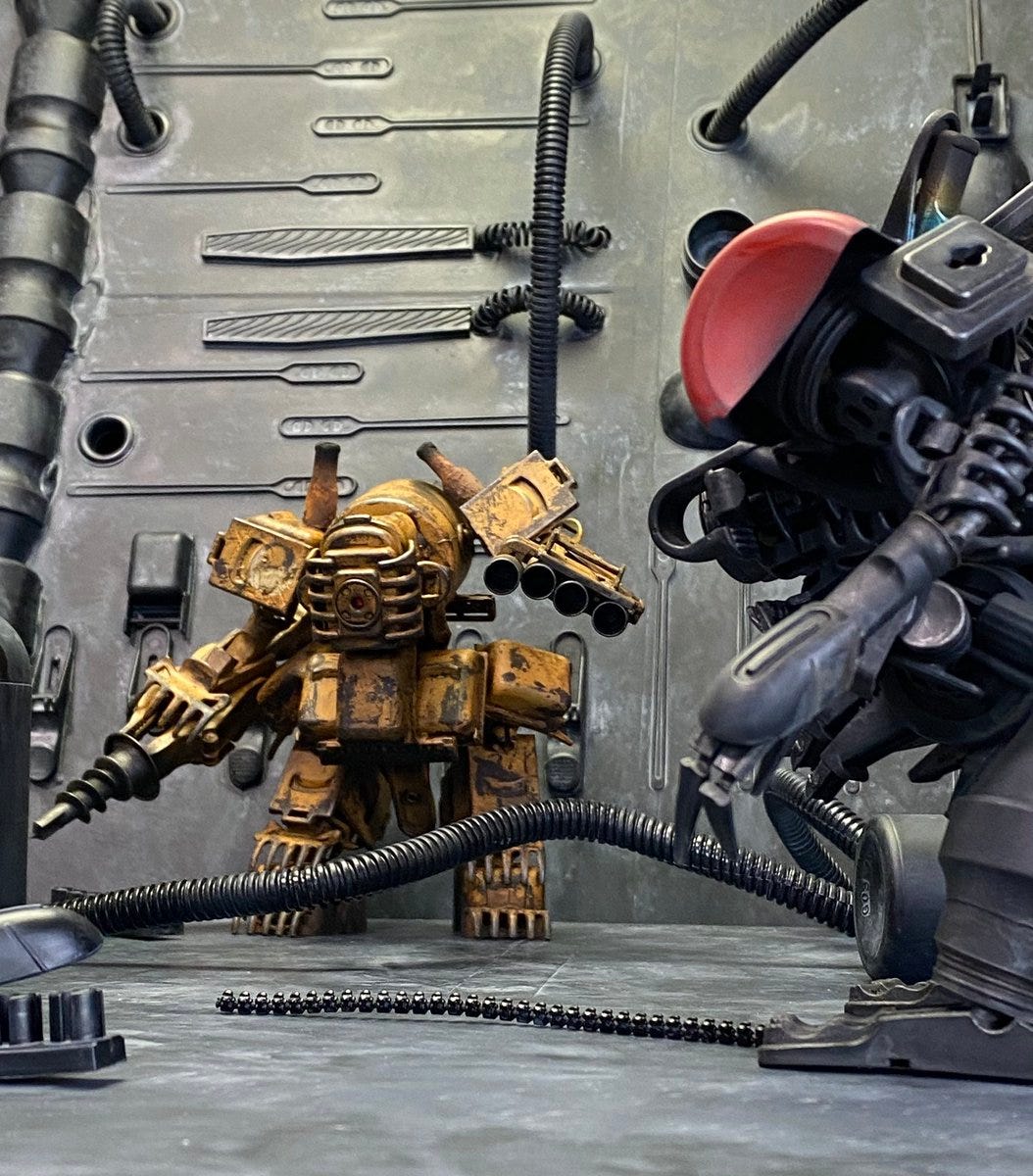
Kerberdyne is a world of robots reborn from garbage.
Trash from the side of the road. The broken stuff in your closet you keep meaning to throw out. Cheap odds and ends from the 100-yen shop (Japan’s version of the dollar store). Empty drink bottles — yes, even those tiny Yakult probiotic bottles. I take all of it and rebuild it, as joyfully and (hopefully) as coolly as I can, into robots.
I’m 44 as I write this, and I’ll admit something a little embarrassing: I have always loved the kind of make-anything-you-want craft project you’d be assigned over summer break as a kid. I’m also a hopeless fan of robots and science-fiction machines. So one summer — back in 2011, fifteen years ago now — I built a robot out of garbage.
And to my complete surprise, my wife loved it.
“That’s so cool! It’d be a waste to throw it away or shove it in a closet — you should put it up on a blog or something.”
So I did. The blog led to Twitter, and somehow, improbably, that road eventually led to publishing books under my own name. I’ve been building models full-time and happily ever since.
I made about ten Kerberdyne over those first few years. Then life happened — my son was born, work got busy, I fell down other hobby rabbit holes (3-inch diecast cars, miniatures, automotive models) — and slowly, I drifted away from it.
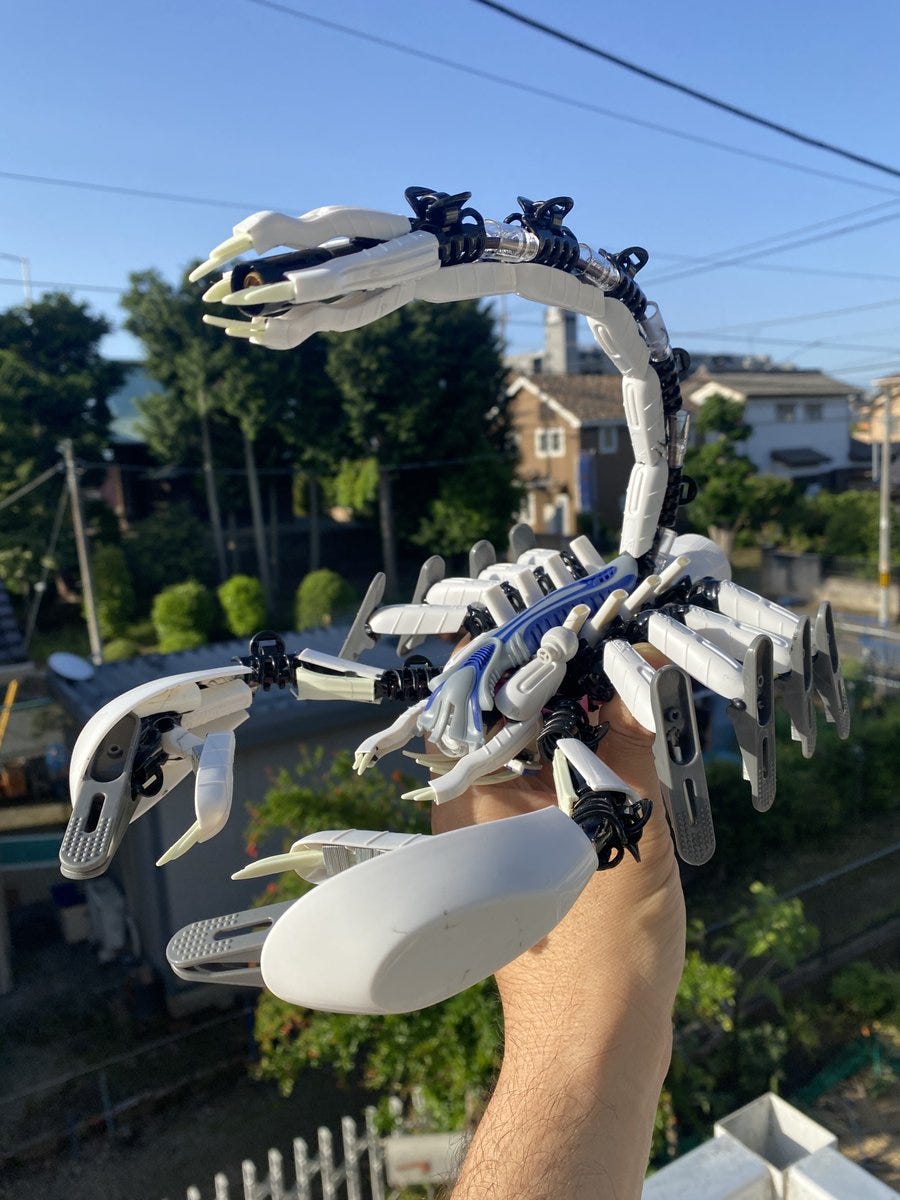
But Kerberdyne never quite let go of me. Even during the years I wasn’t building it, it stayed lodged in a corner of my heart.
Why?
Because it was the one thing I had built completely from zero — entirely my own original.
Here’s the thing about my day job. When I build a model kit, I’m assembling something that someone else designed, that came alive through animation or film, that was given meaning and story as a character, and that a manufacturer then produced using genuinely astonishing engineering. I’m just putting it together. And when people praise the result — which, thankfully, they often do — the truth is that it isn’t really me they should be praising. It’s everyone whose work made that kit possible in the first place.
Even if no kit existed and I scratch-built the whole thing by hand, I still didn’t create the character’s value. Honestly? I’ve come to think the value I personally add through building tops out at maybe 10% — and 10% would already be generous.
To be clear: I’m not complaining. Kits are small miracles, and the people who make them are extraordinary. This is just a quiet, personal itch — the plain human want to point at something and say, I made that. All of it. From nothing.
So why did I stop making Kerberdyne for all those years?
It wasn’t that it took up space, or that glue got expensive, or that work got busy, or that other hobbies were more fun.
The real reason is almost stupid: I got embarrassed.
Inventing your own original creations and settings — and then showing them to other people — takes a genuinely terrifying amount of courage. If someone dug up the notebook I kept in high school, the one crammed front-to-back with my own self-invented sci-fi settings, and posted it online, I am quite confident I would instantly combust and crumble into ash.
And yet — people who make original work do it anyway. They send their creations out into a headwind of:
“Ugh, this premise is so generic.” “Lol, what an idiot.” “How do you write something this embarrassing?” “Yikes — that’s painful to look at.” “Why not do it this way? I could make it a hundred times better.” “No talent.”
…and they keep putting out the thing they want to make regardless. That takes something real.
When people tell me they want to build a model but keep hesitating — waiting for the right moment, fretting over some sticking point — I almost always say the same thing: build it right now.
Because “I’ll do it someday” and “I’ll make it once I’m better” almost always mean the moment never arrives.
I’m a professional, and yes, I’m better at this than most people. And I still have a pile of kits I bought years ago telling myself “I’ll build it once I’m good enough.” But that feeling — “once I’m better” — is usually just a polite mask over “I’d hate for someone to see this and call it bad.” It’s the fear of being judged, dressed up as patience.
It sounds like: “This kit is wrong here, here, and here compared to the real thing, so I’ll have to modify it, detail it all up, do it properly — there’s an incredible heavily-modified build online, so I’d better at least match that.”
But you know what? Plenty of people build that exact same kit straight out of the box, no modifications at all. And their work isn’t worse for it — the kit’s own character shines through, it’s wonderful, and above all you can feel that the person building it was enjoying themselves to the core. Detailing, accuracy research, virtuoso painting — it’s not that they couldn’t. They’re simply doing what they can do, right now.
Near the end of my first Kerberdyne run, I was going through a rough patch at work and had lost a lot of confidence in myself. I can’t draw. I’m not a mecha designer. I’m not a writer who dreams up stories. I’m not a photographer. I’m just gluing garbage together and calling it a robot — aren’t I really just making new garbage? My whole mind had turned into a tally of everything I lacked, everything I couldn’t do.
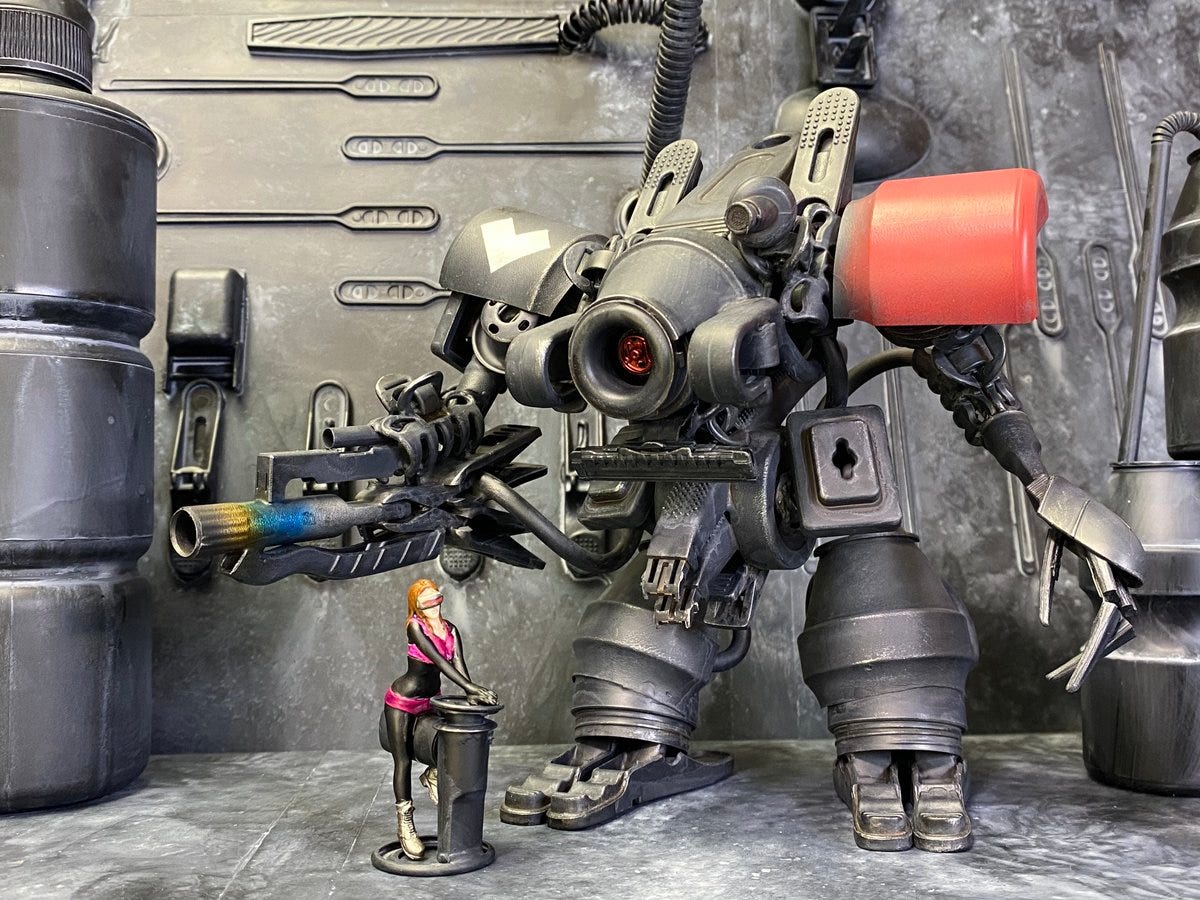
Recently, for reasons I’ll share another time, I decided to start Kerberdyne again.
I still can’t draw. I’m still not a mecha designer, or a writer, or a photographer. But I can take just about anything and rebuild it into a robot or a science-fiction machine. And who knows — maybe along the way I’ll get better at drawing, or learn to design mecha, or figure out how to write a genuinely great story, or become a far better photographer.
No one can interrupt it. No one can overrule it or alter it without my say. It’s mine — built outside the publishing world, owned by no one but me.
To make something entirely your own, with your own hands — and to swing both arms down with everything you’ve got and not a trace of hesitation —
If watching Kerberdyne stirs even a little of that fire of creation that lives in every single one of us, then I’ll be a happy man.
So: welcome. Let’s build something.
No posts
Comments
Nothing yet. Say the first thing.
Sign in to join the conversation.