
“Are you experiencing any pain today?”
The nurse asks the questions she must. It’s protocol. It’s charting.
It’s fucking aggravating.
Where do I even start? I think to myself.
The constant burning in my left hand? The way it’s going totally numb and I’m losing feeling and function? What about my chest pain? If I tell her about that, it’ll become a whole thing and I might get sent to the ER…And then—dammit—I’ll have to do this all over again, but with a nice side of chronic illness gaslighting.
“Um…there’s pain all over,” I say.
“What number would you give it on a scale of 1-10? Ten being the worst you’ve ever experienced and 1 being no pain at all?”
“I hate the pain scale. This is useless…,” I say, “But…sure, I guess you can write down a 6.”
If you’ve been to a doctor, you know the drill. The most commonly used pain scale across North American Healthcare systems is nearly meaningless and a mindfuck, simple labels that shove systemic, complex needs into tiny little math boxes dreamed up by a bunch of mostly male researchers after WWII to try to quantify internal discomfort. (We’ll save our history lesson for a day I’m far less sick.)
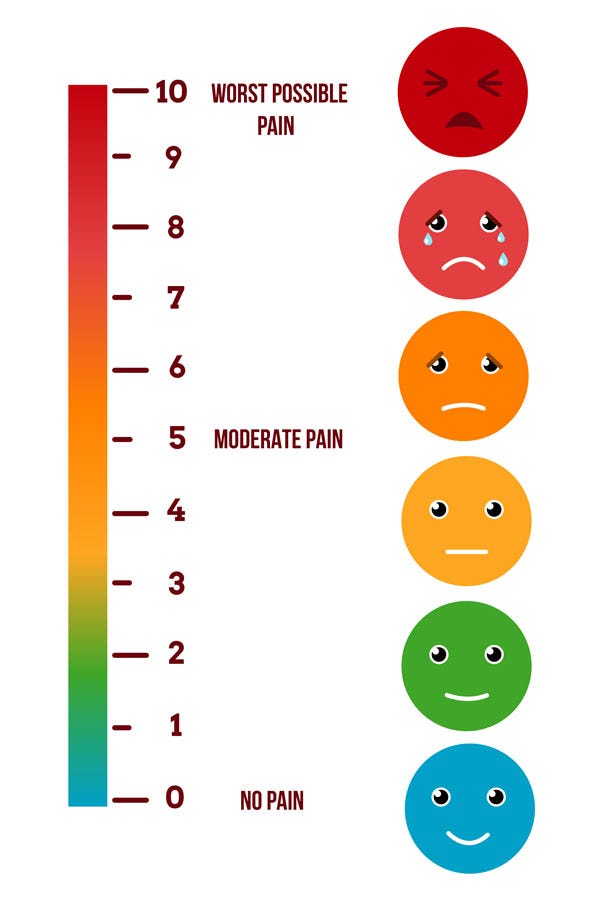
The point is if you repeat this clinical evaluation hundreds or even thousands of times in the course of one year as a chronically ill patient, no amount of Healthy Self-Concept or Body Positivity or Manifesting Your Way Out of Disease Into Your DREAMZ is gonna keep you from regularly feeling more like a number than a person with a name.
Last week I cried on a massage table when my trauma-informed lymphatic drainage massage therapist gently touched my swollen belly. Twenty plus pounds of water from high dose steroids and a medical complication called SIADH have ballooned my stomach, face, and more. It actually hurts. And, psychologically, I never thought I’d experience being quite as swollen or sick as I was three years ago, in the story I told in The Place Between Our Pains.
“It’s been so long since I’ve been touched by anyone other than my husband in a non-medical way.” I sobbed. “Every poke and tube…it just all adds up to feeling more like a machine to fix than a person with a life and dreams and hopes.”
You might not remember the last time you had to rank your complicated, living, breathing, brutal reality on a scale of 1-10, but you probably can remember right now in the knot between your shoulder blades or the tiny tear you are holding back in the corner of your eye that you’ve been reduced. Your grief has been gaslit. Your sadness has been shoved into some small closet in the corner of your community where no one has to look at it. Your questions and rage and cries have been steadily silenced behind socially-acceptable smiles.
God, I’m tired of people having no other way to inhabit or relate to their pain than to quantify it or compare it with others’. God, I wonder how much more alive we’d all feel if we gave each other permission to stop trying to perform our way out pain.
Pain has a voice. I described it like this in my memoir:
We live in a loud world that shouts that persistent pain is proof of either a failure of faith and personal freedom or a fault in one’s commitment to release trauma. But my body speaks a stranger story: pain has a voice, and binaries only box us into believing we must silence it.
But healing is hearing the ache that resounds. Healing is heeding the alarms in body and soul that alert us all to recognize that our flourishing is stitched to systems larger than ourselves, that we are made stronger by solidarity and sicker in its absence, that ache can never be fully answered alone.1
Poetry might not cure your chronic illness. You effing know it hasn’t cured mine. But poetry can give you power to reclaim your personhood. Poetry can give you something better to do with your pain than only reporting it to a provider who may or may not help you or even offer compassion. Poetry can give voice to the vulnerable pain inside you that actually needs to be heard to be healed. And if you’ve read my work for any length of time, you know I believe healing is about far more than getting rid of hard symptoms or sickness. Healing is about being fully human. Full stop.
I wish you knew how much power your pain contains.
I wish you knew how much life-force-energy exists in the pain you can’t quantify nor wish away.
I wish you could dare to partner with your pain as a creative force, always inviting you into fuller aliveness, even when life doesn’t get easier.
Poetry won’t cure your chronic illness nor will it replace your Wellbutrin prescription, but it just might—day by day—give your soul a sturdy place to remember you are not a number to rank or judge nor a machine to fix or discard but a person who contains mysteries and majesty that no amount of disease, doubt, or distress could ever erase.
Poetry is one place pulsing with life. When you place your pen to a page and dare to let your pain be more than a number, you reclaim your right to be a person worthy of hearing and knowing and respecting regardless of your disability, gender, income, sexuality, religion, or status. Do that over and over in the course of a month or year and, well, you might just see how much your soul and this brutal, beautiful world actually shimmers every single day. Struggling or not. Democracy collapsing or not.
I’m in a severe flare of lupus and autoimmune autonomic ganglionopathy, a flare so severe it is system- and organ-threatening, requiring me to undergo rescue treatment. Yesterday I started PLEX—also known as therapeutic plasma exchange (TPE)—at a hospital in Denver under the care of an incredible oncologist. The day before, I had a second central line placed that I have to use for PLEX, a Trifusion Catheter. It was my fourth surgery this year. Right now, I have a port on the right side of my chest2 and this other catheter on the left. And this one has three lumens that will be sticking out of my chest for the foreseeable future…like six months or more. I’ve decided to call them my three extra teets. ☠️
I don’t love that I need any of this. And it turns out, PLEX is a lot more intense than I even expected. This is gonna be hard. Woof.
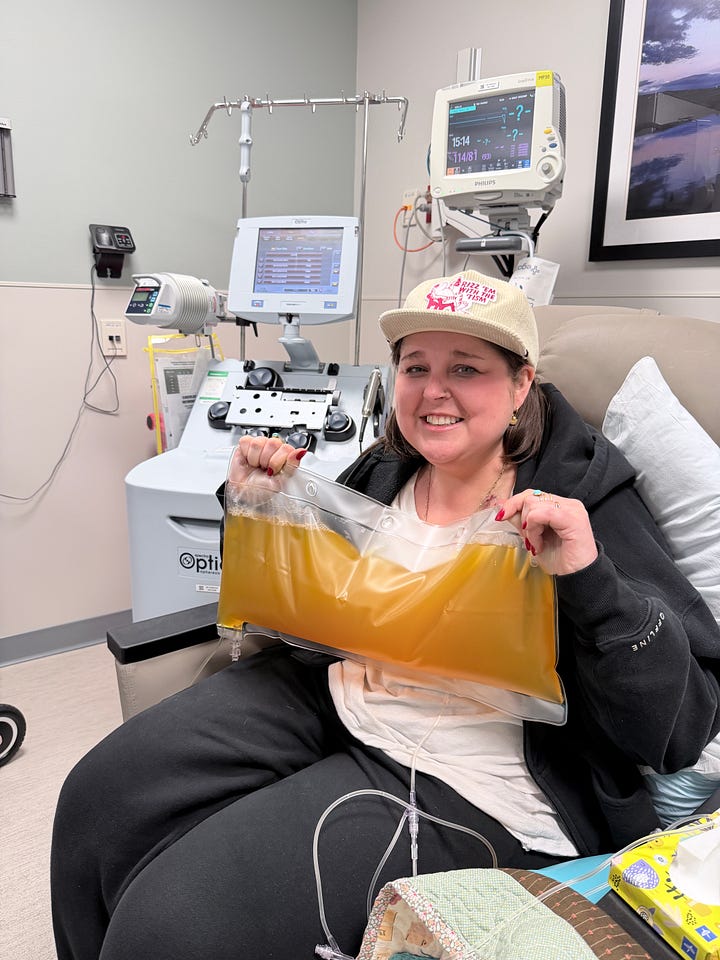
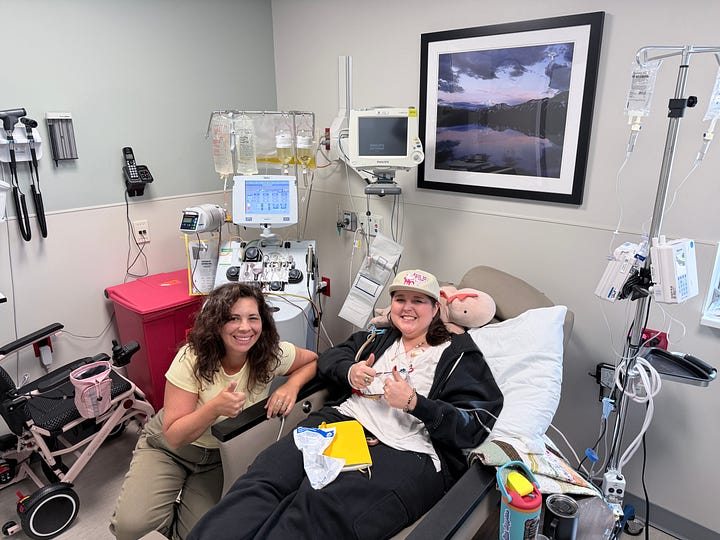
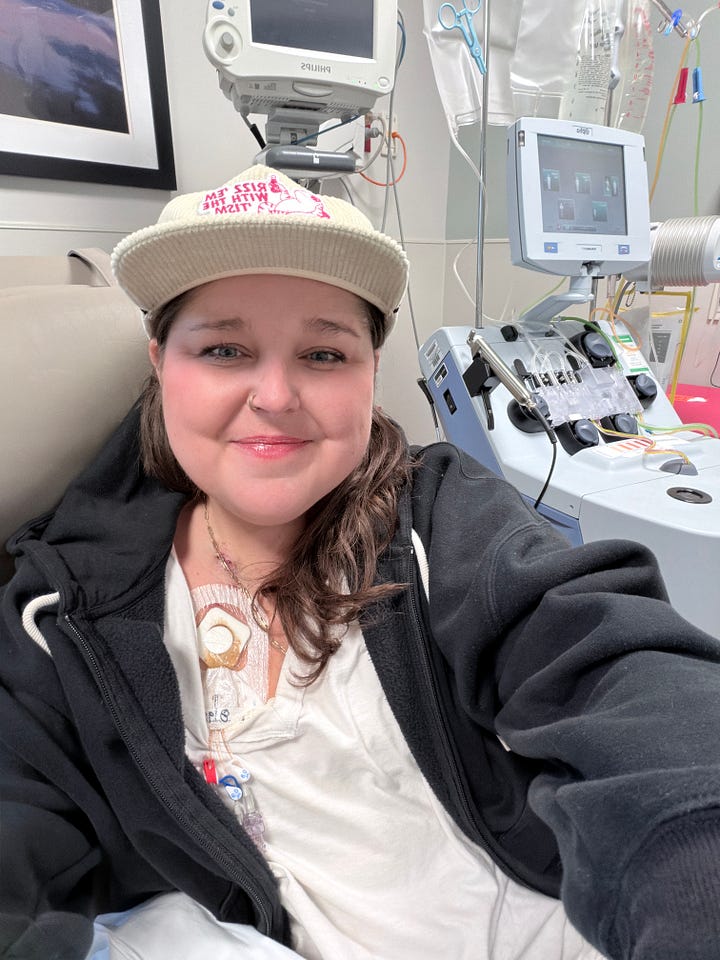
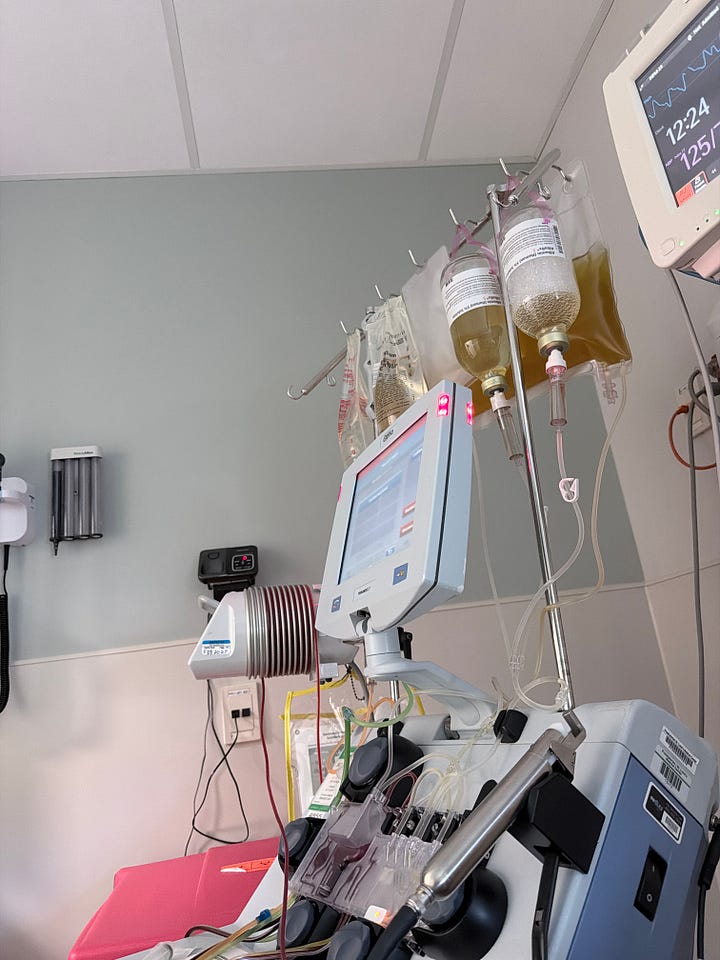
I am mostly too sick to fully take care of myself. I’m feeling so many miserable symptoms every single day that if I listed them all, they’d be longer than this whole post. I’ve gone through so much since just early April (when I learned about my face-eating tumor) that someday when people read it in a book, reviewers might question whether I made it all up. It’s that…wild.
I don’t know what the future holds, but I do feel a lot of hope. And to live in that hope, to aim my attention toward aliveness, I need small, steady ways to partner with my pain as a creative rather than entirely crushing force.
I need to reverse the reduction of the Pain Scale on my personhood.
I need handholds on this epic climb out of a dark pit of disease that allow me to sense in my soul that I am not stuck.
I need poetry to remember I am not just a patient nor a meat-bag full of problems but a person.
So, I figured, why not, I don’t know, do that with some of you??
YOU DO NOT HAVE TO BE POET TO BE PART OF PAIN SPEAKS.
You do not have to be “a writer”—though, I’d argue a writer is just someone who chooses to write. You do not have to produce publishable poems. Your poems can be cheesy AF. You can write prayers every single time if that’s what your soul needs. Your poems could quite seriously be five stanzas of F bombs every single time, and it would probably be healing for you. The point isn’t pretty words. The point is reclaiming our power.
I’ll be sharing fresh poems with paid subscribers of Embodied (my substack K.J. Ramsey), material I’ve probably never shown you and/or simple, short poems I am writing while undergoing treatment.
These posts will be short and will arrive anywhere from 1-3 x per week, depending on how treatment goes.
If there are weeks I get way too sick to share something new, I’ll share a poem that’s been holding space for compassion or hope for me lately.
These posts will often include tiny updates from my treatment room and the goodness I’m finding along the way.
I’ll also be providing prompts for you to write your own poems.
For instance, the prompt I’ll probably share later this weekend involves writing a piece based on a news article that’s caught your interest or connects to a part of your pain/frustrations that often gets overlooked.
A collective space for letting our Pain Speak: You’ll be invited to share your poems in the comments section and interact with each other’s words, all behind a paywall for privacy and a sense of safety.
There is zero expectation that you share your poems. But if you want to…if you wanna summon the courage to share a little here and there, you absolutely can.
The comments section for sharing will be a No Mean-Butthead-Behavior Space. We will not mock you. We will not critique you. This is not an MFA program this is a Let’s Survive Hard Shit Together Strategy. We will hear you.
For expectation setting, please know that I am currently too sick to deeply engage in this comments section or reply to most or every or maybe any comment. However, as my body allows, I will be reading and trying to reply when I can. Giving space for you all to connect to each other feels like the best use of my very limited energy right now.
How Long Will this last? Right now I don’t know how long PLEX will be, so I’m going to take this almost month by month. For now, I’m planning on ending or re-evaluating our little club on October 1st.
A paid subscription gives you access to Pain Speaks.
Paid subscriptions cost $6/month and you are under no obligation to keep subscribing month after month.
If you cannot afford a subscription, please email kj@kjramsey.com and one of my loved ones will help me enter your info for a month of free access. It might take us some time to get those loaded, so please be patient.
K.J. Ramsey, The Place Between Our Pains: A Memoir of What Joy Can Survive (New York: Convergent Books, 2026), 149.
Great news, she’s been in my body one full month and is working perfectly, which means THE PORT IS HERE TO STAY! SHE IS BEING NAMED TODAY! I’m so thankful.
No posts
Comments
Nothing yet. Say the first thing.
Sign in to join the conversation.