
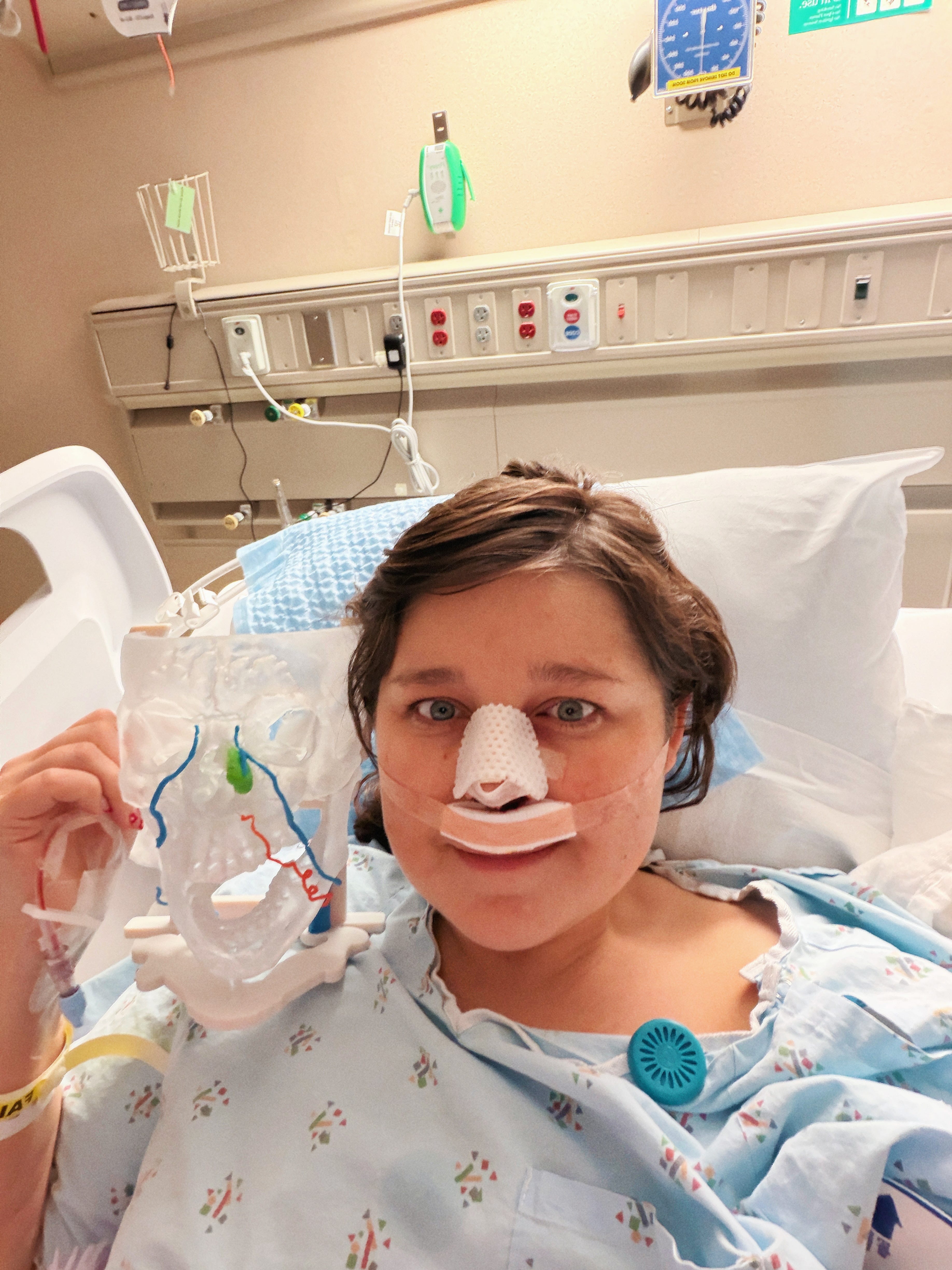
Sure, you’d see constellations of bruises along sky of my arms, the evidence of ERs and treatment in a body that is so tired. But you wouldn’t see the massive divot on my skull unless I showed you, the spot where surgeons at Mayo Clinic sliced through my scalp and sawed out a small tribute of calvarium skull bone just four weeks ago to rebuild the nose bone that a rare, aggressive tumor fully swallowed in two short, hungry months. Cartilage and skin from the left side of my nose are knitting together cell by cell with my skull bone to give me back what a tumor snatched so fast.
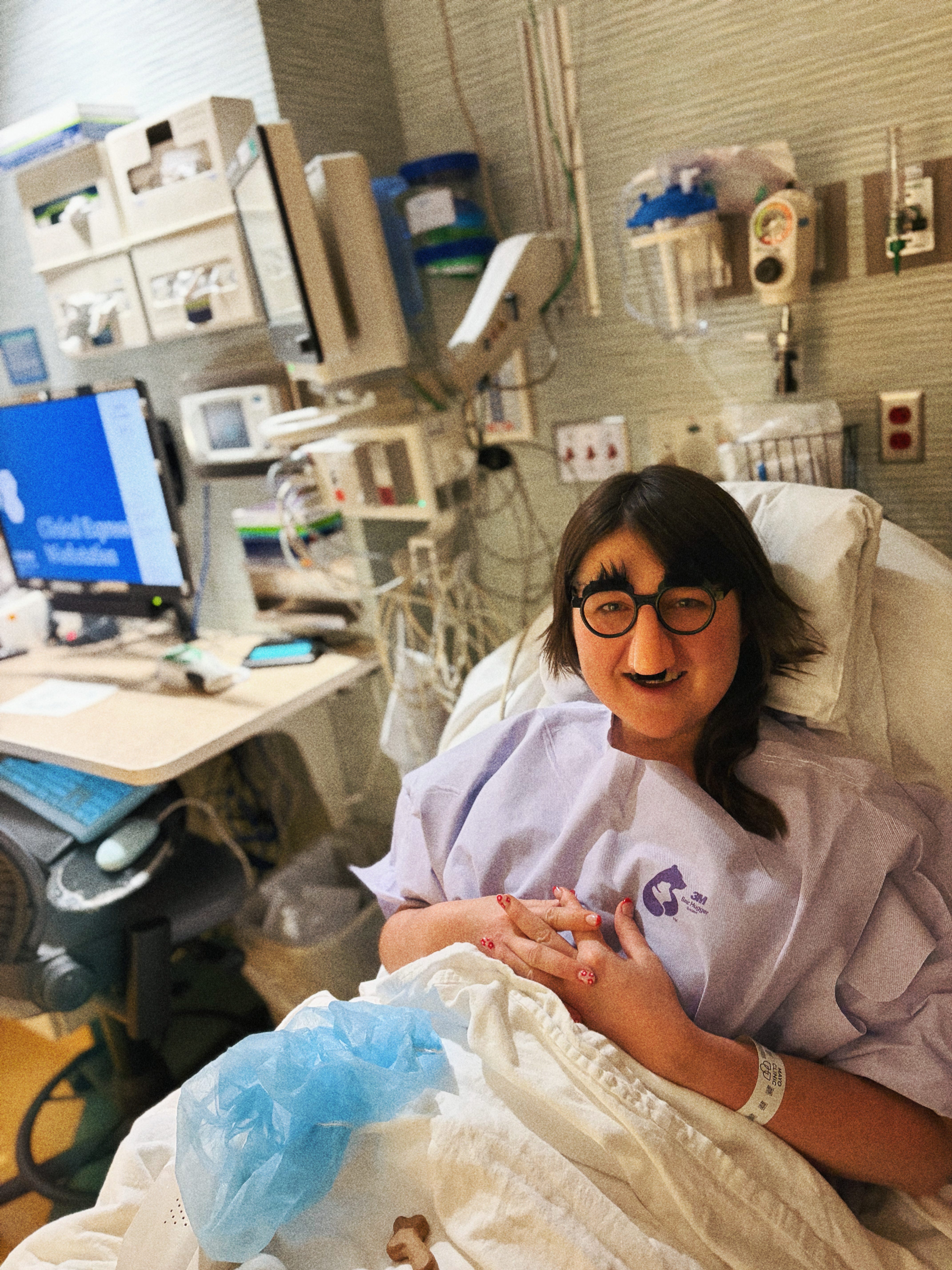
This is not a nursery rhyme.
I have been rebuilt thrice, so far. Stem cells from my hips filled holes in my necrotic knees, twice. Bone from my skull saved my nose. The body that broke is the body that heals. None of it was wanted. All of it is astounding.
A tumor would still be giddily growing in my face, Pac-manning its eager way toward my eye and brain at pace more terrifying than my trauma nightmares. My knees would already be crumbled, more than they are.
I am alive and can walk because I have believed my body and have kept believing her even when her truths are rare, confusing, and hard to treat.
The first ENT to evaluate the mass I felt growing like a grape under the surface of my skin says, “It’s probably nothing. That’s probably been there a long time.”
“Women know our faces,” I reply. “This has not been here for longer than two months, tops. We have to see what it is.”
He orders a CT, “just to be safe.” When I see him to discuss my results, his shoulders are braced with bad news. “In thirty years of practicing medicine, I’ve never seen anything like this.” He pauses to text a surgeon friend in Denver. It is one month before my debut memoir is set to release, a story of medical gaslighting and mystery so scary it already took all my strength to survive, and now I need a tumor to come out, too. I decide to believe my own words bound in those new pages. I decide to believe I can welcome more grief, expecting enough joy to sustain me through yet another saga. I am under the knife within one short week to begin removing and testing the tumor that could have easily not even received a scan.
It is that bad. It is that aggressive. Probably nothing in a body experiencing changes that are undeniable to the patient is almost always something. Belief in the body, belief in one’s own perception of reality—belief can save our lives.
I’m sitting on a hot concrete retainer wall wearing orange cotton bike shorts and a big t-shirt with my tee-ball team’s name screen-printed on the front, wrapping an ankle in the Ace Bandage that my parents have let me keep and use but definitely roll their eyes at.
My ankles roll, for no reason. I fall. Often.
I am five, or maybe seven, and I feel different than everyone around me. I don’t know why my knees hurt. I don’t know why my ankles roll. I just know I need support. I call out for my parents often, knees skinned and ankles puffy, but our doctor can never find a reason for my sprains and tells them it wouldn’t hurt to just let me have Ace Bandages, to use them like kids play doctor. Maybe it’s phase, I overhear him tell my mother.
I can tell they think I just want attention. I can tell they think I’m faking it.
Over the years, extended family members mock me, affectionate razzing meant to rile, but the sting writes a story in my soul. No one will believe you when you bring up what hurts. It’s best to take care of yourself in silence. Hide the pain or you’ll be the object of someone’s humor. Trying to be comforted will only bring contempt. Seeking support comes with a side of shame.
“I can feel the tumor growing,” I tell my first ENT surgeon in Denver, after he has removed large parts of it.
His eyebrows climb an inch. “I…” he pauses, swallowing. “I highly doubt that. I’m hopeful you’ll be able to watch and wait instead of having this fully removed.”
“I know you probably think I sound crazy,” I reply, crossing my arms like a shield in the stiff exam chair. “But I am the same patient who knew her bones were dying in her femurs five whole months before doctors even ordered imaging. I can feel micro-sensations that most people can’t. I don’t know why. I just can.”
Two weeks later, I can still feel the tumor pulsing into my sinuses and beginning to crowd my eye. It is so rare that it has stumped two pathology teams, but appears to be a central giant cell granuloma (CGCG), a type of tumor that should not behave as aggressive as mine is, a tumor that almost 100% of the time presents in the jaw, a tumor for which there are only a few documented cases that look anything like mine.
My new surgeons at Mayo Clinic in MN run another CT and find that in just 18 days since my first tumor surgery, the tumor has already grown back and invaded three new structures in my face. “It must be removed within no longer than two months,” they tell me. “It will require careful planning and 3D modeling.” We pick the fastest possible surgery date. The tumor will come out two weeks after my book does. The timing is baffling.
The smallest, strangest of sensations sometimes can be sensed. The sacred speech of my body is a language I listen to, a story I will never silence.
The next time I see the Denver surgeon, I show him the scans. “Well,” he smiles—honestly, without malice or contempt, “I think at this point, you officially have a superpower.”
“It’s a superpower I wish I didn’t have,” I reply, “but it’s definitely real.”
December 2023
It is two and a half years earlier. I climb out of a wheelchair on the subway level of Mayo Clinic’s Gonda Building and step with a cane into the dark, womb-like Center for the Spirit—the ecumenical space set up for patients and families to sit and pray and remember that there are realities larger than we can see, energies that evade statistics.
I glance at a wooden wall, where a quote from Mayo’s founder, Dr. William J. Mayo, is transposed in metal letters:
“We must not forget that happiness is a state of mind, not necessarily of body, and that life is what each person believes it to be. The sick man needs faith, faith in his physician, but there comes a time when faith in a higher power may be necessary to sustain his morale.”
I am struck as a bell, the iron of my heart, hardened by too many hard things, echoes a sound I wasn’t sure it still could make.
Believing my body while doctors have yet to find anything entirely believable to explain why I am so sick nor why I almost died is silencing my spirit. I feel forsaken, marooned on some medical mystery island with no airport nor a common language. I don’t think I have what it takes to survive life here, nor the pain inside my legs, which feels like decay, like death. I’m not sure how I even recognize the sensation as decay, except that its grains are too sharp and searing to silence, too horrifyingly to ignore or even imagine living with for much longer. Most days, I honestly want the relief of death more than I want the joy of life. I want to crawl into a ball to rest and recede into the ground as a fallen log, my life returning to the soil.
There comes a time when faith in a higher power may be necessary to sustain…
And I can tell the time. I cannot sustain myself.
I decide that if the story of God and even Jesus is real and true then it will rise back up from the dead in me when it damn well pleases.
I recognize that a faith that is fallow does not have to mean dead. I choose to believe that the invisible realities within my skin and self are true, worth fighting to tell, worth fighting to never be silenced. I choose to believe there is love beyond my current capacity to perceive, love that can nourish me without me even being able to reach for it.
A few days later, an MRI shows that the sensations of decay gnawing at my hope and placing me in a wheelchair were precisely what I intuited—bone death, large lesions of necrotic tissue, killed by the high dose steroids that had just 5 months before kept me alive.
I decide to mother my despair. I decide that despair cannot dictate my future. I decide to believe I have a future that I somehow will be able to survive, existentially, if not physically.
June 2026
Disappointment is a weight that can drown us. The chasm between what we hope for and what happens is often Grand Canyon Wide and Tall.
Authors labor unbelievably hard behind the scenes for years to see our books published—in the case of The Place Between Our Pains, three years—years in which I was not only writing a book but crawling out of the pit of a medical hell that almost killed my body and then my spirit.
To reach publication season only to have a tumor steal the scene is not just shocking. It’s a beating.
Instead of sitting for interviews to promote the book, I sit on a plane next to my husband Ryan, winging to Minnesota, where the world’s leading experts in the rarest face tumors are ready to remove the weirdest thing to happen inside my body yet. Our tickets have been paid for by my church, where I have been coming anonymously and infrequently for three years, tiptoeing towards a faith I still want and need.
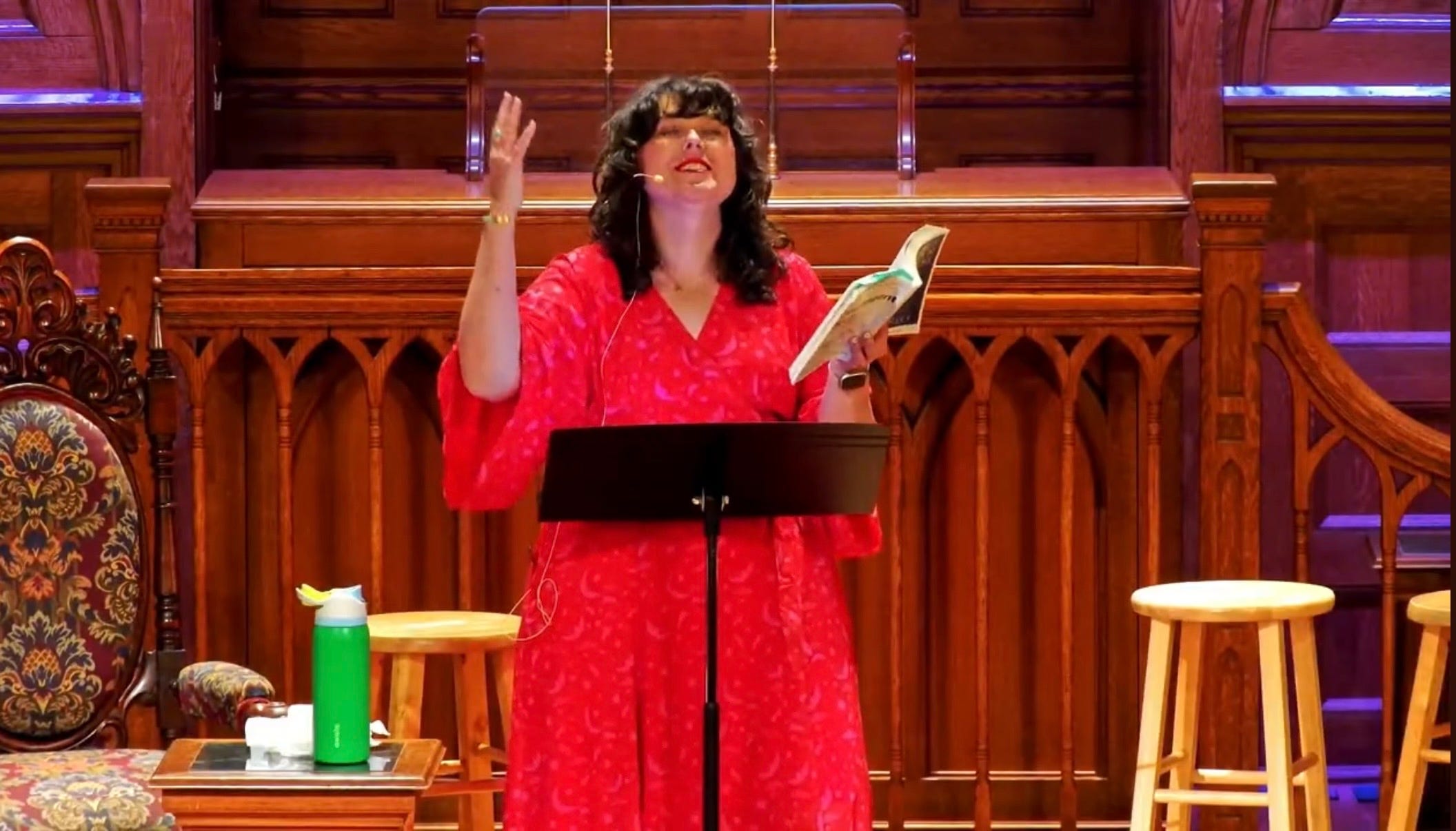
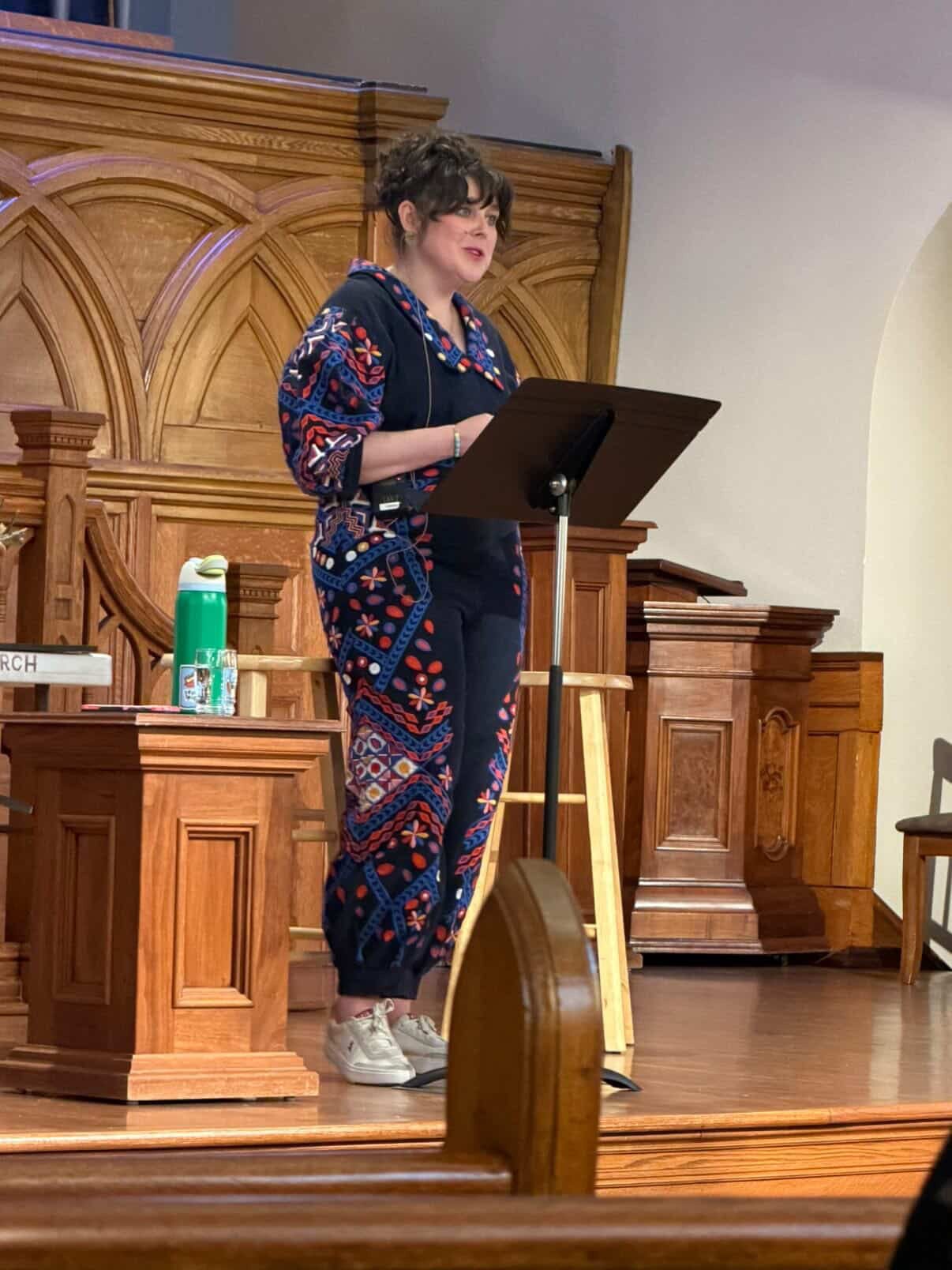
The week I found out about the tumor, I spoke on a stage in front of 200 people in Colorado Springs all weekend—perhaps a silly choice, but I am nothing if not a stubborn bitch—and in the crowd was a familiar face I couldn’t place.
(PS Sorry to interrupt but don’t miss the chance to hear me speak at several book tour stops still happening! Deets are at the bottom of this email)
On Sunday, I got a text. It was our new rector. I hadn’t recognized him without his vestments. We have only seen each other through the brief exchange of bread and wine. He invites me to pray.
And I sense it again, the truth that my story cannot be sustained simply on the strength of my own perspective nor resources. I am too tired. I am too disappointed. I have already suffered more medically than almost anyone I know personally. It is too much, and to publish a book while drowning in another medical disappointment (and at the time, cancer scare) is simply too much for any human. I type, yes.
Terry Tempest Williams calls the moments Glorians.1 Moments of grace, often perceived in the midst of fear and pain, when we encounter a belonging pulsing toward us, ready to sustain and remake us.
But like the body keeps breathing when the mind wants to quit, the soul is sturdier than we imagine. There is an aliveness awake inside you that no amount of disappointment can drown. The burning core of desire inside you to live is molten and mammoth and still responsive to love no matter how much you have lost. I cannot prove it to you, for it is a reality each must surrender to see.
So, I wing my way to Mayo, on the dime of others’ prayers. And the disappointment of my Botched Book Launch shimmers instead with the sight of sustenance, kindness aimed like an arrow at my ache, kindness I didn’t even have to ask for to receive. This is how the universe works. The psalmist was a fuck-up, but he also was right—goodness and mercy actually do hound us more than grief or pain. The scales of grief and goodness need not be perfectly counterbalanced to be continuously enlivening. Goodness weighs more than pain.
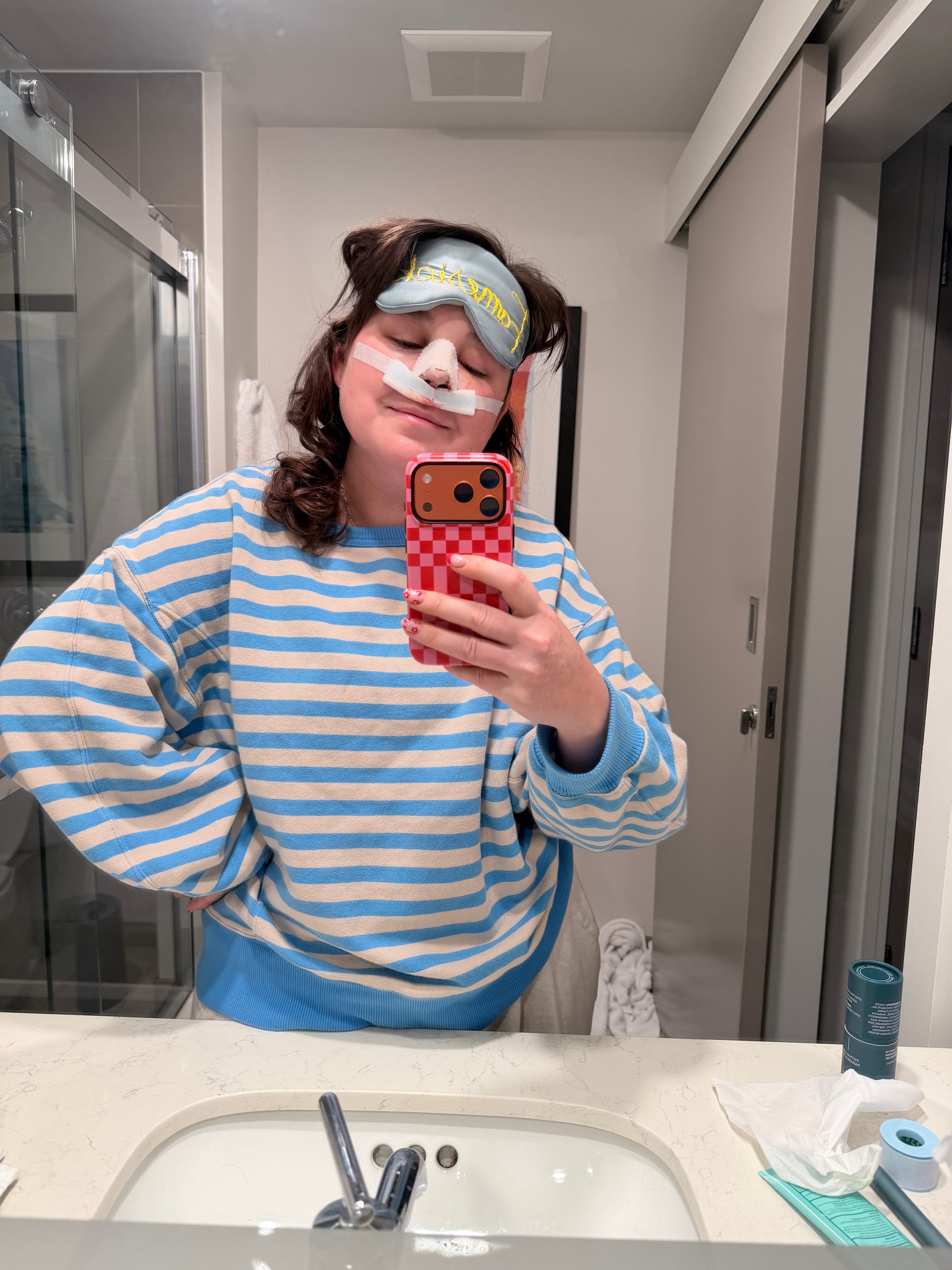
After my June 4th surgery, I spend over two weeks in a dark hotel room in Rochester, MN, cared for by my husband and then my in-laws, two of the most deeply kind human beings I will ever know. My mother-in-law, a retired nurse, drips saline into my skin-cartilage-bone grafted nose at all hours of the day. They make sure I eat. I am in more pain than ever before in my life, which is really saying something. But in the pain, there is presence. And that is not an analgesic but it is an antibiotic, pressing back the infection of my imagination, that even now, three years after a medical crisis that nearly killed me, I will be loved into more life.
I decide that ease no longer is the evidence of joy and that the removal of pain is not a prerequisite for peace. I will feel it all. Grief and joy are zany best friends, opening the gate for each other day after hard day. I can hate my circumstances and laugh at their absurd humor.
When my in-laws have to fly back to their home in NC and I need to stay at Mayo longer for my fragile grafts to heal before seeing my surgeons again, I face the fact that I’m too sick to do everything on my own for my final few days in MN. A reader named April, who has reached out every time I’ve traveled to Mayo for medical care, keeps reaching out. She brought us soup and the best gluten free rolls of my sad breadless existence, which means she must be good people. So, when April offers to take me to my appointments, I let her.
The moment I see her face at 6:30am in my hotel lobby, round and wide like a full moon, I recognize myself. Because, while most of our scars are not visible, some are. Her face tells me the only story I need to hear: she too has been marked by high dose steroids, at doses one only receives when extraordinarily terrible things have happened to them.
Once again, there is glory, glorians, belonging pulsing toward me in pain.
Later that afternoon, April is present with me in an appointment in which I am blindsided by the worst medical gaslighting of my life. I am seeing an allergist to be cleared to receive a new central line—when a medical mystery with my first port almost killed me three years ago. It is help I desperately need. It is a story that defies statistics. The scars live on my chest and in my bones, but they sting most in my soul. I think I am in this appointment to be helped. Instead, I am met with more harm.
A woman who has had to fiercely believe her own body sits next to me, believing me while an aged-allergist questions whether the worst things that have ever happened to me are even real.
In 2023, my body was on the receiving end of 11 shots of epinephrine and 4 epi breathing treatments. Doctors don’t just give you epi. Several providers in hospitals and clinics, over many weeks saw my throat closing and had to give me epi to keep me from being intubated or dying. But it doesn’t matter that the facts are clearly listed in my chart, they are so intense and strange that the man in front of me can’t see me. He only sees statistics.
“That would be so rare,” the senior allergist stutters. “Are you sure your throat was closing? Maybe it was vocal cord tightness?”
I can feel April’s strength pulsing toward me from the other end of the couch. I can feel her indignation, born in the burning core of her own will to live against the odds of doctors who have also dismissed her. And that strength is enough to sit up straight and demand clarity, demand dignity.
“Do you see the bandages on my face?” I state simply. “I am here at Mayo Clinic because an extremely rare face tumor that should not behave this aggressively ate a large part of my face in less than two months. Rare, medically bad things happen to me more than most patients. It is why I am here.”
The doctor stammers, before continuing to question whether my severe anaphylactic events were real or even possible, simply because they break the box he has come to treat as more trustworthy than a woman’s medical chart or experience of her own throat closing.
Like I wrote in The Place Between Our Pains, “This is healthcare in the United States of America. Many physicians would rather give a psych consult to a woman in horrific pain than confront the reality that her body may be experiencing disease processes beyond the scope of their intelligence.”2
And yet, a moment that would have been intolerable and devastating alone is bearable, because the weight of unbelief is distributed across more than myself. “Hope is a team sport,” I wrote in The Place Between Our Pains, and damn, it keeps proving to be the truest thing I’ve ever written. The glory of kinship, of belonging even in brutality, is stronger than the force of suspicion and shame.
And I believe again. I believe my body. I believe my story. I believe my need for support. I believe that every moment there is more life pulsing toward me and you than there is loss, and that this love sustains us even in death.
Now, four weeks after surgery, though I would like to order a coma on demand to get through the lupus and Autoimmune Autonomic Ganglionopathy (AAG)3 flare happening right now that had me in the ER a couple nights ago with an adrenal crisis, I am still being sustained by the strange glory of kinship and feral joy.
My body hates surgery, and the inflammation exceeds a base amount of steroids in my adrenally insufficient body. And I’m over here stubbornly still doing my book tour and any moment I have not been on a stage or plane, I’ve been mostly in bed, horizontal, storing up energy to see you across America. This is my summer of feral joy.
The joy of remembering my kinship to you is filling me up, like a storehouse in my soul. Last weekend in Charlotte, I met a woman who has one of the same diseases as me, who came to one of my book events in a wheelchair. She shared that other than doctor’s appointments, coming to meet me was her first time leaving her house in 8 months. This is the power of kinship. We crave being seen and believed by others who share our scars—the ones we can see and the ones that sting silently.
At the next event, a man handed me his newly purchased copy of The Place Between Our Pains and shook my hand. “I’m an internal medicine physician.” There were tears in his eyes. “I am going to read your book and place in it my office in spot where I can see it every single day to remember that patients are the experts of their own bodies.”
Somehow, in the strangest, saddest book launch of my life, I am continuously stunned at the power of believing our own bodies, how the love inherent in listening to our own tissues and tightness and pain ripples out from the burning core of our own will to live, remaking the world that wounded us.
I believed my body, and in believing her, I have been met with love beyond my limits. There is life pulsing through even the driest deserts of disease. It is no less real when I feel ruined than when I feel my resilience. I am being resurrected. I have more diseases than I did three years ago, and yet, I am more healed. Because I am more human. Because I am aware and sustained by the life that is ever sustaining mine. The energy that made the world pulses through you and through me, defying cortisol levels and odds. There is joy in the place between our pains, and it’s hard to believe and makes no sense, but it is enough.
—KJ
And, yes, I will cancel events if my medical team, Ryan, and I determine I must. I’ve been traveling because of the empowerment of my rheumatologist. And I’m doing much better after my ER visit this week, now that I am on high dose steroids again. (Yes, that’s always a complicated and hard choice to make.)
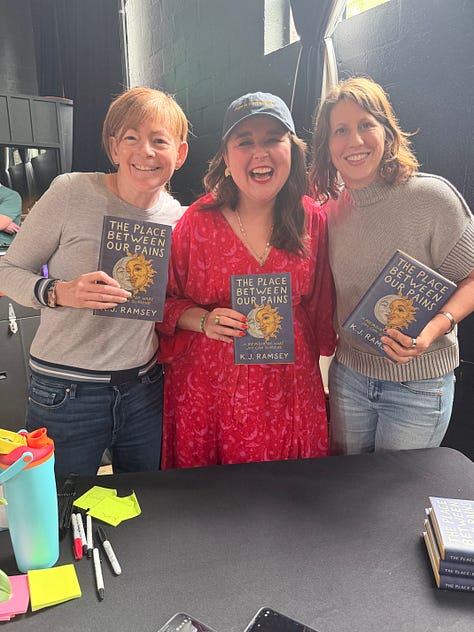
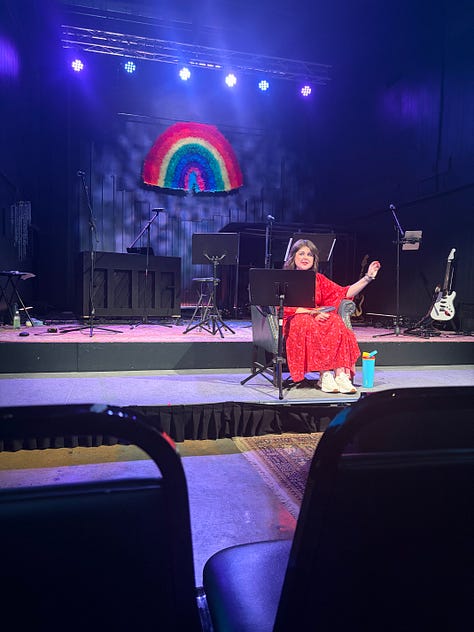
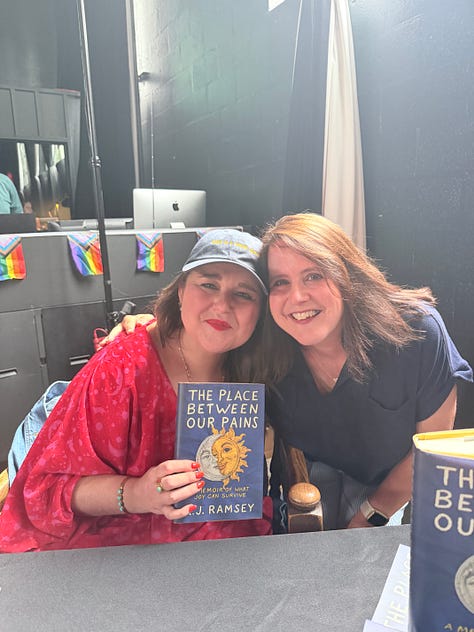
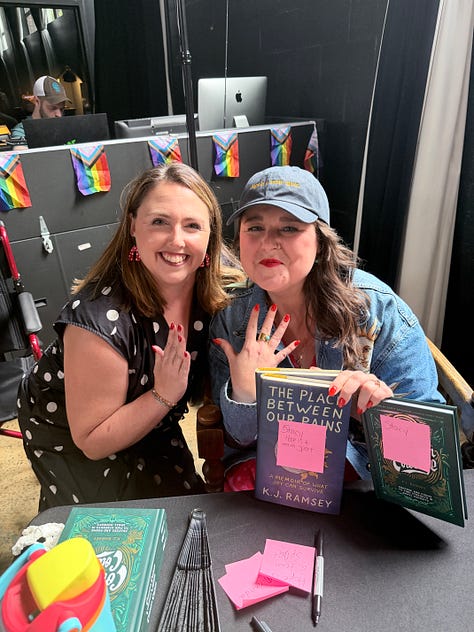

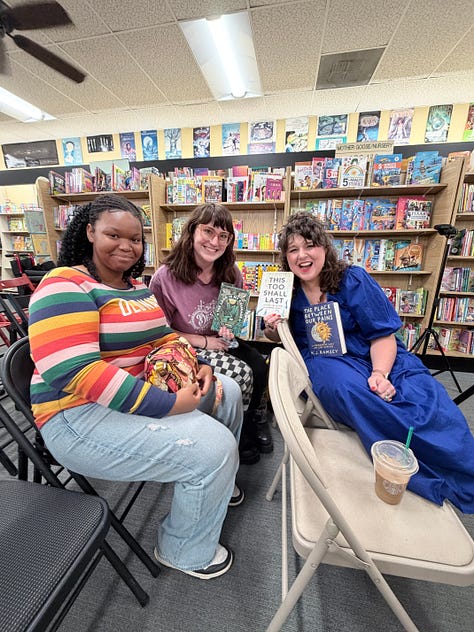
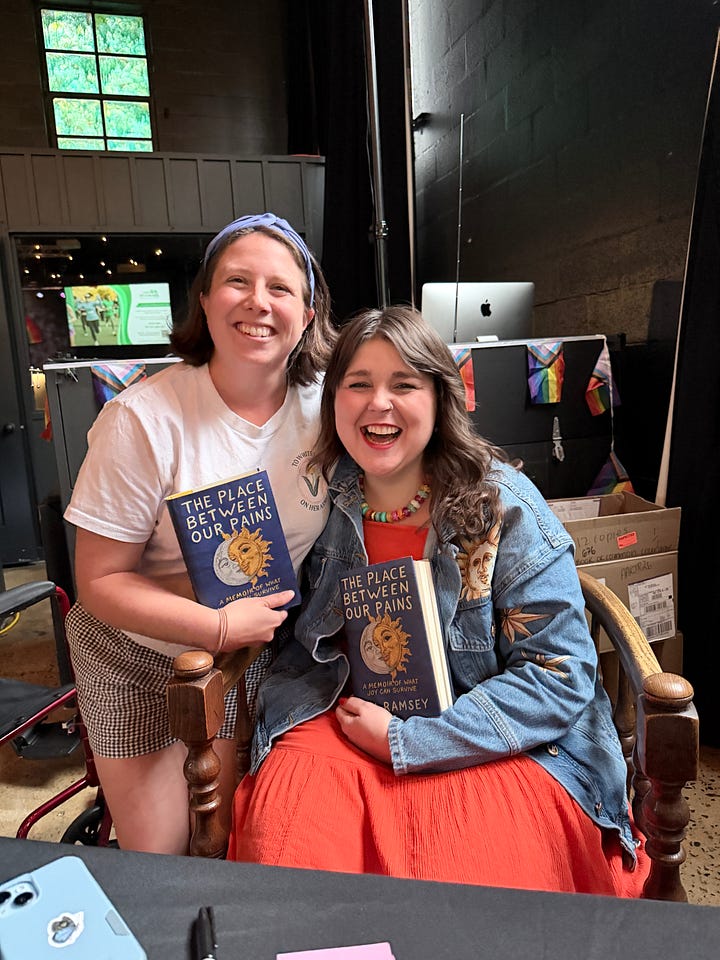
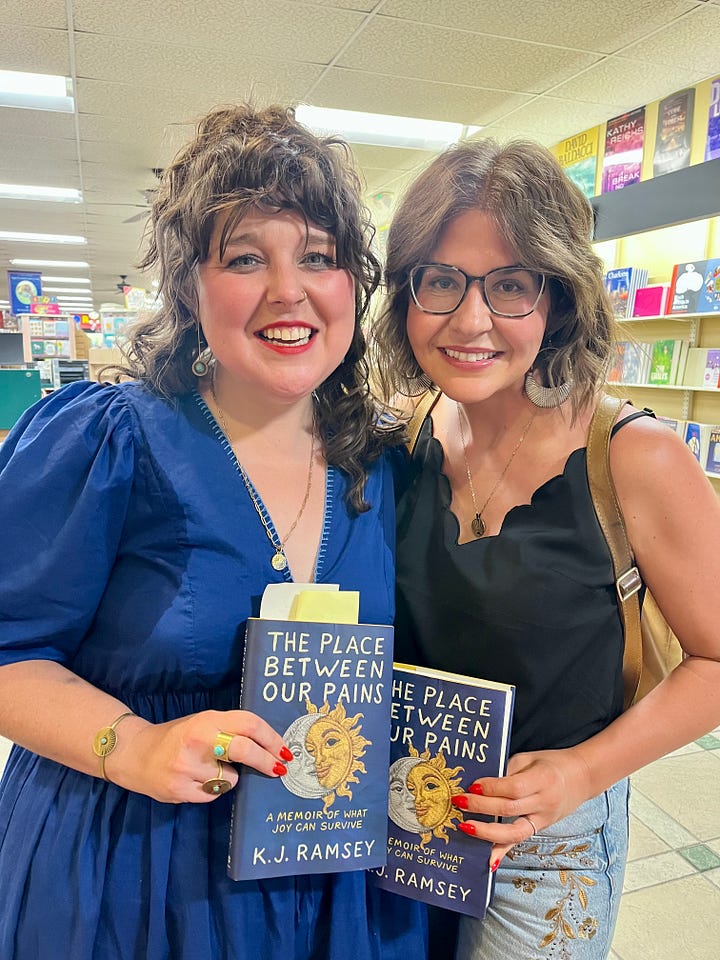
CHICAGOLAND, IL | Tuesday, July 7th at 6pm at Bookends & Beginnings Bookstore in Evanston, IL. Please RSVP. I will be in conversation with beloved local author and spiritual abuse advocate Laura Barringer, the co-author of A Church Called Tov.
GRAND RAPIDS, MI | Thursday, July 9th at 6:30pm at Schuler Books. Please RSVP. I will be in conversation with Jeff Chu 朱天慧, the author of Good Soil (a book I adore) and the co-author of the late Rachel Held Evans’s Wholehearted Faith.
CASTLE ROCK, CO | Sunday, July 12th at 6pm (5:30pm for drinks and mingling!) at Sudden Fiction Books. Limited tickets, intimate book club setting. Register today.
MINNEAPOLIS/ST. PAUL, MN | Sunday, July 19th at 6:30pm at Art House North. Sustenance: An Evening of Storytelling Around the Surprising Endurance of Joy with beloved local authors Laura Kelly Fanucci and Elizabeth Berget. Tickets are $10 and help fund my next very necessary trip to Mayo (which is why I’ll be in MN). They are selling fast, so don’t miss your chance! Books will be available for purchase from local indie bookstore, Moon Palace Books.
VIRTUAL, WITH DR. HILLARY MCBRIDE: Monday July 20th at 8pm EST/5pm Pacific. The Body is a Place Where Wisdom Sits: A Conversational Workshop. This special, hour-long and tender-hearted event is free for anyone who has purchased a copy of The Place Between Our Pains. Register today.
Guess this is as good a time as any to tell you that I was also diagnosed with an extremely rare neuro-immune disease caused by lupus/sjogren’s disease, Autoimmune Autonomic Ganglionopathy (AAG). It causes severe BP drops, orthostatic intolerance, frequent urination, GI issues, and more. Unlike most POTS cases, it is from irreversible damage to my body’s acetylcholine receptors and must be treated pretty intensely by IVIG, Plasma Exchange, and/or Rituxan. I might be having to get inpatient plasma exchange (PLEX) later in the summer but cannot receive it yet, because I’m too medically fragile for it right now.
Yes, it’s been a lot to take in. I’ve been experiencing AAG for about five years, and now many bad stretches of my health make more sense, as well as my strong response to IVIG over the years. But it also is really shitty to be diagnosed with an incurable, irreversible disease only 40-100 people in the United States are diagnosed with annually.
The diagnosis conversation was sad but semi funny. “I alraedy diagnosed you with this months ago,” Dr. Space (rheumatologist) said. “Whoops. I think the tumor was maybe too much for me to take that in,” I replied.
I have some other hopeful/hard/important medical updates too, but I’ll save those for another essay. Don’t worry, I’m not dying.
No posts
Comments
Nothing yet. Say the first thing.
Sign in to join the conversation.