
When I first began to dream up the How Mothers Work series, I imagined each post including the stories of two, maybe three, women, to show how connected we all are in our experiences of motherhood and work. But then I came across an interview so profound that it felt almost disrespectful to blend it with another – not because there aren’t numerous connection points (there are!) – but because it deserves the space to breathe.
When I asked her if she’d be comfortable with this, she responded: “I haven't come across any mothers who have had an experience anywhere similar to mine, so while it is scary to share it all, I am happy to do it because I think the visibility and honesty is important. I can't complain that there is nobody to relate to if I'm not willing to do it myself, too.”

Kat is the Head of Faculty at a large High School, where she also works as the Head of Languages (English and Modern Languages).
She returned to her paid work a couple of weeks ago after 2.5 years away.
In that time, she became a mother and took her maternity leave. In that time, she was also diagnosed with Stage IV cancer.
This interview explores Kat’s work lives – both paid and unpaid – and what it means to do both while managing illness.
As Kat shared, “In the UK, two women per day are diagnosed with cancer in and around pregnancy. I’m sure the stats in the US would be similar.”
“There is no extra support available. How can you raise a child and recover from cancer? How can you build up strength when you cannot afford childcare? I wish I had answers to these questions. We have struggled with them and found no answers. Mothering is hard. Illness is hard. How can you square that circle?”
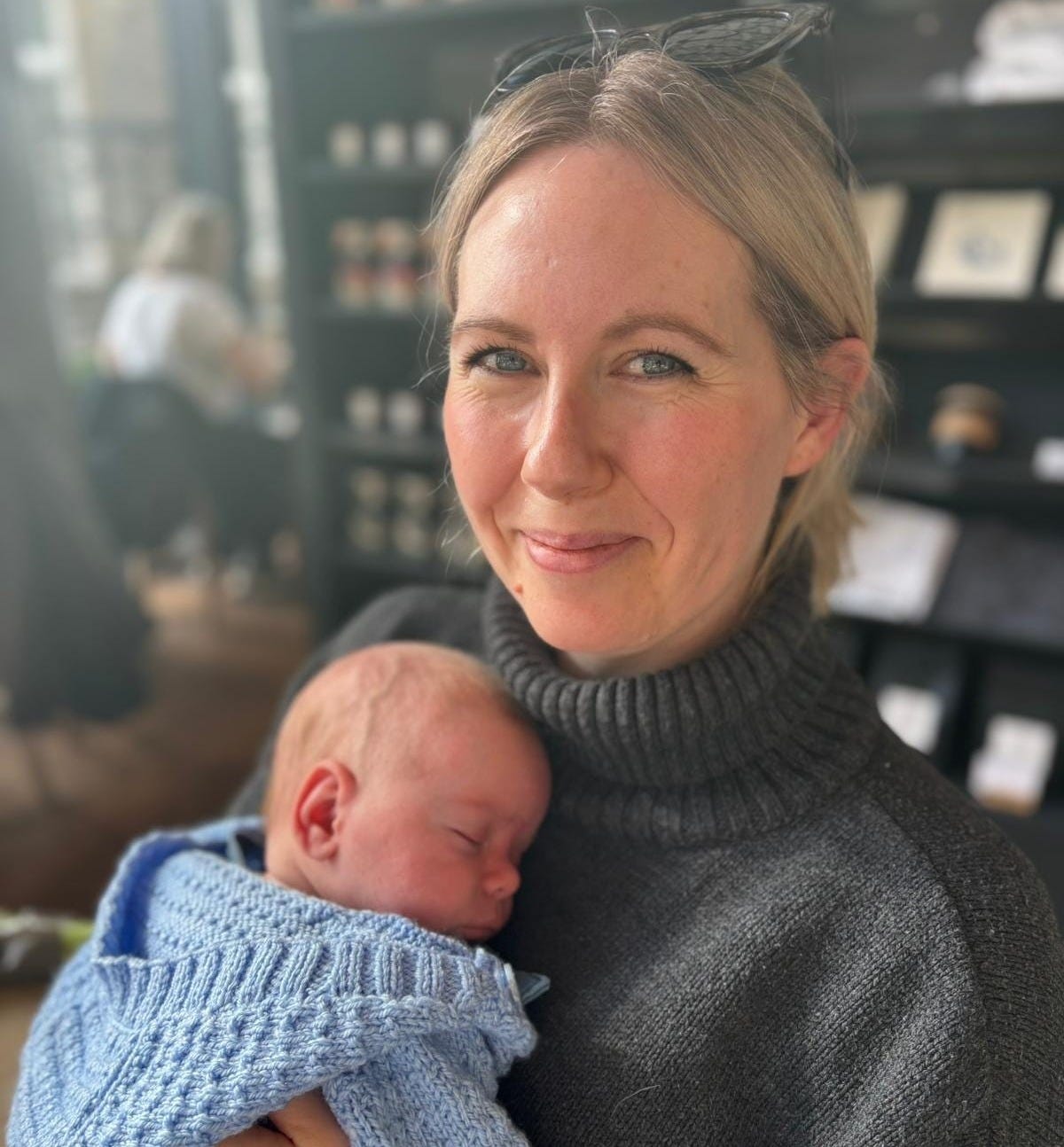
Kat has returned to work part-time – an option she was initially told on maternity leave was “unavailable” because it “just wasn’t done” in her job.
“So I was going to be back full-time, paying daycare literally thousands a month to look after my son.”
But then, following her diagnosis, she explained that the Principal of her school, along with other admin staff, pushed back on the local council that oversees education, calling the ‘no part-time norm’ discriminatory.
“Thank God they did this for me. Now, I get to job-share with someone awesome… My cancer diagnosis, while horrific, has made my return to work easier and given me the space and time I have needed.”
“To be clear, you shouldn’t need to be ill and disabled, as I now am, to be able to work part-time to raise your family.”
Kat works 3.5 days each week. She gets to school around 8:15 am after getting herself and her son ready for the day. With the fullness of each morning, and noting her need to manage her energy levels, Kat explains that she often showers at night and doesn’t spend too long with hair, etc., in getting ready each day.
“If there are no meetings after school, I leave by 4 pm to pick him up from daycare, or relieve whoever has been looking after him. Then it’s the dinner, bath, bed routine until 7.30 pm. My laptop will then come out again for admin tasks. I am also writing a book, and this is what I was doing in the evenings before I went back to work. The writing has slowed way down… My non-working days are as above, but I do not use nap times or evenings of non-working days for school work.”
She described this approach to work as being quite different to what her work life looked like before maternity leave and her diagnosis.
“Before I had my child, I was up by 6 and may have gone for a swim before work. I was dedicated to my work 100%. I worked 5/6 days a week. I was in school by 7.45 am, but I would probably have had my laptop out at home beforehand, checking to see if I had any teachers who were out sick or if an urgent email had come through overnight. I would be in school until around 5 pm, and maybe get my laptop out after dinner to schedule some emails for the next morning. At the weekends, or on holidays, I would maybe mark some essays, check some data if there was an assessment window coming up, or follow-up with parents and external partners.”
Kat shared that nowadays she sees that work isn’t everything – that a promotion is not going to make her life better or happier in any way.
“I am happy in the job I have... I will not gain more satisfaction from it – I can see that. I used to think taking on more responsibility would make me feel an even greater sense of achievement, but spending time with my son and watching him grow does that for me.”
“I’m more boundaried now. I can’t and won’t be working weekends unless there is some real crushing emergency. My son comes first and always will.”
Though now, as a mother, Kat also finds herself even more invested in the outcomes of young people.
“I hope he has teachers who care enough about him to give him the best possible education.”
I asked Kat where she’d like her work life to go. She shared that previously she had wanted to continue her career into senior leadership, like a Vice Principal.
“But not now. I have no desire to take on more responsibility within a school. The emotional and mental load would be too much. If I were to change roles, I would move into academia. I am about to complete my Masters, and I hope to take on a PhD. If I were able to move into a university and teach there, I would. But jobs are hard to come by as education funding is cut year on year. My current role will never be cut, so I am in a safe place.”
When it comes to the support that makes her work possible, she described a combination of strategies.
“When I am at work, my husband has my son for one day, daycare has him for two days, and my dad (who is 77) has him for one morning. We couldn’t afford more daycare, and I wouldn’t want him to be there any more anyway. My husband has become self-employed to enable him to work 4 days. His old employer would not allow him to have flexible working, either for childcare reasons or to look after his very sick wife.”
I asked what happens when that support isn’t available, to which she responded that they haven’t encountered it yet, though noting that in nearly all circumstances, it would fall to her to care for her son.
Kat mentioned that she doesn’t have a “village”, so to speak, being an only child whose mother had previously passed away. Her in-laws also don’t live nearby.
When she received her diagnosis, she said that it was hard to work out who to tell.
“I had a few friends I had made through baby classes who were new friends. I relied on them heavily, but I didn’t really know them. It showed me how important it is to have friends from all walks of life and for all seasons.”
“The women who showed up for me? Honestly? My childless friends. I think the mums amongst us found the idea of being a new mum and having cancer too hard to bear.”
Kat’s diagnosis came when she was nine months postpartum and getting ready to return to her paid work. She mentioned that because of the timing, she reflects on many of her postpartum challenges being mixed in with cancer challenges.
“I’m so fatigued it’s unreal.”
She described that managing the normal tiredness that comes with new motherhood, while also being in constant pain, as “hard” – which, honestly, I cannot even begin to comprehend.
“There is also something in the idea that all symptoms lead back to the postpartum period and tiredness/being run down, much in the way that all symptoms women experience can be written off as ‘normal’ parts of the menstrual cycle, menopause, or just having a uterus. I do wonder if women in the postpartum period need closer monitoring of their health, as we are certainly not immune to cancer and other diseases just because we’ve just had a baby.”
Once diagnosed and in treatment, Kat shared that she had to wean her son sooner than she would have liked because of both the painkillers she needed as well as the energy breastfeeding was demanding of her body.
“The resulting fatigue – and subsequent hospitalisations – meant that I wasn’t able to put my son to bed for 6 months. This ‘loss of work’, if you will, felt so anathema to everything I had been and wanted to be as a mum. Bedtime and soothing him to sleep were so important in the first 11 months of his life that to have that aspect of my mothering taken away for so long was disconcerting.”
The “loss of work” she describes here, being that of her desire to do the physical work of mothering, was also often replaced by the work of managing her cancer treatments – while also doing the invisible work of mothering.
“There was major work involved in organising childcare – both formal with daycare, and informal with friends and neighbours – to allow my husband to come to all of my appointments and treatments with me. My medical team were very understanding and allowed me to move chemo/radio appts later in the morning to allow for a daycare drop off.”
“And lastly, even when I was very ill, bedridden, in hospital, a lot of the mental load of mothering continued. Before I went into the hospital for my first 21-hour surgery, I filled the freezer with meals, baby banana bread and veggie muffins. I read daycare reports, asked questions about what he was eating, ordered him clothes in the next size up, all from my hospital bed, making sure that the logistics of motherhood continued. Would my husband have done it? Maybe. But I felt like I both needed to do it, to ensure that it happened, and I felt like I had to because it connected me back to him when I couldn’t be with him.”
Kat raised an interesting point here that I think is often overlooked in dialogues around the “mental load” – which is, for many women, this “load” is their way of connecting to the care of their children when they are being asked to exist in systems that require separation.
Though I don’t think the “choice” of it as a connection point makes it any less heavy, or any less deserving of recognition from those around us.
Kat shared that having “47 tabs” open in her mind – in another window from the work tabs – is what she feels continues to be invisible in her work of mothering.
“The only parts that feel visible to others are when I am interacting with my son – the rest isn’t seen or acknowledged.”
She described this as being not dissimilar to the invisible work of her paid work.
“I teach 18 periods of English a week, which all need to be planned, and then the work needs to be checked. I also quality assure other teachers’ practice, do performance reviews, provide lessons when other teachers are out sick, check report cards for my 16 members of staff, deal with all discipline and wellbeing issues in the faculty, communicate with parents, keep senior leaders informed, plan the curriculum (for each year group - we have 6), liaise with external providers, involve support teachers for those with additional needs. I could go on. The only part of my job that is visible is the 18 periods of teaching.”
In both her paid work and her unpaid work in mothering, Kat also feels like her roles are so often doing all the “hard work” for success, and that her involvement in the successes are rarely celebrated.
“When things go wrong, the buck stops with me. When things go well, we celebrate the class teachers. I am happy to share the success – I absolutely do not want accolades for someone else being a good teacher. But I wish it were recognised that it is my job to facilitate their job. If I weren’t treading water manically at all times, they wouldn’t be able to calmly teach a really engaging lesson about poetry.
“In mothering, I feel similarly. It is my ‘fault’ if he falls and bumps his head, or has a rash, or catches a virus. But when he learns new words, or can climb to the top of the climbing frame, or can count to 10, we celebrate him. I do not want a medal! But that is also me. Encouraging him, teaching him, helping him understand. I did that too.”
In writing up this interview, I keep thinking of a line that Tyece Wilkins-Amadi shared in last week’s interview – of when mothers have paid jobs that are not “emotionally neutral”, and how that carries into the unpaid work of mothering.
Kat echoed this sentiment when I asked her about the hardest part of her work.
“The emotional part of working with thousands of young people. I personally teach around 200 students a week. For some teachers, it can be more. I am responsible for the outcomes of around 1500 students. That is a weighty responsibility. If I get it badly wrong, there will be lifelong consequences for our students. Qualifications and literacy skills are the key to a successful life, and for me, there is nothing more important. At the same time, I am responsible for emotionally regulating teenagers who are not able to do it for themselves. Some can, but not all. Some are extremely volatile and hostile. This can be hugely draining.”
“With mothering, it is the unexpected nature of toddler emotions. Will he like pasta today? Don’t know! Will he play nicely with this new kid at the park? Who knows? The unpredictability makes me feel on edge. People say ‘take it easy, he’s just a toddler’ Sure, but it’s me who gets stared at when he has a meltdown because I won’t let him climb into a storm drain.”
So, what keeps Kat doing the work she does?
“This is two-fold at school: I love seeing students succeed, especially those from the hardest of backgrounds. Pupils who struggle with the effects of poverty, or who have arrived as refugees, or who have navigated the care system their whole lives. When those kids succeed, which can look very different for each kid, I feel such a sense of purpose. I remember why I do what I do. Similarly, I really get a kick out of long-term planning. I’ve been doing this job (in different schools) for many years, and I know how important long-term curriculum management is. If we get it right in the early years, it has a transformative and compound effect by the end of school. I like making changes that make staff’s lives easier and ensure success for our young people. It means having all the tabs open in my brain is worth it.”
“With my son, I love seeing his brain developing and him getting better every day. It’s fascinating, I can see him working things out and concentrating when I explain things. It makes my heart swell to see him become his own person.”
Kat described her decision to return to paid work as being both a choice and a financial necessity for her family’s current living situation. She noted that if they did have to live only on her husband’s salary – as they have for the past 2.5 years – that she would genuinely miss her work.
“I have missed it over the past 2.5 years. I’ve been a teacher for 18 years, and it is part of my identity. I want my son to grow up seeing that women can be fulfilled outside of the home. That it is possible (although hard) to be a good mother and a good ‘worker’. That having a job that you love and is meaningful is as important to women as it is to men. I think a lot of grown men forget this, and I do not want my son to grow up and be one of them.”
On the financial point, she shared that following her diagnosis, a major issue around work was the financial aspect.
“Like many new parents, we had gone through our savings while I was on maternity leave and had been waiting for my salary to kick back in. And just like that, it wasn’t. Luckily, I went straight on sick pay, but I know this isn’t always going to be the case for others. Healthcare is free at the point of use in the UK, and for that I am very grateful.”
Later in the interview, Kat noted maternity leave payment as being something she would change about how society treats mothers.
“Maternity leave should be a full year paid. End of story. Mine, in public sector teaching in the UK, was 3 months full pay, then 6 months Statutory Maternity Pay (or 33 weeks at £190 a week). This is great compared to the US, I know. But a friend of mine who works for a private equity firm had 6 months full pay, 6 months half pay. Similarly, our 2 days a week of daycare cost us £715 a month.
“A government cannot say it values mothers and raising families (in a climate of falling birth rates) if childcare and maternity leave send families into bankruptcy. Mothers who choose not to work should also have access to more support with free or cheaper activities so they can meet other mothers and children.”
I hesitate to centre my own emotions here, but in wrapping up this interview, I am flooded with emotion reflecting on what Kat has been through over the past couple of years. All the work she has had to do to arrive here in prioritising her son, showing up in her paid work, and recovering from cancer.
I’m struck by the load she’s carried, and how even in the hospital, her work as a mother continued – in part by necessity, sure, but also out of choice – a choice to continue showing up every day as the mother she could be.
I am so deeply grateful to Kat for sharing her work life, in its many forms, with us.
As Kat mentioned earlier in this interview, she is currently writing a novel and also shares her experiences and writing on her Substack publication, “From Inside Out”. Her writing is moving – but she has a talent for making you want to smile and chuckle a bit, too. What a gift that is.
With care,
Kiya
How Mothers Work is a new series of interviews exploring all the ways mothers work — both paid and unpaid. The goal is to make visible the many paths mothers navigate, and to show that no path is linear. In these interviews, I hope mothers see their own possibilities reflected in others, and that partners, employers, and friends come away with a deeper understanding of what mothers are actually experiencing when it comes to work.
Thank you for reading! Subscribers of Promoted to Mother receive 1-2 essays each week on motherhood and the work we do – paid, unpaid and the internal work too. My essays blend personal experiences, interviews and my PhD research on the topics.
If you’d like to support that work, you can choose a paid subscription for $5 a month, or leave a coffee tip here. Paid subscribers receive research deep dives on motherhood and work, along with quarterly resources.
Comments
Nothing yet. Say the first thing.
Sign in to join the conversation.