

Whether it’s football stickers in the UK or baseball stickers in the US, kids have been buying, coveting, trading, swapping and sharing collectibles of their favourite sports icons for decades. With the arrival of the World Cup comes the excitement of a new sticker book to complete and the expectation that every new packet of stickers purchased will fill in gaps in the album, taking you one step closer to completion.
But as the tournament progresses and your collection grows, it seems harder and harder to fill those elusive gaps – to find the missing shiny or the obscure defender. Buying a new packet that yields only swaps with no new gap-filling stickers can feel like throwing money down the drain. The despondency can leave many, initially avid collectors, to question how much it will cost them to complete the album and many more to abandon their collection before reaching the end.
So how much should it cost to complete an album? Well that depends on your strategy. If you are planning to simply buy packet after packet to complete your set then you’re going to have to have deep pockets. The 2026 Panini World Cup sticker album comes complete with 980 different blank spaces to fill. With each pack of seven stickers costing £1.25 you’re looking at a minimum possible outlay of £175. But this would require each sticker you find to be a new one, with no swaps, and while this is a statistical possibility, it’s so astronomically unlikely as to make it practically impossible.
In reality, for each gap we want to fill, we are going to have to buy multiple stickers. The first sticker we get is guaranteed to be completely new to us, so the expected number of stickers we need to buy to fill the first empty spot in the book is just one. To fill another spot in the album our next sticker can be any of the 979 stickers we haven’t already got, which happens with probability 979/980. This means that on average we will need to buy 980/979 (just over one) stickers to fill this next slot. And so the trend continues with the next spot needing 980/978 stickers and the one after that requiring 980/977 stickers on average.
Because these numbers are all quite close to one, it’s likely that we won’t get any repeats for a while. However, as we draw closer to completing the album, the expected number of stickers we need to buy to fill the next gap balloons massively. We find the penultimate sticker, which is only one of two that we don’t yet have, with probability 2/980. This means we need to buy 980/2=490 stickers on average to fill the penultimate gap. The last sticker is even worse. On average we need to buy 980 stickers to find the elusive one we are looking for.
Adding all these up, in total we would expect to have to buy

stickers at a cost of £1307.50 (remembering you have to buy stickers in packs of 7).
In general, if your sticker album contains spaces for N stickers, then you will need to buy

stickers, on average, to complete your set.
Share Kit Yates - Math(s) and the real world
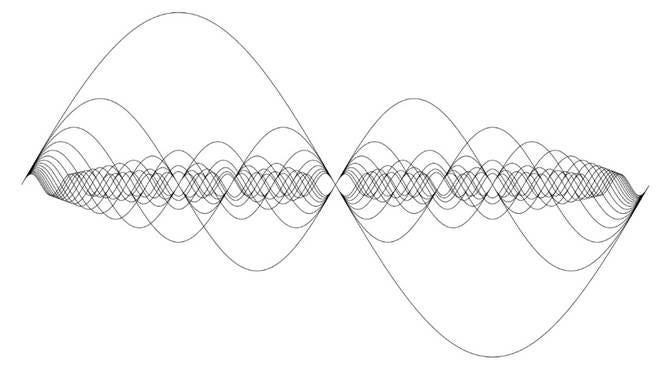
The diminishing set of fractions inside the brackets are a well-known mathematical object called the ‘Harmonic Series’. The name comes from the concept of ‘overtones’ or ‘harmonics’ in music, which give each instrument its distinctive sound. The fundamental frequency of vibration of a string determines its basic pitch. The string’s harmonics have frequencies that are whole number multiples of the string’s fundamental frequency – that is to say they oscillate 2, 3, 4 etc times more often than the fundamental wave does. Correspondingly, the wavelengths of the harmonics are 1/2, 1/3, 1/4, etc of the string’s fundamental wavelength (as illustrated in the image below).
The formula we found for completing the sticker album crops up in a huge variety of different areas because it relates to the cost or effort required to fully explore an unknown set. In market research if you want to sample the full range of different consumer preferences then the harmonic series tells you how many people you will expect to have to survey. For DNA sequencing, where DNA is broken into fragments, sequenced and then reassembled, the harmonic series helps you approximate how many fragments you should expect to sequence before you have coverage of the whole genome.
Thanks for reading Kit Yates - Math(s) and the real world! This post is public so feel free to share it.
In ecology, scientists use the harmonic series to estimate the number of species in a particular habitat. The underlying theory is not dissimilar to the sticker album filling problem. Imagine there are a number, N, of species in the ecosystem the scientists are studying. Each time they observe the system they note how many different species they find. If it were a collector’s album of species then the question would be ‘how many observations would the scientists expect to make before they observed all N species?’ Instead, since the number of species in an ecosystem is not known in advance but something we would like to know, the problem is often the other way around: given that I’ve seen a certain number of species from my observations of this ecosystem so far, how many are still out there that I’ve not seen. The harmonic series is key to estimating the distribution of this unseen biodiversity.
Heading back to our sticker collection problem, the harmonic series formula not only tells us how much it will cost to fill a sticker album, but also explains why it is so much more satisfying (not to mention quicker) to fill the first half of the album than the second. To fill the first 490 gaps of a 980-sticker album we would expect to have to buy just 679 stickers at a cost of £121.25. But to fill the second half we would need to buy another 6637 stickers, at a cost of £1186.25.
If we thought it were going to cost us well over £1000 to fill our sticker albums then we’d probably never even buy them in the first place. In reality, once you start to get duplicates then you can begin to swap them with your friends, filling in the gaps in both your albums. There is a mathematical formula relating to the harmonic series which can tell you how many stickers you and your friends would need to buy to complete all your albums, but it’s complicated. Imagine you’ve got 10 friends who are all collecting and you want to build up 11 complete albums (one for each of you). With our 980-sticker album example, you would need to buy roughly 26,230 stickers, which works out at roughly 2385 stickers each at a cost of about £426 – a substantial saving compared to the £1300 you’d spend collecting alone. Even with just four other friends, the cost would come down to £533 each – still a substantial saving.
Even without the help of your friends, once you get close to the end of your collection, you can usually head to the Panini website and order any missing stickers. They typically cost you twice as much as a normal sticker and there’s a strict limit on the number you can purchase. If you’re interested, the most cost effective way to complete the album would be to collect the first half (490) of the stickers by buying packets at a cost of about £121 and then to order the rest from the website for about £175. This would set you back £296, which isn’t too far from the minimum possible outlay of £175. Whether Panini let you order the 490 missing stickers directly is a different matter.
Of course, in this modern age, you can collect your ‘stickers’ in an online album. There’s no need to go to the shops to buy your sticker packets, no call for spending time swapping with your friends and no requirement to painstakingly stick the stickers into the album in the right place. But where’s the fun in that?
A version of this article was originally published on BBC Futures.
Comments
Nothing yet. Say the first thing.
Sign in to join the conversation.