
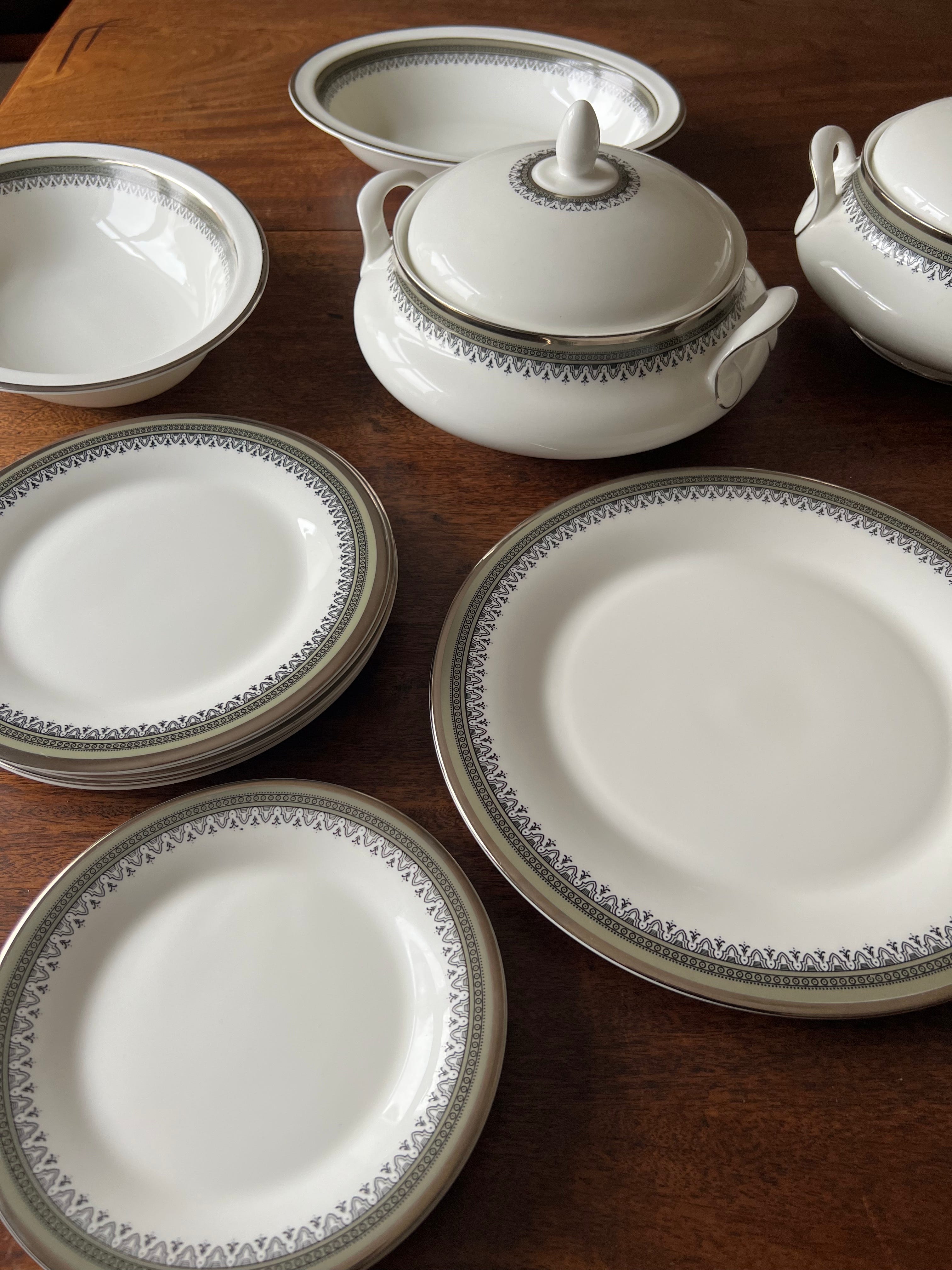
Roopa Gulati’s Royal Doulton Braemar china dinner service
Do you have anything in your kitchen which is too special or precious or beautiful to use, except on certain rare, ritual occasions such as Christmas or Thanksgiving? Perhaps it is something inherited from a parent or grandparent who taught you that the world might end if these lovely things were ever to smash. Or perhaps it is an expensive gift and you don’t quite feel worthy of it yet.
It’s curious how beholden we can feel to inanimate objects. Perhaps your object is something special you bought for yourself long ago in one of those shops with big signs up saying ALL BREAKAGES MUST BE PAID FOR and DON’T TOUCH. As a clumsy child, those signs used to put the fear of God into me. Clutching my mother’s hand, I couldn’t breathe easy until we were out of the shop.
Maybe you feel you need to be extra careful with some drinking glasses or a certain set of china because it was a wedding gift (and maybe the wedding was yours). Or it could be something that belonged to a dear one you have lost and there is something about keeping the object safe which makes you feel the person is still alive.
Whatever our reason for saving things for ‘best’, what we are doing is saying that at some level we are worth less than the object itself. We are keeping our lives on hold for some moment on the horizon when we are finally worthy of the ‘best’. But what is a beautiful object without a person to admire its beauty? The crazy part is that the ‘for best’ mentality leads us to behave in self-defeating ways around our own possessions.
I sometimes remember a special bone china teapot my mother bought for herself. She was so proud and happy when she brought it back from the shop. Buying it was an act of generosity to herself but sadly one that she couldn’t quite follow through on. As the months went by and she became so terrified of washing it up too vigorously that it developed deep brown stains from the tea. The irony was that the special teapot was now less special than her everyday teapot because it was less clean.
Among younger generations, precious china doesn’t have the same cachet that it once did. But the ‘for best’ mindset remains. When I went on The Splendid Table podcast earlier this year to talk about my book THE HEART-SHAPED TIN with Francis Lam, he said he had once spent way too much money on some shoes which he then didn’t really wear because they felt too good and he sometimes realised that by not wearing them, he was wasting his own money.
Whatever the object and the reason, I am here to say that you have permission to use the beautiful things right here and right now, as freely as you wish. Now is the best time because (if you’ll forgive the morbid thought) now may be the only time.
The fullest way you can possibly honour the person who first made or bought those lovely objects (even if that person was you) is to use them to brighten your everyday life. You are allowed to use the best china now. Unless you actually don’t really like it that much. In which case you have full permission to give it away to someone who likes it more than you do.
Someone who has taught me more about this subject than anyone else is Roopa Gulati, the British-Indian food writer. Many of you who have read THE HEART-SHAPED TIN have told me that your favourite chapter was the one about Roopa and her family dinner service. There’s an excerpt below for paid subscribers (and thank you).
Growing up in Cumbria, Roopa was taught by her parents that nothing was more special than the family’s Royal Doulton set of china which had been purchased with great ceremony and cost. It’s a very elegant pattern - see the photo above. Roopa thinks that, consciously or not, the design with its olive-green ring and geometric patterns may have reminded her parents of the Mughal designs of northern India.
As a child, Roopa found these plates both beautiful and scary. She remembers how her mother - the only Asian woman in their village - would lay the table for a special dinner two days before the guests arrived. The plates looked so beautiful shining in the light. But Roopa also remembers the pit she felt in her stomach at the idea of breaking so much as a single side plate. Neither she nor her siblings were allowed to wash these plates up; her father always washed them and her mother always dried them.
After her parents died and Roopa inherited the plates, she found that she still couldn’t use them. The thought of any of this lovely set smashing was unbearable. ‘It would be a bit of my mum and dad gone’, she told me. I noticed that she was talking about her tableware as if it were alive; and I realised that I felt the same about many of my own plates, especially the ones I associated with my family.
It was only after Roopa’s husband Dan was diagnosed with a brain tumour that Roopa suddenly started worrying about the unused plates up in the attic. She suddenly couldn’t bear to think of the china having a life ‘half-lived’. With Dan in hospital, she got the Braemar out of storage and started using it every day for her ordinary solitary breakfast of toast and marmalade.
Thanks to the plates, these ordinary breakfasts became a way to celebrate her own existence and the fact of life itself, which now felt so precious, with Dan so ill. Roopa told me that she had a strong urge for these special plates to hold different foods and witness more conversations.
Last weekend, two years on from our conversation for the book, I had the great joy of returning to Roopa’s house and eating from these beautiful plates again. It’s hard to describe how celebratory it felt to be there eating Roopa’s lamb biryani made smoky from charcoal wrapped in betel leaf, served with yoghurt and a chopped salad. The softness of the lamb and the rice and the warmth of the spices were exquisite. And the plates shone silver against the pink of Roopa’s tablecloth.
If you are still hesitating over using your special object, I want you to remember the look of joy and celebration on Roopa’s face here! (And notice the lovely Braemar tureens on the shelf behind her).
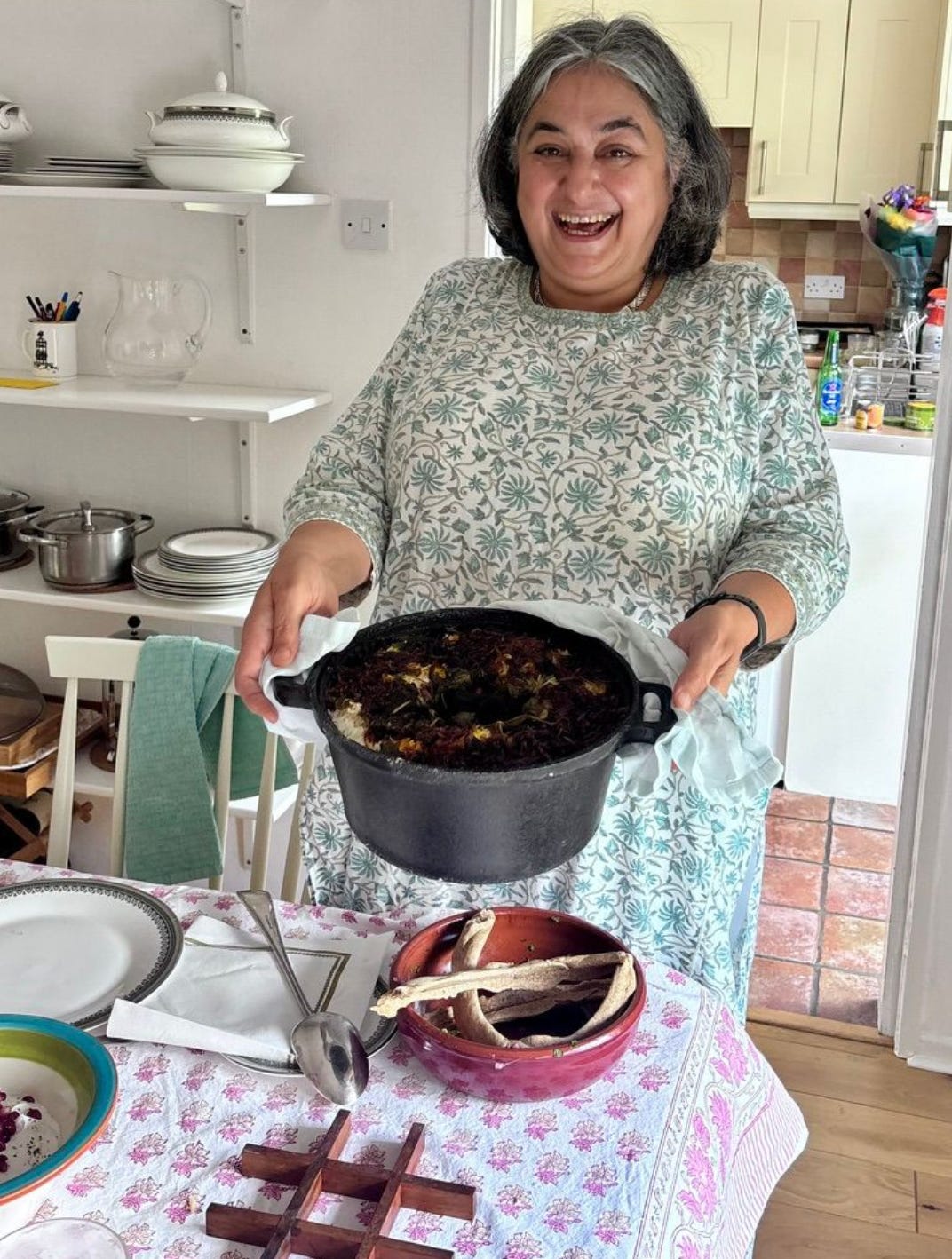
Roopa has had a lot to celebrate this year. Her wonderful cookbook INDIAN KITCHENS has won not one but two food writing prizes.The most celebratory thing of all was to have Dan there at the table eating with us, along with two of Roopa’s closest friends.
Among the other wonderful things Roopa made were:
Comments
Nothing yet. Say the first thing.
Sign in to join the conversation.