
Welcome to Until Golden. Thank you to everyone who subscribes to this newsletter, whether paid or free. If you’ve not yet subscribed, you can do so here!
How are you holding up in the heat? I’m sending you cooling thoughts and hope you are not wilting too much.
I am one of those strange people who seems to get more hungry in hot weather rather than less. When I hear others say they can hardly nibble more than a slice of melon for dinner on a hot day, I feel out on a limb. On hot evenings, I find myself craving strong, salty, savoury dinners. I want salads, yes, and cold soups and icy juicy fruits, to be sure. But on the side of those salads, I crave hearty plates of rice and crispy potatoes and warm flatbreads and salty cheeses and so many other foods besides.
Apparently, getting hungrier in hot weather is a thing, even if it doesn’t seem to make much sense.
As a general rule, hot weather suppresses hunger. There’s a clue in the fact that humans are warm-blooded animals. As A.W. Logue wrote in The Psychology of Eating and Drinking, if you want people to eat less at a summer dinner party, just ‘turn off the air-conditioning’. A 1947 study found that there was a huge difference in the calorie intake of soldiers in hot regions versus soldiers in cold regions. As summarised in this paper on the effect of heat on appetite, ‘Troops stationed in the tropics ate on average 3100 calories, whereas arctic troops ate 4900 calories; in both cases, troops were allegedly offered as much food as they wanted’. One of the many functions of food is to raise body temperature so it’s perfectly logical that in hot weather we would lesson our intake to keep our bodies cooler.
But nothing is as strange or as varied as human appetite and some of us seek out more food rather than less in the heat and the sun. If you are a man, newish research shows that one of the effects of UV light can be to increase what scientists call ‘food-seeking behaviour’. It seems that this works in male bodies by increasing a hormone called ghrelin which regulates hunger. The reason women react differently to sunshine is because estrogen blocks the elevation of ghrelin levels in response to UV radiation.
A more universal reason why some of us want to eat more in the heat may simply be that we are confused about whether we are hungry or thirsty. Hunger and thirst are complex and inter-relating drives. Whether you are a human or a mouse, science suggests that when you are dehydrated, it’s easy to mistake your thirst for hunger and choose extra food when what you really needed was more water. Obvious as it sounds, I’m finding that my summer-hunger has lessened slightly since I’ve started reminding myself to drink a huge glass of water several times a day. Salt craving could be another reason for seeking out large portions of savoury food in the heat. We lose electrolytes including sodium when we sweat, which drives some of us to seek out salty foods in the sun.
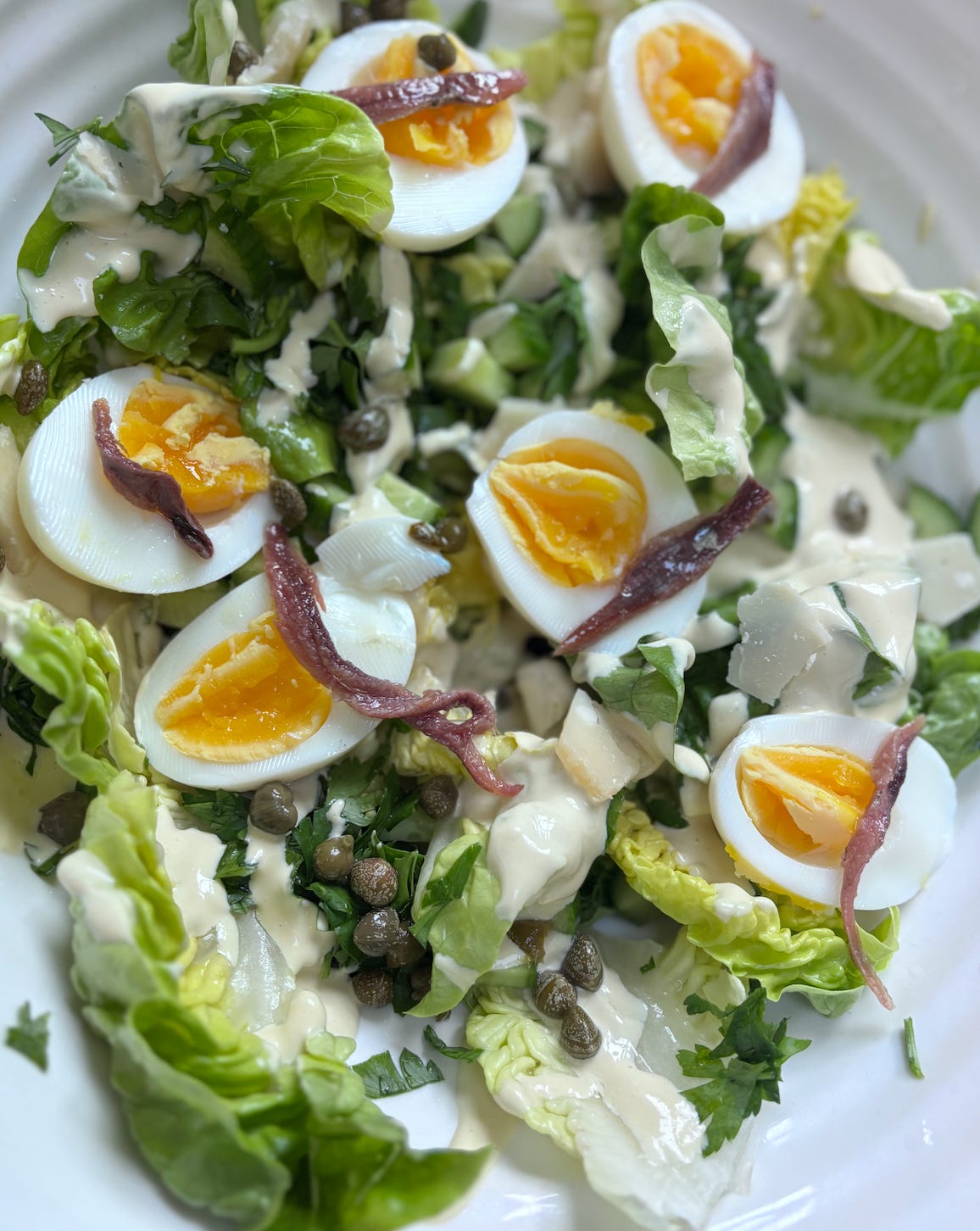
Whether your appetite is smaller or larger on these hot evenings, I hope you will love this Caesar-ish salad as much as I do. It’s crunchy and umami and deeply satisfying . For anyone who craves salt in the heat, the anchovy-rich dressing is divine (vegetarians can double up on capers instead of the anchovies). I add Dijon to the dressing for bite and a spoonful of cream to mellow things out. This makes too much dressing for one salad but that can only be a good thing, given that this pale Parmesan-rich emulsion is divine not just with lettuce but as a dunking vehicle for raw vegetables or in any summer sandwich.
The boiled egg and capers are just what I want to turn a Caesar-ish salad from a side dish to something more filling and sustaining. It surprises me that there are so many variations of chicken Caesar salad in the world and so few made with boiled eggs, even though eggs go so happily with anchovies. After all, the eggs in the dressing are one of the very few elements in a modern Caesar salad that were actually there in the original version.
A ‘Caesar salad’ tends to be thought of as a classic American salad made with anchovies and lemon. Yet there were neither anchovies nor lemon in the original Caesar salad and the dish was invented not in the U.S. but in Mexico. The original Caesar was made with Worcester sauce, whole coddled eggs and lime not lemon. The Mexican food writer Carolynn Carreño has described eating the dish as a child in the 1950s and remembered that it was definitely made with small Mexican green limes. The Spanish word limón can mean either lemon or lime. There would also have been garlic, oil and Parmesan, and it was all tossed together with Romaine and croutons (that much has remained the same).
In theory, the salad was invented in Tijuana in 1924 at Caesar’s Restaurante-Bar. The most commonly told origin story is that the owner, an Italian immigrant called Caesar Cardini, was running out of food on July 4th (Independence Day) when he improvised a new dish to please his American customers. This ur-Caesar salad was originally tossed to order by waiters from a salad cart. It contained no anchovies because Caesar did not consider them to have a subtle enough flavour. Customers loved the drama of having their salad made tableside. The salad had soon become so popular that film stars from Hollywood including Clark Gable travelled to Tijuana just to try it. The fact that they could also get Mexican alcohol during a time of Prohibition in America did not hurt.
Sadly, the original Caesar salad recipe has not survived. The closest we may come to recreating it is the testimony of food writer Julia Child who wrote that she could ‘personally attest to the authenticity’ of her recipe having had it made in from of her at Cardini’s in Mexico many years earlier. Julia followed Caesar Cardini in using Worcester sauce and no anchovies. Then again, there’s doubt over whether Caesar is the one who actually deserves credit for the salad’s invention.
In some versions of the origin story, it was created not by Caesar but by a young employee at his restaurant called Livio Santini. A third theory is that the real inventor was Caesar’s brother Alex, who had been a pilot during the First World War. Alex’s name for the salad was ‘Aviator’s Salad’. According to Diana Kennedy, who wrote about the food of Mexico, Kennedy wrote: ‘First known as Aviator’s Salad, it then became popularly known and copied as Caesar, but I shall call it as it should be called: Alex-Caesar Cardini Salad’. The thing I like about the Alex theory is that unlike his brother, Alex did use anchovies in his salad, a decision that almost every lover of Caesar salad around the world has followed him in. I’ve tried making Worcester sauce Caesars and although they have a Bloody Mary charm, I miss the anchovies, authentic or not.
I can’t pretend that my recipe here is either a true ‘Caesar’, a true ‘Livio’ or a true ‘Alex’. I use lemons not limes and don’t coddle my eggs. But I love it this way and hope it will comfort you too, one hot evening.
Comments
Nothing yet. Say the first thing.
Sign in to join the conversation.