
As discussions about trans medicine have become the subject of polarized, heated debates, I’ve noticed something curious happen with the term “gender-affirming care.” It has become ahistorical, decontextualized from trans people’s lives, and lost its fundamental meaning.
Over the last several years, many progressive allies and some trans/nonbinary people have begun to say:
“cis people get gender-affirming care, too”
Initially I thought this was a catchy slogan, pointing out all the ways that cis people can also change their bodies with medical interventions in the pursuit of body satisfaction and greater confidence. Cis men may get hair transplant surgery, or have breast removal/gynecomastia surgery; women can get breast augmentation, and so forth—these are essentially gender-related cosmetic procedures that follow from masculine or feminine aesthetic ideals. But the more that I have encountered the idea that cis people get gender-affirming care online (and even in some academic trans care papers, too), I have come to a different perspective. Always on a learning journey!
Upon closer inspection, the idea that “cis people get gender-affirming care” makes little sense when examining it alongside the history of trans medicine and psychiatry. It also discursively de-centres trans experiences and the phenomenology of gender dysphoria in conversations that are really meant to be about transition-related healthcare.
So I am here to say that, no, I don’t think cis people do get gender-affirming care.
Before I start meandering around the issue I think it is important to clarify that I recognize this rhetoric comes from a very well-intentioned place—a desire to emphasize shared humanity between cis and trans people. I wonder if, in rushing to defend trans people and in an effort to normalize medical transition, mainstream leftist discourse has started to misunderstand many trans people’s experiences.
I’m also curious to hear what others people think about the rhetoric that “cis people get gender-affirming care,” or that “cis people also experience gender dysphoria” (see example below).
Language in the field of trans medicine can be hard to get a grip on. For outsiders, and sometimes even for trans people and clinicians themselves. It’s been made byzantine because key concepts and many underlying clinical values change relatively quickly. Some of this has been driven by internet discourse. A friend once told me that there is no homogenous trans population but rather “trans micro-generations.”
I remember in 2018 when I had a paper under review and a reviewer requested that I remove the terms “HRT” and “SRS” and replace them with “gender-affirming hormones” and “gender-affirming surgery.” That was the year that the American Academy of Pediatrics published its first policy on “gender-affirmation.” I felt annoyed by this peer reviewer request because I was already using community recognized, inclusive language, terms used by my own research participants, and words that I had long applied to describe my own medical transition. But, to get the paper published I felt would have to make the changes to satisfy the reviewer. So I did it.
Gender-affirming care has since become a nebulous term. So much in fact that at a trans care conference I attended in 2023, one American trans advocate-academic presenter advised the audience to stop using “gender-affirming care” because it apparently confuses the general public, stoking fears of children getting sex-change surgery. I tend to agree the concept has become muddled and hard to pin down.
Today, gender-affirming care can refer to affirming, non-medical psychosocial supports for trans and nonbinary people that work specifically from the clinical philosophy that gender nonconformity/trans identities are not inherently disordered. But for my purposes here, I am presuming that in the “cis people get gender affirming care” parlance, we are refering to biomedical transition-related interventions like hormones and surgeries. I am going to really date my own trans micro-generation here (oh well). We used to call this taking cross-sex hormones (“HRT”) or getting sex reassignment surgery (“SRS”). There was also a brief period in the 2010s where I was seeing “gender confirmation surgery” fairly often.
Gregory Bateson once said in the 1972 book Steps to an Ecology of Mind:
“The map is not the territory, and the name is not the thing named” (italics, mine)
In a recent “Trans 101” episode produced by a YouTube channel called “Taboo Science,” host Ashley Hamer explained that “cis people can also experience a form of gender dysphoria” - just like trans people.
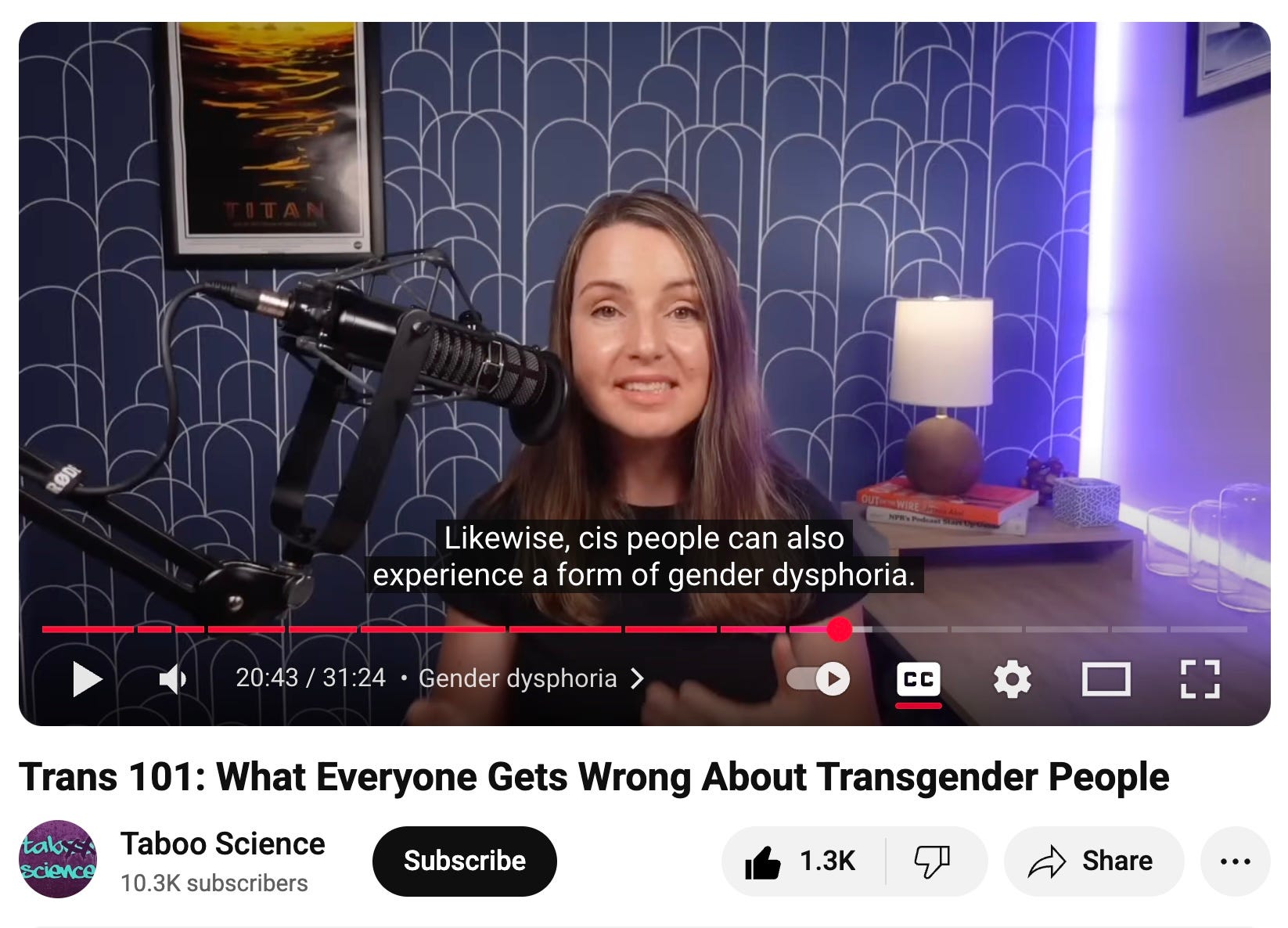
(Note: I have participated in this series and generally really enjoyed this episode as a good intro to trans stuff, including great interviews. Definitely worth checking out. I reached out to Ashley via email to ask about this notion of “cis-gender dysphoria.” She acknowledged this short 3.5 minute gender dysphoria segment was largely informed by common online discourse rather than diagnostic criteria for gender dysphoria.)
In the video, Ashley elaborated on what she meant, explaining that during puberty she had a kind of “cis-gender dysphoria” because she yearned to develop breasts and a “curvier figure.” She goes on to relate her own experiences to trans man comedian Charlie James who realized a desire to medically transition after seeing the flat chests of some cis male actors—he desired a similar aesthetic to cis men, acknowledging he wanted his breasts gone.
In other words, Charlie wanted a male chest, feeling a desire to rid himself of sex traits that were congruent with his female birth sex. He desired a male chest. Ashley’s description of “cis-gender dysphoria” is categorically different, desiring accentuated traits congruent with her female sex. (Speaking for only myself here, listening to Ashley describe her experience of puberty and an emerging desire for a feminine body shape is entirely foreign to me and it diverges profoundly from own embodied experience of female puberty.) In my view, this is the critical dimension of gender dysphoria that gets lost within the commonly shared idea that “cis people get gender-affirming care.” It loses sight of (many) trans people’s actual experiences of GD.
In the video Ashley also suggested that:
-cis people feeling sadness after cancer-related mastectomy, or orchiectomy after testicular cancer is also a kind of gender dysphoria.
To me, the examples provided in this segment don’t really sound much like gender dysphoria/gender incongruence/transsexualism at all.
Dysphoria is a general term. It refers to sadness, dissatisfaction in life, or being in a state of profound unease. The term gender dysphoria has been used in the academic trans healthcare literature since the early days, and it eventually replaced the diagnosis of “gender identity disorder” in the DSM-5 (in 2013).
Cis people may indeed be “dysphoric” about their bodies, but body dissatisfaction alone is not the same phenomenon as gender dysphoria. It may compose a dimension of it, but body dissatisfaction in GD typically relates to physical sex characteristics that humans can pick up on via sight (bodily visual cues) and sound (voice) that together lead to reading people as men or women. But sometimes these feelings about the body are disconnected from others’ perceptions, and are even present whilst alone. Trans/nonbinary people often refer to this as “physical dysphoria”.
According to a systematic review of the phenomenology of gender dysphoria, Cooper et al (2020) identified four key dimensions and sub-themes of GD:
distress due to dissonance of assigned and experienced gender:
-body dysphoria; gender distress with living in the wrong gender
interface of assigned gender, gender identity and society;
-distress due to misgendering; conflict between internal sense of self and and dominant social norms
social consequences of gender identity;
-isolation; identity invalidation from family and peers
internal processing of rejection, and transphobia
-hypervigilence relating to transphobia; internalized transphobia
For a look at gender dysphoria diagnostic criteria, the DSM-5 stipulates at least two of the following criteria should be met, leading to distress. The incongruence between the assigned sex/gender and desire to be the other gender or have sex traits or be treated as the other gender is key:
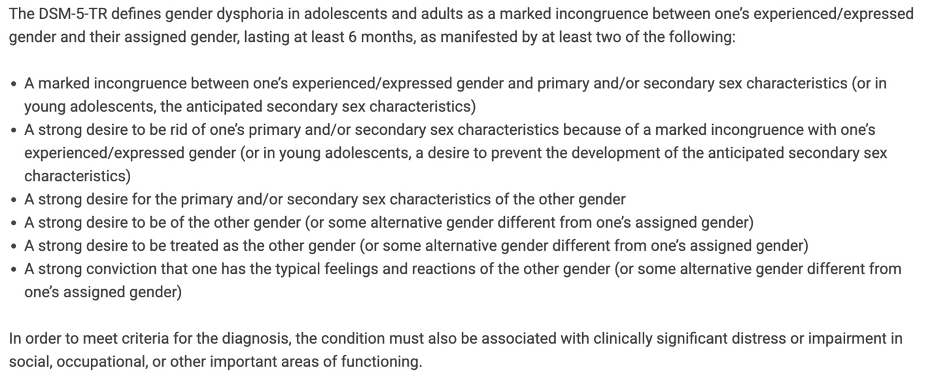
So, I am not really sure what to make of this concept called “cis-gender dysphoria.” It seems to come from a noble desire to normalize trans medicine and connect with trans people (which, again, is very nice!!!). But it falls into a trap of misunderstanding gender dysphoria/incongruence and the purpose of transition-related healthcare.
Further below, I will review some older clinical theorizing that produced the gender dysphoria construct in order to shed light on the historical development of these criteria, and why we eventually ended up with a depathologized care model called “gender-affirming care”. Spoiler: I will be engaging with 1980s psychiatry literature about identity diffusion, gender dysphoria, and transsexualism. But before I move on any further I want to state my own academic and community experiences.
Some of my perspectives may very well be idiosyncratic, but they are mine, and informed by the following:
reading a good chunk of decades of scholarship in trans medicine published from roughly the 1970s-2020s, and conducting a few of my own studies on how treatments are experienced by trans, nonbinary, and detransitioned people;
communicating with a wide range of gender clinicians who work with all ages including children, adolescents, and adults;
getting to know many dozens and of trans, nonbinary, and gender nonconforming people over the last 20 years, some older than me, some younger. Many medically transitioned, but many others didn’t;
nurturing an academic interest in the sociology of healthcare, history of medicine, and psychiatric nosology;
being assessed and transitioning my own body via hormones, surgery, and a fervor for bodybuilding.
If I had to choose a label to describe myself it would be generally “transmasc” and sometimes “butch.” But when I started testosterone in 2010, I would have declared myself butch, genderqueer, and FTM. I once jokingly said I was female-to-muscle (not female-to-male).

If enrolled in my own study, I would probably end up coding myself nonbinary rather than binary-trans. All that said (and despite what may be portrayed in the above image) I can’t say that I’ve ever held a male gender identity. My transition had less to do with feelings about “gender identity” but instead was driven by a strong and long-standing drive to masculinize my body. These feelings, combined with a childhood of behaving and expressing my gender in more stereotypically “masculine” ways, were probably why I ultimately decided to transition (about 16 years ago). And I pursued those desires to their fullest. Some people would call that transsexualism and I wouldn’t disagree.
I’ve noticed that some people within gender critical, anti-psychiatry, and even some folks in pro-trans circles are skeptical that gender dysphoria exists. Some suggest it may be more of a cultural artefact and the result of pathologizing “deviant,” non-normative sexualities and it’s ultimately a social construction. For similar reasons, together with the history of gatekeeping trans medicine and intracommunity trans/nonbinary politics, the subject of dysphoria and “true transsexualism” have become controversial within some sections of trans/nonbinary communities and especially in online discourse. For a more comprehensive discussion about pros/cons of even researching gender dysphoria in trans care research see: Trans Care 101 “We’re Thinking About Transition Success Wrong: The Case for Dysphoria.”
These debates aside, there is a substantial body of research demonstrating the empirical reality of gender dysphoria from decades of clinical research and trans community insights. Lindley and colleagues (2024) conducted a fascinating analysis on sociocultural messages about gender dysphoria dimensions, and how trans and nonbinary people experienced various aspects of dysphoria themselves, often in more nuanced ways than is portrayed by popular discourse.
For many trans people, hormones and/or surgery can help to relieve dysphoria and improve quality of life. Some of that is because of what the interventions do to the body, and some of it is because of “society” (and sex/gender norms). I have known several trans people who would not have medically transitioned had it not been for years of constant misgendering. They couldn’t pass without hormones and it was causing them a lot of stress and anxiety. Historically, some trans/gender nonconforming people of the mid to late twentieth century transitioned for economic reasons, to pursue work. Not necessarily because of their embodied desires or “gender identities.”
The term gender dysphoria also made many appearances in psychiatry writing from the 1970s-80s, describing not only transsexuals but also homosexuals, bisexuals, and other gender-variant people. Old-guard psychiatrists wrote a fair bit about gender nonconformity and homosexuality. Back then, gender dysphoria was not exclusively applied to those who wanted to medically transition, it was also used to psychopathologize gender nonconforming behaviours and sexual orientations.
Introducing the syndrome of identity diffusion, Salman Akhtar in 1984 listed gender dysphoria as one of its six key clinical features. Gender dysphoria—I’m paraphrasing Akhtar here—occurred in those who lacked sex-appropriate demeanour, including patients who seemed not to possess a clear sense of belonging to one sex over the other; they displayed nonconforming gender roles and sexual behaviours, and were often in same-sex relationships. Akhtar noted that many people “seeking sex-reassignment surgery display borderline personality organization” and that gender dysphoria frequently co-occurred alongside identity diffusion (p. 1383). Examining gender variant people and transsexuals was fundamental in the early development of knowledge about identity diffusion and the borderline personality construct. Consider also that homophobia was rampant in society and within the healthcare system at this time. Anita Bryant’s campaign to save children from the “homosexual agenda” began in 1977. The early 1980s marked the beginning of the AIDS crisis, with the Centres for Disease Control publishing in 1981 its first report of five cases of the illness among “active homosexuals.” There were a lot of negative ideas about LGBTQ+ people in the air, and this was also inspiring more direct action from the gay rights movement.
Similar to the empirical evidence underlying the construct today, gender dysphoria has always been understood as heterogenous and not a single thing. But unlike today wherein access to transition-related care for adults has become more liberalized, much of the initial taxonomizing of gender dysphoria aimed to identify a core group of patients (sometimes referred to as those with primary gender dysphoria, or “true” transsexuals). Most of the early gender clinicians thought it was mainly the primary transsexuals who would make good candidates for sex reassignment, though this belief was variable even at the time. For example, Stephen Levine and Leslie Lothstein in 1981 wrote a paper describing what they referred to as “the gender dysphoria syndromes.” Plural.
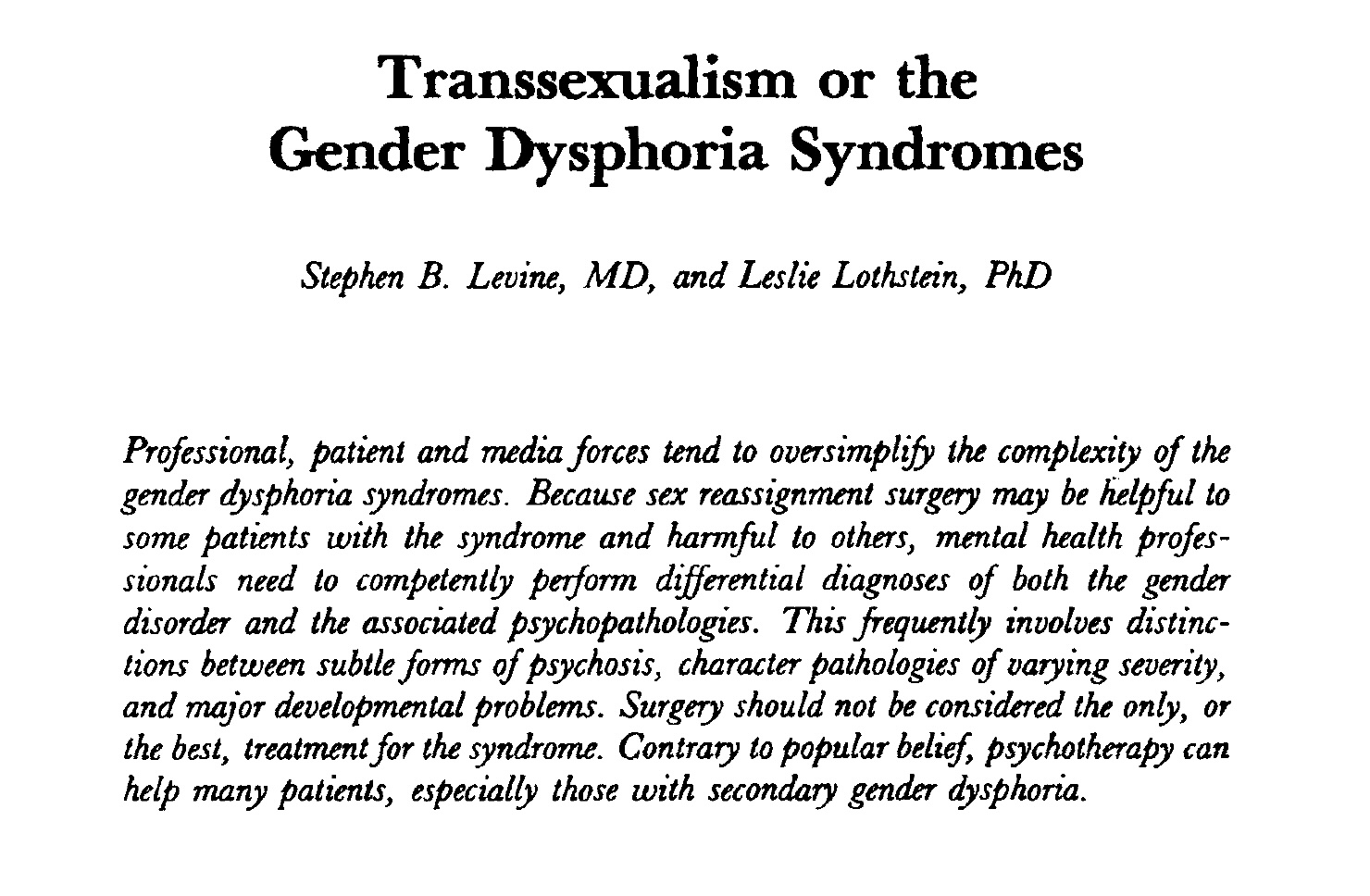
The paper is a great artefact in the sociology of knowledge underpinning gender care. It points to the ideologies of early gender clinicians and their efforts to classify patients and funnel treatment toward sex reassignment or psychotherapy. Much of this article goes into detail surrounding differential diagnoses based on patients’ gendered life histories, psychosocial functioning, sexual behaviours and orientations (e.g. heterosexual, bisexual, or homosexual; weeding out “effeminate homosexuals” from the primary GD category as they were decidedly secondary gender dysphorics). However, they also noted that “clinicians reported most of their patients did not really fit into any one category.” (p. 91).
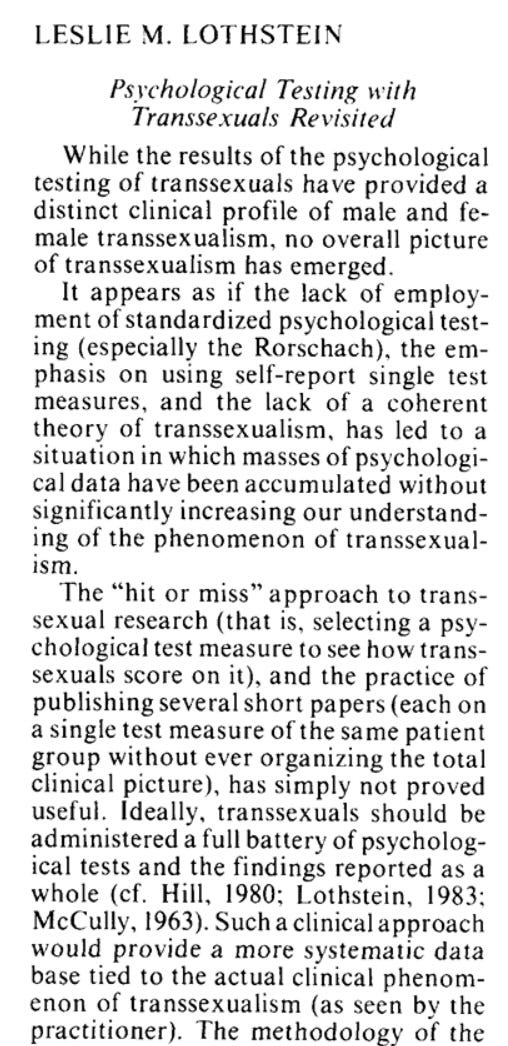
A few years after the 1981 paper with Stephen Levine, Lothstein published a review of 30-years of clinical literature on transsexualism. He ended up arguing something similar to Akhtar, maybe they were trading notes. Pointing to the lack of standardized testing, Lothstein (1984) rendered transsexualism an invalid diagnostic category, suggesting that it ought to be instead classified as a “variant of borderline pathology.” In effect he seems to reject his earlier paper with Levine that taxonomized primary and secondary gender dysphoria. A forerunner to Hilary Cass, Lothstein agonized over the unreliable state of the literature. He pointed out trans care’s disregard of “the Rorschach” in studying transsexuals, especially disappointed with the gender clinicians for deploying instead the (apparently) less reliable “draw-a-person” test (!).
[………………….]
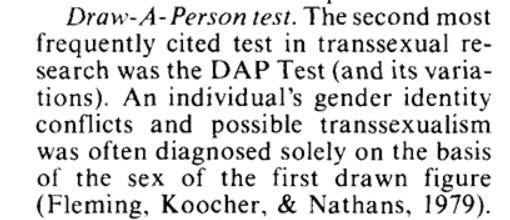
It bothered Lothstein that some trans people were apparently diagnosed as transsexuals (or not) on the basis of the sex of the first person drawn on command of the diagnostician. In the end though, Lothstein still noted transsexuals tended to show psychosocial improvements following sex reassignment.
Reading Lothstein’s 1984 review of the literature on transsexualism, I found myself wondering if many of the patients described in it might today be understood as “low-support needs” autistic trans people. (Not borderlines, as Lothstein would have it, even in the absence of the definitive Rorschach!) Lothstein notes that “transsexuals were variously seen as having a brighter than average IQ or Superior IQ (though the range of IQs varied from Dull Normal to Very Superior)” (p. 501). Over the last 15 years the intersection between autism and transness/dysphoria has been well-established, and ASD is estimated to occur among trans/GD populations between 11-30% (but perhaps this is also partly due to the expansion of the autism spectrum roughly following a similar trajectory of expanded understanding of transness and gender-diversity). Lothstein’s combined sample was composed of 699 self-identified transsexuals (81% trans women, the rest were trans men; average age, 29.4). A large majority (~95%) were white (but only 22% of the included studies reported demographic information on race/ethnicity).
So back to the issue at hand. Cis people dysphoria… The concept of gender dysphoria has never been used to describe a sole desire customize aspects of the body via cosmetic enhancements in the way it appears in common discourse circling the notion that “cis people get gender-affirming care” or “cis-gender dysphoria.” Gender dysphoria was historically developed within psychology and psychiatry to describe, classify, and in many ways to psychopathologize LGBTQ+ people’s gender nonconforming behaviours and how those conflicted with their identities and societal expectations. And also, to treat them with psychological and biomedical interventions (sometimes even involuntarily).
What eventually led to the DSM-5’s Gender Dysphoria diagnosis was the culmination of studying gender nonconforming LGBTQ+ people struggling to survive in the context of a deeply cisheternormative/homophobic world. This included trans people seeking sex reassignment to live in a “cross-gender” role but it also included other types of gender-variant folks. Decades of psychiatric nosology of gender-variance and clinical treatment of it (some good; some very bad), is what eventually birthed today’s diagnostic criteria for Gender Dysphoria and Gender Incongruence (in the ICD).
Trans and LGBTQ+ activism, responding to those societal and clinical conditions, played a large role in the paradigm shift that eventually led to LGBTQ+ affirming psychological care and later the “gender-affirming” model of trans healthcare.
Modern, mainstream conversations about “gender-affirming care” often lack a nuanced socio-political, economic, and cultural analysis about why trans people pursue transition. It has a tendency to frame transition as being about a journey to find one’s true self and to exercise bodily autonomy. Which may very well be important aspects of the transition experience for many, but it’s also why it has become so easy to draw a comparison to cisgender cosmetic enhancements.
So, is there cis-gender dysphoria? Do cis people get gender-affirming care? Perhaps. But only if we primarily understand gender-affirming care as aesthetic self-actualization, untethered from decades of LGBTQ+ political struggle, and disconnected from the phenomenology of gender dysphoria that many trans people do indeed experience.
Thank you for reading. Feel free to subscribe, leave a comment, and share with a friend.
Notes:
I’m not a transmedicalist. Before I joined TikTok in 2021 I didn’t spend much time observing online trans discourse. I had never encountered the term “transmedicalism.” After I joined TikTok and immersed myself in modern trans discourse and started seeing this word online I asked a colleague: “Is transmedicalism like a community way of talking about transnormativity?”
Within the field of Trans Studies, the concept of “transnormativity”1 was introduced by trans sociologists around 2015, but it built from earlier scholarship in the sociology of trans medicine. It refers generally to medicine’s power to define transness, the medicalization of transness, and how trans communities regulate ourselves via psychiatric and medical discourse. As Evan Vipond puts it, transnormativity creates a hierarchy in which those who medically transition are seen as more legitimately trans than those who don’t. I have applied transnormativity in my own academic work including to raise questions about how this ideology may lead some within the trans community to conclude detransitioners were “never really trans.” (Another common claim that I don’t agree with.)
Although I’m still not sure I fully understand all the nuances of transmedicalism, I don’t hold the opinion that only those who transition medically are “truly trans.” I do not ascribe virtue to medically transitioning (or to being trans/nonbinary, or even to staying trans/nonbinary, for that matter). And while I have my own skepticism toward Gender Dysphoria nosology and the trade-offs of diagnosing gender nonconforming people with gender-related diagnoses, I’ve seen sufficient evidence of GD phenomenology (in the literature and in the wild) to conclude that it’s a real thing. Does it also intersect with neurodivergence, non-normative sexualities, psychosocial distress, and specific cultural, socio-political and economic contexts?
I think so, yes.
1. The concept of transnormativity was introduced in 2015 in two separate works by transmasculine scholars Austin Johnston and Evan Vipond. But the concept built from prior trans-led research, including scholarship by Viviane Namaste in her 2000 book titled Invisible Lives: The Erasure of Transsexual and Transgendered People.
No posts
Comments
Nothing yet. Say the first thing.
Sign in to join the conversation.