
Note: you can hear or watch the podcast version of this here.
I think today what I really want to talk about is externalizing parts of my brain.
Now, that may sound a little strange when I say it that way, but we’ve really been doing this as human beings for thousands of years, and people have been worrying about it for almost as long.
For instance, Plato tells a story through Socrates about the invention of writing. In the story, they worry that writing will weaken human memory. If we can write something down, after all, we don’t have to remember it.
And you know what? There was something to that concern.
Writing changed the way human beings store and retrieve information. We don’t have to memorize everything anymore. Most of us can no longer memorize long poems. I certainly don’t. I have trouble remembering anything much longer than a phone number.
But there is a wonderful irony here. Socrates didn’t leave us any writings of his own. The only way we know what he taught largely comes because other people, like Plato, wrote it down.
We externalized memory, and look what we gained.
That’s what writing does. That’s what a grocery list does. That’s what an address book does. That’s what outlining and mind mapping do for me.
I learned a long time ago that if I’m wrestling with a complicated set of ideas, I can put them on paper or put them on a computer screen, and then I can step back and look at them all at once.
Suddenly, I don’t have to hold the entire thing in my head. I can see the ideas. I can move them around. I can see how they relate to each other.
In a very practical sense, I’ve taken something my brain was trying to do internally and moved part of the work outside my skull. That gives my brain more leverage, not less.
Now, this isn’t just an ADHD thing. Human beings have been inventing ways to extend our capabilities for a very long time.
Which brings me to artificial intelligence.
I have to emphasize that this is not really even about AI, but more about how we humans tend to deal with change.
There are philosophical questions floating around AI right now. What makes us human? Is it our intelligence? Our creativity? Our ability to adapt? Our ability to make meaning from experience?
I’m inclined toward that last one.
Storytelling. Meaning-making. Taking what happens to us and somehow turning experience into meaning.
But I’m less interested today in solving the philosophical question about what makes us human than in noticing how urgent the question suddenly feels, just in the last hundred years.
Machines replaced enormous amounts of physical labor. That stressed and even freaked out people who made their living through physical labor. But at least those of us who work primarily with our brains could take a little comfort in the idea that machines couldn’t do what we do.
Oops.
Now they can do some of that, too. And that’s making a lot of people uncomfortable.
A writer friend recently commented to me about how surprised he was by how creative and effective AI could be. Meanwhile, I constantly hear other writers say that AI writing is flat, generic, soulless, easy to recognize.
Those observations sound contradictory. I don’t think they necessarily are.
Here’s my hypothesis: maybe the difference isn’t so much the AI as the human working with it. I notice, for instance, that my writer friend who commented on how good the output was isn’t threatened by it.
Now, I’m not claiming that I have research proving this. This is simply what I see happening.
A skilled writer brings years of experience to the interaction: a sense of rhythm, judgment, taste, an ear for language, an understanding of audience, the ability to recognize when something works and when something merely sounds plausible.
AI doesn’t make those things disappear. If anything, I suspect those human characteristics become more important.

Joanna Penn frequently talks about the need to, as she says, “double down on being human” in the age of AI. I think she’s onto something that applies to our use of AI itself.
I sometimes hear people say AI is just a tool. I’m not sure I would put the word just in there, but it is a tool. And tools give human beings leverage.
Put a hammer and chisel in the hands of a friend of mine from college, and he will create an amazingly beautiful sculpture. Put that same hammer and chisel in my hands, and you’ll probably wind up with a misshapen lump of stone and a substantial quantity of gravel.
Same tools, different human.
Here’s another example.
A few years ago, I bought a better webcam. My old webcam worked perfectly fine, but the new one had better resolution and much better color.
Suddenly, I could see things I hadn’t noticed before: a little beard shadow, a flaky bit of skin, all sorts of things I really didn’t need presented to me in high definition.
Do I really have that many stray hairs?
The webcam didn’t create any of those. It just amplified what already existed or, in this case, grew.
I wonder whether AI sometimes works the same way. Not always, and certainly not perfectly, but I wonder whether it simply amplifies what the person using it brings to the process.
That may help explain something else.
I know people who confidently declare that they can spot AI writing a mile away. The research I’ve seen gives me considerably less confidence that they have that ability.
People aren’t nearly as good at reliably identifying AI-generated writing as many of us think we are. Nor are they so great at reliably identifying human-generated writing.
I suspect people are often really good at identifying bad writing, however it’s produced.
Humans have been producing plenty of bad writing without technological assistance for a very long time.
So here’s another metaphor.
AI isn’t the guitar. It’s the amplifier. The amplifier can change the sound. It can make things possible that weren’t possible before. It can also amplify lousy guitar playing.
But there still has to be somebody playing the guitar.
And if you care about what comes out of the speaker, you still have to listen. You still have to make choices. You still have to revise. You still have to decide, “Nope, that’s not what I meant.”
Now, before you say it, I understand that you can use a computer to produce something that sounds like a guitar. That’s beside my point.
The creativity, the person driving the instrument, whether it’s a real guitar or an electronic one, is what brings the judgment and the choices and the revision to it.
I do that with AI all the time. Which brings us to the current argument among writers. There is tremendous anxiety around AI use in publishing. Some of that anxiety is justified.
There are legitimate copyright questions. There are disclosure requirements on some platforms and in some jurisdictions. Different distributors have different policies.
IngramSpark, for example, says it may reject content created using automated means, including AI-generated content.
What precisely does that mean? I don’t know.
Does one AI-generated sentence make a book unacceptable? Their policy doesn’t tell me that.
Where exactly is the line between AI-generated and AI-assisted? Again, their policy doesn’t give me a ruler I can lay against a manuscript and measure.
Ultimately, IngramSpark is a private distributor. It gets to decide what it will and won’t distribute.
Amazon has taken a different approach. KDP distinguishes between AI-generated and AI-assisted material and currently requires disclosure of AI-generated material.
Meanwhile, we’ve seen publishing deals run into serious trouble when questions arise about possible AI involvement.
Now, I understand why publishers are nervous. They have legal questions to think about. Contractual questions. Copyright questions. Marketing questions. All kinds of questions. And they have to think about what readers and authors will say if a controversy erupts.
I don’t blame them for thinking about those things. But I also don’t particularly want to organize my creative life around them. That’s one more reason independent publishing appeals to me.
Traditional publishing is already extraordinarily difficult to break into. The odds of the kinds of deals writers sometimes dream about are tiny.
If we reach a point where even suspicion about the tools I used while creating something can become part of whether somebody wants to work with me, I’ve reached a personal conclusion.
And here it is:
Screw it.
That’s not advice for you. That’s a decision for me. I’m going to write the things I want to write. I’m going to use the tools I want to use. I’m going to focus on producing the best final product I can.
I want to express what I actually mean. I want the work to sound like me. And most importantly, I want to serve the person who reads it.
If somebody wants to work with me, wonderful. But if somebody says, “Before we can have a contractual relationship with you, you must prove that you spent at least 20 minutes every day standing on your head while writing with your left hand,” then I think we’re probably not a good match.
Should you make the same decision?
I have no idea. You do you, Boo. This is, after all, The Alignment Show. We’re interested in that place where what matters meets real life.
Only you can decide what matters to you. And only you can decide what a particular opportunity is worth in terms of your limited time and precious life. This is where I’m landing with mine.
Now, there’s an old Buddhist story that helps me think about this. It appears in a discourse attributed to the historical Buddha.
A man has been shot with a poisoned arrow. But before he’ll let somebody remove it, he wants answers. “Who shot me? What kind of bow did he use? What was the arrow made from? What sort of feathers are on it?”
And on and on like that.
Meanwhile, he’s been shot with a poisoned arrow.
Dude! Who cares?!? Let’s just get that thing out of you and stop the bleeding!
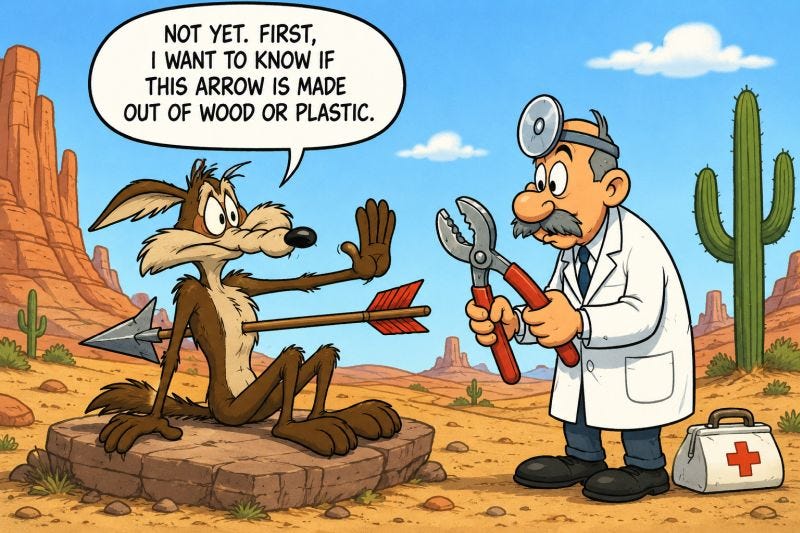
I sometimes feel that way about the arguments over process.
As a reader, I’m curious about how writers work. I’m fascinated by process. But ultimately, I don’t care whether a novelist writes with a fountain pen, dictates into an iPhone, types on a laptop, brainstorms with a friend, covers the wall with index cards, or talks through plot problems with an AI.
I care about the book. Did I enjoy it? Did it move me? Did it make me think? Did it give me an insight I didn’t have before? Did it serve me in some way?
Those are the readers I care about when I write. And that brings me back to externalizing my brain.
I write grocery lists because I forget things. I write down contact information because I can’t remember it all. I make mind maps because they let me see relationships between ideas.
Sometimes I make those mind maps on paper. Sometimes I use software.
Sometimes I sit in a coffee shop with a friend and bounce ideas around. Both of us come up with ideas we probably wouldn’t have found alone.
And sometimes I discuss ideas with Lizzie, my AI.
Now, she doesn’t write stuff for me. That’s the fun part. I’m no more interested in turning that over to an AI (or to a human ghostwriter) than I would be in paying somebody to eat a steak dinner in my place.
I want the steak.
But I do use AI to help me think. I use it to challenge an idea. I use it to notice something that I’ve missed. I use it to organize material when I’ve dumped too much of my brain onto the page at once. And increasingly, I dictate.
Part of that is practical. My arthritic hands don’t always appreciate long sessions at a keyboard anymore.
Dictation changes my writing. I’m certain of that. But so did the keyboard on my typewriter and, again, on my word processor. So did the fountain pen.
Marshall McLuhan famously said, “The medium is the message.” I’ve always understood part of that to mean that the medium doesn’t merely carry what we’re saying. It also shapes what we’re able to say and how we say it.
There’s a wonderful historical example of this.
In 1882, Friedrich Nietzsche was having serious trouble with his eyesight. Sustained handwriting had become difficult, so he began using a Malling-Hansen Writing Ball, an early typewriter.
People around him noticed a difference in his writing. His prose appeared to become more compressed, more telegraphic. Nietzsche himself recognized that something had changed. He opined that our writing tools participate in the formation of our thoughts.
By the way, I used a computer to look up the question, “How do you pronounce Nietzsche?”
Was it cheating? I don’t think so. It was just a tool to help me be a little bit better.
Now, this is not an AI problem. It’s a human-and-tools reality.
And, yeah, I know that’s one of those things literature teachers would call an antithesis, supposedly a clue to AI writing. But AI didn’t invent it. It’s a perfectly legitimate rhetorical device. The problem isn’t using it. It’s that AI-generated prose has developed an almost comical fondness for it.
And guess what?
There’s another one! I’ve used them since at least 1969, and I’ll quit using them when you pry them out of my cold, dead em dashes.
So changing the physical technology through which we express thought can change the thought we express. That doesn’t automatically make the result worse. It makes it different.
Sometimes I record these things off the top of my head or from brief notes, like a grocery list. And sometimes I write them out, like this one.
They come out differently. They sound different. Each approach has advantages and disadvantages, but none of them are wrong.
So if you pull out your iPhone and record a voice memo because you know that wonderful idea is going to evaporate before you get home, have you somehow cheated?
Of course not. You’ve externalized a function of your brain. It’s still your brain. You’ve extended yourself.
A notebook does that. So does an abacus, a calculator, or counting on your fingers. A mind map extends your brain. A conversation with a friend does that, too.
And, yes, AI can do that.
Now, that doesn’t mean every use of a tool is good. Of course it isn’t. A tool can be used carelessly, dishonestly, destructively, lazily.
But maybe we’re asking the wrong question when we ask whether a particular tool is inherently wrong. I think there are better questions.
What are we using it for?
Does this tool help me think more deeply?
Does it help me communicate more clearly?
Does it help me create something worth creating?
Does it help me treat other people with greater dignity and respect?
Does it help me become more fully the person I actually want to be?
That’s where the technology question becomes an alignment question.
We’ve always extended ourselves through our tools. We don’t need to stop doing that.
We just need to make sure that what we’re extending is worth amplifying.
I’m Donn King. I write about what it means to live and speak from your values, without sanding off the quirks that make a voice worth hearing. This space is where I reflect, tell stories, and stay connected with readers who value clarity, honesty, and the long work of becoming who we’re meant to be.
No posts
Comments
Nothing yet. Say the first thing.
Sign in to join the conversation.