
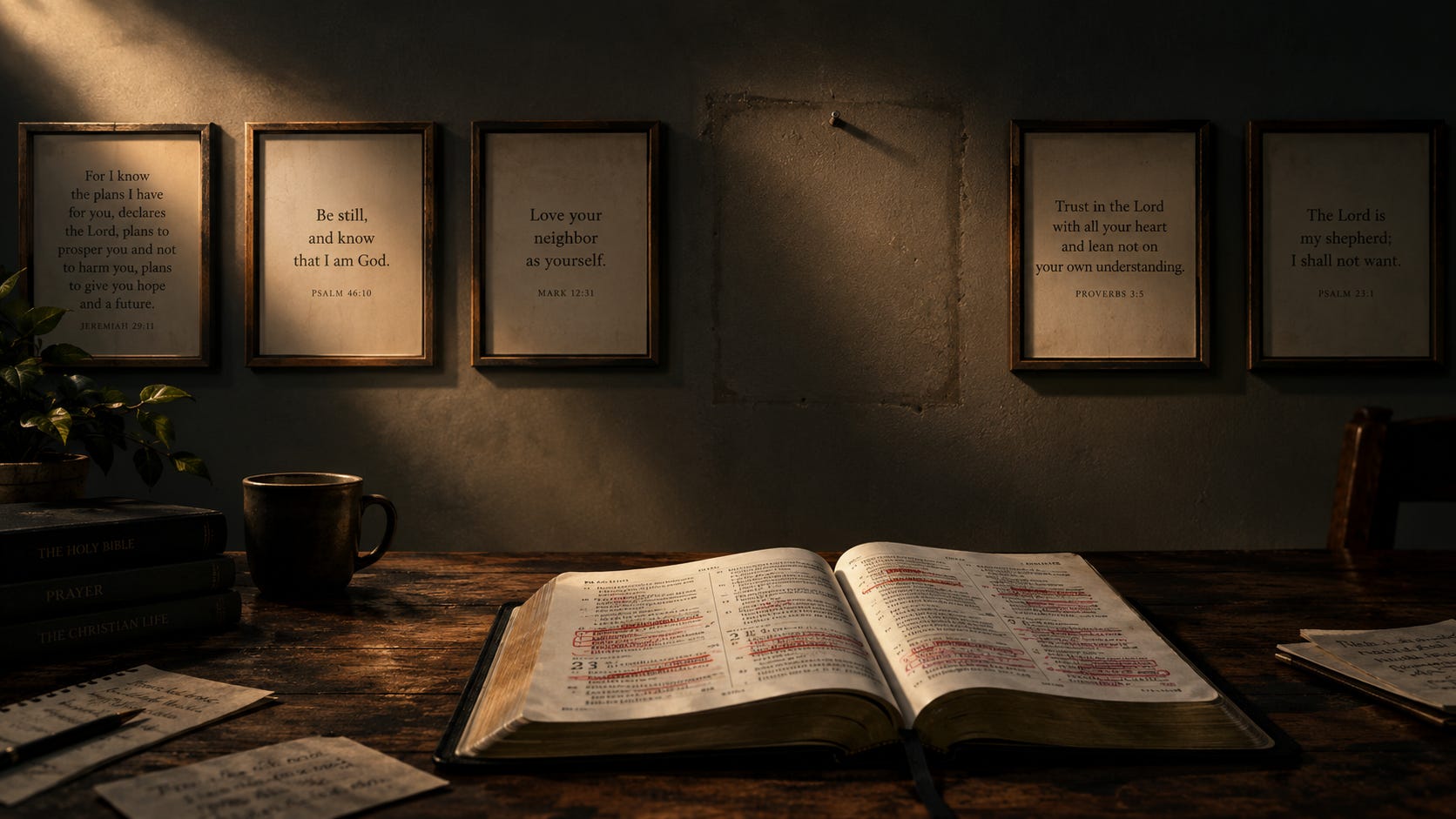
Modern Christianity has a familiar verse vocabulary.
“Come to Me, all who labor.”
“God so loved the world.”
“Do not be anxious.”
“I can do all things.”
“My grace is sufficient.”
These verses are true. They belong in the Church. They have carried people through grief, fear, illness, poverty, doubt, and more ordinary Tuesday afternoons than anybody could count.
But the same Bible also contains warnings that rarely make it into the standard Christian vocabulary. And many of the hardest come directly from Christ Himself.
These verses do not usually become wall art. They are far less visible on devotional cards and sermon graphics. They are not part of the standard memory-verse rotation in most popular Christian spaces.
They speak about judgment, division, repentance, hypocrisy, false disciples, obedience, Gehenna, and what happens when people reject the rule of Christ.
“But these enemies of mine, those not having been willing for me to reign over them, bring them here and slay them before me.”
The Context: This closes the Parable of the Minas. A nobleman leaves to receive a kingdom, while his citizens hate him and send an official delegation declaring they will not have him reign over them. He returns with full royal authority, calls his servants to an exact accounting of what they produced, and then turns to those who actively rejected his jurisdiction.
Modern theology loves the picture of a Savior knocking politely at the door. Christ presents Himself as a returning King who executes the rebels who refused His throne.
“Do not think that I came to bring peace to the earth; I did not come to bring peace, but a sword.”
The Context: Jesus is deploying the Twelve into hostile territory and preparing them for institutional persecution, flogging, betrayal, and public hatred. He follows this warning by declaring that His arrival will cut straight through the family unit: father against son, daughter against mother, daughter-in-law against mother-in-law.
The sword appears inside an explicit warning: absolute allegiance to Christ will fracture the closest human loyalties. If family demands treason against the King, the family tie gets severed.
“I came to cast fire upon the earth, and how I wish it were kindled already!”
The Context: Jesus speaks of a baptism of distress He must undergo, then immediately turns to the crowd and asks whether they believe He came to give peace on earth. His answer is categorical: division.
While Matthew 10 focuses on relational fractures, Luke 12 reveals the catalytic fire of divine judgment. The Gospel is not a treaty with the existing world order; it is an invading crisis that forces every human soul into binary alignment.
“Serpents! Offspring of vipers! How will you escape from the sentence of Gehenna?”
The Context: This is the climax of the seven woes against the scribes and Pharisees. Jesus systematically deconstructs the religious establishment for performative piety, systemic exploitation, legalistic technicalities, and presenting an outward appearance of righteousness while rotting with inward lawlessness.
This is public, uncompromising prophetic denunciation. Christ does not build a consensus bridge with corrupt religious leaders; He sentences them.
“You are of your father the devil, and you desire to do the desires of your father.”
The Context: Jesus is engaged in a high-stakes jurisdictional debate with religious elites who claim Abrahamic descent and divine paternity. Jesus dismantling their claim: if they were truly children of Abraham, they would recognize the truth. Instead, they seek to assassinate Him.
Christ shifts the battlefield from biological pedigree to spiritual allegiance. You belong to the one whose works you execute.
“Whoever causes one of these little ones believing in Me to stumble, it is better for him that a heavy millstone be hung around his neck and he be sunk in the depth of the sea.”
The Context: Jesus places a physical child in the center of the disciples while teaching on Kingdom authority and radical humility. He pivots immediately from welcoming the vulnerable to issuing an unyielding threat against anyone who leads a believer into sin.
The millstone is not hyperbolic rhetoric, it is the floor of the warning. The severity of the imagery reflects the lethal weight Christ places on protecting His disciples from corruption.
“Unless you repent, you will all perish likewise.”
The Context: Eyewitnesses bring Jesus breaking news about Galileans whom Pilate butchered while they were offering sacrifices. Jesus explicitly rejects the popular assumption that these victims suffered because they were more wicked than anyone else. He points to the catastrophic collapse of the tower of Siloam and repeats the identical formula.
Jesus refuses to turn tragedy into a philosophical debate about why bad things happen. He converts human mortality into an immediate, urgent ultimatum for repentance.
“Not everyone saying to Me, ‘Lord, Lord,’ will enter into the kingdom of the heavens…”
The Context: The closing offensive of the Sermon on the Mount. Jesus turns from warning about wolves in sheep’s clothing to confronting people who openly possess the correct theological vocabulary and point to an impressive resume of prophecy, exorcisms, and miracles done in His name.
Christ’s verdict is devastating: “Depart from Me, you who practice lawlessness.” The warning is not addressed to secular atheists outside the building. It is aimed directly at religious insiders who know the name, use the dialect, perform the signs, and refuse obedience.
“Depart from Me, those being cursed, into the eternal fire having been prepared for the devil and his angels.”
The Context: The cosmic judgment of the nations. The Son of Man sits upon His glorious throne, all peoples are assembled before Him, and He divides humanity with the finality of a shepherd separating sheep from goats. One group enters the inheritance; the other receives this verdict.
Modern sentimentality assumes everyone eventually finds their way home. The King of the Gospels establishes an absolute boundary with an eternal fire prepared for cosmic rebellion.
“And if your right eye causes you to stumble, tear it out and cast it from you…”
The Context: Jesus’s foundational exposition of the Law in the Sermon on the Mount. He takes the prohibition against adultery and presses it past the physical act into the covert desires of the heart, immediately prescribing the gouging of the eye and the amputation of the hand.
Modern therapeutic religion treats sin as a behavioral injury to be managed with comfortable self-care. Christ treats sin as an aggressive malignancy that demands immediate, ruthless amputation to preserve the soul from Gehenna.
And that is really the strange part of this list.
None of these verses are hidden.
They are not sitting in a sealed archive under Rome. Nobody cut them out of the New Testament manuscripts. You can read them in the exact same Gospels where Jesus blesses children, heals the broken, forgives the adulteress, and calls the weary to find rest.
Modern Christianity has done something much quieter.
It has constructed a curated canon within the canon.
One set of texts gets memorized early, printed large on bookstore merch, repeated in worship choruses, posted online, and carried as the emotional baseline of the faith. The other set remains locked on the page, almost entirely absent from the modern pulpit.
The imbalance is worth examining.
Because the problem isn’t that these verses are uncomfortable.
The problem is what happens when Christians claim to follow the whole counsel of Scripture while systematically avoiding half the King’s vocabulary.
If your picture of Jesus requires His hardest words to remain offstage, the problem isn’t the verses.
The problem is the Jesus you were handed.
Which of these ten was the first one your church skipped?
Comments
Nothing yet. Say the first thing.
Sign in to join the conversation.