
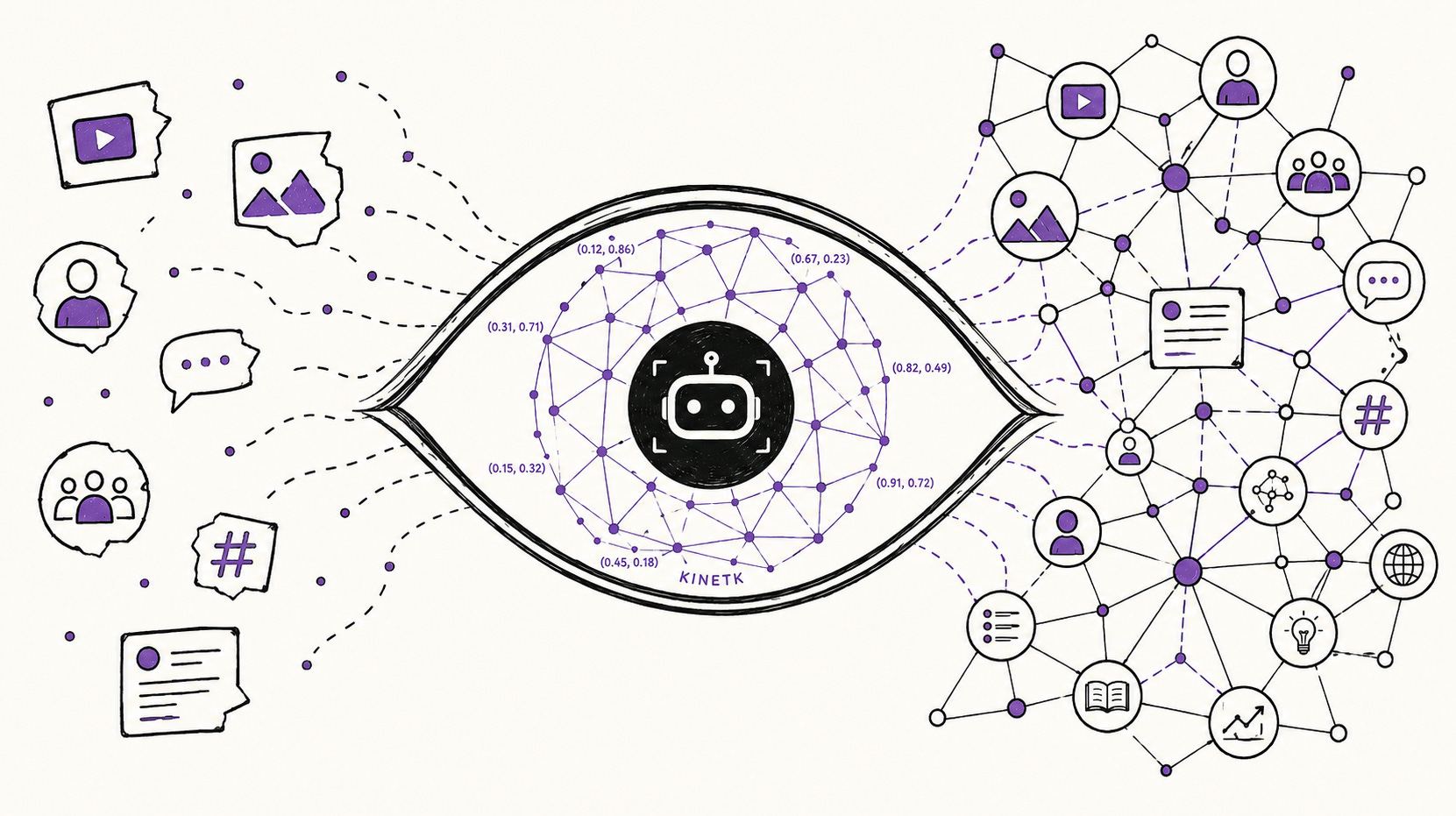
The internet stopped being text years ago, but AI infrastructure still behaves like it hasn’t.
Culture, consumer behavior, and public opinion now move through TikTok clips, Instagram Reels, screenshots, memes, YouTube Shorts, Reddit communities, and the relationships connecting contextual relationships across platforms. Most AI agents cannot properly observe that process. They scrape webpages, read captions, retrieve documents, and try to reconstruct what is happening from fragments. Therefore, their view of the world remains static, fragmented and incomplete.
KINETK is built to close that gap by turning the social web into a structured, multimodal intelligence graph layer that AI agents can query and understand.
Its foundation is a shared high-dimensional embedding space across text, images, and video, containing more than 15 billion vectors. Because every modality is represented within the same coordinate system, a text query can retrieve a relevant clip, an image can surface visually related video, and the same cultural pattern can be traced across platforms even when the captions, hashtags, and usernames completely change.
This matters because many of the strongest signals on the social web are never described in words. A clip may contain a product, behavior, aesthetic, visual format, or cultural reference that does not appear anywhere in its caption or metadata.
Imagine a new sneaker aesthetic spreading through short-form video. The brand is rarely named, the captions vary across languages, and most of the posts use unrelated hashtags. Text search sees a collection of disconnected clips. A multimodal system can recognize the shared visual pattern, identify the creators repeating it, connect the communities adopting it, and track the platforms where it is gaining momentum.
Text search cannot retrieve what was never written. Multimodal retrieval can recognize it.
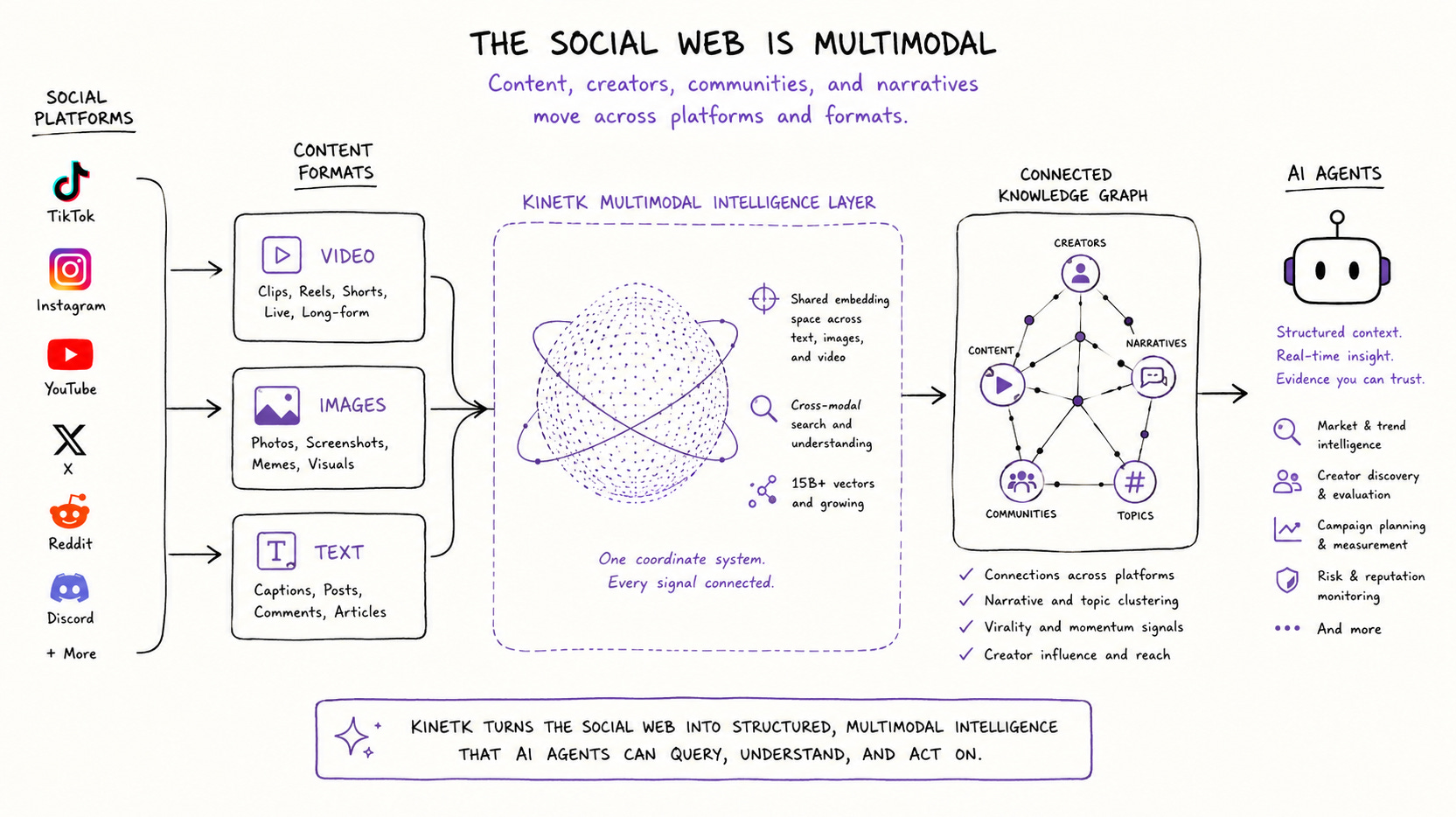
Finding relevant content is only the first step. The social web is fragmented across platforms that store content, engagement, creators, and communities in completely different ways.
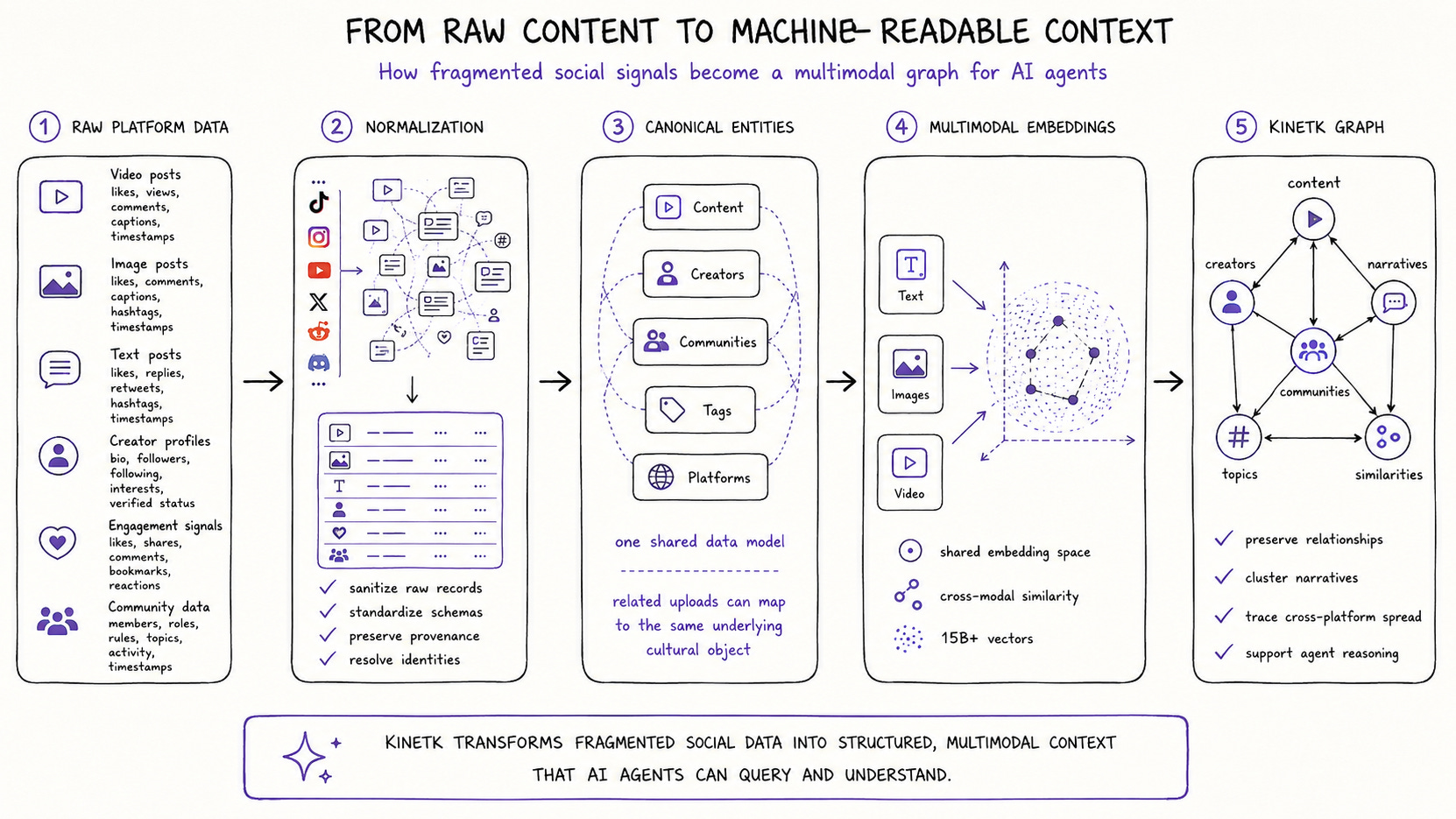
KINETK continuously ingests these signals, sanitizes the raw records, and normalizes them into canonical entities for content, creators, communities, tags, and platforms. The original metadata is preserved for provenance, while related uploads and transformations can be connected to the same underlying piece of culture. This is data network effects at work.
That structure allows the system to recognize that a TikTok clip, an Instagram remix, and a screenshot discussed on Reddit may all belong to the same developing narrative. Instead of treating them as isolated posts, KINETK connects them inside a graph that preserves how content, people, communities, and ideas relate to one another.
When an agent submits a question, KINETK does not simply search for the exact phrase it received. A language model expands the request into several semantically related queries, and each variation is embedded and searched against the relevant image and video vectors in parallel.
The fused candidates are then joined with real-world metadata and reranked using signals such as recency, engagement, creator relevance, platform behavior, and narrative fit. Vector search finds what may be relevant; signal-weighted reranking determines what matters now.
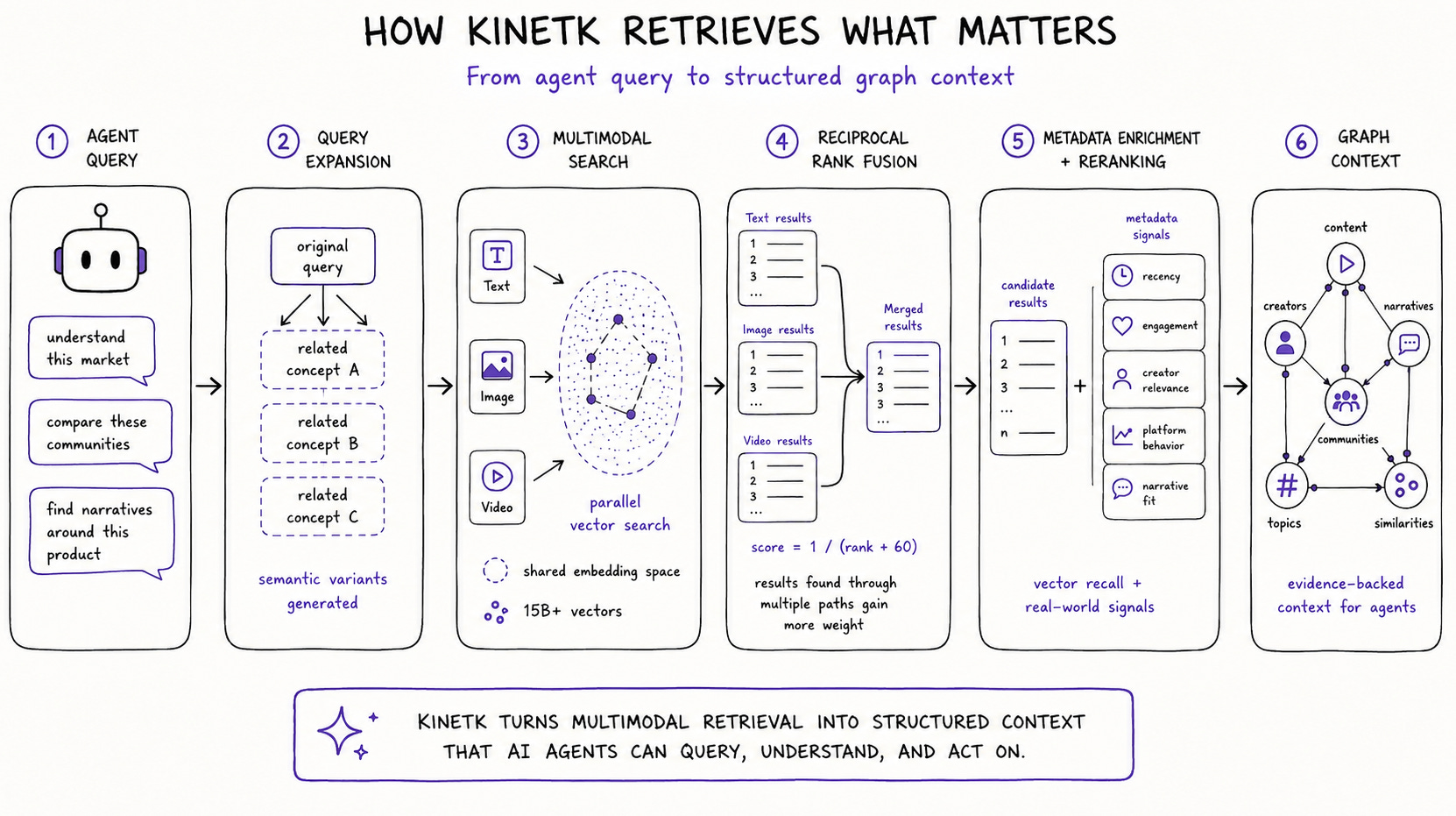
Traditional retrieval systems usually return a flat list of documents or posts. KINETK instead connects the selected evidence through a graph of content, creators, communities, topics, similarities, and narratives.
This allows an agent to move beyond asking for posts about a topic and begin investigating the system around it: who is shaping the conversation, which communities are adopting it, where it began, how it is spreading, whether independent creators are driving the growth, and which pieces of content support the conclusion.
That is the difference between retrieving information and understanding how information moves.
The final challenge is delivering this intelligence in a form agents can actually use.
Traditional APIs were designed for software controlled by developers. They expose endpoints and parameters, while the developer decides what to call, in which order, and how to combine the responses.
Agents begin with intentions. They want to understand a market, compare communities, identify the creators driving attention, or find the narratives forming around a product.
KINETK keeps the full HTTP API available for developers while providing agents with a smaller, intent-shaped interface through MCP. Instead of forcing an agent to navigate and orchestrate dozens of endpoints, it can create an intelligence job, check its status, and receive structured context when the analysis is complete.
Heavy retrieval and graph operations run asynchronously, while the final response is designed to be token-efficient, traceable, and backed by the evidence used to produce it. The documentation is also machine-readable, allowing coding agents and AI assistants to understand the available capabilities and determine how to use them.
This will matter more as software moves from assistance to automation. Agents will monitor markets, research competitors, discover creators, evaluate risks, and plan campaigns without someone manually connecting ten different dashboards.
But automation is only as reliable as the information behind it. A model cannot identify a visual movement through text alone, understand a narrative from a disconnected list of posts, or make reliable decisions from stale and untraceable context.
The next generation of AI will not be defined only by which model is the largest or most fluent. It will also be defined by what those models are able to observe.
Models are becoming the reasoning layer of the internet.
KINETK is building the perception layer that helps them understand what is actually happening.
Comments
Nothing yet. Say the first thing.
Sign in to join the conversation.