
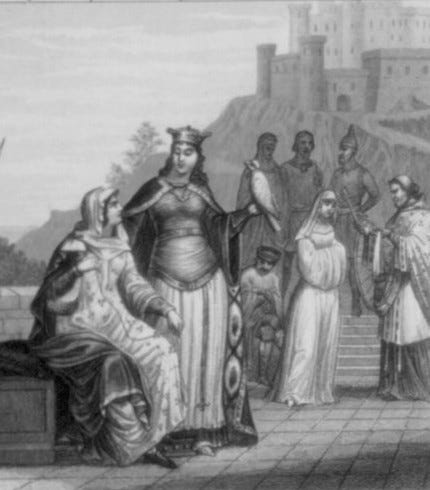
In early medieval times, an aristocratic woman’s family had two options for her: marriage to a high-ranking man or marriage to God, with the possibly of leading an abbey or a combined convent and monastery (also called a double monastery).
An abbess had control of land and its resources, and for all intents and purposes, she was independent. A queen (or countess or duchess) could serve as diplomat, treasurer, and chief of staff, and she was responsible for the household as well as the children’s early education and moral upbringing.
So, both paths had their advantages and their drawbacks. For more on those, see my blog.
The factors behind whether a woman (who could be as young as 12 or 13) would marry were practical. Did the family need to solidify connections with allies, amass more territory for the next generation, build peace between rivals, or limit the number of heirs?
This dynamic runs through all four of my novels, and the choice has ramifications beyond the individual.
In The Cross and the Dragon, Queen Mother Bertrada asks the heroine, Alda, to consider becoming an abbess, if she and her husband remain childless. The queen mother herself has taken the widow’s veil, a vow to remain chaste rather than remarry, and a widow who is jealous of Alda has become an abbess rather than marry again.
In The Ashes of Heaven’s Pillar, two sisters (supporting characters) take different paths. One becomes an abbess while the other marries a count. For the enslaved family who serve the patriarch, the younger daughter’s marriage has heartbreaking consequences.
In Queen of the Darkest Hour, Charlemagne’s first wife, Himiltrude, is provided with an abbey as part of a divorce settlement. The former queen and her brother are embittered, and that sentiment underlies a conspiracy against the monarch to set her son Pepin on the throne.
In Duchess of the New Dawn, the heroine Chiltrude sees an abbey as a form of imprisonment, even though her older brothers, Karlomann and Pippin, want her to take the veil. Here she discusses her possible fate with Karlomann’s wife, Adalswind.
*
Adalswind drew me from my thoughts. “I wish I could cheer you.”
“Karlomann supporting marriage for me and Odilo would cheer me. Can you talk some sense into him?”
“Karlomann knows what’s best for you. You should embrace life as an abbess. It would not be much different from that of a countess.”
Spoken by the woman who had borne two heirs to the realm. After my father died, she would be more influential than Swanahild. The realization was like opening a shutter on a sunny day, expelling the shadows in the room’s corners and revealing every hidden, ugly thing. I had thought Adalswind—the woman who professed to worry about my heart—was my friend. Now I saw her as she really was. “The cloister would ensure I will have no children to rival your sons’ claims to rule. If, by chance, Odilo dies without an heir, Karlomann gets to choose his successor. You two will do anything to consolidate power and call it holy.”
*
We know Karlomann was married and the father of two sons. We don’t know anything about his wife, including her name. But it stands to reason Adalswind (as I call her) would be ambitious for her sons and want to get any competitors, including her own sister-in-law, out of the way.
Despite the lack of rights, Dark Ages women tried to shape their world.
If you like to know more about my books, including buy links, visit kimrendfeld.com.
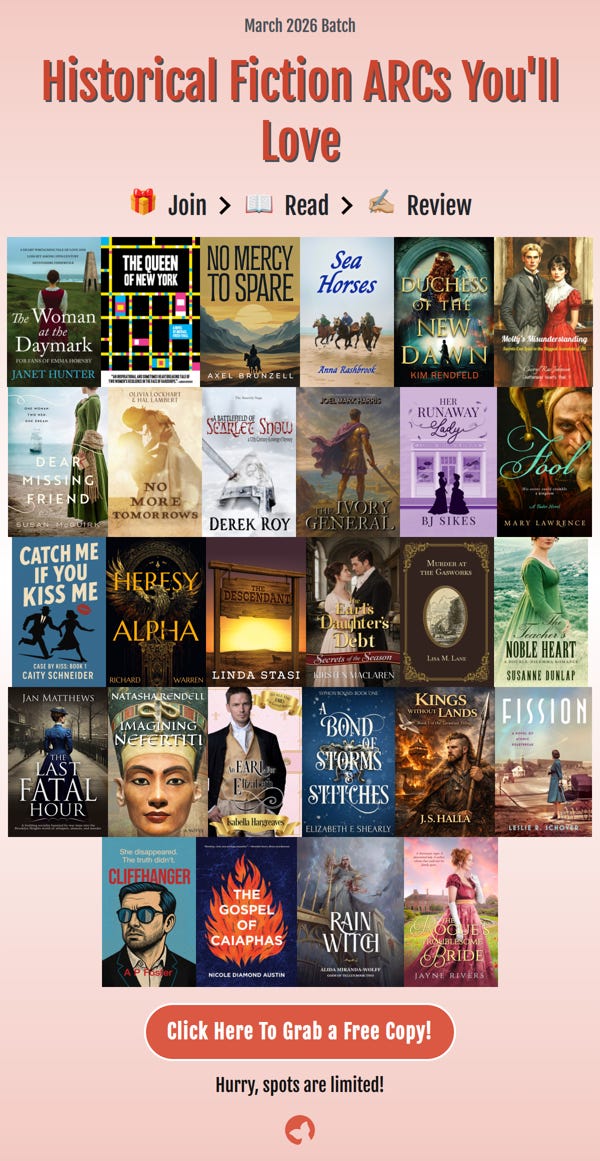
If you’d like to snag a free advanced reader copy (ARC) of Duchess of the New Dawn, visit BookSirens, which has included my forthcoming novel among 28 “Historical Fiction ARCs You’ll Love.” If women’s fiction is more your thing, “Duchess” is also among 28 “Women’s Fiction ARCs You’ll Love.”
My thanks to Erin Al-Mehairi for including my post about the real-life Chiltrude among Hook of Book’s articles about Women’s History Month. Visit Hook of a Book to check it out.
Looking for some good-quality historical fiction this spring? Check out the April Flowers online book fair, underway until May 18. There, you will find more than 30 novels spanning Ancient Egypt to the 20th century. Two of my novels, Queen of the Darkest Hour and Duchess of the New Dawn, are among them.

April is Indie Author Month, and what better way to celebrate than establishing a bookstore featuring indie authors. Many thanks to the Alliance of Independent Authors (ALLi) for opening the Indie Author Bookstore, where you can find my books and thousands of others.

No posts
Comments
Nothing yet. Say the first thing.
Sign in to join the conversation.