
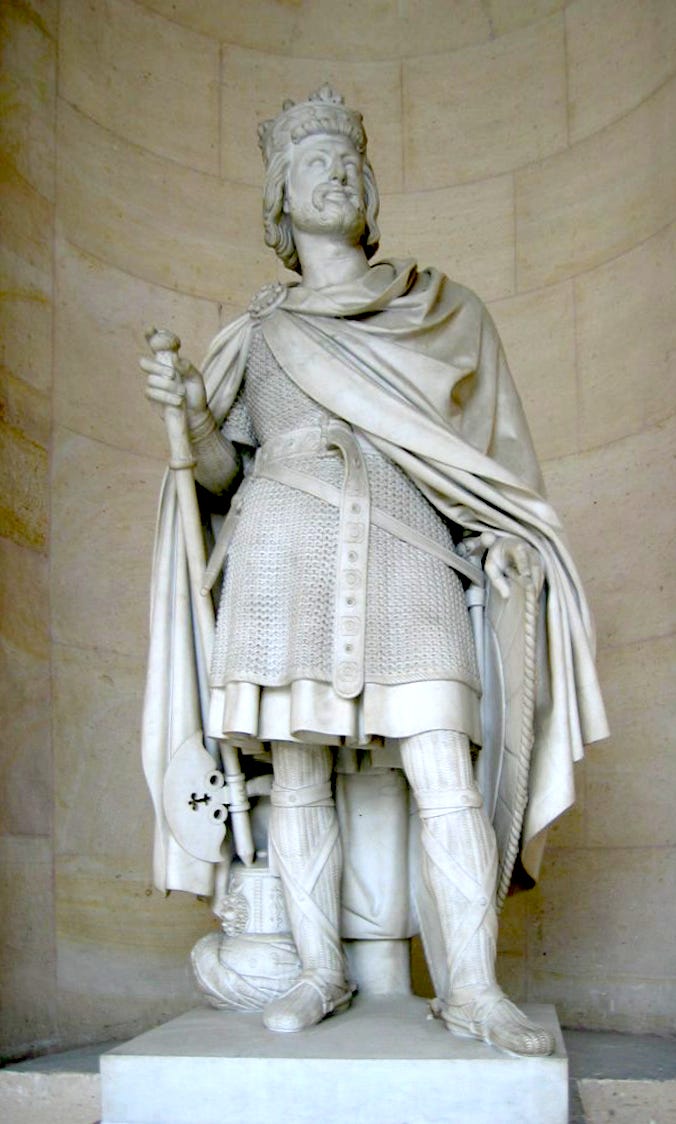
Charles Martel (c. 686-741), a supporting character in my forthcoming novel Duchess of the New Dawn (June 16, 2026), was a complex man in real life.
Officially mayor of the palace, he was the true ruler of Francia for about 20 years in the name of whatever Merovingian was on the throne. He was a military genius and a hero, best known for his victory at Poitiers against the Arabs in 732. Yet people who got in his way had a convenient habit of dying, and I don’t mean on the battlefield.
The list includes:
King Chlothar IV, whose passing made it possible for Charles to make a deal with the monarch’s rival King Chilperic II in 718.
At least one of Charles’s nephews, whom he had imprisoned with the child’s brother, in 723.
Pilitrude, the high-ranking aunt of his second wife, Swanahild, who was from the Agilolfing clan that ruled Bavaria, around 725.
On top of that, he had a complicated family life. His daughter, Chiltrude, the heroine of Duchess, and her brothers Karlomann and Pippin are the children of Charles’s first wife, Chrodtrude, who was from an important family. After Chrodtrude died in 725, he probably needed to maintain good relations with her family.
But when he invaded Bavaria that year, he married Swanahild. Chrodtrude’s family might have seen Grifo, Charles’s son by Swanahild, as a threat. She expected her boy to have a share of the inheritance. And she sometimes governed on behalf of her husband and witnessed his donations. Plus, he sired three sons out of wedlock (that we know of).
Because Charles is not the hero of Duchess, I didn’t need to make him sympathetic or even palatable. But I did not want to make him a cardboard cutout either.
To make him fully human, the readers will see him through Chiltrude’s eyes. Chiltrude loves him but understands why some people hate him. She sees him as he is, faults and all. When the story opens in 740, she worries about him as his health is failing, rages against him when refused to let her wed Bavarian Duke Odilo, grieves his passing, and dreads that Karlomann, Pippin, and Grifo will tear Francia apart in their quest for power.
In this excerpt, she reflects on her family’s past and what it might mean for her future.
*
A chill that had nothing to do with the cold ran down my spine as I remembered the stories of what happened after Grandfather Pippin’s death. His wife, Plectrude, had ensured he named her grandsons—the children of her late sons—as his heirs, excluding my father, the child of another spouse. Then, Plectrude imprisoned my father. He escaped, fought back, and captured the boys. Depriving them of freedom wasn’t enough for him. They died in captivity.
I knew this only through stories I had overheard among the courtiers. My grandfather had died before I was born, and I had been a little girl when my cousins passed away. At the time, I had believed that it was God’s will. As I grew older, I rationalized my father’s actions: he needed to secure Francia through any means necessary.
But now I was carrying a child, and I could no longer avoid the question. What would Karlomann and Pippin do to my babe? If a girl, they would send her to an abbey or choose a husband, whichever suited their purpose when she reached a marriageable age. If a boy, Karlomann might force the tonsure on him to ensure the inheritance for his sons. Pippin—my breath caught—Pippin could do worse, like my father had.
No! a voice inside me cried. If you survive the birth, you will not let the babe grow up motherless. You will not let him grow up without the protection of a father.
My duty to protect my child shoved aside my guilt over disloyalty to my brothers. At that moment, I knew what I would do—and that success would cost me dearly.
*
To find out what happens next, get the book, which will be released June 16, one week from today. You can preorder Duchess of the New Dawn now on Amazon, Bookshop.org, Barnes & Noble, other ebook vendors, and retailers of print books such as Books-A-Million, Walmart, and Waterstones.
There is still time to snag a free advanced reader copy (ARC) of Duchess, which is among 20 novels BookSirens calls “Historical Women’s Fiction ARCs You’ll Love.” Visit the BookSirens website to view all 20 books.

The Summertime Reading online book fair features 30+ historical fiction novels, appealing the varied tastes. Tales take place in Ancient Egypt, the Byzantine Empire, the Middle Ages, and 18th, 19th and 20th century America, Europe and Asia, and they showcase everything from court intrigue to challenges faced by regular people. Visit the book fair now and find that perfect read for the beach, the mountains, or whenever you will be.
The Carolingians: A Family Who Forged Europe by Pierre Riché
The Age of Charles Martel by Paul Fouracre
No posts
Comments
Nothing yet. Say the first thing.
Sign in to join the conversation.