
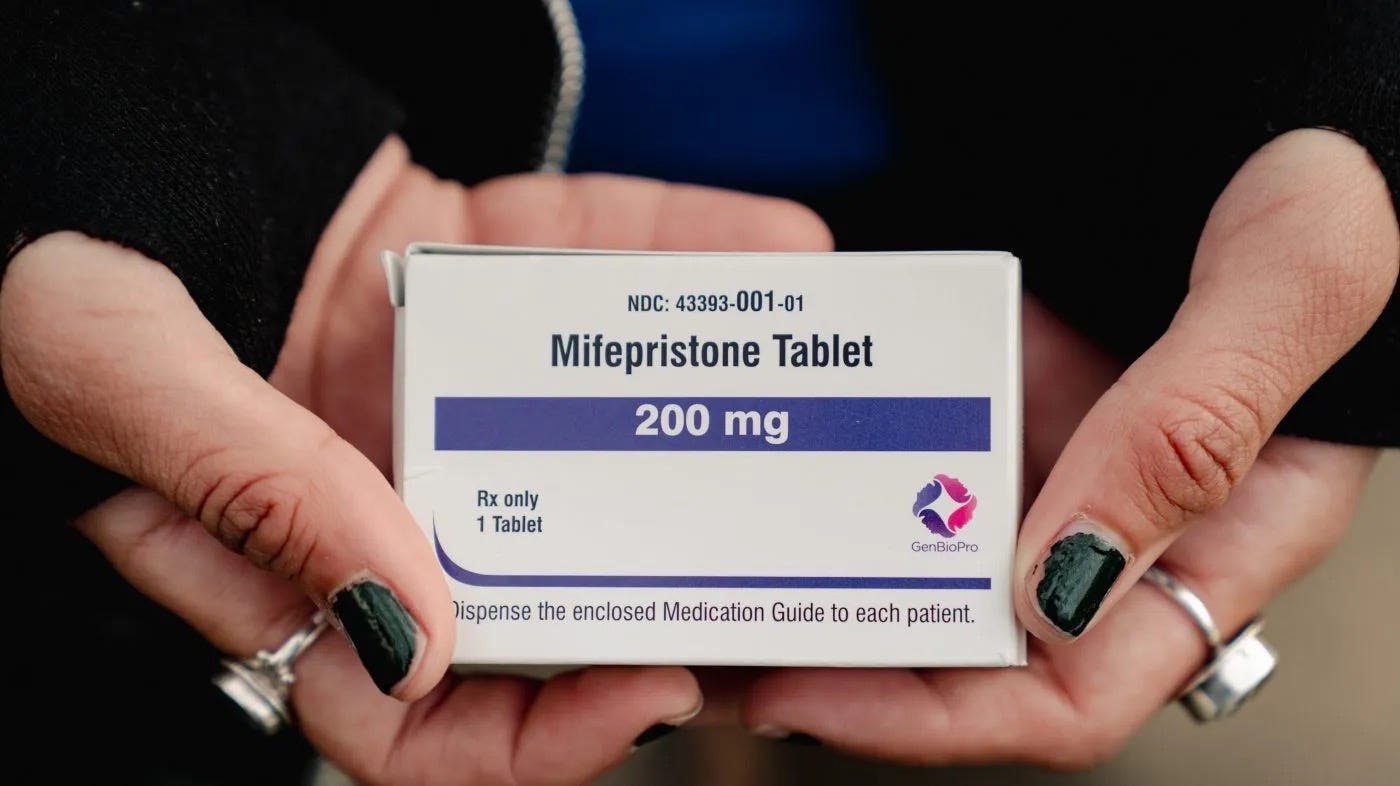
At 5:20 yesterday evening, three judges on the Fifth Circuit ruled that Mifepristone — a drug approved by the FDA in 2000, prescribed to more than five million people, with a safety record stronger than Tylenol’s — would no longer arrive by mail. Patients who had, for the better part of five years, received the medication after a telemedicine consultation will now be required to present themselves in person at a clinic.
For some of them, the nearest clinic is a hundred miles away.
For others, it is across a state line.
For all of them, including those who live in states whose constitutions explicitly enshrine reproductive freedom, the federal court system has just decided that the protections their states wrote, ratified, and defended do not extend to the mailbox.
This news is heavy. Given the state of the world and the speed at which the headlines arrive, it may not have set in with you yet. It hasn’t fully set in with me. So let me break down the ruling, and we can sit with it together.
The Fifth Circuit’s decision targets a delivery mechanism, not a right. The court did not overturn any state’s protection of abortion. It did not strike down a single ballot initiative.
It did not need to.
What it did was reach into the federal regulation of the United States Postal Service and decree that a particular medication, lawful in dozens of states, may no longer travel through the mail to reach the patients those states have agreed to protect. The right remains. The route to the right has been closed.
This is the part I want every reader in California, New York, Massachusetts, Michigan, Alaska, and every state where reproductive freedom is currently codified to understand: your state constitution is not a firewall.
It is a wall that protects you from your own state government, and a federal ruling that operates on the infrastructure between you and your medication does not need to climb that wall.
It walks around it.
The protections you fought for, that you canvassed for, that you rang doorbells in November weather to defend — those protections are intact and largely irrelevant. They cannot put a pill in your hand if the federal courts have decided the pill cannot travel.
That is the architecture of what just happened.
A ruling like this does not land evenly. It never has.
The woman in San Francisco with a credit card, a flexible job, and a partner who can drive her four hours each way to a clinic and back will eventually get her medication. The ruling is an inconvenience for her, an outrage, an insult — but she will get the pill. The system is built to bend, in the end, for women like her.
The woman who is built to break is the one without the credit card.
The one working two jobs, neither of which will give her a day off.
The one whose nearest clinic is across a state line, whose car will not survive.
The one who is undocumented and cannot risk the highway.
The one whose pregnancy is the result of a rape she has not told anyone about.
The one whose partner monitors her phone.
The one in rural Mississippi, in rural Alabama, in the parts of Texas where the clinic network was hollowed out years ago, and the mail, until tonight, was the only thing left.
The Black woman, whose maternal mortality rate in this country is already three times that of a white woman, and for whom every additional hour of unwanted pregnancy is not an abstraction but a measurable risk to her life.
The Indigenous woman whose access to reproductive care has been routed through a federal Indian Health Service that has, historically, been the agency removing her reproductive autonomy rather than protecting it.
The teenager whose parents do not know.
The trans man for whom every clinic visit is a negotiation with paperwork and personnel that may or may not see him as a person at all.
These are the patients the mail was briefly reaching. The Fifth Circuit has just decided that the country can do without reaching them. That is what the ruling is.
It is a decision about which women count, made by judges who will never need the medication, on behalf of an administration whose authors have written, on the page, that the women who count are the ones inside marriages they approve of.
I want to say this without ornament: the women who will die because of this ruling will be poor, and they will be disproportionately Black, and they will be disproportionately rural, and they will be disproportionately young, and the people writing the ruling know this, and the people who wrote the document the ruling came from know this, and the people who voted for the candidate who promised to deliver this know this.
There is no version of this ruling in which the harm is distributed evenly. And it’s by design.
The Heritage Foundation’s Mandate for Leadership, the 900-page document the country has come to know as Project 2025, contains a chapter on Health and Human Services that, in plain and unembarrassed language, calls for exactly this (starts on page 449). The FDA must reverse its approval of Mifepristone, the chapter instructs, on the grounds that the original approval was politicized and unlawful.
The Comstock Act of 1873 — a postal regulation written before women could vote, drafted by a man who believed contraceptive pamphlets were obscenity — must be revived to criminalize the mailing of abortion medication anywhere in the country, regardless of the laws of the state receiving it.
The Department of Health and Human Services must be renamed the Department of Life. The phrases reproductive health, reproductive rights, and abortion must be deleted from federal statutes. IVF, the document says, should become “fully obsolete and ethically unthinkable.” Birth control pills are framed as a public health crisis requiring intervention.
This was published in 2023. It was distributed openly. The candidate spent his second campaign denying he had read it. Within four days of his second inauguration, Time found that nearly two-thirds of his executive actions mirrored, wholly or in part, proposals from the document. The Center for Progressive Reform’s tracker, as of early this year, has logged 53% of its administrative agenda implemented or initiated within twelve months.
Today’s ruling is part of that 53%. It is on schedule. It is a deliverable.
Roger Severino, who drafted the HHS chapter, served as the agency’s civil rights office director during the first Trump administration.
The Comstock revival has been advanced for years by Jonathan Mitchell, the lawyer who designed Texas’s SB8 bounty system.
The judges who issued today’s order sit on a Fifth Circuit that has been remade, lifetime appointment by lifetime appointment, since 2017.
The personnel were assembled before the policy was finalized.
The policy was drafted before there was an administration to staff.
They prepared for years.
They prepared in public.
They told us what they were going to do.
There is nothing new about a state regulating women’s bodies through the mail.
The Comstock Act was, in its original form, exactly that — a law passed in 1873 to allow the federal government to seize, and prosecute, anything sent through the postal system that the state considered indecent. Margaret Sanger went to prison under it for mailing pamphlets about contraception. The law has never been repealed. It has only been ignored. What the Fifth Circuit has done, in effect, is decide that the time of ignoring it is over.
The administration of women’s reproductive lives through state machinery is also not a new project. It is, in fact, one of the oldest projects this country has run. Black women bore children for the ledgers of their enslavers, and the children were the ledger. Indigenous women were sterilized in Indian Health Service facilities, frequently without consent, into the 1970s. Tens of thousands of poor women across the South — disproportionately Black, but not exclusively — were sterilized through state-run programs whose subjects were sometimes told they were undergoing routine appendectomies.
The state has been deciding which women bear children and which women do not for the entirety of its existence.
The paperwork changed. The project did not.
And it is not only an American project. My mother was born in West Germany in 1968, into the long shadow of a regime that, two and a half decades earlier, had run reproductive control through both faces of the same coin — Lebensborn programs to produce the children the state wanted, and forced sterilization to prevent the children the state did not. She was placed in an orphanage. The orphanage has since burned to the ground, taking her records with it. I do not know my grandmother’s name. I do not know the circumstances under which my mother was given up, or taken. I can’t advocate for her line because I don’t have it.
The line was unmade by paper, and then by fire, and then by silence.
I write this down because I want to be honest about what the inheritance is. The women I come from are women whose histories were erased, sometimes by fascism and sometimes by ordinary American cruelty, and the country I am raising my children in is now reaching, with deliberation and on schedule, for the tools that did the erasing.
I promised my children I could protect them. I meant their rights, too.
It is a particular kind of privilege to have ever believed I could. The mothers in this country who have known, for generations, that the state would not protect their children — Black mothers, Indigenous mothers, immigrant mothers, the mothers of disabled children, the mothers of trans children — have never had the luxury of the promise I made.
I made it anyway. I want to be honest about that before I go any further.
I want to write that line straight, without softening it, because softening it would make it bearable, and I do not want it to be bearable. I made the kind of promise that mothers make — the one about the dark, the one about the world, the one a mother makes by the hand she puts on the back of a child’s head when the child is afraid. I meant the promise to extend further than the dark. I meant it to extend to the country. I meant it to cover the right of my children to make decisions about their own bodies, to live in states that recognized them, to receive medical care without the moral feelings of strangers gating the door.
I cannot keep that promise tonight. I may not be able to keep it tomorrow. The protections I assumed would hold — Roe, the Voting Rights Act, the administrative state, the independence of the courts, the basic notion that an institution can resist a bad-faith executive — have come apart faster than I can describe them to my children, and I am the one who described the country to them in the first place. I told them what was true. The country has decided to make me a liar.
Fund the providers still mailing pills tonight, in the states that will let them, until the federal courts take that route too. Fund the litigators. Fund the abortion funds, the shield-state networks, the practical-support organizations driving women across state lines. Vote in every cycle and at every level, in margins so wide the federal courts cannot pretend the public did not choose. Elect prosecutors who will not enforce these laws. Elect attorneys general who will sue to block them. Elect governors who will protect providers within their borders.
All of this is necessary. None of this is sufficient.
I want to say that out loud, because the piece I have just written has spent two thousand words demonstrating that the people running this country prepared for fifty years to take what they are taking, that they did it on the page, that they are executing on a schedule that was published before the election they did not need to win cleanly. If that is true — and it is true — then the answer to what do we do cannot, with a straight face, be only vote harder. The piece’s own diagnosis forbids it.
Tracy Chapman recorded Talkin’ ‘bout a Revolution in 1988, when she was twenty-four years old. The song has been waiting on the shelf of American political music for almost forty years.
Don’t you know, she sings, they’re talkin’ ‘bout a revolution. It sounds like a whisper.
It does. It has been sounding like a whisper for some time. The whisper is getting louder in rooms I did not expect to hear it in.
I do not use the word revolution lightly, and I do not use it as metaphor. I mean a fundamental reordering of what we are willing to comply with. The doctors who will keep mailing pills regardless of the ruling. The pharmacists who will keep dispensing. The patients who will keep receiving. The networks of mutual aid that kept abortion accessible before Roe and will keep it accessible after — the Jane Collective in Chicago performed an estimated eleven thousand abortions between 1969 and 1973, in defiance of Illinois law, with a safety record cleaner than the legal medical system of the time.
The infrastructure of refusal already exists in this country’s history. It is being rebuilt right now, in kitchens, in cars, in the trunks of people who drive other people to clinics.
We are going to need it.
The exhaustion you feel is engineered. The conviction that the only thing left is to keep performing the procedures of a democracy being dismantled in front of you — that is engineered too.
Refuse the engineering.
Find your people.
Build what comes next.
The list of organizations to donate to is real, and you should donate, and the list is also not the list that is going to save this. The list that is going to save this has not been written yet.
We are going to have to write it.
I am writing this down to be on the record. Ten years from now, I want to remember the day in May of 2026 when a federal court took the mail away from the women of America. I want to remember what I knew, and when I knew it, and what I told my children, and what I had to tell them later. I want to remember that the document was readable. That the architects were named. That the country had been told.
The mail used to carry a pill. It carried, with the pill, a particular kind of freedom — the freedom to receive medical care without performing your geography for a stranger, without driving for a day, without explaining yourself at a clinic door, without being seen. That freedom was, briefly, a fact. It was a fact for five years. It is no longer a fact tonight.
I promised my children I could protect them. I meant their rights, too. The rights are being taken from them on a schedule that was published before they were old enough to read. I am going to spend the rest of my life trying to keep the promise anyway.
No posts
Comments
Nothing yet. Say the first thing.
Sign in to join the conversation.