

This week, the United States is fighting a war that is making its economic crisis worse, cutting the housing program that keeps veterans off the street while sending new ones to the front, and marking the one-year anniversary of a tariff policy that was supposed to make America wealthy again, with a trade deficit that hit an all-time high.
Every bad policy choice the Trump administration has made is now multiplying the others. The Iran war is driving up energy costs that compound the tariff damage. The same administration pushing tax cuts has gutted housing programs. Housing cuts are leaving veterans homeless while the war machine needs more bodies.
That isn’t just dysfunction — that’s compound interest.
And this week, the bill started coming due.
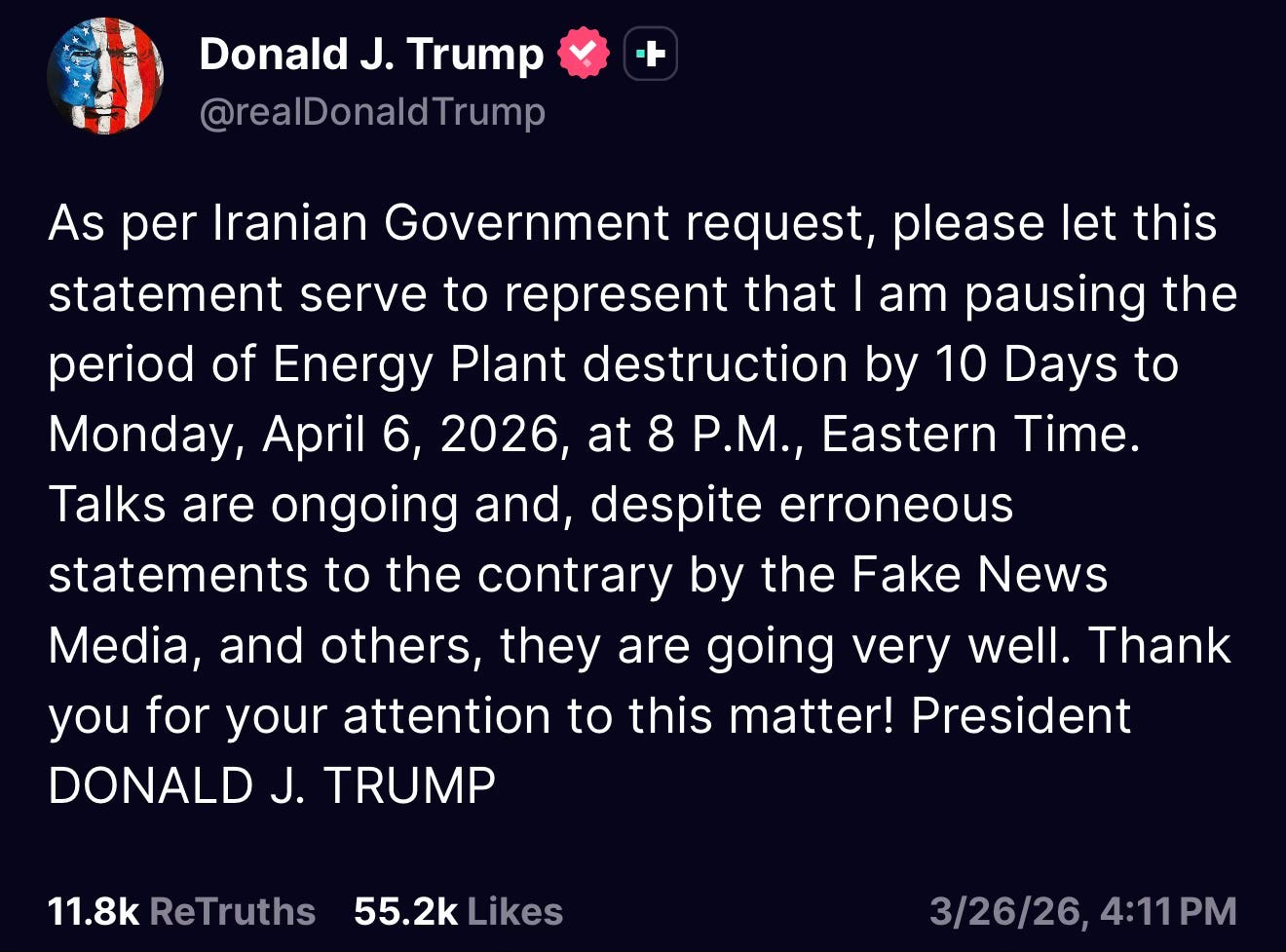
On Thursday, March 26th, Trump posted on Truth Social that he was extending his pause on striking Iranian energy sites by ten days, writing that “talks are ongoing” and “going very well.” Three days later, Iran’s parliament speaker Mohammad Bagher Ghalibaf publicly rejected the negotiations, saying Iran could not be forced into submission. That same day, Trump told reporters that Iran had agreed to most of the United States’ demands.
One of these parties is describing a different conversation entirely. The record suggests it isn't Tehran.
The Trump administration has spent five weeks insisting that the war they started on February 28th — the strikes that killed Supreme Leader Khamenei and senior Iranian military officials, that closed the Strait of Hormuz, that drew retaliatory missiles into six Gulf states — is actually going well, actually nearly over, actually producing results. The pattern is consistent: Trump announces progress, Iran denies it, and the strikes continue. Meanwhile, more than 3,400 people are dead across the region, gas prices have crossed $4 a gallon for the first time since 2022, and The Organisation for Economic Co-operation and Development (OECD) has raised its inflation forecast for G20 economies to 4%.
The war is going badly. But the larger problem is that the administration appears to be describing a war that isn't happening — and hiding behind that description to avoid answering for the one that is.
This morning, Trump posted on Truth Social that “Tuesday will be Power Plant Day, and Bridge Day, all wrapped up in one, in Iran.” He told Iran to open the strait, or they’d be “living in Hell.” He signed it: “Praise be to Allah.” The 10-day pause expires tomorrow at 8:00 pm. The talks that were going “very well” appear to be over.
Trump says the talks are going well; Iran says there are no talks. Somewhere between those two statements, people are dying.
Trump extends pause on Iranian energy strikes (CNBC) | Trump extends pause, Witkoff 15-point proposal (CBS News) | Iran parliament speaker rejects negotiations (Al Jazeera) | Are there talks? Depends on which side you ask (NBC News) | 35 days of attacks mapped (Al Jazeera)
The Trump administration has proposed cuts that would slash or eliminate several HUD programs that keep veterans housed, including Housing Choice Vouchers, Community Development Block Grants, and the Fair Housing Initiative Program. Analysts estimate that up to 600,000 people could lose rental assistance if the reductions go through, with a meaningful share at immediate risk of being displaced.
The HUD-VASH program — the joint HUD-VA initiative that pairs housing vouchers with VA case management for unhoused veterans — has not been formally cut. But the broader voucher program it runs through has been targeted for cuts in consecutive budget proposals. And the VA case managers who make it function are already stretched thin across a system, losing staff to federal workforce reductions driven by DOGE.
The administration is currently asking Americans to support a war being fought, in part, by the same veterans it is preparing to leave without stable housing. This is a policy sequence, not a political talking point. You can track it in the budget.
The cuts to housing, Medicaid, and SNAP don’t exist in a vacuum. They are the domestic costs of a defense posture that now includes a full-scale war in the Middle East with no defined end. The people absorbing that cost are not the people making the decisions.
The same government sending veterans to fight in Iran is writing a budget that leaves their counterparts homeless.
600,000 at risk from housing cuts (Center on Budget and Policy Priorities) | HUD-VASH program overview (VA Homeless Programs) | Virginia voucher holders fear cuts (Virginia Mercury)
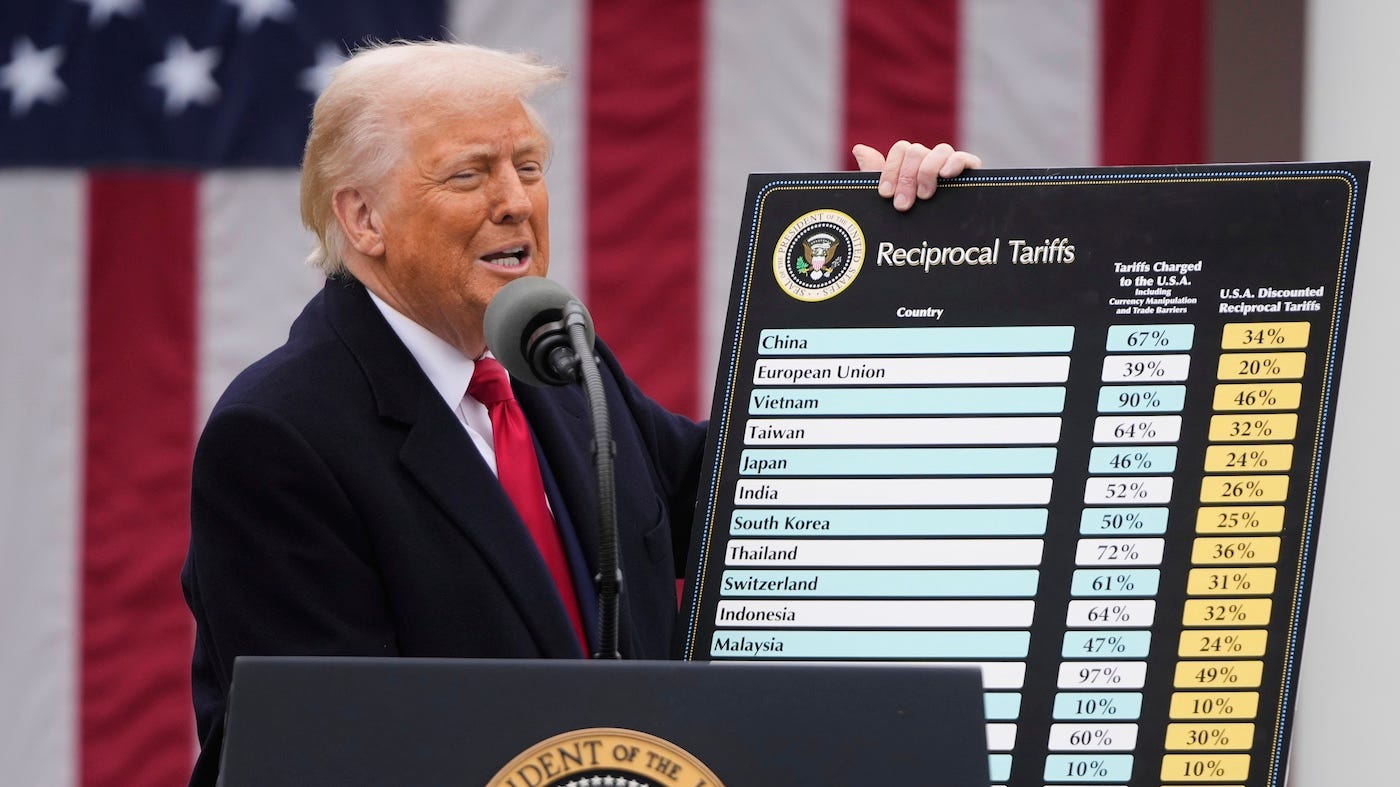
April 2nd marked one year since Trump walked into the White House Rose Garden with an oversized posterboard and announced sweeping tariffs on virtually everything the United States imports, calling it “Liberation Day” and promising factories would come “roaring back.”
One year later: the U.S. goods trade deficit hit an all-time high in 2025. The manufacturing sector lost more than 80,000 manufacturing jobs in the months following the announcement. The average American household is facing roughly $1,500 in additional costs due to the 2026 tariff structure. And the Supreme Court struck down the broadest tariff authorities earlier this year — though many remain in place through other legal pathways.
The tariffs didn’t fail by accident. They failed by design — or rather, they succeeded at what tariffs actually do: tax imports in ways that fall hardest on domestic consumers and manufacturers who depend on imported materials. Economists said this would happen. Farm organizations are now warning that the agricultural sector is on the edge of collapse. Retailers absorbed what they could and passed the rest on. The Iran war arrived on top of all of it, driving energy costs up and erasing whatever margin was left.
The anniversary is a receipt.
A year ago, Trump promised Liberation Day would make America wealthy again. The bill for that promise is $1,500 per household — and that’s before you factor in the war.
Liberation Day one-year review (NPR) | Tariffs handcuffed farmers and manufacturers (National Taxpayers Union) | $1,500 average household cost (Tax Foundation) | Tracking tariff impact (CNN)
The Iran war is not contained to the Middle East. Energy costs have risen to their highest levels since Russia invaded Ukraine. The OECD downgraded global growth forecasts and sharply raised inflation projections. In the Philippines, the president declared a national energy emergency. The Strait of Hormuz — through which roughly 20 percent of the world’s oil passes — remains effectively closed. Consumer goods companies are tacking on fees on top of existing tariff-driven price increases. J.P. Morgan has flagged a serious recession risk heading into midyear.
The Iran war and the tariff regime were both sold as instruments of American strength. Together, they are functioning as instruments of American inflation. The supply chain disruptions, the energy cost spike, the market volatility, the global growth downgrades — these aren’t unrelated side effects. They’re what happens when you layer an active war over an already-stressed trade policy without a plan for what comes next.
There is no exit strategy visible from here. Not for the war. Not for the tariffs. Not for the people absorbing the cost of both.
Two policies sold as strength. One economy absorbing both of them. The people who made these decisions will be fine. Everyone else is doing the math.
The damage is compounding.
Middle East special issue, economic impact (ACLED) | J.P. Morgan recession risk (J.P. Morgan) | US-Israel war on Iran overview (House of Commons Library)
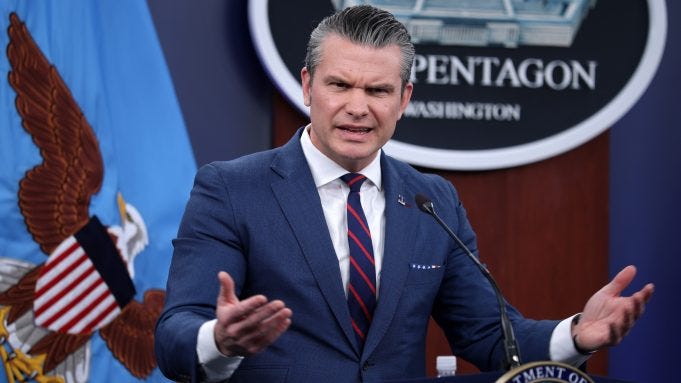
Defense Secretary Pete Hegseth has blocked or delayed promotions for more than a dozen Black and female senior officers across all four branches of the military. Nine U.S. officials confirmed the scope to NBC News — every branch affected, no exceptions. In the Army alone, four colonels were removed from a promotion list before it reached the Senate: two Black men, two women, all with combat records and no disciplinary history. Three Marine officers — two women and a Black man — were passed over with full support from their own leadership. A Navy promotion list has sat on Hegseth’s desk for over a month. Air Force promotions have stalled.
When Army Chief of Staff General Randy George asked to meet with Hegseth to discuss the blocked promotions, Hegseth refused. Then he fired him. George’s term wasn’t set to expire until 2027.
The Pentagon’s response: “Meritocracy, which reigns in this Department, is apolitical and unbiased.”
The word “meritocracy” is doing a lot of work here for a department that can’t explain why decorated combat veterans with spotless records were removed from promotion lists with no charges, no investigations, and no stated cause. Officials say Hegseth’s criteria have included past support for COVID vaccine mandates, perceived ties to DEI programs, association with former Joint Chiefs Chairman Mark Milley, and — by the pattern of every single removal — being Black or female.
This is the same Pentagon currently fighting a war in the Middle East — a war that requires a fully staffed, fully functional military. The same Pentagon that needs to recruit from a country where the military is nearly 40% nonwhite and female enlistment has been rising steadily for two decades. When you tell those people the ceiling is lower than they thought, they notice. A retired senior officer put it plainly: Unexplained interference like this “will certainly cast a shadow across our officer corps."
Hegseth is telling everyone watching what the ceiling looks like now.
They called it meritocracy. The officers they blocked had combat records, spotless files, and the full support of their own leadership. The only thing they had in common was what they looked like.
Hegseth blocks promotions across all four branches (NBC News) | Hegseth blocks Black and female Army officers (NPR) | Hegseth fires Army Chief of Staff Randy George (Military Times)

On April 1st, NASA launched Artemis II from Kennedy Space Center — the first crewed mission beyond Earth orbit since Apollo 17 in December 1972.
Fifty-four years later.
Four astronauts: Commander Reid Wiseman, Pilot Victor Glover, Mission Specialist Christina Koch, and Canadian Space Agency astronaut Jeremy Hansen are currently en route to the Moon aboard the Orion spacecraft, which the crew named Integrity. The lunar flyby happens tomorrow, April 6th.
Victor Glover is the first Black man to travel beyond low Earth orbit. Christina Koch is the first woman. Jeremy Hansen is the first non-U.S. citizen. The launch went smoothly on the first attempt, which veteran launch watchers described as genuinely shocking for this rocket. From inside Orion, pilot Glover said from space that the launch "totally takes you by surprise, even though you're expecting it" — and that he had a huge smile across his face.
Because this one is ours. All of it — the engineering, the years of work, the people who built and rebuilt and delayed and tried again. And because this week, the same government that is purging Black officers and women from military leadership watched a Black man and a woman leave Earth orbit for the first time in human history. No administration gets credit for that. The people who built those systems, trained for those missions, and sat in those seats do.
It’s worth pausing. Not everything this week was damage.
This week, the government told Black officers and women that there is a ceiling. Four hundred thousand kilometers away, Victor Glover and Christina Koch are proving there isn’t.
Artemis II launch day updates (NASA) | Liftoff: NASA launches historic Artemis moon mission (NASA) | Artemis II begins its journey to the Moon (CNN)
If this landed — share it with someone who needs to see it. This is independent, reader-supported journalism. Paid subscribers keep it going.
No posts
Comments
Nothing yet. Say the first thing.
Sign in to join the conversation.