
Studying manuscripts and doing archaeology have a surprising amount in common.
Over the past few months I’ve been ‘excavating’ a very famous Torah codex: British Library Oriental 4445 (henceforth simply Or. 4445).1 Trying to separate between chronological layers. Trying, for each layer, to ascertain a ‘when’, a ‘who’ and a ‘where’.
In its present state, the codex is very clearly the work of at least two different periods. The original codex appears to have been produced in the 10th century (maybe). At some point in the ensuing five hundred years the beginning and the end of the original codex were lost. Replacement pages were added in 1539 by a scribe of Yemenite or Persian origin.
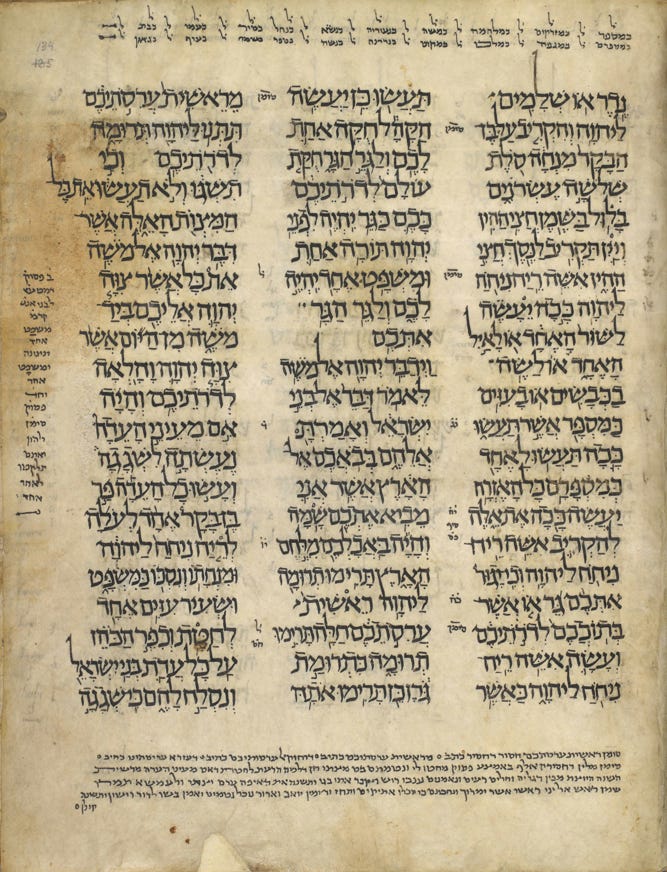
A page from the original codex
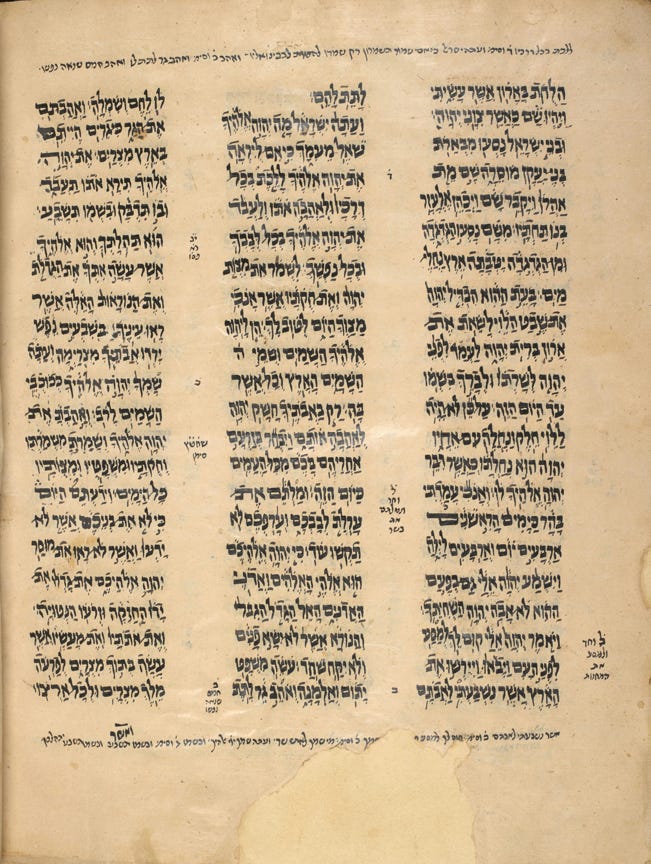
A page from the 16th century replacement folios (it’s OK, you can say it: no, they are nowhere near as beautiful as the original pages)
I think there are sufficient clues in the manuscript to reveal four (and a half) chronological stages: (i) the original codex; (ii) an interim phase; (iii) the replacement folios phase (which comes in two parts); (iv) the latest phase.
Geographically, the discussion repeatedly gravitates towards Persia. Without any doubt the manuscript ended up in that region (at the end of the manuscript an ownership colophon appears - written in Judeo-Persian! Bit of a clue…) As we will see, there is also reasonable evidence that the manuscript was originally written in a Persian context. As for the interim periods, it seems to me that an ongoing Persian location for the manuscript makes the best sense of the available data.
The original colophon—if such existed—was lost with the loss of the head and tail of the codex. Nevertheless, we can know a bit about the scribe and provenance of the original codex , thanks to a clever scribal trick…
In the top and bottom margins of many mediaeval masoretic manuscripts, you can find textual notes designed to protect and preserve all the fine-grained details of the biblical text. One very special subset of these notes involves collecting multiple examples of a particular phenomenon, where each specific example collected is unique in some way. For example, from the paragraph so far I could create the following list: margins; manuscripts; details; examples. This list gives all the plural words in the paragraph so far that occur only once (which is why ‘notes’ isn’t included in the list). Another list could be: bottom; collecting; collected; following; occur; appears; common; letter. Here again, each of these words appears only once in this paragraph; the common denominator is that they each contain a doubled letter.
I could rearrange that second list: appears; bottom; collecting; collected… now they are arranged alphabetically. In fact any order would be fine. If I were particularly fond of horses I might choose to order the beginning of my list like this: Following; Occur; Appears; Letter…
Or, if I were a scribe slaving away at a complicated manuscript, I might want to hide my identity among these sorts of notes…
This is exactly what the original scribe behind Or. 4445 did. Three times.
These notes reveal the name: ניסי בן דניאל הכהן, ישמרהו אל ‘Nissi ben Daniel HaCohen (may God preserve him!)’ to which is added (written out in full) על שם הכותב והמנקד והמסיים ‘according to the name of the scribe, vocaliser and masoretic annotator’. Here is the example from fol 113v:

One scholar of this manuscript has suggested that this Nissi (and therefore his codex) are of Persian origin, on the grounds that the name Nissi(m) is a very common name in and around modern-day Iran at the time.
More recently, another scholar (the great Yosef Ofer) has raised the intriguing possibility that the—Persian—origins of the scribe are also hidden in one of the three name-acrostics. On fol. 139r we find the basic name-acrostic, followed once again by the fully-written phrase ‘according to the name of the scribe… etc.’:
נ-ס-י ב-ן ד-נ-י-א-ל על שם הכתב והמנקד והמסיים
There are also eight further list items following this note. Ofer has proposed reading the first non-prefixed letters of each phrase (as usual) to read the expression: משאקאמאד, which he interprets as ‘from Shaqabad’ (today known as Shaqlawa, in North Eastern Iraq).
So far, so good. We can put a name to the scribe who wrote the original part of the manuscript, and we have some clues as to his origins (and, potentially, the place where the original manuscript was written).
In part two I will share one previously-unnoticed detail which further ties this manuscript to Persia, and then we’ll think about the thorny issue of the date…
For the past century or so, Or. 4445 has served as one of the six major biblical codices for the discussion of the Masoretic Text. The codex has merited a full PhD thesis and various smaller, independent studies. These studies have mainly focused on the Masoretic notes of the codex (which are unusually plentiful), and the text itself as a potentially pre-Ben Asher witness to the Tiberian biblical text (spoiler: it isn’t).
No posts
Comments
Nothing yet. Say the first thing.
Sign in to join the conversation.