

Men & Friends (or lack thereof)
My husband and his friends just returned from their annual fantasy football draft. You might be wondering how long it takes to pick players for an imaginary football team. Three days at a cabin on a lake is the correct answer. Watching the euphoria these middle-aged men get from this tradition made me think about the nature of male friendships—especially against the backdrop of the loneliness epidemic.
Research has long shown that female friendships tend to be more talk-based, while male friendships tend to be more activity-based (Lever 1978, Maccoby 1990, Caldwell and Peplau 1982, Fear 1996, Rawlins 1992, Reisman 1990). Talk-based friendships can be woven into everyday life. For example, I call my best friend while driving to pick up my kids. We catch up, and laugh, and talk about The Summer I Turned Pretty (the show, not my personal summer of 2009). By the time I’ve parked the car, we feel more connected. (Women may also have been socialized to fit relationships inside the confines of daily responsibilities. People smarter than me can comment on that).
For many men, friendship maintenance looks different. Activity-based connection often requires dedicated blocks of time—time that can be harder to carve out around work, family, and other responsibilities. (Understandably, this contrast can, and does, create tension in some straight couples. I say understandably because it’s not about fault—it’s about logistics).
That difference might help explain why male friendships have declined more sharply than female friendships in the smartphone era. Today’s men have fewer close friends than they did in 1990. In his upcoming book, Scott Galloway explores why this is happening, why it matters, and what might help. As he writes:
“What happens to those men when the shit gets real? One horrifying data point: Men account for 3 out of every 4 deaths of despair in America. Too many men are stuck, isolated, unproductive, and prone to obesity. They’re addicted to drugs, gambling, porn, and whatever other substances provide a dopa hit with minimal friction. They’re susceptible to misogyny, conspiracy theories, and radicalization. They make inadequate mates, employees, and citizens. Can we turn this around? Yes. We have to.”
Male loneliness isn’t just a “men’s issue” or a “women’s issue.” It’s a societal one. When connection frays—whether in families, friendships, or communities—the effects ripple outward. Understanding the forces at play is one way to begin repairing the fabric. I, for one, am open to options that can deter the trend of, as Galloway put it, “misogynistic conspiracy theorists.”
Brain Gyms
New research out of Cornell shows significant neural and behavioral consequences of LLM-assisted essay writing. Participants that used only their brain for the essay exhibited the strongest, most distributed brain neural networks. LLM users had the weakest connectivity. The authors state: “While LLMs offer immediate convenience, our findings highlight potential cognitive costs.”
Our usage of LLMs isn’t going to diminish, no matter how much we learn about brain deterioration. Most of the college students I talk with about AI mention the potential downsides but recognize that if they were to stop leveraging these tools, they would quickly fall behind their peers. And they’re right.
But this doesn’t mean that we all need to slowly get dumber!
Kylee from Plum Pits wrote a great essay about how she sharpens her mind. She writes:
“Your brain isn’t broken. You haven’t peaked. You’re not doomed to scroll yourself into oblivion. It’s still in there—that sharp, curious, wide-eyed version of you.”
When our physical lives became more sedentary, we created gyms to stop our muscles from atrophying. Our cognitive lives may also become sedentary as AI takes bigger bites of our creative muscles. In the luxury market, we’ll likely see more brain-health retreats. For the rest of us, it’s about consciously “unrotting” our minds. Think: book clubs focused on challenging texts followed by university-level discussion, the return of handwritten letters, local clubs where people give keynote talks on topics of interest.
Hopefully these brain gym activities can help us stay sharp while using AI because let’s be honest, students are not writing essays, one-third of teachers are using ChatGPT to write assignments, and President Trump has signed an executive order promoting AI use in the classroom.
Just as our physical strength no longer comes from daily labor, our cognitive strength may soon require intentional effort.
Millennial Nostalgia
Backstreet Boys are selling out The Sphere, Lindsay Lohan is on the big screen, young stars are dressing like a Delia’s catalogue, and fro-yo is making a comeback. We are reaching peak Millennial nostalgia—and even Gen Z and Gen Alpha are getting in on it.

Golden era thinking isn’t new, but I’m interested in what younger generations are nostalgic for. In the case of Gen Z and Gen Alpha, it seems to be freedom: unsupervised time with friends, the inability of parents to track them, and the pre-smartphone, pre-social media version of adolescence.
Jon Haidt and Harris Poll surveyed more than 500 children ages 8 to 12 across the US and found that their preferred way to be with friends is in-person and unsupervised.
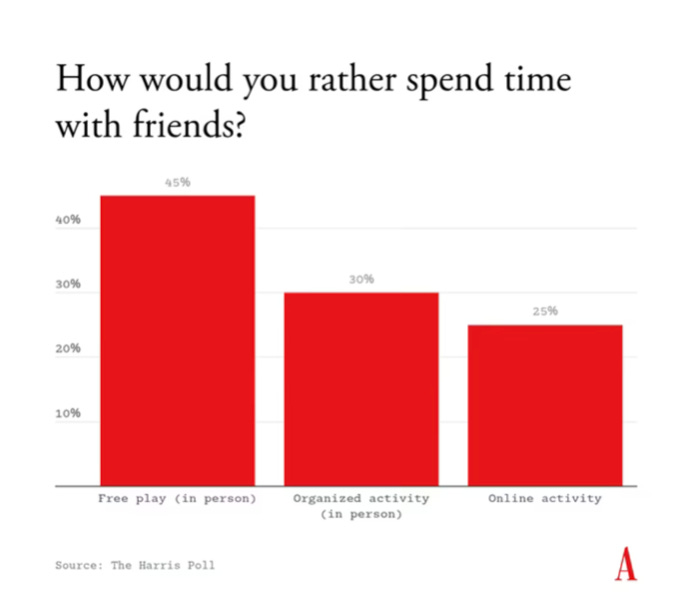
Haidt and collaborators write:
“Children want to meet up in person, no screens or supervision. But because so many parents restrict their ability to socialize in the real world on their own, kids resort to the one thing that allows them to hang out with no adults hovering: their phones.”
Young people are being vocal about what they want. Now it’s up to parents and broader society to find ways to create a more autonomous, risk-taking childhood.
My summer internship just wrapped up. I recruited people from diverse backgrounds, studying a range of topics, and able to engage respectfully around complex issues facing their generation. Not to brag, but I recruited perfectly this year.
I feel incredibly lucky to get to bring together a thoughtful group of young people to discuss their formative years, their perspectives on their generation, and their hopes for the future.
The topics and complete reading list can be found here.
There’s a lot to unpack from our discussions but here are a few reflections:
The most animated discussions were around politics/DEI/wokeness, dating/relationships, and wellbeing/mental health.
I requested feedback at the end of the program about what could make the experience more valuable for future interns. They all wanted more meetings, more discussions, and more pre-reads.
The conversation about declining birth rates stuck with me. Many in the group assumed it was about unaffordable housing, economic headwinds, and climate anxiety. But when we looked at Japan, South Korea, and Sweden—places with universal healthcare, generous parental leave, and child-friendly policies—birth rates are still declining.
This choice to forgo parenthood is clearly more complex than just economics or nihilism. We explored ideas like:
“Convenienceification” making hard things feel insurmountable
Scientific breakthroughs allowing later-in-life parenthood
Mismatches in the heterosexual dating market making it hard for straight women to find eligible partners
The fear of failing at parenting becoming a deterrent in itself
More reflections to come. A sincere thank you to this amazing group. Our time together was a highlight of my summer and I hope it was for you too. Applications for my 2026 internship will open right after Thanksgiving.
In August, I’m speaking in Denver and Milwaukee. Next month I’ll be in San Francisco, Santa Clara, Minneapolis, Boise, and Palo Alto.
The past few weeks have really given us the best of pop culture. Conrad girls are thriving. The Yukon remix is really good. The trailer for Marty Supreme was finally released. Ben Platt sang Addison Rae’s Diet Pepsi. And most importantly, TS 12 was announced on New Heights.
No posts
Comments
Nothing yet. Say the first thing.
Sign in to join the conversation.