
Hello Readers -
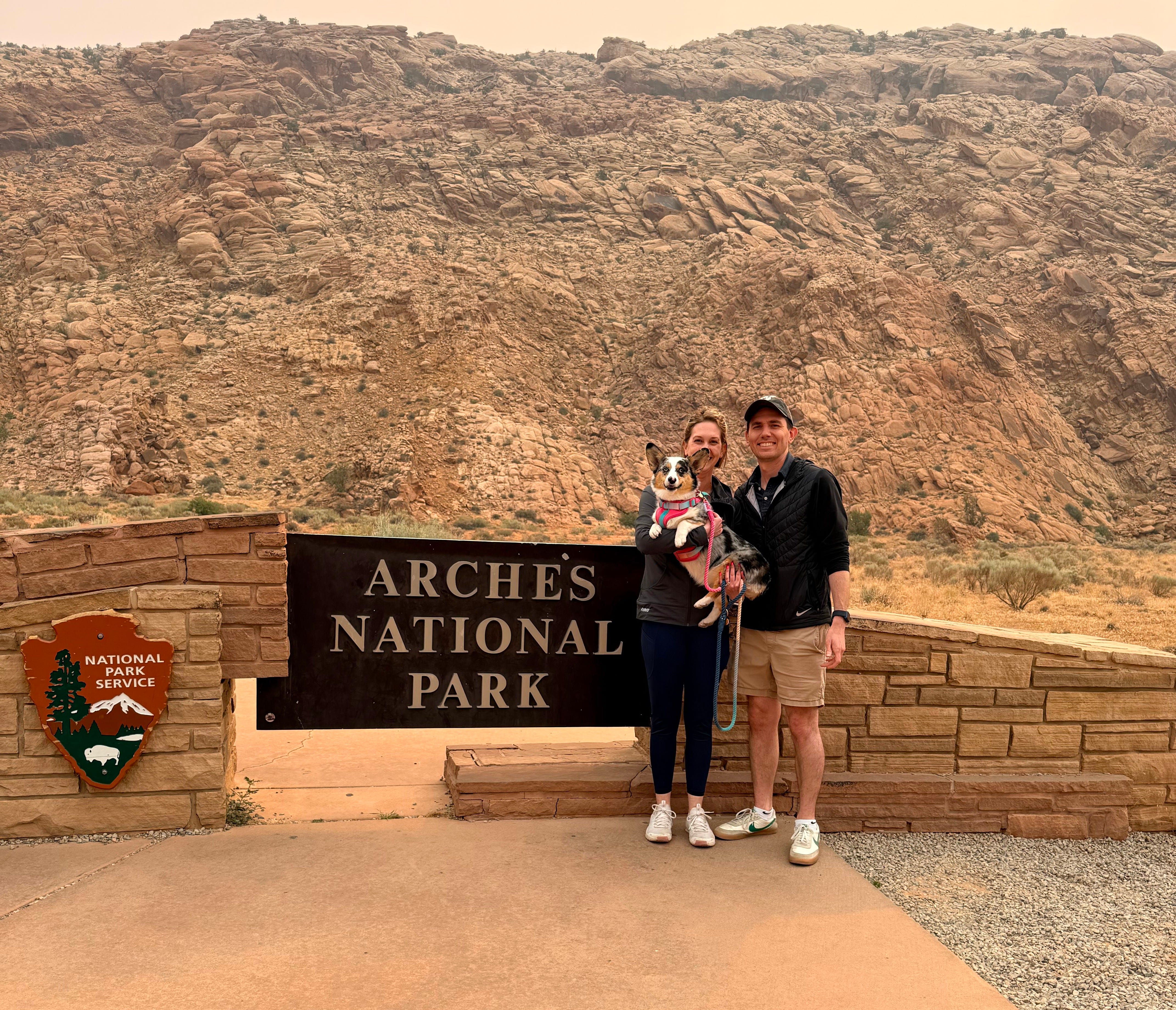
I am glad to be back sharing news with you after a two-week long cross-country road trip at the end of June into July. My husband, my corgi, and I piled our things into our car and drove across 18 states in 15 days. We saw 10 National Parks, 2 State Parks, and visited 700 other corgis at the Seaside, OR corgi beach takeover. It was a trip of a lifetime and a moment we used to celebrate a year from my C1-C2 spinal fusion. Please enjoy this picture of us at Arches National Park.
This month, July, was Disability Pride month. Unfortunately, the harmful policies and impacts on disabled people across the country made it a difficult moment to celebrate. Jimothy the raccoon (google the name and get a fun surprise!) was a bright spot along with the American Association of People with Disabilities ADA Celebration. I love being in community and catching up with everyone at these events.
I also had the pleasure of attending an incredible screening of Take Me Home at the Center for American Progress this month. The film highlights the complexities of caregiving and the intersection of aging, disability, and family dynamics. Moments of the film caused gasps, tears, and laughter as the story of one family played out across the screen. I strongly recommend watching this film whenever it is widely available. And check out the panel from the screening with the director of the film.
July also marked a big moment for the United States - 250 years. While I was lucky enough to get out of DC for the 4th, neighbors and friends shared that the flyovers, fireworks, and (less than) Great American State Fair were enough to put a damper on a usually fun day of BBQs and family. In a different timeline, maybe we would all be celebrating. But, in this moment when there is a war, constant deaths by ICE, dismantling of our government, and continued passage of harmful policies, it is difficult to celebrate. I encourage reading this piece from New America about disability at 250 reflecting on history and what it means to achieve the “American Dream.” Additionally, this great research into the accessibility of democracy shines a light on who actually gets to participate.
For this month’s newsletter, I have articles from June and July. I hope you enjoy reading through each of them.
Onward!
Kim
Did someone forward you this newsletter? Subscribe today to have it delivered to your inbox each month.
Since February’s newsletter, I’ve provided quick accessibility tips of the month. So far, we’ve covered the following topics: a) leverage organizational strategy to make accessibility a driver of innovation, b) make web content accessible, c) develop a plan and process for accessible meetings, and d) make your documents accessible. This month, we are going to talk about creating accessible social media and digital content.
In July for disability pride month, organizations often increase public advocacy and awareness campaigns about disability and accessibility. Ironically, not all this content is actually accessible itself. When social media content isn’t built for accessibility, it is not just a loss of a like or view, we see active exclusion of disabled people. Social channels are an extension of your organization’s public brand, and accessibility should be standard.
The first step is to move beyond auto-generated defaults. Often the alt text that is automated needs some editing or complete rewriting. AI can be helpful but needs to be checked to make sure it makes sense. Graphics can be the biggest barrier when there isn’t any alt text or image descriptions, but many platforms highly rely on graphics for engagement. While the following suggestions do not solve all accessibility barriers, they can get you started in the right direction:
Alt Text: Don’t rely solely on automated image recognition, which often fails to capture context. Write concise descriptions that convey the core message. If an image contains text (like an event flyer), that text must be included in the alt text or as an image description in your caption.
Capitalize Your Hashtags (CamelCase): Screen readers read lowercase hashtags as one long, unintelligible word. Plus, for many of us, lowercase hashtags are difficult to distinguish. Use #CamelCase capitalization (e.g., #DisabilityPrideMonth instead of #disabilitypridemonth).
Caption Every Video: Many people watch social media videos on mute, making captions essential for everyone and vital for Deaf and hard-of-hearing users. Use captions when creating your videos or verify that platform-generated closed captions are accurate before publishing. Really read the captions before publishing - they are not always correct and some errors make the content confusing.
Limit Emojis: Screen readers speak the full alt text of every emoji (e.g., “Clapping Hands Emoji”). Placing ten emojis in a row disrupts the flow. Use them sparingly.
Senate Markup on July 30, 2026, U.S. Senate Committee on Health, Education, Labor and Pensions. Many bills were considered, most were bipartisan. Among bills passed out of committee include:
RISE Act - requires colleges and universities to accept IEP, 504, and other K-12 documentation as proof of disability for accommodations. Passed with 22 yeas and 0 nays.
College Transparency Act (does not include data collection for students with disabilities)
Disability Impacts Every Policy We Create and Every Policy Impacts Disabled People (FAIR CounterSpin, 07.07.2026).
Trump Administration Sued Over Delay of Accessibility Rules (Disability Scoop, 06.08.2026).
ICYMI: More Than Ramps - Accessibility Issues Remain Prevalent in Health Care (Government Accountability Office, 05.21.2026).
ED Move of OSERS to HHS and OCR to DOJ
U.S. Department of Education Announces Additional Partnerships to Strengthen Coordination for Individuals with Disabilities Programs, Bolster Civil Rights Enforcement (Department of Education, 06.16.2026).
In Private Call, Education Dept. Tried, But Failed, To Reassure Disability Advocates (NPR Weekend Edition, 07.09.2026).
Transfer of Key Special Education Offices Out of Department of Education Harms Students with Disabilities (AUCD, 06.16.2026).
DOJ Olmstead Memo
Application of the Rehabilitation Act and Americans with Disabilities Act to State Institutionalization of Patients with Severe Mental Illness or Disabilities, Memorandum Opinion For The Counsel To The President (Department of Justice, 06.18.2026).
Clarification on Department of Justice Guidance Titled, “Statement of the Department of Justice on Enforcement of the Integration Mandate of Title II of the Americans With Disabilities Act and Olmstead v. L.C.” (Federal Register, 07.20.2026).
New Justice Department Memo Questions Decades of Protections for People with Disabilities (PBS News Hour, 06.22.2026).
DOJ Memo Stoke Fear Among Disability Advocates of a Return to Institutionalization (NPR All Things Considered, 06.20.2026).
DOJ Memo is Attempting to Turn Back the Clock on Integration and Olmstead’s Promise (AAPD, 06.18.2026).
Medicaid Changes and Barriers
Medicaid Changes Will Push People with Disabilities Off Program, Advocates Warn (Disability Scoop, 06.03.2026).
Looming Medicaid Cuts Put Care for People with Disabilities At Risk (NBC News, 07.07.2026).
New Medicaid Work Rules: What People with Disabilities and Families Should Know (The Arc, 07.16.2026).
Deloitte-run Systems Denied Medicaid to Disabled People. New Laws Could Make it Worse (NPR, 07.20.2026).
Education
My Accessibility Journey, Part 3: Accessibility is About People, Not Checklists (Central Michigan University, 07.24.2026).
ADA Title II Web Accessibility: A Compliance Guide for Small K-12 Districts (EdTech, 06.04.2026).
Screens are Leaving Schools Fast, Though Some Students with Disabilities Rely on Them (NPR, 06.04.2026). *A good read on the “blunt instrument” of screen bans in schools. What do you think about these new policies popping up?
Rethinking the Debate Over Rising Disability Accommodations in Higher Education (American Bar Association, 06.03.2026). *Strongly encourage reading this article. Here’s a great quote from it “What appears to be overrepresentation may therefore reflect the cumulative effects of uneven access and improved identification over time, rather than evidence that large numbers of students are improperly receiving accommodations.”
Accessibility in Businesses
Target’s Focus on Inclusive Design and Guest Experience: Fact Sheet (Target, 07.08.2026).
Accessibility 2.0 is Becoming a Leadership Conversation (Forbes, 06.24.2026).
Accessibility is More Than a Design Problem (Fast Company, 06.17.2026).
Towards Audio Inclusivity - How to Make Spaces that Work Better for People who are Sensitive to Noise (Building Design, Intelligence for Architects, n.d.).
Nearly 4 in 10 Businesses Sued for Accessibility Already Had a Solution. Here’s What Went Wrong (Charlotte Observer, 05.28.2026). *Interesting observations about the money being left behind by businesses with inaccessible websites. Read more!
Other Great Reads
A 10th Anniversary Reflection for Accessibility in the News Subscribers (Digital Accessibility Digest, 07.20.2026).
The Quiet Effort to Dismantle Disability Rights (American Bar Association, 07.20.2026). *I would suggest it is not a quiet effort but this is a good list of many attacks.
Portlanders with Disabilities Struggle to Find Housing that’s Both Affordable and Accessible (KGW8, 06.22.2026).
Why Section 504 Still Matters Today (Disability Belongs, 05.27.2026).
Millions of People with Disabilities May Be Missing Out on this Little-Known Savings Tool (CNBC, 05.27.2026).
When I compile the newsletter, these are open roles, but changes to status occur quickly. Please note, I do not have any additional information beyond the links provided about these positions, and I do not have affiliations with these jobs.
Southern New Hampshire University is seeking a Director of Digital Accessibility in the Office of the President. This full time position is remote and “serves as SNHU’s lead authority on digital accessibility and a strategic driver of the University’s digital inclusion efforts.” Check out this job description to learn more.
The National Center for Learning Disabilities is hiring for a program associate or program manager. This remote position involves travel and supports the coordination of grant funded initiatives to improve outcomes for students with learning disabilities. Learn more here.
The American Association of People with Disabilities is hiring for several positions including an executive assistant, disability data fellow, and alumni network regional gathering co-organizers. Learn more here.
The Center for American Progress has numerous positions across programs open. These include associate director of health policy, chief of staff and vice president, director of digital engagement, executive vice president of policy, vice president of democracy, and many more. Learn about all the positions here.
New America has a few positions available. These positions include internships, full time senior positions, and more. Plus, there is an open call for contractors who can support project based work. Read more about the positions and all the details. Find the postings here.
Connect with Kim today to share content for this newsletter or learn more about services offered by Unlock Access. Enjoying the accessibility tips of the month? Download the Unlock Access Accessible Business Starter Kit or Digital Accessibility Toolkit today!
Comments
Nothing yet. Say the first thing.
Sign in to join the conversation.