
"A lot of people think Japanese food is difficult, a lot of work.
But you don't have to buy the knife I have. You don't have to train as long as I have.
You can do my cooking in your kitchen."
- Iron Chef Masaharu Morimoto
Happy Summer Friday. I hope you all are having a fun and safe summer!
After my marathon and slightly angst-provoking “I” post, I wanted to pick a less-complex and faster recipe for my “J” country. I am actually starting this post as I cook my braised lamb shank for its initial 4-hour cook on Saturday, July 5th. How far into “J” could I get while it cooked? I was going to try and find out. “Speed and ease, speed and ease,” I told myself. “No rabbit holes, go with your instincts and let the choice come to you.” Sometimes easier said than done.
Being that there are only 3 “J” countries, Jamaica, Japan, and Jordan, I decided to pick Japan. Quick decision. Yay me! For a moment, I thought about trying to make sushi, but struck that idea after thinking about technique, ingredient lists, and where I could find the appropriate quality of fish. I talked about in “I”, how I researched, shopped, read, libraried, and spent a bunch of time and money going down the rabbit hole of Israeli and Persian cooking. Not to mention the lamb shanks I decided to make were going to take from Friday to Sunday to prep, cook, and serve.
Maybe this time instead of challenging myself to make something complex and ingredient-heavy, I would challenge myself to make something from a new-to-me-cooking-but-not-new-to-me-eating cuisine with ingredients I already had. Could I make a Japanese recipe and not have to buy a single ingredient other than the raw ingredients? No new spices, no new sauces, no new nothing that would go in my already fully stocked spice and dry ingredient pantry. Or, would those restrictions hamper me from making something truly spectacular.
For some reason, in the last couple of years, there have been an explosion of fried chicken restaurants opening by me: Raising Cane’s, Dave’s Hot Chicken, Federal Donuts and Chicken, Asad’s, and Birdie’s. The best one imo, Call Me Crispy, is not a chain and is a bit of a drive but definitely worth the time to get there and the calories. Oh, and one of the most beloved of all time, Roy Rogers, just opened not too far from my house and people have waited two hours and blocked traffic on a highly-traveled road to get their hands on their fried chicken and Double-R Bar burgers. It has been quite the story around here.
I listen to a lot of podcasts, especially when I am in the house just puttering around, or in this case, waiting four hours for my lamb to cook and trying to get a jump on this next post. So, when a podcast commercial came on for yet another fried chicken place, I had to laugh. There was my answer: Chicken Karaage: marinated and fried Japanese chicken.
Turns out the “karaage” doesn’t refer to the chicken; it refers to the cooking method and can be applied to many foods cooked in the karaage method, similar in the way “tempura” can apply to many foods. Karaage is “a Japanese cooking method involving deep-frying food after it has been lightly coated in a mixture of flour and starch (like potato or cornstarch)”, which I guess is also similar to tempura, which is also a deep-frying method.
Now, where was I going to find my recipe? Ok, who is the most famous Japanese chef I could think of? Easy: Iron Chef Masaharu Morimoto, who coincidentally open his very first eponymous restaurant where? Well, in Philadelphia, of course! Does he have a recipe for chicken karaage? Yes, he does! Easy, breezy. I am going to use Morimoto’s Chicken Karaage with Spicy Garlic Soy recipe developed for his partnership with Williams Sonoma.
Ok, time for a time check. Two hours, eight minutes left on the lamb. In the last one hour and 52 minutes, I’ve not only started this post, but I’ve run also the dishwasher and done a load of laundry. And, it’s only 11:30. I still have the whole day ahead of me!
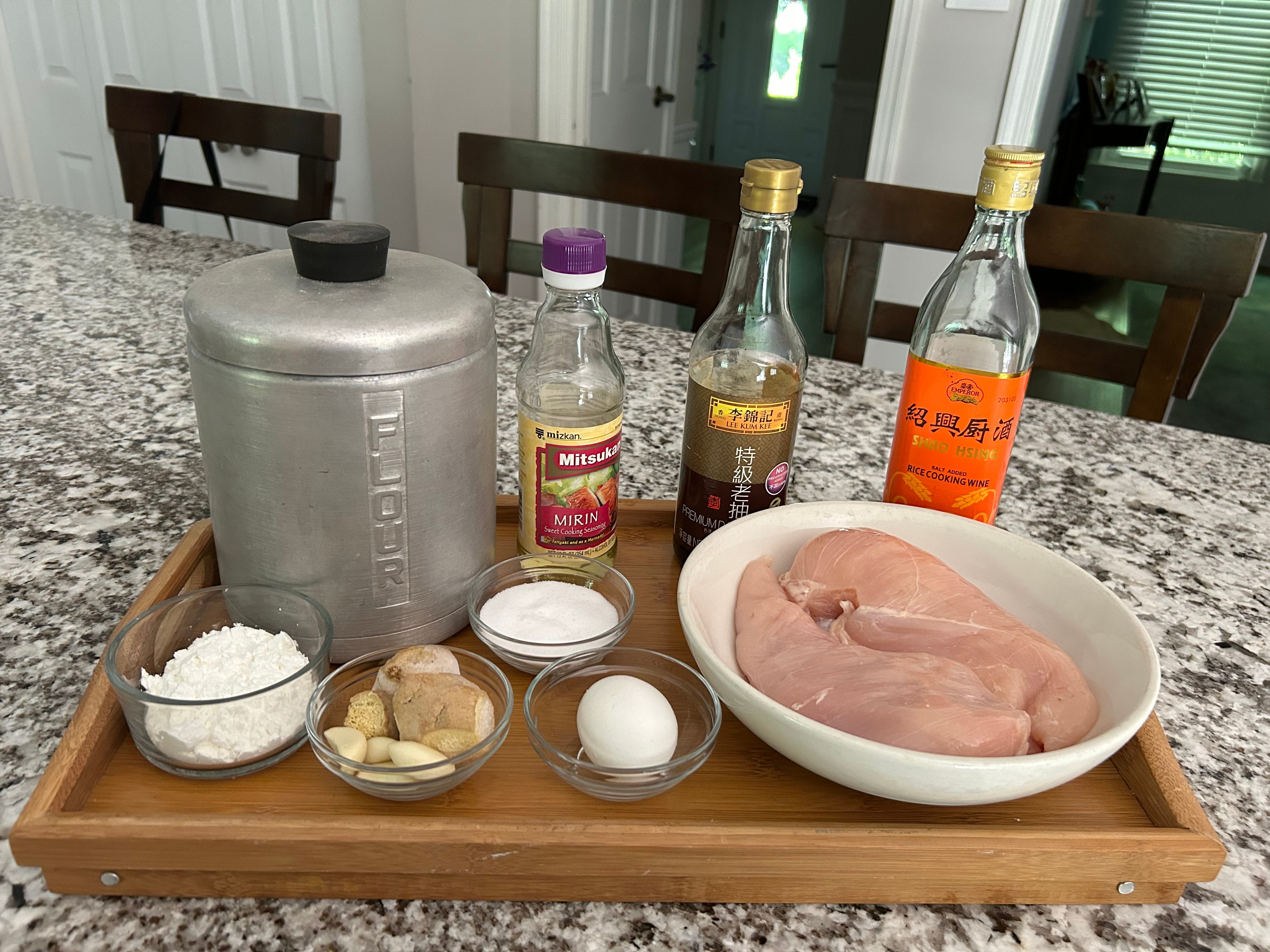
Ok, now time for the pantry check. I had all the ingredients I needed except for the sake, the scallions, and the Morimoto x Williams Sonoma Spicy Garlic Soy Sauce. But, here’s what I am going to do: substitute chicken breast for thigh, substitute Shaoxing wine for the sake, omit the sauce because it’s a dipping sauce (and the brick and mortar WS stores that were close-by have sadly closed), and either buy the scallions or omit them completely because they are a garnish. Done! I don’t really need to buy one thing.
Chicken Karaage with Spicy Garlic Soy
For the marinade:
1 Tbs. sake (I am substituting Shaoxing wine)
1 Tbs. mirin
1 egg, lightly beaten
3 garlic cloves, minced
1-inch piece fresh ginger, peeled and minced
1/2 tsp. kosher salt
1/4 tsp. soy sauce (I used dark soy sauce)
8 oz. boneless, skinless chicken thighs (about 2 thighs), cut into bite-size pieces
3 Tbs. cornstarch
3 Tbs. all-purpose flour
Canola oil for frying
1 oz. Morimoto x Williams Sonoma Spicy Garlic Soy Sauce for dipping (omitted)
Sliced scallions for garnish
To make the marinade, in a large sealable plastic bag, combine the sake, mirin, egg, garlic, ginger, salt and soy sauce and mix until blended. Add the chicken and knead well until the chicken has absorbed all the marinade (I would let this marinate for at least a couple of hours, maybe even overnight).
In a small bowl, stir together the cornstarch and flour.
In a large, heavy pot over medium-high heat, pour in canola oil to a depth of 2 inches and heat to 350°F on a deep-frying thermometer.
Remove the chicken from the bag and place the chicken on a plate. Sprinkle with the cornstarch-flour mixture to coat each piece.
Add the chicken to the hot oil and fry until golden and cooked through, about 3 minutes. Using a slotted spoon, transfer the chicken to a paper towel–lined plate. Increase the oil temperature to 375°F.
Fry the chicken again until deeply golden and crispy, about 1 minute. Using a slotted spoon, transfer to another paper towel–lined plate.
In a large bowl, toss the chicken with the spicy garlic soy sauce. Taste and add more sauce if desired. Garnish with scallions and serve immediately. Serves 2 to 4.
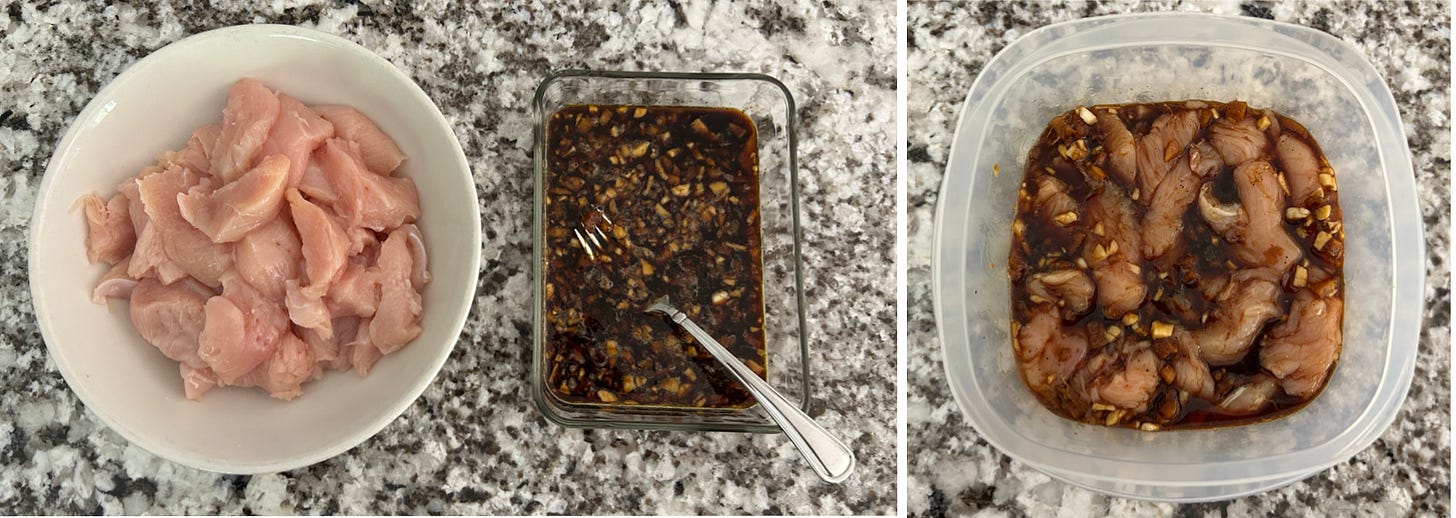
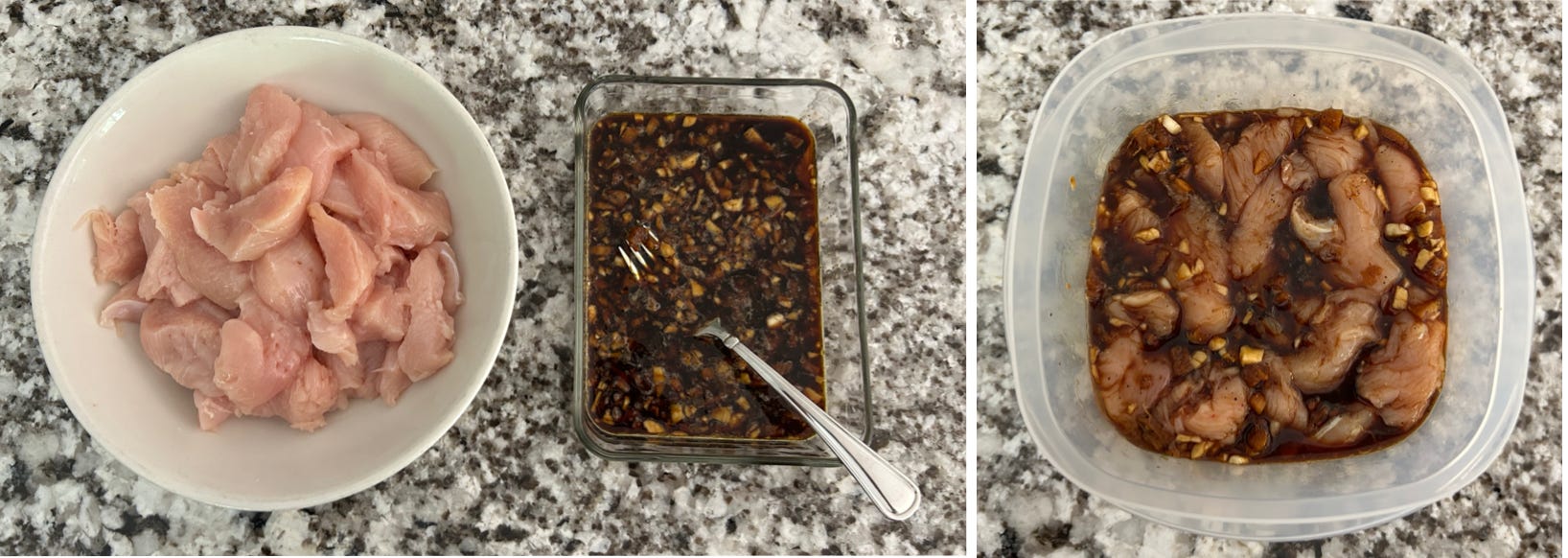
The chicken and the marinade is quick to put together. Using dark soy sauce adds flavor and depth that regular soy sauce doesn’t.
Because the was so fast to pull together, I decided to try different flours to do the frying to see how each coating would turn out. I used corn starch as the recipe calls for, potato starch, and rice flour. Then I tried each of those mixed with regular flour. I find that using regular flour doesn’t give the best crisp, so I figured I would try all these combos. The rice flour in both circumstances was the crispiest.
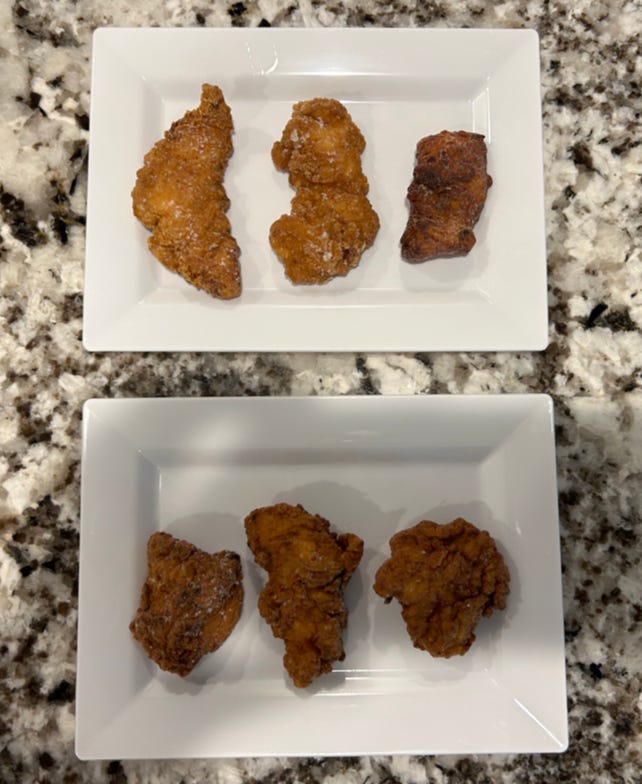
Then I couldn’t resist going one step further and had to try a seventh version using a bit of panko. The combination of rice flour, regular flour and panko (50% - 30% - 20%) was hands down the winner.
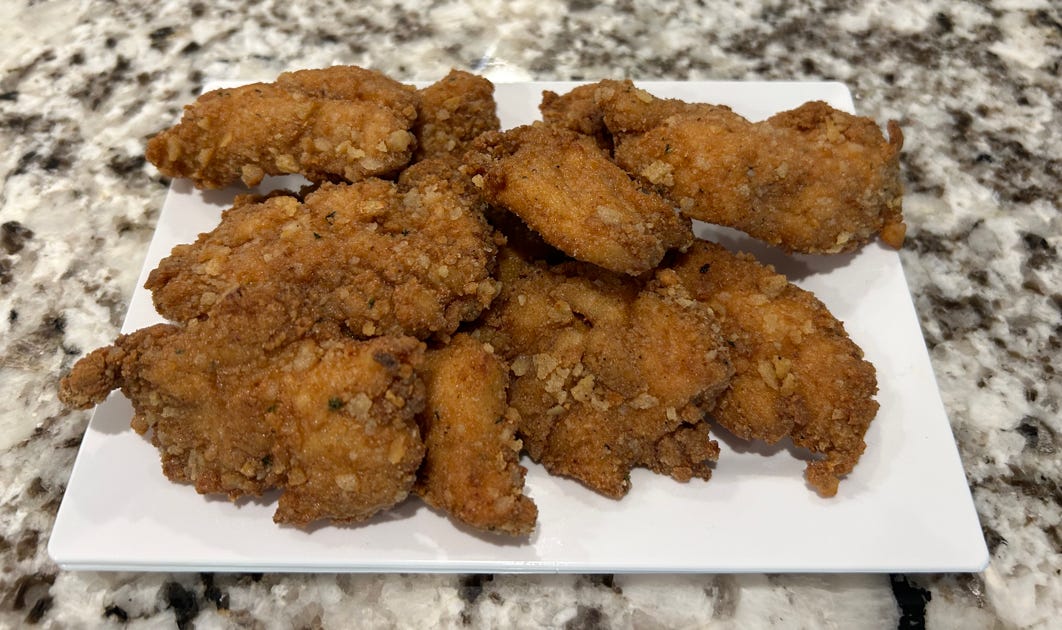
These little chickens came out so good. They are filling and the dark soy, garlic, and ginger are a flavor bomb. They were great on their own and were so flavorful that the dipping sauce wasn’t missed at all. They were also great the next day as well - they kept their crisp well (I think that is because of the rice flour) and were delicious cold. They would be great as an app, at a get-together as an hors d'oeuvres, as a main meal, or in a salad. I am pretty proud that I ripped right through J (including writing this post) in just a couple of hours It should remind me that sometimes making things easier and faster is really the way to go.
Also, as a coda to my Guyanese Pepperpot post, one of the IG accounts I follow - metemgee - which was one of the recipe sources I used for the pepperpot, did a 2-parter on IG about how cassareep is made. You can check it out here and here.
As another way to divert my attention to what is going on in the real world, I’ve started a new monthly column here on kimchantment, called “Let’s Watch”, where I’ll be chatting about what I watch on mostly streamers and some regular TV each month. I will most likely start emailing it out in the fall. I wrote a Holiday version earlier this year and you can find the first monthly installment (June+July) by clicking on the below banner.

Thanks for stopping by. This installment of “Let’s Eat” is free, so feel free to share.
Enjoying kimchantment? You can also share the full site with others.
Click here for more “Let’s Eat” posts.
Join kimchantment on Instagram.
Visit the full kimchantment site.
The recipe I used was courtesy of restaurateur and Iron Chef Masaharu Morimoto and Williams Sonoma.
© 2025 Kim Selby & Storm Your Brain, LLC. All rights reserved. All photography © Kim Selby unless otherwise credited.
Comments
Nothing yet. Say the first thing.
Sign in to join the conversation.