
The document was supposed to take two weeks. You knew the shape of this work, you’d done versions of it before. Fourteen days of mornings, the slow accumulation of pages, the familiar frustration of finding the right word. By day ten, you’d usually hit the wall. By day thirteen, you’d retrieve it. That was the rhythm. That was how you knew you were actually working.
This time, you started on a Tuesday. By Thursday afternoon, it was done.
Not the first-draft kind of done. The kind where you read it back and the thought count felt right, the examples landed, the voice was there. The transitions didn’t limp. You’d even caught yourself making small choices, cutting a paragraph that was fine but unnecessary, adding a line that changed the tone of a whole section. The decisions felt like yours. The work felt like yours. And something in your chest had gone still.
Not happy still. Confused still.
You sat with the document open. Read it again. Looked for the part where it broke, where the seams showed, where you’d gotten lazy. Nothing. It held. It held better, maybe, than things that had taken you longer.
So why did it feel like cheating?
∗ ∗ ∗
The first thought was small, the kind you barely notice. Something is wrong with me. Not wrong as in broken, but wrong as in, you have lost something. Calibration. Standards. The ability to push yourself properly, because if it came this easily, you must not have pushed at all. The effort-value equation, though you didn’t have a name for it yet, had already solved itself in your nervous system before your conscious mind caught up. No struggle equals no real work. No real work means the output is suspect. The output is suspect means you are suspect.
You closed the laptop.
Your shoulders were high, when had they risen? They were nearly at your ears, and you consciously pressed them down and felt them rise again within seconds. The body knows something before the mind arrives at it. The body was already arguing with the thing you’d just created.
This is what disorientation feels like when it lives in the nervous system instead of the mind. It doesn’t announce itself as confusion. It announces itself as a problem in the shoulder blade. A tightness in the jaw. The held breath you only notice when you try to breathe normally and find there’s no room.
∗ ∗ ∗
Everyone talks about the moment of achievement as though it would feel like something, arrival, landing, the moment a plane stops climbing and levels off. But the nervous system doesn’t experience achievement. It experiences the absence of what it used to feel. It experiences loss.
Competence, when it actually arrives, doesn’t announce itself. It arrives the way altitude changes when you’re driving through a mountain pass, you don’t notice the moment the pressure shifts in your ears. You just look up, and the landmarks are gone. The landmarks you’d been using to know where you were, to know if you were headed the right direction. And suddenly they’re not there, and the body has no reference points, and you start to suspect you’ve gone in a circle.
The body was designed to trust sensation. Pain means something is wrong. Resistance means you’re pushing against something real. The struggle is the reality check. When the resistance goes quiet, the nervous system spins. Nothing to grip. Nothing to push against. No feedback except the kind that says, yes, this is done, yes, it’s good, and that feedback is so quiet it feels like nothing at all.
Consider the woman at the conference—the one overheard at the coffee station, talking about finishing a document in what used to take weeks. I’m terrified it’s not good, she said to someone she clearly didn’t know well. It came too fast. I can’t find the part where I actually did the work. Someone tried to reassure her. Congratulated her. But she kept shaking her head. I don’t feel like I’ve done anything. It doesn’t feel like I deserve to claim it.
This is competence in a body that’s been trained to recognize struggle as the evidence of reality.
∗ ∗ ∗
The guilt that comes next is strange because it doesn’t announce itself as guilt. It arrives as a problem with math. If the output is the same or better, but the input was radically less, then something doesn’t add up. The equation running in the background of your whole life says: great work equals great effort. Therefore, if the work is great and the effort was minimal, something is being hidden. Either the work isn’t actually great, or you’re not seeing where the effort went, or, and this is the one the body seizes on, you’re doing something wrong.
The guilt is not the kind that makes you want to do better. It’s the kind that makes you want to hide. If you let people see that something only took you two hours, they’ll know you’re lazy. If it only took two hours and it’s actually good, they’ll know you’ve been holding back all along. The guilt is retrospective. It reframes every piece of work that took you a long time and makes you wonder if that was because you were thorough or because you were slow.
So the guilt sits quietly. It sits in the same place the strain used to sit. It’s a different kind of tension, but it’s tension, and tension is at least familiar. The body prefers guilt to the unmoored feeling of having done something well and not knowing how you did it.
Struggle is dramatic. Struggle has a shape, a narrative. There is a problem, there is your effort against it, and there is the moment when either you or the problem gives way. Ease has no narrative. It is what happens when the narrative has already been written somewhere else, in your tissues, your intuition, your hands, and now the story is just being transcribed. There is nothing for you to push against. There is just the result, clean and quiet, with no visible evidence of its own making.
You open the document again. It’s still there. Still done. Still good. The shoulders are still high. The jaw is still tight. The coffee is cold. The body hasn’t solved the problem of the absence of struggle. Every time ease arrives, the nervous system will have to learn again what ease actually is. Not laziness. Not the absence of care. Not evidence of insufficiency. Just ease. Just the way the work feels when the learning has already done its work underneath.
The mind knows this. The mind can understand the logic. But the mind lives in a body, and the body remembers what it was taught. The body learned that strain is proof, that effort is evidence, that struggle is the price of anything worth doing.
The document sits on the screen. It is done. It is good. Your hands are trembling slightly, the way they do when you’re not sure if you should feel relief or grief.
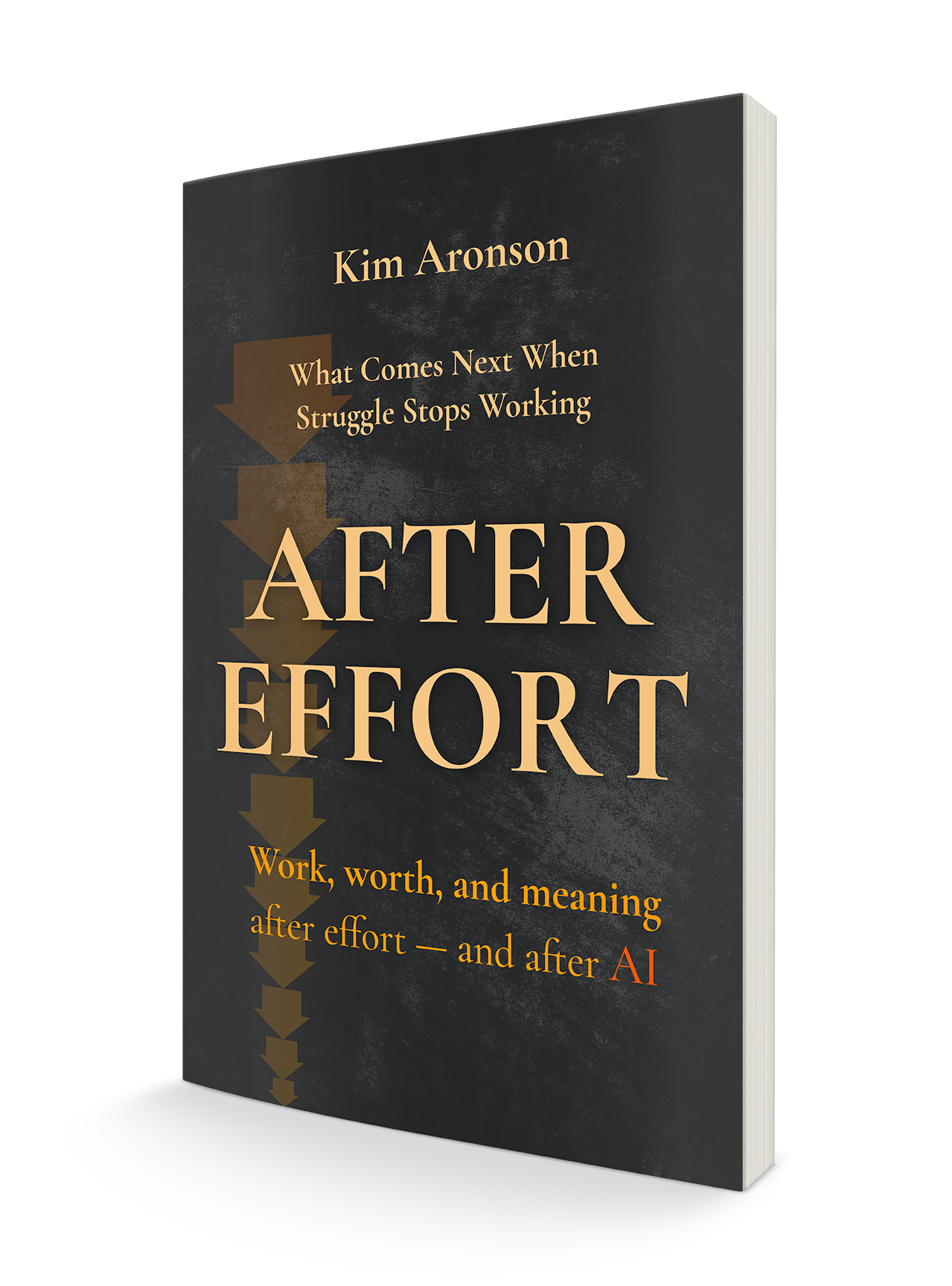
This blog post is an excerpt from my book After Effort: Work, worth, and meaning after effort — and after AI. To learn more about the book, visit www.WisdomManuals.com
I’m a writer exploring consciousness, relationships, and the inner life. I run a publishing company where I help thoughtful people turn lived experience into books, and I work one-to-one with individuals navigating personal transitions.
Comments
Nothing yet. Say the first thing.
Sign in to join the conversation.