

Our family has been slow traveling abroad since May 2025, looking for a place to raise our kids where childhood works a little differently and taking note of what we learn from everywhere we visit along the way. Siem Reap wasn’t on our original itinerary. If you’re new here, this post explains how the search started.
I silently munch some overnight oats, do some stretches, and tiptoe out of our short-term rental apartment.
It’s 6:30am in February. The sun is already up.
I hear the monks’ chants as I cut through a path next to the nearby Buddhist temple, but otherwise the entire neighborhood is silent. There is a calmness that’s hard to describe.
With my three-day visitor pass in hand, I set off running toward my destination: Angkor Archaeological Park.
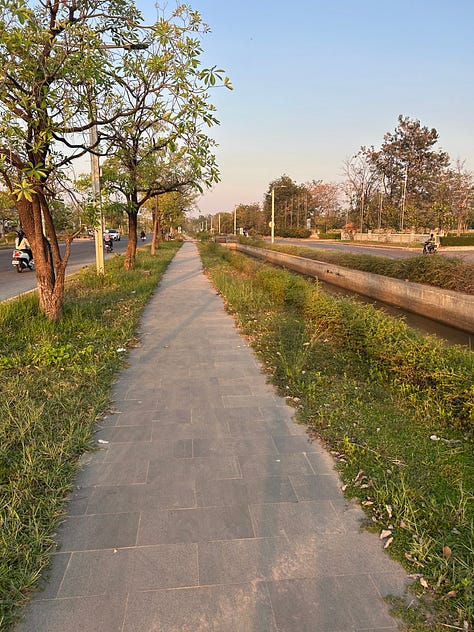
I find a paved trail that leads all the way to the park, shaded from the sun all the way. Keeping it easy today, conversational pace. But, no one to talk but the birds and the trees.
Then I follow the trail across the road but stay in the woods. The trail has turned to dirt and rocks. I realize I am now running through people’s property. Small, makeshift shelters on my right, additional shelter and storage on my left.
I’m dodging chickens and then some feisty dogs. I see people doing household tasks and fetching water for the day. I ask a man if it’s okay that I’m literally running through their home. Who knows if he understands, but he gives me a nod.
Eventually I reach one of the official entrances to Angkor Wat — the largest religious monument in the world.
One of the workers looks at my pass. “Are you sure you want to run here?” I’m confused. I nod. “Okay,” and he punches my pass.
I run further in and realize I’m the only one running. The area is not large enough for a real jog and is filled with tour groups. This isn’t a place to run at all.
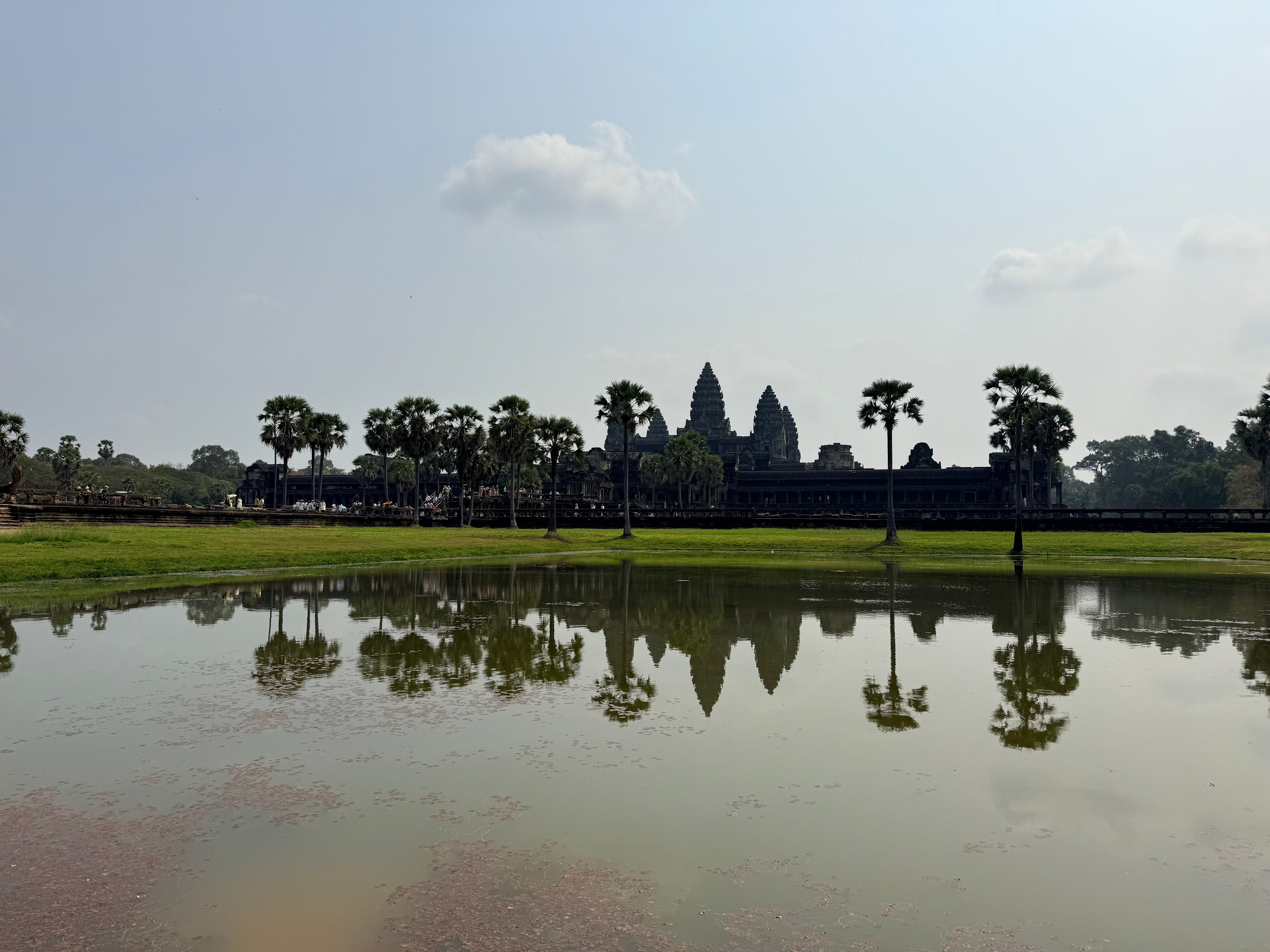
Putting aside my slight embarrassment about wasting a day of my pass, I look to my right and see Angkor Wat over the river, off in the distance.
It really is magnificent.
When we decided to spend a week in Siem Reap, we really had no idea what to expect. We just felt like we had to see Angkor Wat, and we were traveling through the region.
The city genuinely surprised us. In a good way.
Siem Reap’s population is about 190,000. It’s quite compact and has a small-town feel. I only witnessed one traffic jam the whole week after basically the entire town came to a standstill for a big parade and festival. There are no high-rises, and most of the main businesses are in the city center.
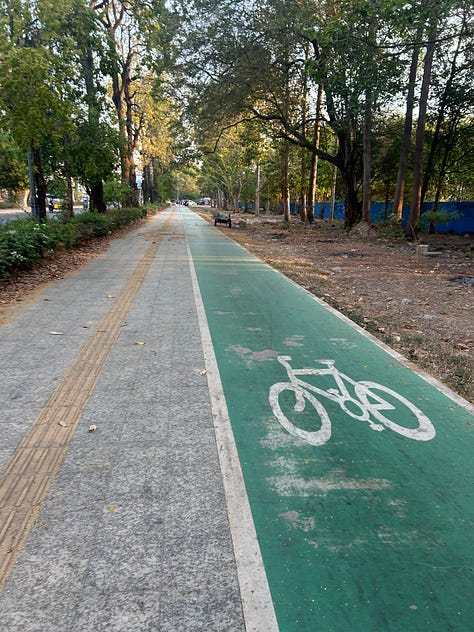
There are decent sidewalks along the main areas near the river and businesses. Most surprisingly, there were actual separated bike lanes in many areas, and a shared-use path that goes all the way to Angkor Archaeological Park. Streets were generally narrow and the city is quite flat, so we didn’t have much trouble biking around with the kids on the back.
On the first day, we went on a quick grocery run, biking down one of the beautiful bike lanes. Green paint and physical separation from zooming motorbikes and cars. I had missed this sense of safety while riding a bicycle.
Then I thought more and got kind of angry. Here is a note I posted about it:
The walking and biking here is better than most American cities. Why can’t we have this in more places?
While the streets had the usual organized chaos of Southeast Asia, we could generally get around well with our bikes – especially on the separated paths. But after about 9am and before 5pm, it was just too hot. The kids would moan if we tried to go anywhere on the bikes. We are not above a siesta, but eight hours is a long time to be hanging out at the pool or in the apartment.
Rideshare exists in Siem Reap but the cars tended to be the most expensive option and not very efficient. Public transit, in the sense that we Americans know it, does not exist in the city.
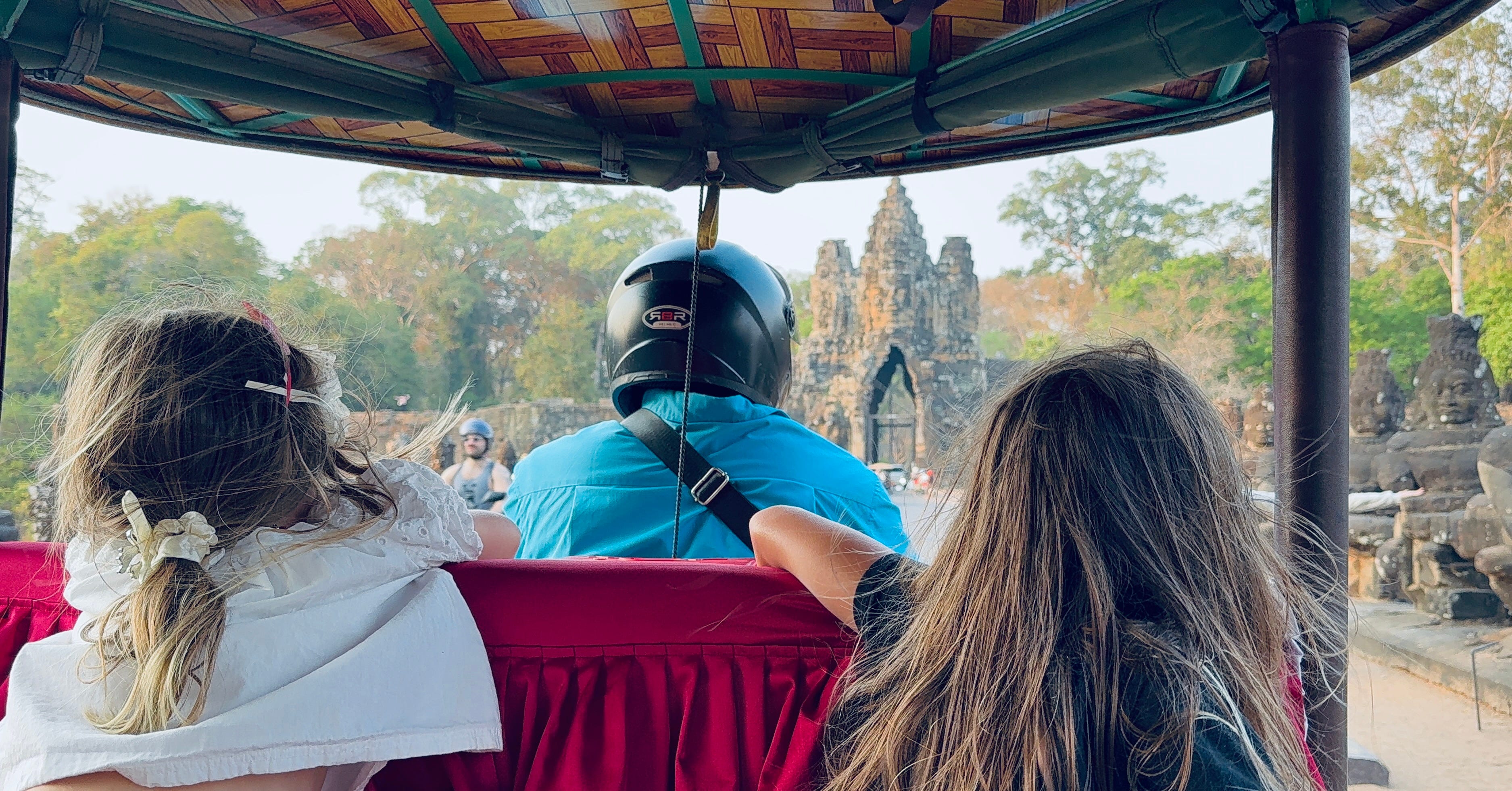
After overcoming my hesitance about tuk-tuks in Thailand, we looked into those. The best option turned out to be the remorque — a Cambodian version of a tuk-tuk where a motorcycle hauls a carriage behind it. After a couple of rides through the Grab app, one of the drivers, Vouek, offered to just be our driver whenever we needed one. We exchanged WhatsApp numbers.
The remorque became our main mode of transportation. Wind blowing through our hair, keeping us cool. We hardly ever reached fast speeds, but they were quick enough to get around town. The kids loved them.
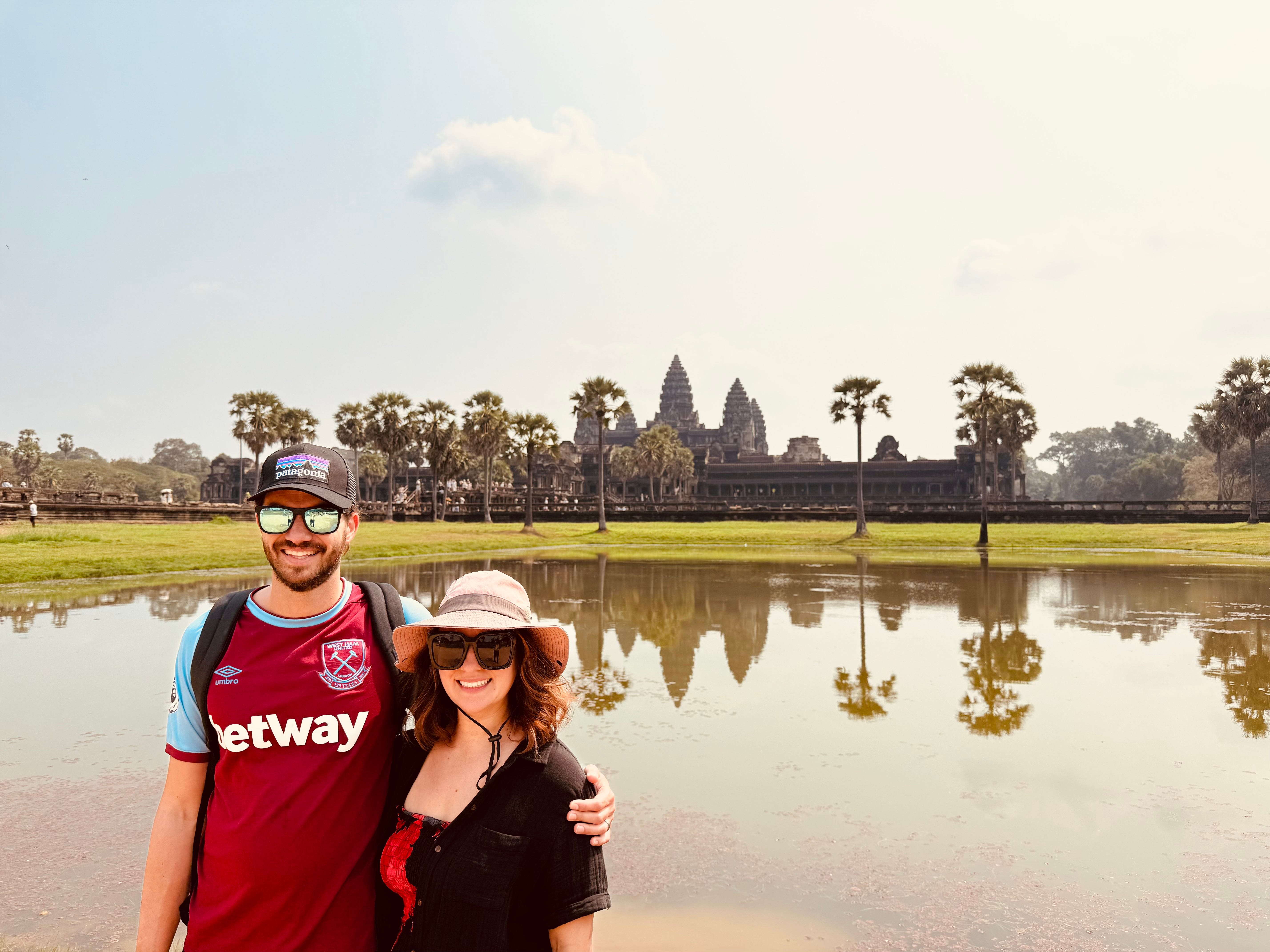
One day, Vouek picked up our family and took us to a drop-off daycare. We left the kids behind, and he chauffeured Sydney and me on the nerdiest and hottest (literally) date we’ve ever been on: a full tour of Angkor Archaeological Park.
We picked up our tour guide, and Vouek drove us all around the park. We started at the main temple. Pretty early on I had to ask our tour guide to stand in the shade when he stopped to explain things to us. The sun was debilitatingly bright and hot. I think he found my lack of resilience quite funny.
While we walked through the temples, Vouek would take some time to rest in the remorque.
At some point between temples, Sydney and I looked at each other and just laughed. We were absolutely drenched in sweat, squinting into the sun, being driven around one of the world’s great archaeological sites in a motorcycle carriage by a guy we met two days ago on an app and listening to another guy tell us about all of his most controversial political opinions about Cambodia.
It was so bizarre and awesome. More dates like this are needed.
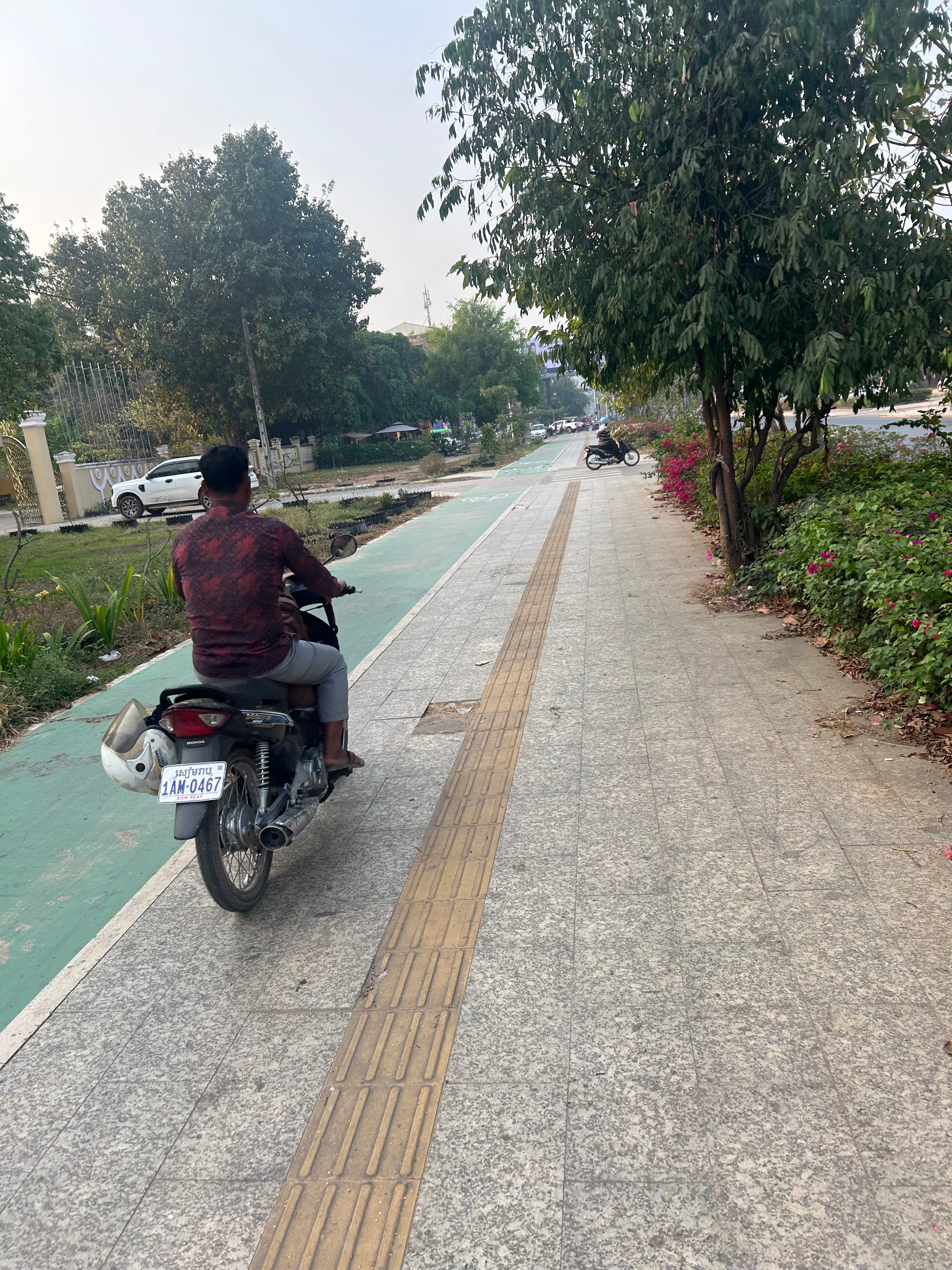
On another morning, I was running down the separated shared-use path out of the city and into the forest. I found myself loving it but then started to get annoyed. First, a few motorbikes zipped by me. “Hey, you’re supposed to be on the road, bro. This is for people on foot or riding a bike,” I thought.
Then there were four stray dogs laying in the path, right next to a food stall and motorbikes parked in front of it. I found myself carefully sneaking by the dogs and running into traffic to avoid the parked motorbikes.
I felt myself growing self-righteous about it. But, then I thought: “dude, you’re not a local here. You’re here for a week. Get a grip.”
Being a tourist is a complicated thing in a place like Siem Reap. I was excited about the bike lanes, sidewalks, and walkability of the city precisely because those things were built with me in mind.
Just like in the US, there has been some pushback from some residents. Locals sometimes park in the lanes or set up food stalls blocking them. Motorbikes occasionally roll through them. It was apparently such a problem that the Prime Minister came and rode his bicycle down the bike lanes himself.
What is undeniable is that the infrastructure improves the built environment for tourists and locals alike. Tourists don’t have to just zip in for two days to see the temples and zip out. They hang around for a week or more when they aren’t completely reliant on Grabs and taxis. They walk or bike to local businesses and spend more time (and more money) in the city itself. Like we did.
Cambodia is still overcoming colonization, genocide, and significant economic challenges. It appears to be a tougher life here even compared to neighboring countries like Vietnam and Thailand. These are all things worth keeping in mind when drawing easy conclusions about what Siem Reap got right.
The city was not a utopia of walking and biking. There were still plenty of places (mostly outside tourist areas) that were hostile to people walking or rolling. Motorbikes zoomed around constantly, keeping our kids close.
There was also a funny mini-motorbike track set up at the local park. It might have been the most nervous we’ve been watching our kids ride little motorized ATVs and scooters around with other kids, weaving and sliding on the dirt. They train kids young on how to navigate the chaotic streets, at least to our western eyes.
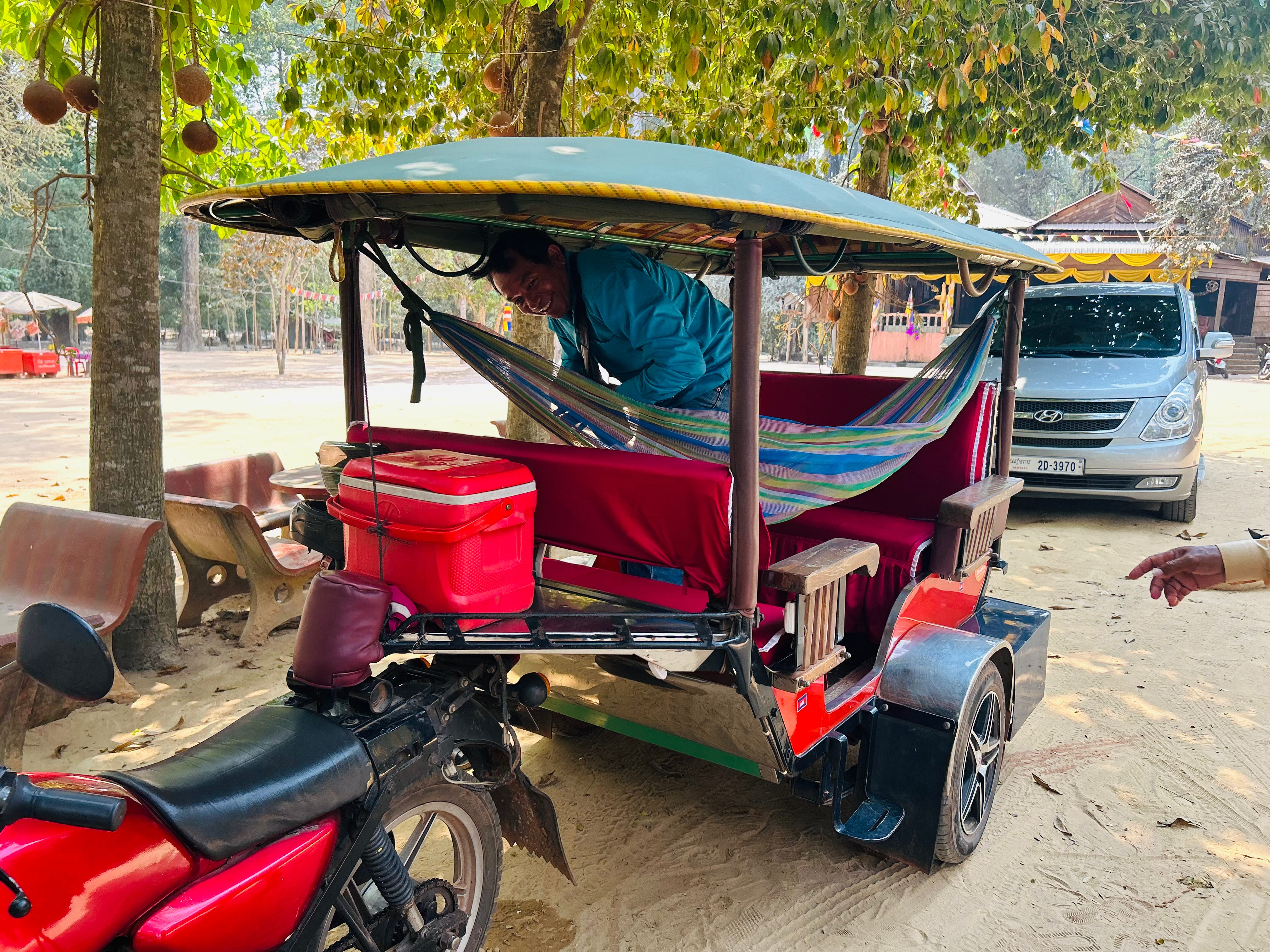
Throughout our time riding with Vouek, we got to know him a bit. He talked to us about growing up in the city, how it has changed, and even touched on more sensitive topics — the ongoing skirmishes with Thailand and the horrific events of the Khmer Rouge. It was a personal and human way to see a place.
I sometimes think about Vouek sleeping in his hammock in the remorque while waiting for us at the temples. It’s undeniably funny, yet so smart. The most efficient use of his time.
That image represents to me a transportation system that is slow, cheap, human, and completely sufficient for what the city needs.
Motorbikes, remorques, tuk-tuks, bikes, and walking. Siem Reap didn’t have fancy trains or fast rideshare. But it didn’t need them. Its compactness, flatness, and people-friendly infrastructure made up for it.
Transportation doesn’t have to be complicated to work well for families.
No posts
Comments
Nothing yet. Say the first thing.
Sign in to join the conversation.