
Hi! I’m Peter, CEO of Kickresume, and these career-related stories caught my attention this month — and might catch yours too.
Today’s story: Corporate bullshit is now a measurable science. The results are awkward.
Handpicked remote job paying in $$$: Remote roles edition!
Random piece of career advice that actually works: How to make a resume on your phone? (video)
Surprise at the end: FREE access to Kickresume Premium for 7 days

It’s not every day that a new psychoanalytical metric piques my interest.
But this one did.
Mostly because it has “bullshit” in the name. (Yes, I am 5 years old.)
The metric in question is called the Corporate Bullshit Receptivity Scale. A real thing, developed by a researcher at Cornell who published a study about it.
It kept my interest even after 35-year-old me regained custody of my brain from 5-year-old me.
Because apart from the fecal headline, the findings turned out to be genuinely interesting.
And if your nose is good at sniffing out corporate BS, you’re going to love the first half of this newsletter.
I’m not so sure about the second half though.

Corporate bullshit, like most natural phenomena, is easier to recognize than to define.
And luckily, some of the world’s most powerful CEOs have been producing examples daily.
Here’s one from Microsoft CEO Satya Nadella, writing about AI a few months ago:
“We need to get beyond the arguments of slop vs sophistication and develop a new equilibrium in terms of our ‘theory of the mind’ that accounts for humans being equipped with these new cognitive amplifier tools as we relate to each other.”
Or here’s Pepsi, back in 2009, opening a 27-page document with “by investing in our history and brand ethos we can create a new trajectory forwards” to justify spending $1.5 million on a slightly different logo.
Some other examples include the entirety of LinkedIn.
It’s sentences like this that made a man at Cornell decide enough was enough.
That man is Shane Littrell, a cognitive psychologist. He wanted to measure:
how good people are at detecting corporate BS, and
whether it has any real impact on their job performance.
To find out, he did what is, in my opinion, a peak academic moment. He built a Corporate Bullshit Generator. (You can read the full study here, it’s really cool.)
It took real quotes from Fortune 500 company leaders as a model, then generated its own meaningless-but-impressive-sounding gibberish, like:
“Working at the intersection of cross-collateralization and blue-sky thinking, we will actualize a renewed level of cradle-to-grave credentialing and end-state vision”
He then mixed the computer-generated BS quotes alongside the real quotes and asked the participants (over 1000 of them) to rate how business-savvy each quote was.
Basically to see who can actually tell real from fake.
The second part of the study ran the same participants through a set of cognitive ability tests to see if BS-receptivity correlated with anything about their actual job performance.
And it did!
Turns out, the participants who were more susceptible to corporate bullshit also:
Scored lower on analytical thinking
Scored lower on reflection
Scored lower on fluid intelligence
Littrell also concluded: “The people that are the most susceptible to the corporate bullshit tended to choose the worst solutions to those problems on a consistent basis.”
Feeling vindicated?
Well, enjoy that while it lasts. Because the same study found something else, too. Something that makes being right a lot less fun.
The study also found that BS-receptive workers are having a much nicer time doing their job.
More specifically it found that people who fall for corporate BS:
Rate their bosses as more charismatic and visionary.
Trust their leadership more.
Are more inspired by the company’s mission statement.
Report higher job satisfaction overall.
Almost like ignorance is some sort of… bliss.
That’s the part with peer review.
Now here’s the part without it. (Mostly.)
I’ve been running a company for ten years, and along the way I’ve been around a lot of other companies and seen first-hand how things go at some of them.
The people who speak corporate BS get promoted. Faster, more often, and over the people who don’t.
It often goes something like this:
Boss speaks corporate bullshit → employee likes corporate BS → employee starts using corporate BS → boss likes that the employee uses BS → boss promotes employee → the other employee rolling their eyes in the corner does not get promoted.
(Cornell hasn’t called yet, but I’m sure they will after this.)
Luckily, there’s a tiny bit of peer-reviewed support for one part of this. Littrell’s previous research found that the old saying “you can’t bullshit a bullshitter” is actually wrong.
Because it turns out the people who spread BS also tend to buy it. (Which is the part where the boss who speaks BS happens to love it when employees speak it back.)
Now, in fairness to the BS-speaking workers, they deserve some credit. Most of them aren’t just nodding along blindly. They’re doing something humans have always done: mirroring.
It’s a well-documented concept in psychology, and the idea is simple: people like people who are similar to them. Who use their words. Who match their energy.
And being likeable? That’s an underrated skill in the workplace.
Which leaves us with a slightly grim summary:
The people who fall for corporate BS are worse at their jobs, happier at them, and getting promoted faster than you.
The people who see through it are maybe vindicated, but also kind of miserable and with less opportunity for career advancement.
That feels unfair. Because it is. But it also points at something you can actually do about it.
Teaching your resume to read the room
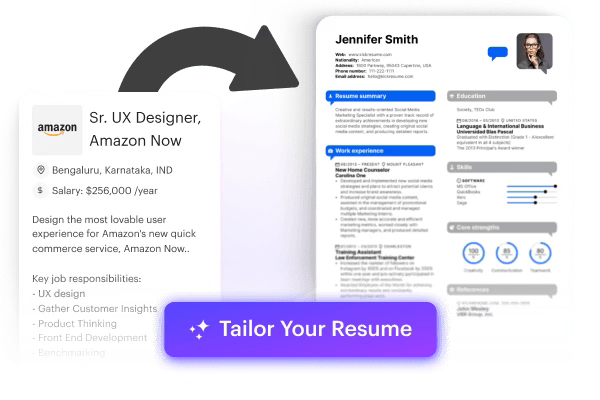
So how do you actually match the room without rewriting your resume from scratch every time?
With Resume Tailoring.
It instantly customizes your resume for any job ad you’re applying to based on your real experience and the job description—matching keywords, emphasizing relevant experience and skills, and making sure you pass the ATS.
That means more interviews, more opportunities, and better offers.
Now for the part where I give you advice that I’d describe as morally questionable but effective.
The key here is to know your audience. (And honestly, to know yourself. Because everything depends on whether you’re willing to roll with the BS or not. If you’re not, good for you.)
It pays off to use corporate BS when your boss is susceptible to BS-ing, and backfires when they’re not.
Don’t believe it. But learn to speak it. Detect it, then use just enough of it to get a promotion
The same logic applies for job hunting.
If the company’s job ad reads like a buzzword salad, your application probably should too. Just enough to pass the ATS, but not enough to lose yourself in the process.
If the interviewer keeps using words like “synergy” and “scalable”, throw a few back.
I realize I’m essentially telling you to gamble on bullshit.
To which I say: Yes I am, but at least I’m not proud of it.
PS: If you’ve made it this far, you clearly have a high tolerance for reading about bullshit. Good news! Shane Littrell, the man behind the study, has an entire Substack dedicated to it.
It’s called Bullshitology and it’s as good as it sounds.

A small but useful update to this section: these jobs now live on our own job board.
Which means you can apply directly from the Kickresume app and prepare for the interview there too.
#1 Senior Site Reliability Engineer at Microsoft
💰$119,800 - $258,000 annual US base range 💰
#2 Software Developer at Boeing
💰$118,150 - $232,300 annual US base range 💰
#3 Manufacturing Test Engineer, AI Compute Infrastructure - Stargate at OpenAI
💰$205,000 - $335,000 annual US base range 💰
#4 PR Manager, Policy Communications at Nvidia
💰$100,000 - $218,500 annual US base range 💰

Most people find job ads on their phone. Most people apply from their laptop.
And somewhere in between, a lot of good opportunities disappear.
Here’s how to create (or update) your resume straight from your phone.

If you’ve scrolled this far, you deserve something nice. How about this?
Kickresume Premium is free for 7 days for you!
Just click the link, sign up with any email, and your premium will be active right away.
There are hundreds of open roles at the top tech companies right now. Your resume should probably be ready for them.
Catch you later!
Peter
Comments
Nothing yet. Say the first thing.
Sign in to join the conversation.