
Funny thing about history is that someone usually chronicles the truth. Perhaps it takes a while to surface and circulate, but stamping-out facts and the truth is easier said than done.
Trump has been talking about Fort Knox—specifically the gold therein—repeatedly of late. His comments about the gold, more specifically, his questioning whether the gold is there or not are unsettling. I remembered reading about Germany’s economy crashing as Hitler was rising, so here is another excerpt from William L. Shirer’s book “The Rise and Fall of the Third Reich”. A bio of Shirer may be found on my previous post, Life in the Third Reich; 1933-37.
https://ki6mnk.substack.com/publish/posts/detail/157720103?referrer=%2Fpublish%2Fposts
From Book 1 chapter 3
VERSAILLES, WEIMAR AND THE BEER HALL PUTSCH
“Down in Bavaria the young firebrand Adolf Hitler grasped the strength of the new nationalist, antidemocratic, antirepublican tide. He began to ride it.
He was greatly aided by the course of events, two in particular: the fall of the mark and the French occupation of the Ruhr. The mark, as we have seen, had begun to slide in 1921, when it dropped to 75 to the dollar; the next year it fell to 400 and by the beginning of 1923 to 7,000. Already in the fall of 1922 the German government had asked the Allies to grant a moratorium on reparation payments. This the French government of Poincaré had bluntly refused. When Germany defaulted in deliveries of timber, the hardheaded French Premier, who had been the wartime President of France, ordered French troops to occupy the Ruhr. The industrial heart of Germany, which, after the loss of Upper Silesia to Poland, furnished the Reich with four fifths of its coal and steel production, was cut off from the rest of the country.
This paralyzing blow to Germany’s economy united the people momentarily as they had not been united since 1914. The workers of the Ruhr declared a general strike and received financial support from the government in Berlin, which called for a campaign of passive resistance. With the help of the Army, sabotage and guerrilla warfare were organized. The French countered with arrests, deportations and even death sentences. But not a wheel in the Ruhr turned.
The strangulation of Germany’s economy hastened the final plunge of the mark. On the occupation of the Ruhr in January 1923, it fell to 18,000 to the dollar; by July 1 it had dropped to 160,000; by August 1 to a million. By November, when Hitler thought his hour had struck, it took four billion marks to buy a dollar, and thereafter the figures became trillions. German currency had become utterly worthless. Purchasing power of salaries and wages was reduced to zero. The life savings of the middle classes and the working classes were wiped out. But something even more important was destroyed: the faith of the people in the economic structure of German society. What good were the standards and practices of such a society, which encouraged savings and investment and solemnly promised a safe return from them and then defaulted? Was this not a fraud upon the people?
And was not the democratic Republic, which had surrendered to the enemy and accepted the burden of reparations, to blame for the disaster? Unfortunately for its survival, the Republic did bear a responsibility. The inflation could have been halted by merely balancing the budget—a difficult but not impossible feat. Adequate taxation might have achieved this, but the new government did not dare to tax adequately. After all, the cost of the war—164 billion marks—had been met not even in part by direct taxation but 93 billions of it by war loans, 29 billions out of Treasury bills and the rest by increasing the issue of paper money. Instead of drastically raising taxes on those who could pay, the republican government actually reduced them in 1921.
From then on, goaded by the big industrialists and landlords, who stood to gain though the masses of the people were financially ruined, the government deliberately let the mark tumble in order to free the State of its public debts, to escape from paying reparations and to sabotage the French in the Ruhr. Moreover, the destruction of the currency enabled German heavy industry to wipe out its indebtedness by refunding its obligations in worthless marks. The General Staff, disguised as the “Truppenamt” (Office of Troops) to evade the peace treaty which supposedly had outlawed it, took notice that the fall of the mark wiped out the war debts and thus left Germany financially unencumbered for a new war.
The masses of the people, however, did not realize how much the industrial tycoons, the Army and the State were benefiting from the ruin of the currency. All they knew was that a large bank account could not buy a straggly bunch of carrots, a half peck of potatoes, a few ounces of sugar, a pound of flour. They knew that as individuals they were bankrupt. And they knew hunger when it gnawed at them, as it did daily.”
In the words of Mark Twain—History Doesn't Repeat Itself, but It Often Rhymes.
Addendum:
The economic collapse didn’t really sink in until i found these.
I was looking through old boxes for family history when I ran across an old envelope stuffed with German Marks.
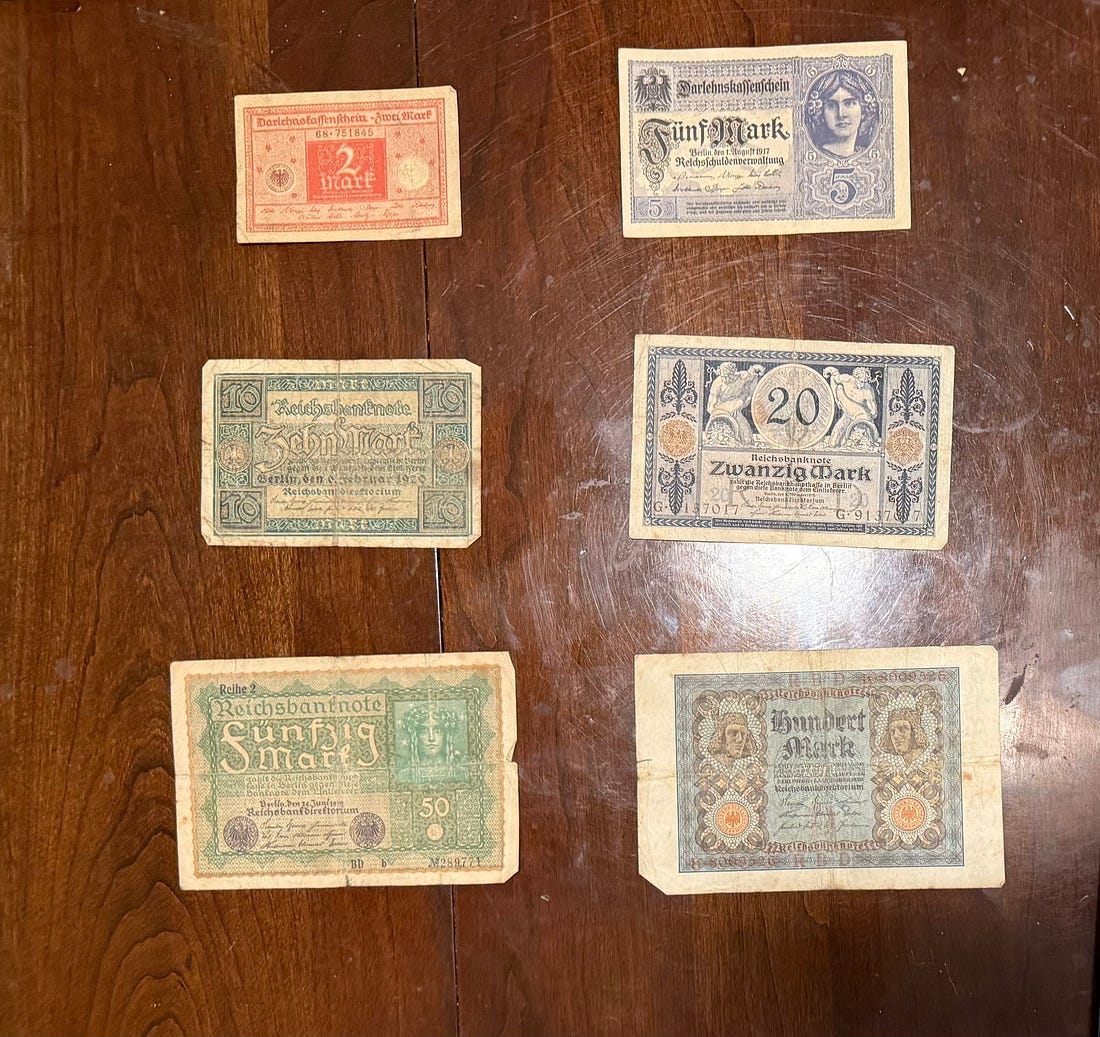
Row 1. 2 Mark 1 Mar1920 5 Mark 1 Aug 1917
Row 2. 10 Mark 6 Feb 1920 20 Mark 4 Nov 1915
Row 3. 50 Mark 24 Jun 1919 100 Mark 1 Nov 1920
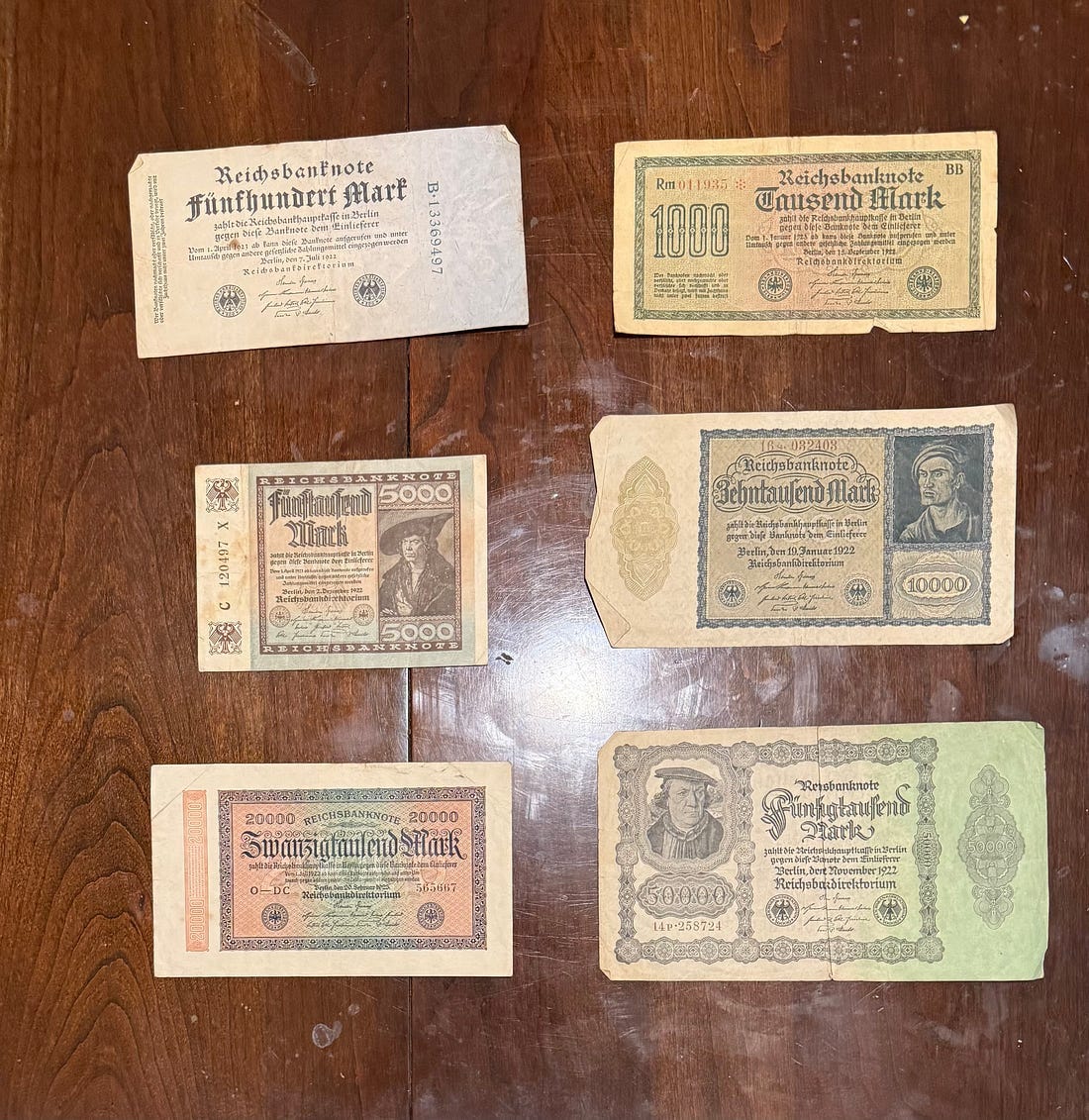
Row 1. 500 Mark 7 Dec 1922 1,00 Mark 15 Sep 1922
Row 2. 5,000 Mark 2 Dec 1922 10,000 Mark 19 Jan 1922
Row 3. 20,000 Mark20 Sep 1923. 50,000 Mark 19 Nov 1922
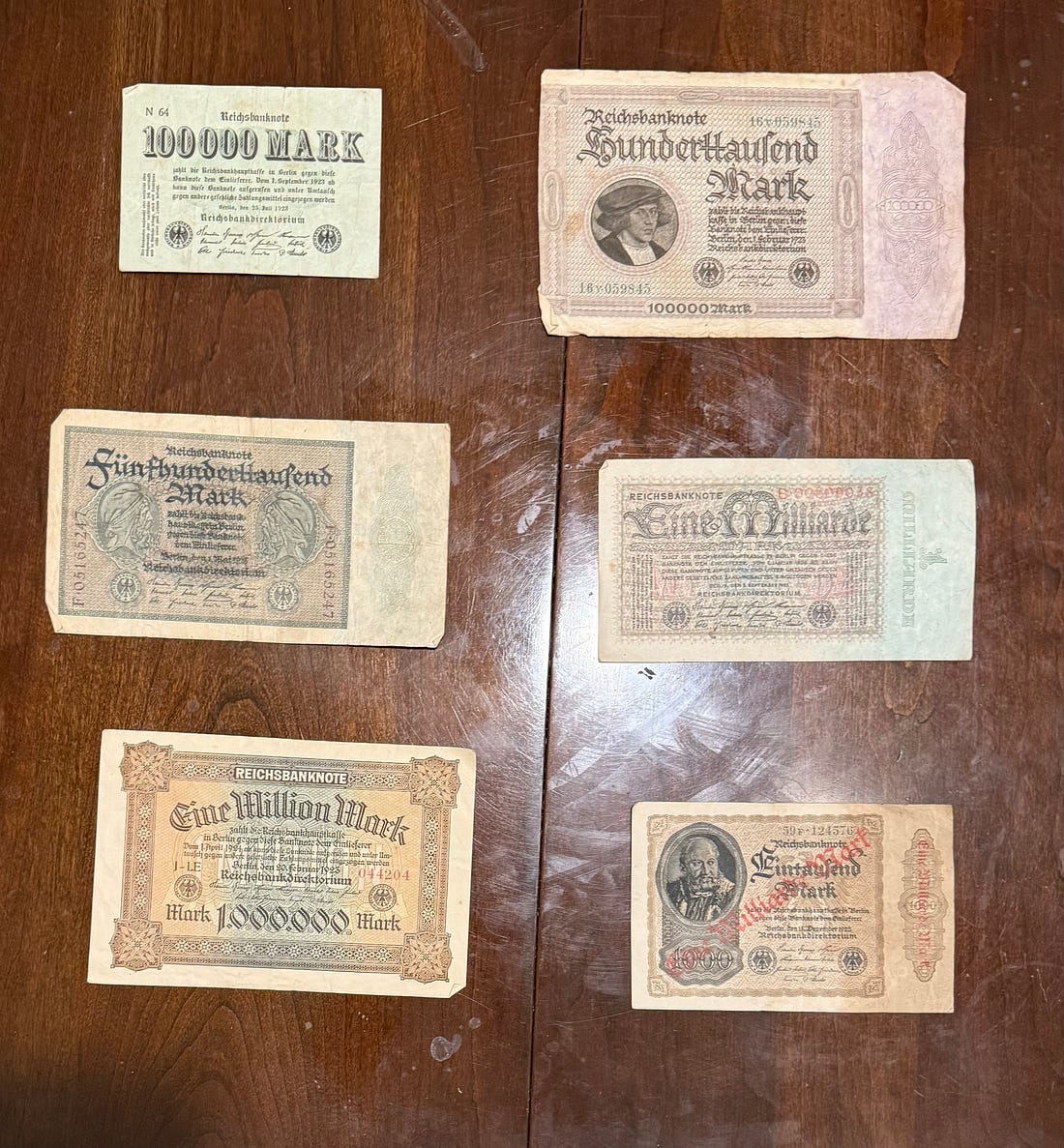
Row 1. 100,000 Mark 25 Jul 1923 100,000 Mark 1 Feb 1923
Row 2. 500,000 Mark 1 May 1923 1,000,000 Mark 5 Sep 1923
Row 3. 1,000,000 Mark 20 Feb 1923. 1,000 15 Dec 1923, stamped 1,000,000 later
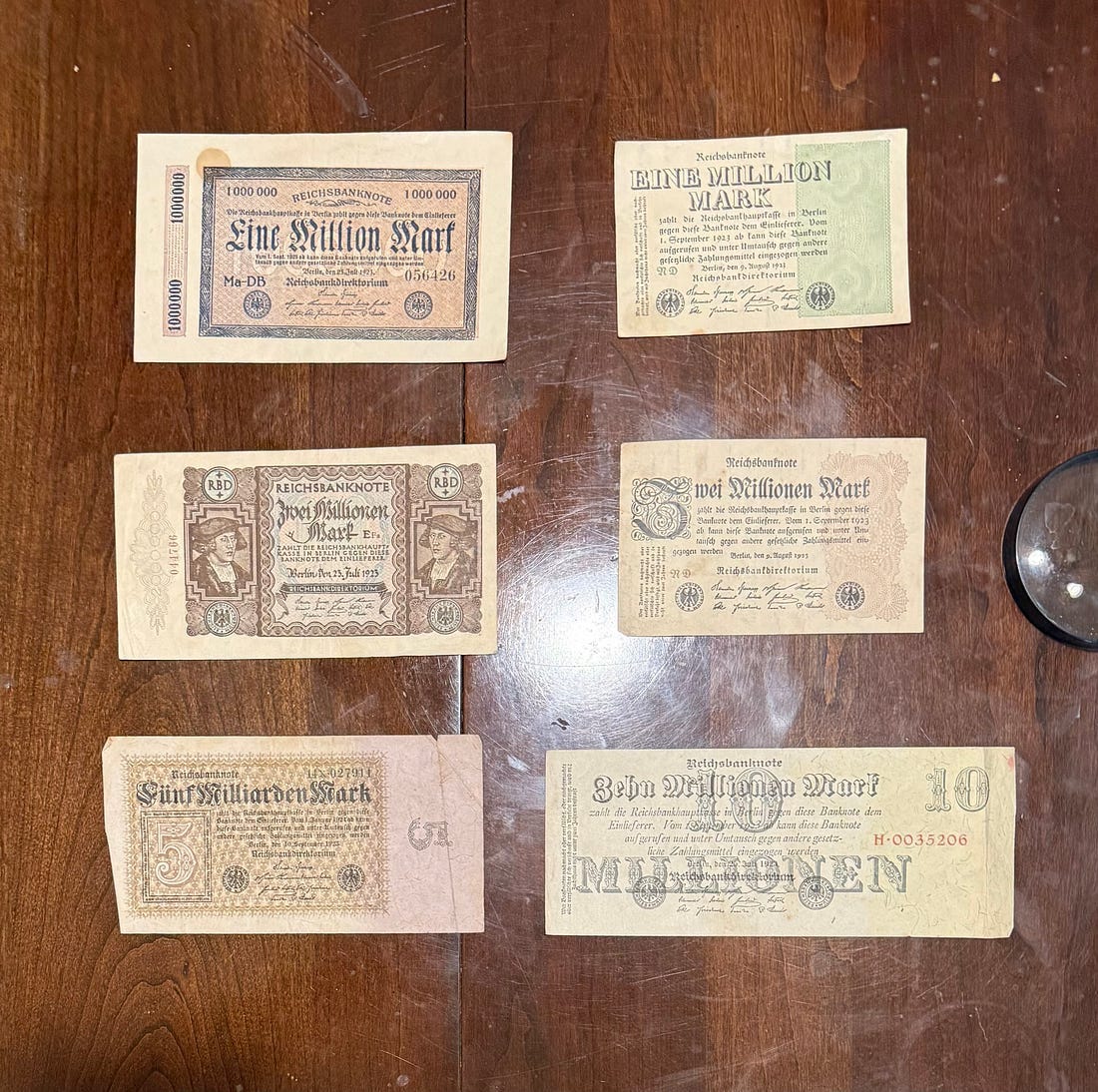
Row 1. 1,000,000 Mark 25 Jul 1923 1,000,000 Mark 9 Aug 1923
Row 2. 2,000,000 Mark 23 Jul 1923 2,000,000 Mark 9 Aug 1923
Row 3. 5,000,000,000 Mark 10 Sep 1923 10,000,000 Mark 25 Jul 1923
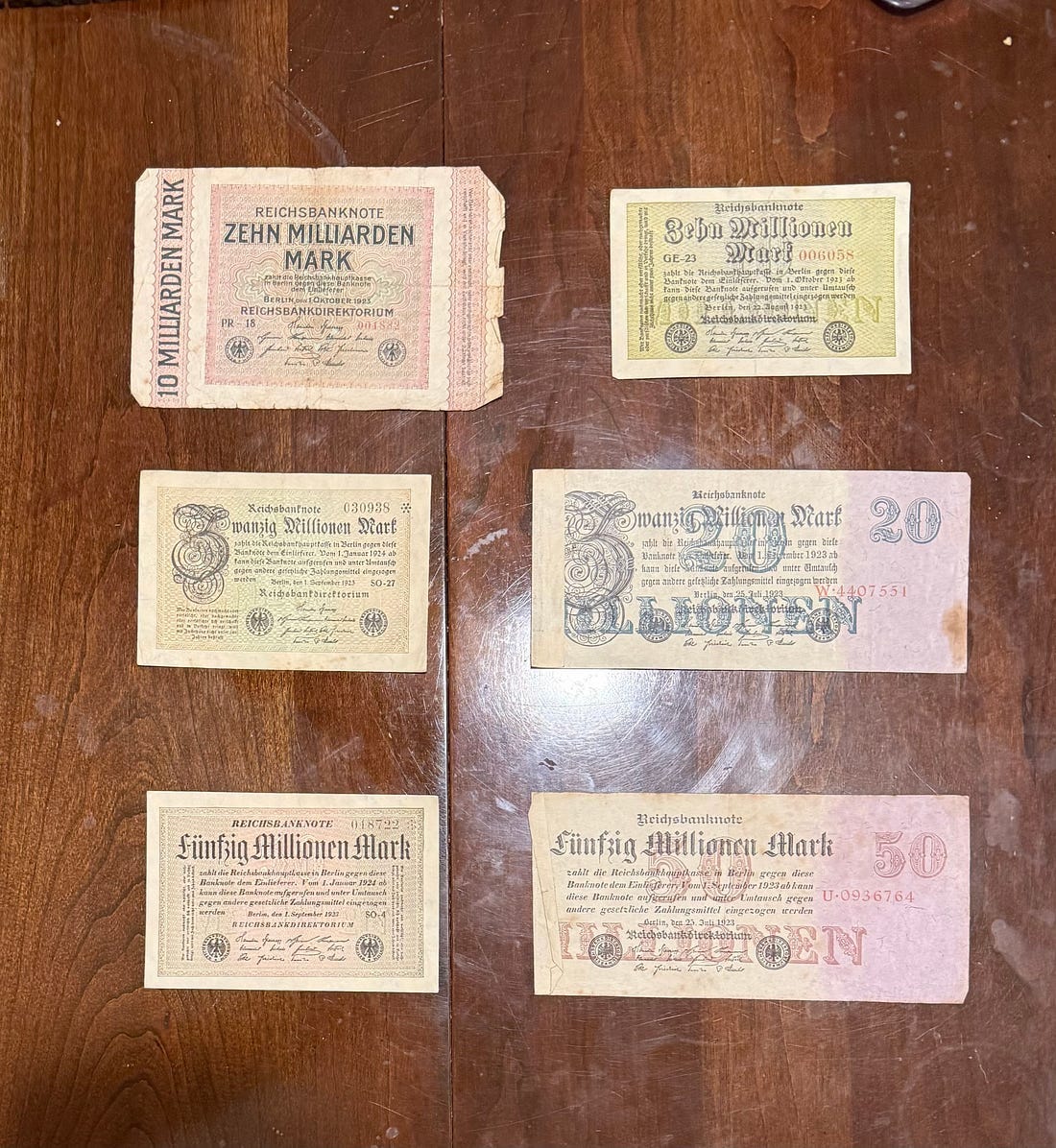
Row 1. 10,000,000,000 Mark 1 Oct 1923 10,000,000 Mark 22 Aug 1923
Row 2. 20,000,000 Mark 1 Sep 1923. 20,000,000 Mark 1 Sep 1923
Row 3. 50,000,000 Mark 1 Sep 1923. 50,000,000 Mark 25 Jul 1923
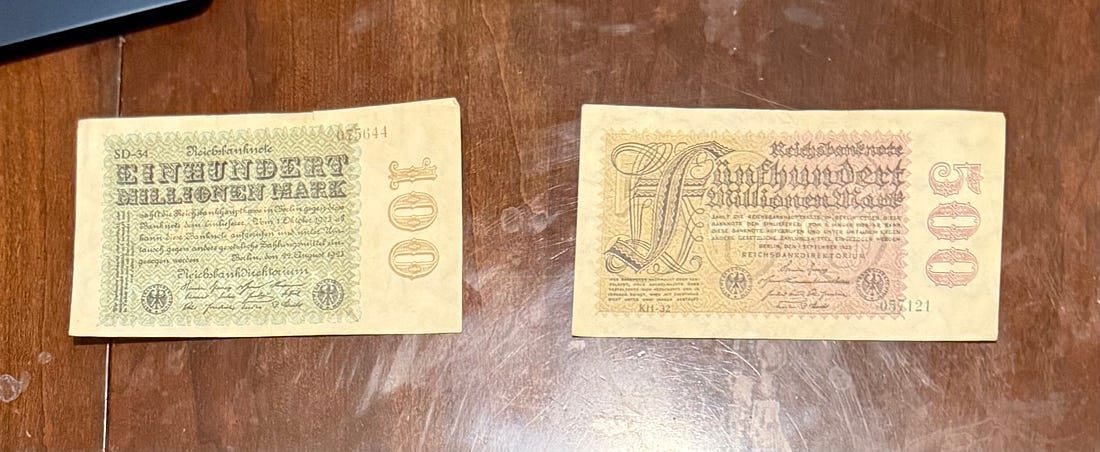
Row 1. 100,000,000 Mark 22 Aug 1923. 500,000,000 Mark 1 Sep 1923
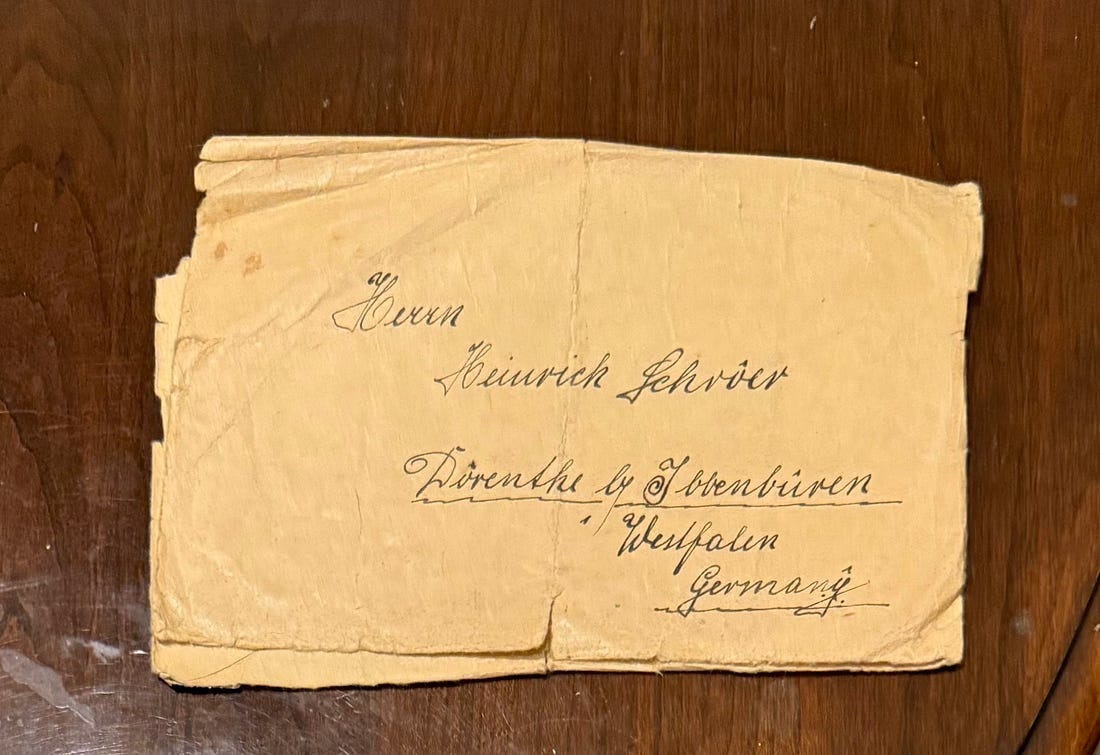
I’ve never been particularly good at reading script, so let me know in the comments section if you can read it.
Don’t believe it can’t happen here. One night they simply move the decimal point.
But the price of eggs…
Thanks for reading
Bob
Comments
Nothing yet. Say the first thing.
Sign in to join the conversation.