
By ranveer singh | 10-12 min. read
The amount of noise currently circulating through social media, mainstream media, political commentary and community statements has reached a point where careful thought is being drowned out by panic, outrage and performance. Everyone seems to be rushing to say something, condemn something, defend something, distance themselves from something or prove something. But in moments such as this, the first responsibility is not simply to speak. It is to think clearly.
The events of that fateful night on December 3, 2025, have already been dealt with. Vickrum Digwa was arrested, prosecuted, convicted and sentenced. Henry Nowak lost his life and his family has been left with a grief that no public debate can ever adequately comprehend. Nothing written here should be read as shifting attention away from the seriousness of what happened. But it is also true that the public conversation has now moved far beyond the incident itself. What began as a terrible wrongdoing has become a wider argument about Sikhs, belonging, the kirpan, immigration, race, loyalty and the very terms upon which minority communities are allowed to exist in Britain. In that wider conversation, something deeply troubling has been revealed, not only about the hostility directed towards Sikhs, but also about the way some Sikhs have responded to that hostility.
Two public responses are worth placing side by side. The first is the response of Nowak’s family, who have called for justice while resisting the weaponisation of their son’s death to create further hatred and division. In the midst of unimaginable grief, they have shown a moral clarity and restraint that many public figures would do well to learn from. Their focus has remained on accountability and preventing further tragedy, not on inflaming tensions between communities. The second response is the kind of language we have seen from Nigel Farage and others who have used this moment to cultivate anger, resentment and suspicion. Instead of allowing the legal process to stand, they have sought to transform one individual’s crime into a collective indictment of an entire people. That is not justice, it is not even political opportunism. The logic at work here is a racial logic in which the actions of a single racialised individual become evidence of the character of an entire people.
But as concerning as that right-wing opportunism is, it is not the main focus of this article, because the far right behaving like the far right should not surprise us. What should trouble us more is the response of certain sections of the Sikh community, because their reaction reveals something far deeper than public relations. It reveals an insecurity that has been cultivated over generations. It reveals the extent to which some Sikhs have internalised the gaze of whiteness and still feel compelled to justify their existence through categories that were never their own.
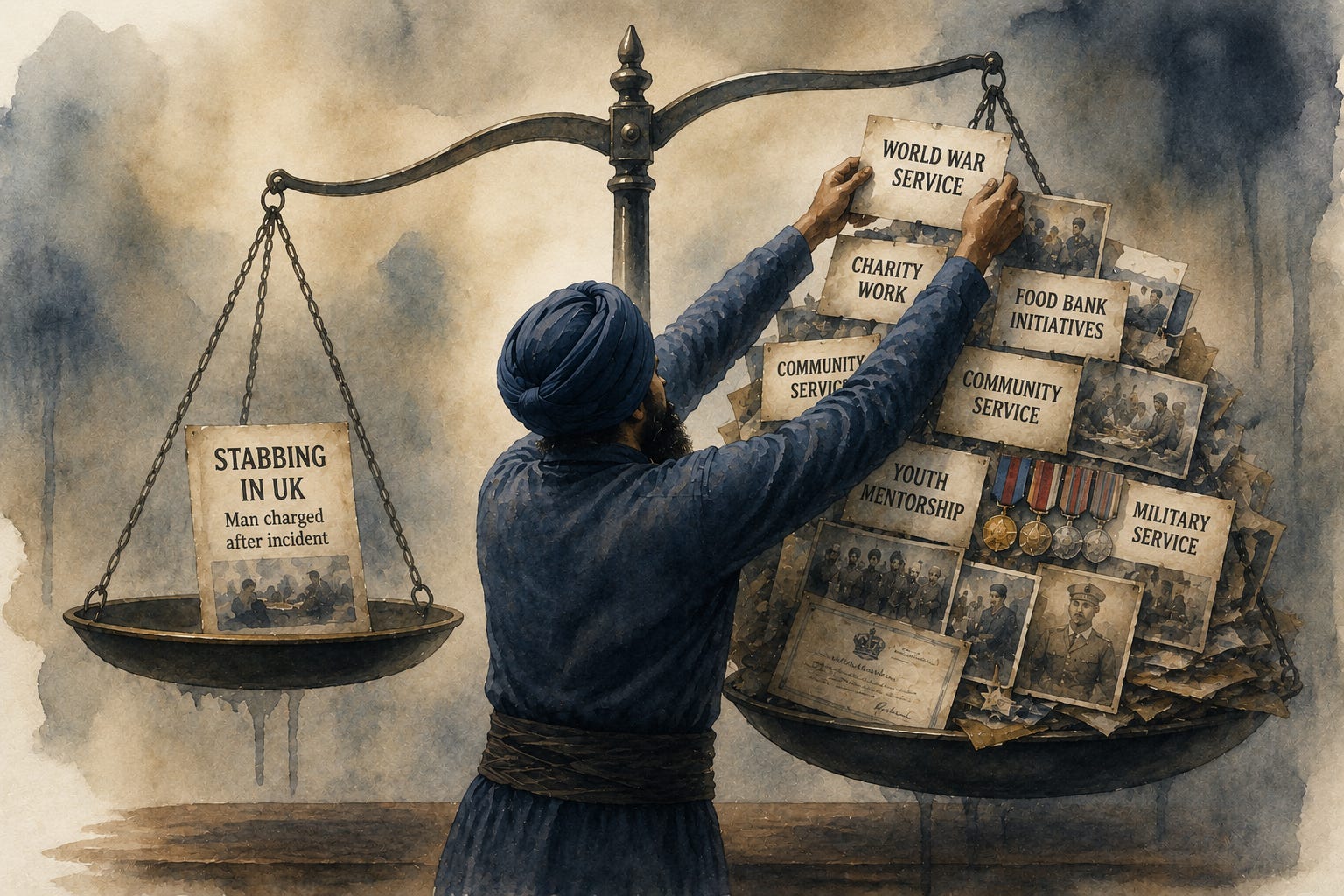
In the days that followed, we saw statements reminding Britain that Sikhs fought in the World Wars, that Sikhs serve in the armed forces, that Sikhs run food banks, that Sikhs feed the homeless, that Sikhs raise money for charity, that Sikhs are law-abiding, hardworking and peaceful citizens. Why, when one individual commits a crime, do some Sikhs immediately begin presenting a collective CV to the nation? On one level, none of these statements are false. Sikhs have indeed contributed significantly to the societies in which they live. Sikh history in Britain includes sacrifice, labour, enterprise, public service and community care. But that is not the issue. The question is not whether those things are true, but why we felt the need to say them at all.
Why do we feel compelled to list our good deeds in order to prove that we deserve to remain? Why do we instinctively respond to hostility by saying, in effect, “But look at all the useful things we have done for you”? What are we trying to prove? Our loyalty? Our innocence? Our gratitude? Our usefulness? And to whom are we making this appeal? This is the trap of the model minority complex. It offers conditional approval in exchange for obedience, usefulness and silence. It says to a community: you may belong, but only if you remain productive, respectable and grateful. You may be praised, but only so long as you do not disturb the dominant order. You may be celebrated, but only when your existence can be used to contrast you against other minorities who are deemed less acceptable.
For Sikhs, this has often taken the form of being told that we are “the good ones”. We work hard. We integrate. We serve in the military. We feed people. We do not complain too much. We are not like the others. But there is no dignity in accepting praise that depends upon the degradation of others. There is no honour in being accepted because we are imagined as useful, loyal or non-threatening. And there is certainly no security in it, because the moment public mood shifts, the same society that praises your contribution can suddenly question your right to exist. That is exactly what we have seen. The same Britain that celebrates Sikh soldiers when it wants to remember imperial wars can quickly turn around and tell Sikhs to “go home”. The same voices that praise langar when it is convenient can suddenly describe Sikhs as a danger. The same public culture that enjoys the image of the charitable Sikh becomes deeply uncomfortable when confronted with the sovereign Sikh, the armed Sikh, the Sikh who does not understand himself merely as a grateful minority within someone else’s story.
This is why pandering to the insecurities of whiteness is futile. It cannot be satisfied, because its anxiety is not based on what Sikhs have or have not done. It is based on the discomfort produced by difference itself. If the problem is that Sikhs are visibly distinct, historically conscious and not easily absorbed into a flat national identity, then no amount of charity work or imperial service will solve that. No amount of public statements declaring loyalty will solve that. A people cannot secure dignity by begging to be understood through the categories of those who already view them with suspicion.
This does not mean that Sikhs should not condemn wrongdoing. Of course we should. A wrongdoing remains a wrongdoing. If an individual lies, behaves recklessly or takes a life, then that must be named honestly. There is nothing Panthic about evading moral responsibility. But we must be able to call a wrongdoing a wrongdoing without dragging the entire Panth into it. We must be able to say that one man committed a crime without accepting the premise that all Sikhs are now on trial. That premise itself is racist. It is the same logic that has long been applied to racialised communities, namely that one individual acts, and suddenly an entire people must explain themselves. One incident occurs, and suddenly politicians, journalists and commentators begin asking questions about culture, religion, immigration and national identity. This is not how Britian responds when the perpetrator belongs to the dominant group. White men and women commit terrible crimes all the time, yet whiteness itself is not placed in the dock. No one asks white communities to issue statements explaining why their culture produced violence. No one demands that white citizens prove their loyalty before being allowed to remain.
So why have some Sikhs accepted this burden voluntarily?
The answer, I think, lies in a colonial mentality that many of us have not fully confronted. Colonialism does not only operate through armies, borders and laws. It also operates through the inner life of a people. It teaches them to see themselves through the eyes of power; to anticipate accusation before it is made, and to soften their language, dilute their institutions and constantly reassure the dominant society that they are harmless.
The irony is that many of the arguments now being deployed by Sikhs were themselves cultivated during the colonial period. Following the annexation of Panjab in 1849, the British did not simply conquer Sikh sovereignty; they reimagined Sikhs through imperial categories. A people who had exercised political power were transformed into a loyal “martial race” whose value was measured by service to imperial interests. Sikh worth became associated with military loyalty, discipline and usefulness to the Empire. It should therefore come as little surprise that, generations later, some Sikhs instinctively respond to hostility by invoking military service, sacrifice and contribution. We remind Britain that Sikhs fought in its wars because we have inherited a framework that taught us to justify our existence through service to power. We are often speaking through categories that were created for us, rather than categories we inherited from the Guru.
For a people like the Sikhs, this is spiritually and politically devastating. The Sikh tradition did not produce a people who needed permission to exist. The Khalsa did not emerge in history by asking the state for approval. Sikhs understood themselves as sovereign, not in the shallow sense of domination over others, but in the sense of being answerable first to Akal Purakh, Guru and Panth, the roots of which are a profound spiritual grounding. That confidence shaped Sikh institutions, Sikh resistance, Sikh ethics and Sikh political imagination. Somewhere along the way, many of us have become more comfortable explaining ourselves in the language of the state than in the language of Sikhi. We have learned to speak of ourselves as a minority rather than a Panth. We have learned to speak of our institutions as cultural symbols rather than living commitments, or to frame our existence through tolerance, exemption and diversity rather than through sovereignty, duty and truth.
The debate around the kirpan exposes this problem clearly. In response to calls for a ban, many Sikhs have rushed to describe the kirpan as a “ceremonial sword” or an “article of faith”. Legally speaking, that language has allowed Sikhs to defend the kirpan within liberal legal frameworks that understand religion primarily as belief, identity and personal expression. In courtrooms, policy documents and equality law, the phrase “article of faith” has often functioned as a protective category. But we should not confuse a legal argument with a Sikh understanding.
The kirpan was not introduced into the Khalsa as a decorative symbol. It was not given as an ornament, a metaphor or a harmless cultural marker. The kirpan is first and foremost a weapon. More specifically, it is a weapon carried within the discipline of the Khalsa, bound to restraint, responsibility and righteousness. It is not a licence for violence, nor an object of ego, nor a tool for personal rage. It belongs within a moral and spiritual order in which force is not worshipped but is subordinated to dharam.
To state that the kirpan is a weapon is not to deny the need for discipline or responsibility. Nor is it to suggest that every weapon is therefore a kirpan. The point is not that Sikhs should be exempt from moral scrutiny, but that Sikhs should not feel compelled to redefine their own institutions in order to make them intelligible to a society increasingly normalising hatred, xenophobia and bigotry. A Sikh understanding of the kirpan begins with what it is, not with what modern sensibilities find easiest to accept. That distinction matters because if we deny that the kirpan is a weapon because the modern state finds weapons uncomfortable, then we have already surrendered the meaning of the kirpan to the state. If we describe it only as ceremonial, then we reduce it to something symbolic and decorative. If we describe it only as an “article of faith”, then we allow the law to become the primary authority over its meaning. At that point, the kirpan is permitted not because the Khalsa carries it as a duty, but because the state temporarily grants it an exemption. And what the state grants, the state can withdraw. We can’t have it both ways.
None of this means Sikhs should behave recklessly. The kirpan demands discipline precisely because it is a weapon. Its presence should make the Sikh more restrained, not less. The question is not whether Sikhs should act responsibly, but whether responsibility requires us to misdescribe our own institutions in order to make them palatable to others. It does not.
This brings us to the wider demand now being repeated with increasing confidence across the political spectrum and in public discourse: “one rule for everyone.” On the surface, this sounds fair because it appeals to a basic instinct that society should treat all citizens equally. But beneath the slogan lies a very different political vision. In practice, “one rule for everyone” often means that difference must be erased and minority traditions must be flattened into the norms of the majority. That is not pluralism. It is assimilation.
A genuinely plural society does not require every community to become culturally identical. It recognises that different communities carry different histories, obligations, practices and ways of life. It does not treat every difference as a threat, but creates space for those differences to exist within a shared society. This does not mean that anything goes, but it does mean that equality cannot simply mean forcing everyone into the mould of the dominant culture. The question Britain now faces is whether it believes in that kind of pluralism. Does it believe that Sikhs can live as Sikhs, not merely as private individuals with unusual beliefs, but as members of a distinct tradition with visible commitments? Does it believe that belonging can include difference, or does belonging now require erasure?
For Sikhs, however, there is an even more urgent question: do we still believe in ourselves?
Do we still have the confidence to speak from within our own tradition? Do we still understand the difference between legal strategy and self-definition? Do we still recognise when we are being invited to apologise for existing? Do we still know how to condemn wrongdoing without accepting collective guilt? Do we still remember that the Panth is not a public relations category, but a living sovereign body shaped by Guru, sovereignty, sacrifice and responsibility? Sikhs must resist the temptation to see themselves through the eyes of those who demand that we justify our existence. We do not strengthen our position by accepting collective guilt for the actions of one individual, or by reducing our institutions, traditions and obligations to categories that are more palatable to whiteness. Moments such as these reveal whether a people possess confidence in themselves or merely confidence in their acceptance by others.
That is the deeper question now facing Sikhs in Britain. Not whether we have contributed enough. Not whether we have proved our loyalty sufficiently or whether we have reassured the public adequately. But whether we still possess the confidence to understand ourselves in our own terms, wholly and unapologetically. Because a nation that forgets how to define itself will always find itself being defined by others.
No posts
Comments
Nothing yet. Say the first thing.
Sign in to join the conversation.