
By ranveer singh | 7 min. read
I have been thinking for some time about the relationship between modernity and Kaljug. Not because they are different words for the same thing, they are not, but because each provides a way of understanding the age in which we live.
We know what year we are living in, but that is not the same as knowing what kind of age we are living through. The West named the age modernity and, through colonialism, made the world inhabit it. Some societies came to be described as modern, others as developing towards modernity, and those which did not conform were considered backward, irrational or trapped by tradition. What began as one civilisational experience was projected as the direction of history itself.
Sikhi gives us another name through which to think about the age: Kaljug.
The comparison must be handled carefully.
Kaljug is an ancient cosmological category; modernity is a historical formation associated with European expansion, colonialism, capitalism, scientific rationality, industrialisation and the modern state. They neither originate together nor describe the world in the same terms, so to collapse them into one another would tell us very little about either. What matters is the relation between them. Modernity presents history as a movement of human ascent, taking what it deems backward and remaking it in the name of civilisation. Kaljug raises a more difficult question: whether the growth of human power has been accompanied by a declining ability to recognise truth.
Guru Nanak Patshah lived from 1469 to 1539, at the opening of the world that modernity would eventually claim as its own. Columbus crossed the Atlantic in 1492; Vasco da Gama reached the Malabar Coast by sea in 1498; conquest, commerce and new techniques of navigation, finance and administration were beginning to bind distant regions into a violently unequal world system. This does not mean that modernity arrived fully formed in the fifteenth century, or that Kaljug began there, but the historical convergence is nevertheless significant because the Sikh articulation of Kaljug entered history at the moment a European trajectory was beginning its transformation into a global order.
That order would later narrate its expansion through discovery, progress and civilisation. Guru Nanak Patshah looked upon conquest, political violence, religious hypocrisy and corrupted authority from an altogether different vantage point:
Kaljug is the knife. The rulers are butchers. Dharam has grown wings and flown away.
—Sri Guru Granth Sahib, Ang 145
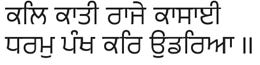
Kaljug is not presented here as a catalogue of private moral failures. The knife of the age is placed in the hands of rulers. Its violence is exercised through authority, while the disappearance of dharam describes the corruption of the arena within which authority operates.
Bhai Gurdas Ji frames this inversion in the following manner:
The rulers commit sin, as if the protective fence itself devours the field.
—Bhai Gurdas, Vaar 1, Pauri 30
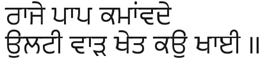
The fence exists to protect the field, yet it becomes the means by which the field is consumed. Read within this context we see how Kaljug therefore has an institutional character. The disorder of haumai does not remain confined to the human interior; it passes into hierarchy, economy, administration and war. Those arrangements then cultivate the forms of personhood they require, and the distinction between the corruption of the individual and the corruption of society becomes difficult to sustain, because each continually reproduces the other.
Modernity is often treated as though it were simply the present, the natural condition of people who have left the past behind. It is better understood as a framework that acquired the authority to decide what counts as knowledge, religion, politics, freedom and progress. It became universal not because every civilisation independently arrived at its categories, but because colonial power carried those categories across the world and embedded them in states, schools, universities, censuses, museums, maps and law – often through violence.
Europe did not merely conquer territory. It organised peoples along a single account of human development, in which the colonised could inhabit the same calendar year as the coloniser while being described as belonging to an earlier stage of history. Within this encounter, difference was converted into delay, allowing colonial rule to appear as the benevolent work of bringing entire peoples forward in time. This is among modernity’s most enduring achievements: it made its own history appear to be the history of humanity as such.
Its conquest was consequently conceptual as well as territorial. Religion was separated from politics and enclosed within the sphere of private belief, and the state emerged as the principal container of legitimate sovereignty. Nature became quantifiable matter available for extraction, while the individual became the fundamental bearer of rights, desire and identity. Other ways of knowing the world were not always necessarily prohibited. They were translated, classified and permitted to survive in forms the new order could recognise.
Sikhi became “Sikhism” within this arrangement. The Guru could be recognised as a religious founder; shabad as scripture; sangat as congregation; naam as meditation; and dharam as private ethics. miri-piri then appeared as an unusual combination of religion and politics, even though it was the modern framework, not Gurmat, that had first insisted upon their separation. The Khalsa could be retained as a martial identity, an ethnic inheritance or an institutional shell around what was said to be a more universal spirituality.
The problem is not merely that English words fail to carry the full meaning of Sikh concepts. Translation takes place within a prior arrangement of knowledge. Once Sikhi is accepted as a religion in the modern sense, whatever exceeds private belief is treated as culture, historical baggage or a political departure from its supposedly spiritual core. This is why “Sikhism” can remain highly visible while Sikhi is absent from the political and intellectual life of the society displaying it.
This should trouble our understanding of parchar. We have tended to measure its success through circulation: more talks, clips, posts and explanations of Sikh practice. Such work has its place, but visibility is a poor substitute for thought. If Gurmat is confined to the category of religion, it may be permitted to speak on prayer, identity and personal morality while the meaning of history, politics, philosophy, psychology and civilisational development continues to be supplied from elsewhere. Put simply, parchar cannot only mean rendering Sikhi intelligible within the categories of the age. It must recover the capacity to think from the Guru’s vantage point, including where that vantage point brings the assumptions of the present into question. The task is not simply to insert Sikhs into an established account of human ascent, but to examine the account itself: what it calls progress, what it renders invisible and which forms of power are concealed by its claim to neutrality.
Modernity is not identical with Kaljug. Kaljug cannot be reduced to Europe or to the last five centuries, and violence, greed and falsehood did not begin in 1492. Nor does a Sikh critique depend upon imagining a harmonious premodern past. Modern medicine, literacy and communication have relieved suffering and opened genuine human possibilities. There is no reason to deny this. The more precise claim is that modernity may be one of the most expansive institutional forms assumed by the conditions named as Kaljug. It did not create haumai, but it has organised it at a scale earlier societies could not attain. Limitless accumulation became an economic imperative; the conquest of nature became development; information became mastery; and the sovereignty of the self became freedom. Through colonialism and global capital, these ceased to be merely local arrangements and became pressures exerted across the world.
Here, the similarity becomes difficult to ignore. In Gurmat, Kaljug describes an inversion in which falsehood occupies the seat from which truth is judged. Modernity places its own historically produced categories in that seat and presents them as universal reason. The particularity of the framework disappears, even while it classifies every other civilisation as a particular culture or religion. What is distorted must then prove itself before the categories responsible for the distortion. To approach modernity through Kaljug reverses this direction of judgement because instead of continually asking whether Sikhi is compatible with modern values, those values themselves become available for examination through Gurmat. Modernity no longer remains the invisible tribunal before which the Guru must be explained, but it becomes an object of judgement.
A Sikh diagnosis cannot end with denunciation. Gurbani does not present Kaljug as an age abandoned by the Guru Sahiban, or one in which truthful life has become impossible. The response of the Guru Sahiban is not an escape from the world, but the formation of another way of living within it. sangat creates the conditions through which the manmukh may be transformed into the gurmukh. pangat and langar gives equality a material and disciplined expression. seva and sangarsh unsettle the self as the sole centre of action, while miri-piri refuses the arrangement through which spirituality is privatised and sovereignty surrendered elsewhere. These are not fragments of a religious lifestyle. Empowered by the patshahi of the Guru’s darbar, they carry an account of authority and collective life.
The Khalsa gives that account an embodied and sovereign form, joining liberation to rehat, power to seva and sovereignty to submission before the Guru. It cannot be reduced to private spirituality, and neither can it be discarded as the historical exterior of Guru Nanak Patshah’s supposedly universal message. If the conditions of Kaljug acquire political and institutional form, the Sikh response must take form within the world too.
The urgent question is not whether Sikhi can survive modernity. It is whether Sikhs can learn again to see the modern world from the Guru’s vantage point, and whether the Khalsa can create forms of life that do not simply reproduce the age it was created to confront.
This article forms part of the ground I am exploring in my forthcoming book, which is an expansion of my MA Philosophy thesis.
No posts
Comments
Nothing yet. Say the first thing.
Sign in to join the conversation.