
10 August 2026
Abstract
A political argument becomes most dangerous when it stops behaving like an argument.
In this essay, I examine Pakistan’s Defence Minister Khawaja Asif’s call for a united Muslim military front against Israel—not primarily as a dispute about Israel, Palestine, or regional strategy, but as an example of something deeper: bad philosophy acquiring machinery.
The question is not whether Pakistan may criticize Israel. Of course it may. The question is what happens when a corrigible political conflict is transformed into a struggle between permanent identities; when “Israel” becomes an essence, “the Muslim world” becomes a single imagined actor, history becomes a final verdict, and contrary evidence is explained away before it can reach the theory.
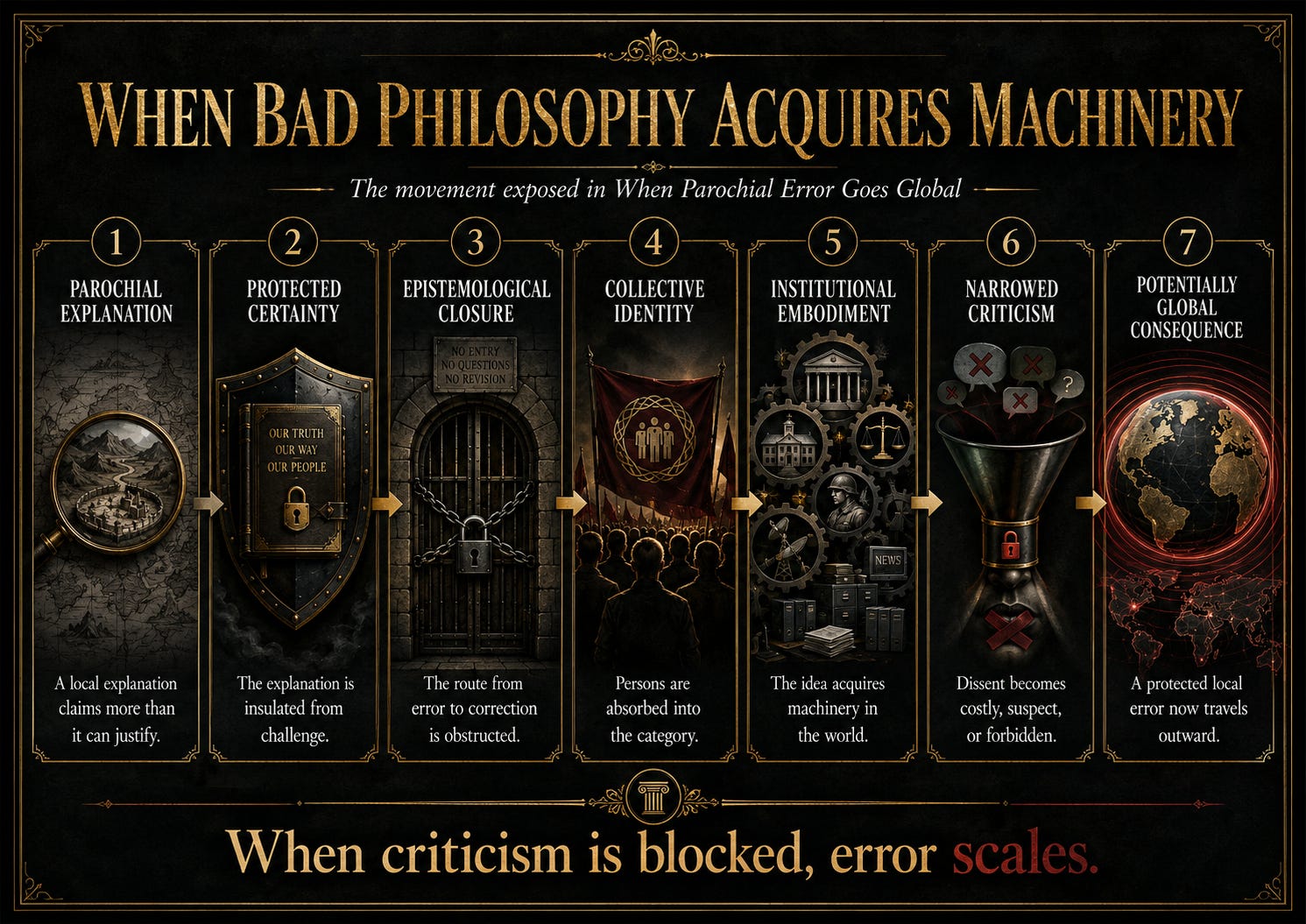
Drawing on David Deutsch and the framework developed in When Parochial Error Goes Global, I follow the movement from parochial explanation → protected certainty → epistemological closure → collective identity → institutional embodiment → narrowed criticism → potentially global consequence.
The test is deliberately simple:
Suppose we are wrong. What could show us that we are wrong?
If the answer is nothing, we have left the territory of rational criticism.
And when such an explanation acquires states, alliances, armies—and nuclear weapons—the question “Where does the error go?” is no longer philosophical decoration.
It becomes a question of survival.
There is a form of political rhetoric that is dangerous not merely because it may be wrong, but because it gradually removes the conditions under which anyone could discover that it is wrong.
David Deutsch calls this bad philosophy: “philosophy that actively prevents the growth of knowledge. [1]
Pakistan’s Defence Minister Khawaja Asif has just offered an unusually clear example.
The source
I wanted to establish his words before criticizing them. My first source is the Times of Israel report of 8 August 2026, which quotes Pakistan’s Defence Minister Khawaja Asif calling Israel “a threat to the entire Muslim world,” urging “a united military front” against it, describing Israel as an “illegitimate state,” and arguing that changes of Israeli government alter the problem only marginally. The Times of Israel also reports his broader claim that the Islamic world must stand against Israel “as one.” [2]
I then checked the Pakistani source trail. Geo News carried the interview under the title “PAK–Saudi Arabia–Turkey Defense Pact — All Muslim countries must unite against Israel — Khawaja Asif,” while the Pakistani newspaper The Nation reproduced the relevant statements. The quotations examined below therefore do not rest on a single secondary report. [3]
Asif calls Israel “a threat to the entire Muslim world” and calls for “a united military front” against it.. He continues:
“In the context of Israel, all Muslim countries must unite. I have no doubt about this.”
He then describes Israel as a product of the Balfour Declaration and an “illegitimate state.” More revealing still, he argues that a change of Israeli government would make little fundamental difference:
“No matter who comes to power in Jerusalem … the differences are only marginal.”
He attributes to Israel an enduring “anti-Islamic mindset” and concludes that the Islamic world must stand against it “as one.” [2]
Those are the propositions I want to examine. Not because Pakistan is Muslim. Not because Asif is Muslim. Not because criticism of Israel is illegitimate.
Precisely the opposite.
Israel, like Pakistan, Turkey, Iran, Britain, the United States, Kurdistan, every religion, every state, every party, every military alliance and every political doctrine must remain radically open to criticism.
My concern begins somewhere else. It begins when criticism stops being criticism and becomes epistemological closure.
The First Move: From a Government to an Essence
There are many things one can reasonably criticize about Israel.
One may criticize a government.
A military operation.
A settlement policy.
A law.
A theory of security.
A conception of Zionism.
A particular interpretation of history.
A treatment of Palestinians.
One may argue that a policy is unjust, destructive, strategically foolish or morally indefensible.
Such arguments remain political arguments because they contain a Backspace Key.
A policy can change.
A government can fall.
A law can be repealed.
A military doctrine can be abandoned.
An explanation can be replaced.
That is precisely what makes criticism meaningful.
Asif makes a different move.
He tells us that replacing Netanyahu with Bennett, or presumably somebody else, would matter only marginally.
Now the object of criticism is no longer primarily what a government does.
The object becomes what Israel is.
That move is philosophically decisive.
Once the adversary is defined by essence rather than by corrigible action, contrary evidence begins losing its power.
A different government?
Marginal.
Different policies?
Marginal.
Israeli dissenters?
Marginal.
Israeli peace movements?
Marginal.
An Israeli government accepting a different Palestinian settlement?
The underlying essence can always be said to remain.
The explanation has begun constructing immunity against its own falsification.
That is bad philosophy.
The deeper problem is that the explanation has begun to consume its possible counterexamples in advance. A different Israeli government can be dismissed as marginal. A different policy can be called tactical. Israeli dissenters can be absorbed into the category. Muslims who disagree can be treated as exceptions to “the Muslim world.” Once an explanation can reinterpret every possible contradiction as further evidence for itself, the question is no longer simply whether the explanation is true. The question becomes: where could error enter this system? If no conceivable evidence is permitted to reach the root claim, the answer approaches: nowhere.
In When Parochial Error Goes Global, I define epistemological closure not as stupidity and not as the absence of sophisticated thought, but as the condition in which the route from error to correction has been obstructed. Human beings remain Universal Explainers; what changes is what criticism is permitted to reach. [4]
Asif’s formulation performs precisely that move.
It moves the theory away from:
Israel may be wrong.
toward:
Israel is the wrong.
The first proposition invites criticism.
The second approaches metaphysics.
The Second Move: Manufacture a Collective Mind
Then comes the phrase “the Muslim world.”
I know why this phrase feels natural. I have used broad civilizational language myself, and in writing When Parochial Error Goes Global I had to correct myself repeatedly whenever an abstraction threatened to swallow the persons living underneath it.
“The Muslim world” sounds like an actor.
But it has no brain.
No single electorate.
No single constitution.
No common legislature.
No unitary foreign policy.
No single set of interests.
Pakistanis, Turks, Saudis, Egyptians, Iranians, Kurds, Indonesians, Bosniaks, Senegalese and British Muslims are not interchangeable pieces of one political organism.
They are persons.
States.
Societies.
Dissenters.
Believers.
Non-believers.
Reformers.
Traditionalists.
Liberals.
Islamists.
Nationalists.
Universal Explainers.
To say that “the Muslim world must stand against them as one” therefore does something more than propose an alliance.
It creates an imagined epistemological subject.
First there is:
the Muslim world.
Then there is:
Israel.
Then the political problem is redescribed as a confrontation between two collectivities.
This is exactly the kind of conceptual compression that my book warns against.
The closed system makes persons fungible with categories. The believer becomes the doctrine. The citizen becomes the state. The dissenter becomes betrayal. The child becomes the next link in the chain. A rational analysis must reverse that process: persons remain larger than the explanations, states, religions and movements acting in their name.
The Pakistani citizen is not “the Muslim world.”
The Israeli citizen is not “Israel.”
The Palestinian is not “Islam.”
The Jew is not an Israeli government.
Once those distinctions disappear, politics becomes much easier.
And much more dangerous.
Because abstractions cannot bleed.
Persons do.
The Third Move: Turn History Into a Verdict
Asif then invokes the Balfour Declaration as a genealogy of illegitimacy.
There are serious historical arguments to be made about Balfour, British imperial policy, Palestinian dispossession and the creation of Israel.
Those arguments should be made.
But genealogical explanation becomes bad philosophy when origin is made into permanent essence.
The structure becomes:
this political entity emerged from an unjust historical process; therefore its present existence remains illegitimate regardless of subsequent change.
But political history is full of terrible origins.
Partition.
Empire.
Conquest.
War.
Forced migration.
Broken promises.
Dynastic bargains.
Colonial borders.
Revolution.
Pakistan itself emerged through the partition of British India in 1947. [5] That fact does not settle whether Pakistan is legitimate today, any more than British involvement alone settles every question about Israel. The interesting questions concern institutions, persons, present rights, political arrangements and possible corrections—not whether history produced an immaculate birth certificate.
History explains.
History does not possess final jurisdiction.
This is one of the central ideas in my book’s discussion of the False Infinite.
A parochial rule becomes dangerous when a finite historical explanation acquires unlimited jurisdiction without acquiring corresponding corrigibility. A local or inherited explanation travels farther than criticism is allowed to reach it. Genuine universality is not mere reach; it is reach under criticism. [6]
Asif takes a historical event—Balfour—and appears to extend it across generations as a permanent verdict on an entire political society.
That is the false infinite in political form.
Its political consequence is even more serious. A conflict consisting of difficult but potentially corrigible problems—borders, security, Palestinian rights, Israeli security, settlements, sovereignty, recognition, institutions—begins to mutate into an eternal identity conflict. If Israel remains essentially the same regardless of government, policy, agreement, or historical change, while “the Muslim world” must remain permanently arrayed against it, politics has been converted into ontology: they are that; we are this; therefore conflict follows. Contingent institutions become permanent essences. Policies become destiny. And once destiny enters political thought, criticism begins losing its job.
The Fourth Move: Define the Enemy Before Examining the Problem
Notice how much explanatory work the phrase “anti-Islamic mindset” performs.
If Israel is fundamentally anti-Islamic, then almost any conflict involving Israel and a Muslim-majority state can be inserted into that prior explanation.
Evidence begins flowing in only one direction.
Israeli violence confirms the theory.
Israeli hostility confirms the theory.
Israeli alliances confirm the theory.
Israeli suspicion confirms the theory.
And conciliatory behavior?
It can always be dismissed as tactical, temporary or marginal.
This is how an explanation begins becoming hard to falsify but easy to repeat.
That distinction is central to When Parochial Error Goes Global.
A bad explanation can survive because it describes reality well.
But it can also survive because it surrounds itself with mechanisms that prevent criticism from reaching its root. Longevity is not truth. Replication is not vindication. The decisive question is: by what mechanism does the explanation survive?
Here the political mechanism is recognizable:
identity → threat → solidarity → loyalty → military alignment.
The question “Is the explanation correct?” gradually gives way to:
Whose side are you on?
That substitution is one of the oldest technologies of epistemological closure.
The Fifth Move: Criticism Becomes Disloyalty
Once the problem is defined as Israel versus “the Muslim world,” criticism inside the Muslim camp becomes politically harder.
Suppose a Pakistani asks:
What if Israel is not a threat to every Muslim society?
What if Israeli policy varies substantially between governments?
What if Palestinian interests and Pakistani interests are not always identical?
What if Saudi, Turkish, Egyptian, Jordanian and Pakistani security calculations differ?
What if diplomatic recognition produces better outcomes than permanent confrontation?
What if the proposed military alliance increases the danger of war?
What if Asif’s theory is wrong?
Where does that criticism go?
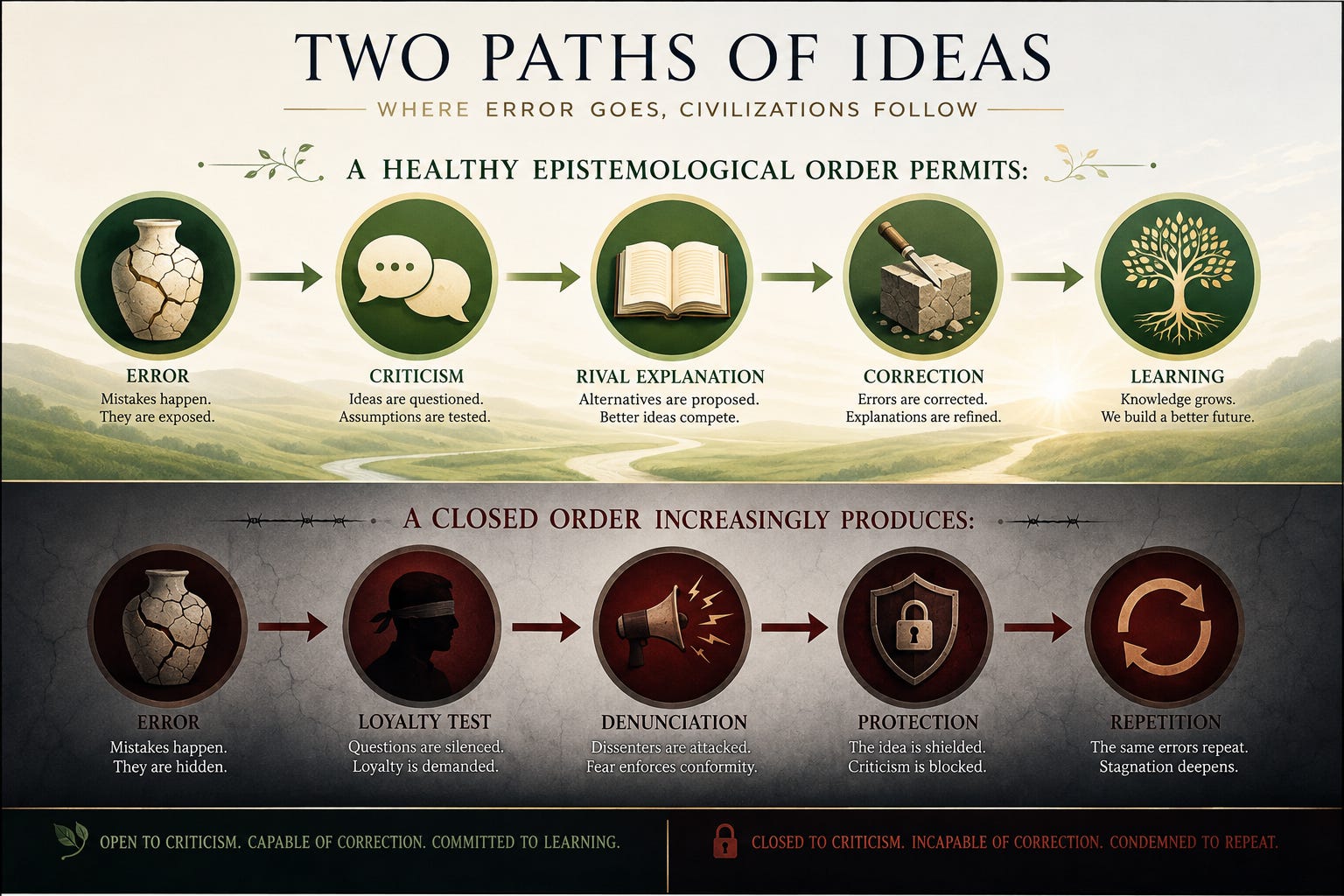
That is my central diagnostic question.
Where does the error go?
A healthy epistemological order permits:
error → criticism → rival explanation → correction → learning.
A closed order increasingly produces:
error → loyalty test → denunciation → protection → repetition.
That distinction runs through the architecture of When Parochial Error Goes Global. The danger is never simply that human beings make mistakes. We always will. The danger begins when the means of discovering the mistake become costly, forbidden or morally suspect.
The moment someone answering Asif can be dismissed as insufficiently Muslim, insufficiently Pakistani, insufficiently Palestinian or insufficiently anti-Israel, the theory has acquired a defence mechanism.
The error has found somewhere to hide.
Then bad philosophy acquires machinery
This would already matter if it remained rhetoric.
But the rhetoric comes at a moment of military institutionalization.
Asif is speaking in the context of emerging defence arrangements involving Pakistan, Saudi Arabia and Turkey, and his remarks explicitly connect Muslim political solidarity with a possible united military front against Israel. The Times of Israel reported Asif’s remarks one day after Turkey, Pakistan, and Saudi Arabia signed a trilateral defence agreement, and reported that Turkish Foreign Minister Hakan Fidan described the pact as technically equivalent to NATO’s Article 5 principle of collective defence.[2]
This is where philosophy becomes causally serious.
An idea does not need hands.
People acting through institutions give it hands.
In my book, I describe the moment when an explanation acquires machinery: family, law, school, court, money, prison, propaganda, armed formations, diplomacy, reputational fear and institutional inertia.[7] At that point an error ceases to be merely an opinion. It becomes a repeatable transformation in the world.
A military alliance is therefore not philosophically neutral.
Its founding explanation matters.
There is an enormous difference between:
If one member state is attacked, we will cooperate in defending it.
and:
A civilizational enemy threatens the Muslim world, therefore Muslim states must unite militarily against it.
The first begins with an event that can in principle be investigated.
Who attacked whom?
What happened?
What response is proportionate?
The second begins with an identity.
Who are they?
That distinction is the difference between a security architecture and an epistemological cage.
This matters especially because Turkish Foreign Minister Hakan Fidan has described the new Turkey–Pakistan–Saudi defence arrangement as technically equivalent to NATO’s Article 5 principle of collective defence.[8] The existence of a collective-defence mechanism is not itself the problem. The epistemological question is whether the alliance contains its own Backspace Key.
Can its members decide that yesterday’s enemy is no longer today’s enemy? Who can challenge the threat assessment? Can evidence revise the definition of aggression? Can a member resist escalation? How does the alliance distinguish attack from provocation, proxy action, accident, miscalculation, or political manipulation? And how does it terminate hostility when circumstances change?
Without such correction mechanisms, collective defence can become collective error protection. An institution created to respond to threats can gradually become an institution for preserving an explanation of who the threat must always be.
I am Not Defending Israel From Criticism
This point must be explicit.
Nothing in this argument requires me to defend Netanyahu.
Or Israeli military policy.
Or settlements.
Or the treatment of Palestinians.
Or Zionism.
Or any particular Israeli explanation of history.
They must all remain criticizable.
Indeed, the more serious the consequences of Israeli power become, the more uncompromising criticism must become.
But criticism of Israeli power is not strengthened by declaring Israelis metaphysically incapable of political correction.
It is weakened.
Because the same principle must apply everywhere.
If I reject the proposition that Muslims are prisoners of Islam, I must reject the proposition that Israelis are prisoners of Israel.
If I reject the proposition that Kurds are their parties, I must reject the proposition that Jews are their government.
If I insist that every Muslim remains a Universal Explainer, I must extend exactly the same dignity to every Israeli and every Palestinian.
Otherwise I have merely changed tribes.
I have not escaped tribal epistemology.
My book begins with this governing distinction: protect the person; isolate the mechanism; test the explanation; keep the framework corrigible.[4] The moment the person is confused with the system, the criticism has begun reproducing the very closure it claims to oppose.
The test must be symmetrical. No people should be reduced to its worst government. No civilization should be reduced to its worst doctrine. No state should be made immune from criticism—and no people should be declared metaphysically incapable of correction. What we demand epistemologically of Israel we must also demand of Pakistan, Turkey, Iran, Kurdistan, Palestine, and every other political community.
Pakistan Should Ask the Question it is Refusing to Ask
Khawaja Asif may be correct about some Israeli policies.
He may be correct about some Israeli threats.
Pakistan may have legitimate security concerns.
Palestinians unquestionably have political grievances that demand serious solutions.
None of that settles the explanatory question.
The rational question is not:
How do Muslims unite against Israel?
It is:
What exactly is the problem, what explanation best accounts for it, what evidence would weaken that explanation, and what political arrangement could correct the problem without making persons disposable?
That is harder.
It does not mobilize crowds as easily.
It does not divide the world into moral camps.
It does not give history a villain and identity an army.
But that is what serious politics requires.
The Pakistani Backspace Test
So I would put one question directly to Pakistan’s Defence Minister:
Minister, suppose you are wrong. What institutional mechanism would allow Pakistan to discover that you are wrong?
What evidence would persuade you that Israel is not inherently a threat to the “entire Muslim world”?
What change in Israeli policy would count?
What Israeli government would count?
What peace agreement would count?
What Palestinian settlement would count?
What criticism from Pakistani citizens would count?
What would make the proposed Muslim military alignment unnecessary?
If the answer is:
nothing,
then we are no longer dealing with a foreign-policy conjecture.
We are dealing with protected error.
And protected error armed with states, militaries, alliances and nuclear weapons is not merely an intellectual mistake.
It is bad philosophy acquiring machinery.
That is precisely the movement I try to expose in When Parochial Error Goes Global:[4, 6, 7]
parochial explanation → protected certainty → epistemological closure → collective identity → institutional embodiment → narrowed criticism → potentially global consequence
The book’s alternative is equally simple: every human being remains a Universal Explainer; every doctrine remains criticizable; the Open Society survives not by possessing final truth but by preserving the means through which errors can be found and replaced.
The fundamental question is therefore not whether Pakistan loves Palestine enough.
Nor whether it opposes Israel strongly enough.
The fundamental question is whether its explanation of the conflict contains a Backspace Key.
Because the most dangerous sentence in politics is never merely:
We are right.
It is:
Nothing could show us that we are wrong.
And once a civilization reaches that sentence, the error has nowhere left to go.
Sources:
[1] David Deutsch, The Beginning of Infinity: Explanations That Transform the World (New York: Viking, 2011), chap. 12, “A Physicist’s History of Bad Philosophy,” glossary entry “Bad philosophy.”
[2] “Pakistan’s defense minister threatens ‘illegitimate’ Israel after inking pact with Saudis, Turkey,” The Times of Israel, 8 August 2026.
[3] Geo News, “PAK–Saudi Arabia–Turkey Defense Pact — All Muslim countries must unite against Israel — Khawaja Asif,” video interview, 8 August 2026; see also The Nation, reporting on Khawaja Asif’s remarks, 9 August 2026.
[4] Khaled Salih, When Parochial Error Goes Global: Islam, Epistemological Closure, and the Defense of the Open Society (EMSAL, 2026), esp. Author’s Note, pp. 1–4, and “Pre-Flight Briefing,” pp. 13–15.
[5] Indian Independence Act 1947, 10 & 11 Geo. 6 c. 30; see also UK Parliament, “1947 Indian Independence Act
[6] Salih, When Parochial Error Goes Global, “Interlude: The False Infinite,” pp. 271–280, esp. pp. 278–280.
[7] Salih, When Parochial Error Goes Global, “Pre-Flight Briefing,” pp. 13–15, esp. “When Error Acquires Machinery,” p. 14.
[8] North Atlantic Treaty Organization, “Collective Defence and Article 5”; North Atlantic Treaty, art. 5.
No posts
Comments
Nothing yet. Say the first thing.
Sign in to join the conversation.