
11 August 2026
Note:
A question for the BBC — and especially for those responsible for its editorial standards.
The BBC recently chose the headline: “Israel accused of weaponising archaeology at ancient West Bank sites.”
My essay asks whether the more interesting problem lies inside that sentence itself.
A public-service broadcaster has enormous power not merely to report events, but to determine the conceptual menu through which millions of people first encounter them. “Weaponizing archaeology” is therefore not an innocent arrangement of words. It carries an explanation: archaeology, historical evidence, political power and contemporary land disputes are compressed into a single causal frame before the reader has examined the evidence.
I think that frame deserves criticism.
My argument is deliberately symmetrical: Jewish archaeological evidence does not justify every Israeli policy; criticism of Israeli policy does not make Jewish archaeological evidence politically suspect. History and present-day political authority are different problems and require different explanations.
The BBC should be able to make that distinction better than almost anyone.
So I am asking a simple question publicly:
What would count, for the BBC, as evidence that its own framing—“weaponizing archaeology”—was mistaken?
If there is no conceivable answer, then the problem is larger than one headline. It concerns how a publicly funded institution uses its extraordinary power to frame reality—and whether that framing itself remains open to criticism.
I would genuinely welcome a BBC response.
The greater an institution’s power to frame reality, the greater its responsibility not to confuse its frame with reality itself.
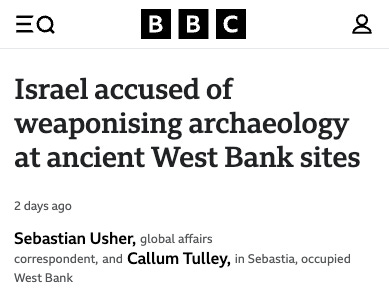
The BBC recently published an article under the headline:
“Israel accused of weaponising archaeology at ancient West Bank sites.”
My concern is not that the BBC investigates Israeli policy. It should.
If land is being expropriated, investigate it. If Palestinian residents are being deprived of access or livelihood, establish what is happening. If archaeology is being used as a legal or administrative pretext for territorial control, demonstrate the mechanism. If Israeli authorities are acting wrongly, criticize them.
That is journalism.
My concern begins one step earlier.
It begins with the headline.
Because before the BBC has explained the controversy, it has already supplied the reader with an explanation:
archaeology is being weaponised.
The qualification “accused of” gives the sentence formal journalistic distance. But it does not remove the conceptual frame. The reader enters the article through a doorway already constructed for him.
And the BBC possesses unusual power to construct such doorways.
This is not simply another private publication offering an opinion to people who voluntarily buy it. The BBC is a public-service institution, principally financed through the license fee, carrying enormous authority accumulated over generations and operating under obligations of accuracy and impartiality.
That makes the choice of explanatory categories especially important.
The danger is not merely that the BBC reports somebody else’s accusation.
The danger is that the BBC uses its institutional authority to select the menu through which millions of people are invited to understand the problem.
That is where bad philosophy becomes institutional power.
The Headline Gives Us the Wrong Problem
There is a familiar mistake in reasoning.
Someone offers us two alternatives and we immediately begin arguing about which one to choose.
But sometimes the alternatives themselves are the mistake.
The rational response is not to select A or B.
It is to ask whether a better explanation dissolves the apparent conflict.
The BBC’s headline gives us something like this menu:
archaeology as legitimate historical inquiry
versus
archaeology weaponised by Israeli power.
But that is not the real choice.
Several different questions have been compressed into one phrase.
What does the archaeology establish?
What interpretation best explains the archaeological evidence?
What are Israeli authorities doing around these sites?
Are land expropriations necessary for preservation?
Who will control access?
Who benefits economically?
Are archaeological projects being connected to settlement or territorial policy?
What rights do present landowners possess?
Those questions are related.
They are not identical.
A good explanation separates them sufficiently that each can be criticized.
The headline does the opposite.
It fuses them before the investigation begins.
Archaeology and the Use of Archaeology Are Different Problems
The distinction is elementary but indispensable.
Archaeology makes claims about reality.
A building existed.
An inscription was produced.
A population inhabited a place.
A political or religious community left material evidence.
An interpretation of those facts can be wrong. Archaeologists can make mistakes. Evidence can be misunderstood. Better discoveries can overturn previous explanations.
But the relevant test remains:
What best explains the evidence?
The political consequences of an archaeological finding are irrelevant to whether the finding is true.
A discovery does not become more true because Palestinians benefit from it.
It does not become less true because Israelis benefit from it.
Reality has no obligation to distribute its evidence politically evenly.
A government may subsequently use archaeological evidence.
That is an entirely different matter.
It may use archaeology to justify preservation.
Tourism.
National identity.
Education.
Expropriation.
Settlement.
Sovereignty.
Territorial consolidation.
Those political uses must themselves be criticized.
But if we fail to distinguish archaeology from its political use, evidence itself begins to acquire the moral characteristics of whoever carries it.
That is a serious philosophical error.
When the Carrier Contaminates the Claim
Suppose an Israeli government invokes genuine evidence of ancient Jewish history.
There are two questions.
First:
Is the historical claim true?
Second:
Does the contemporary political policy follow from it?
The answer could perfectly coherently be:
yes to the first and no to the second.
This should not be difficult.
A government can cite a true proposition in support of a bad policy.
A morally objectionable actor can discover something true.
A politically sympathetic actor can say something false.
The truth of the proposition does not inherit the morality of its carrier.
Yet much contemporary discussion increasingly reverses this relationship.
Instead of asking:
Is this explanation true?
we ask:
Who benefits from this explanation?
That can sometimes be a useful political question.
It is a disastrous substitute for epistemology.
Once the beneficiary of a proposition becomes evidence against the proposition, knowledge itself becomes tribal.
Facts acquire political owners.
The BBC should be helping its audience escape that intellectual trap.
Its headline risks reinforcing it.
“Weaponizing Archaeology” Is Too Easy to Vary
A good explanation should be constrained.
Its details should matter.
Change an important part and the explanation should stop working.
“Weaponizing archaeology” is weak precisely because it is so flexible.
What exactly constitutes the weapon?
The excavation?
The evidence?
The interpretation?
The national park?
The government funding?
The expropriation order?
The movement of an entrance?
The Jewish historical narrative?
The assertion of sovereignty?
These are different mechanisms.
If the claim is that Israeli authorities are using archaeological development to facilitate a particular land expropriation, say so.
That can be investigated.
Was the land taken?
Why?
What alternative preservation schemes were considered?
Would the archaeological site be damaged without expropriation?
Who controls the resulting park?
Can Palestinian residents enter?
Who receives tourism revenues?
Now the explanation can fail.
Evidence can contradict it.
But the more elastic phrase “weaponizing archaeology” can survive almost anything.
If an excavation uncovers politically significant Jewish history, it can be described as weaponisation.
If Israel funds a site, weaponisation.
If officials publicize Jewish remains, weaponisation.
If a national park is established, weaponisation.
If land is expropriated, weaponisation.
The concept can migrate from questionable governmental conduct all the way into the production of historical knowledge itself.
That is precisely why the BBC should have been more careful.
The Irony of Institutional Weaponisation
There is an irony here worth examining.
The BBC’s headline tells us that archaeology may be being weaponised.
But a headline issued by an institution with the BBC’s authority is itself an exercise of power.
The BBC decides which story becomes visible.
It selects the headline.
It chooses the causal vocabulary.
It determines which quotation appears early and which appears late.
It decides what constitutes context.
It selects the conceptual lens through which millions of readers first encounter an unfamiliar dispute.
That does not mean the BBC should not exercise editorial judgment.
Editorial judgment is unavoidable.
The question is whether that power remains open to criticism.
When a politically loaded explanatory category appears in a BBC headline, it acquires institutional reach that the original activist, politician or advocacy group making the accusation could never achieve alone.
The BBC has not merely reported the choice-menu.
It has amplified it through its institutional authority.
That is why public-service journalism carries a special burden.
The greater the institutional reach, the greater the obligation to make explanatory distinctions explicit.
Sebastia Requires Better Thinking
Sebastia illustrates exactly why.
There is ancient Jewish history there.
There are Roman remains.
Christian history.
Islamic history.
Crusader history.
Ottoman history.
There are also Palestinian residents living with and around this inherited landscape today.
None of these facts has to erase another.
Ancient Jewish history can be real.
Palestinian contemporary rights can be real.
Archaeological preservation can be legitimate.
A particular expropriation can still be unjustified.
There is no logical contradiction.
The contradiction emerges only if history is treated as a zero-sum political possession.
Then Jewish history threatens Palestinian legitimacy.
Or Palestinian rights threaten Jewish history.
That is the bad menu.
The intellectually serious alternative is harder:
preserve every historical truth that survives criticism while independently scrutinizing every contemporary exercise of political power.
That is not splitting the difference.
It is separating two different problems.
History Does Not Automatically Confer Modern Political Authority
The opposite error must also be rejected.
Authentic Jewish archaeology does not automatically justify every contemporary Israeli policy.
Archaeology tells us things about the past.
It can establish presence.
It can falsify denials.
It can uncover civilizations, institutions, religious practices and political communities.
But archaeology alone cannot determine the modern ownership of every olive field.
It cannot write contemporary property law.
It cannot decide citizenship.
It cannot settle every question of territorial sovereignty.
Those require additional arguments.
So the proper principle runs in both directions:
Do not deny historical truth because its political consequences are uncomfortable. Do not derive contemporary political authority from historical truth without further argument.
That distinction should have been at the centre of the BBC article.
Instead, the headline begins by merging the categories.
Public-Service Broadcasting Requires Epistemic Restraint
This matters particularly because the BBC’s authority is publicly constituted.
A public-service broadcaster should provide more than information.
It should model intellectual discipline.
It should distinguish:
evidence from interpretation;
interpretation from policy;
policy from motive;
motive from consequence;
historical truth from contemporary entitlement.
That is not sterile neutrality.
Quite the opposite.
It makes stronger criticism possible.
If Israeli authorities are using preservation rules to transfer land improperly, identify the institutional mechanism.
If local Palestinian residents are being excluded, document the exclusion.
If a development project privileges one historical layer while destroying another, show it.
If government officials are manipulating evidence, expose the manipulation.
But do not place the word archaeology itself inside the weapon before showing exactly where the weaponisation occurs.
Otherwise the conceptual ambiguity performs political work that the evidence has not yet earned.
A Better Choice
There is no need to choose between these positions:
Defend Jewish history.
or:
Defend Palestinian rights.
That is a primitive choice-menu.
Create a better option.
Defend historical truth against political denial.
Defend present human beings against unjustified coercion.
Preserve archaeological evidence.
Criticize governmental policy.
Demand evidence from Palestinian claims.
Demand evidence from Israeli claims.
Permit neither identity nor power to determine truth.
Now the apparent contradiction disappears.
That is what better explanations do.
They do not merely choose between existing positions.
They reorganize the problem.
Where Does the Error Go Inside the BBC?
The institutional question therefore becomes:
Where does the error go?
Suppose “weaponizing archaeology” is a poor explanatory category.
Can someone inside the BBC challenge the premise?
Can an editor say:
We have evidence of controversial land expropriations, but have we demonstrated that archaeology itself is the mechanism?
Are we distinguishing the archaeology from heritage administration?
Are we accidentally encouraging readers to interpret genuine historical evidence as political propaganda?
What would show our framing to be wrong?
Those are healthy questions.
The danger for any powerful institution arises when its own vocabulary becomes immune to them.
An institution begins by using a phrase.
The phrase becomes normal.
Normal becomes neutral.
And eventually nobody notices that the language contains a theory.
That is how protected error develops.
Not necessarily through conspiracy.
Often through habit.
What a Better BBC Headline Could Have Done
Consider the difference:
Israel accused of weaponizing archaeology at ancient West Bank sites
versus:
Israeli plans for ancient sites raise dispute over land, heritage and political control
The second is less dramatic.
It is also intellectually superior.
It tells us what is actually contested without deciding in advance how the components relate.
Land.
Heritage.
Archaeology.
Political control.
The article must then explain the connections.
That is journalism doing explanatory work rather than importing the explanation into the headline.
Another possibility:
Who should control Sebastia? Archaeology and land rights collide at an ancient site
Again, the problem remains open.
The reader has not yet been told which causal theory to inhabit.
Institutional Power Should Make the BBC More Careful, Not Less
The BBC’s institutional authority is precisely why the problem matters.
A private activist can call something “weaponised archaeology.”
A politician can call it colonialism.
Another politician can call it historical restoration.
Those are arguments.
But when a public-service broadcaster places one of those conceptual structures in its headline, the frame acquires a different status.
It arrives with the BBC’s accumulated authority.
That authority should not be used casually.
The BBC should not weaponize its institutional power by turning contestable philosophical interpretations into the default menu through which the public encounters reality.
Its responsibility is the opposite.
Open the menu.
Separate the claims.
Increase the number of explanations that can be criticized.
Then let the evidence destroy the bad ones.
The central rule is simple:
The greater an institution’s power to frame reality, the greater its responsibility not to confuse a frame with reality itself.
The BBC can investigate Israeli power without making evidence guilty by association.
It can defend Palestinian property rights without treating ancient Jewish history as a political inconvenience.
It can scrutinize archaeological policy without converting archaeology itself into a weapon.
That is the standard a public-service institution should meet.
And perhaps the better headline for the intellectual problem is not that Israel is accused of weaponizing archaeology.
It is this:
Is the BBC Weaponizing Its Institutional Power?
Because before we ask who is weaponizing archaeology, we should also ask who has the power to decide what the public is invited to see as the weapon.
No posts
Comments
Nothing yet. Say the first thing.
Sign in to join the conversation.