
There is something I did not fully appreciate until I began studying history beyond what I had been taught in school.
I had grown up Muslim in the West. I had studied Western history. I knew the usual curriculum: Greece, Rome, the Middle Ages, the Renaissance, the Reformation, the Enlightenment, industrialization, the World Wars, the Cold War.
What I did not realize was how much of that history was happening in constant contact with Muslims. It felt as if historical eras or events happened in isolation. These were shared with through my father, who was always fascinated by history
It wasn’t occasionally did Muslims interact with the West, or in specific times. It was constantly. It made frustrated because the way Western history was taught, it was as if the West and Muslim World existed on two different planets until recently. It wasn’t that the Muslims were absent from European and American history. It was absent because of the way it was taught. That makes a difference, it tells me that leaving out Muslims from Western history is intentional.
Muslims students educated in America go into college or graduate high school thinking that Western history and Muslim history are separate. That the two only met during the Crusaders and went back to their separate worlds. For almost 1,400 years Muslims are non-existent, then all of a sudden they appear in the 20th century. Iran is brought up, Iraq is an ally then an enemy, 9/11 happens then there is a worldwide terrorism problem.
This is not only how Muslims living in the west saw it, but the average American was pretty much clueless about Muslim until these issues came on the headlines. Because Muslims educated on the west receive the same education as other Americans, we also develop the same historical blind spots.
A shallow way to look at this is to be upset that Muslims were left out. We could complain about how the achievements and roles they played historically was left out. How it is unfair. My issue with leaving Muslims out of Western history, is that makes it harder to understand both European and Muslim history. They did not develop in isolation. They developed input and despite the other. It is hard to ignore that for 13 centuries Muslim powers were somewhere in the political, military, intellectual, or economic picture of European history.
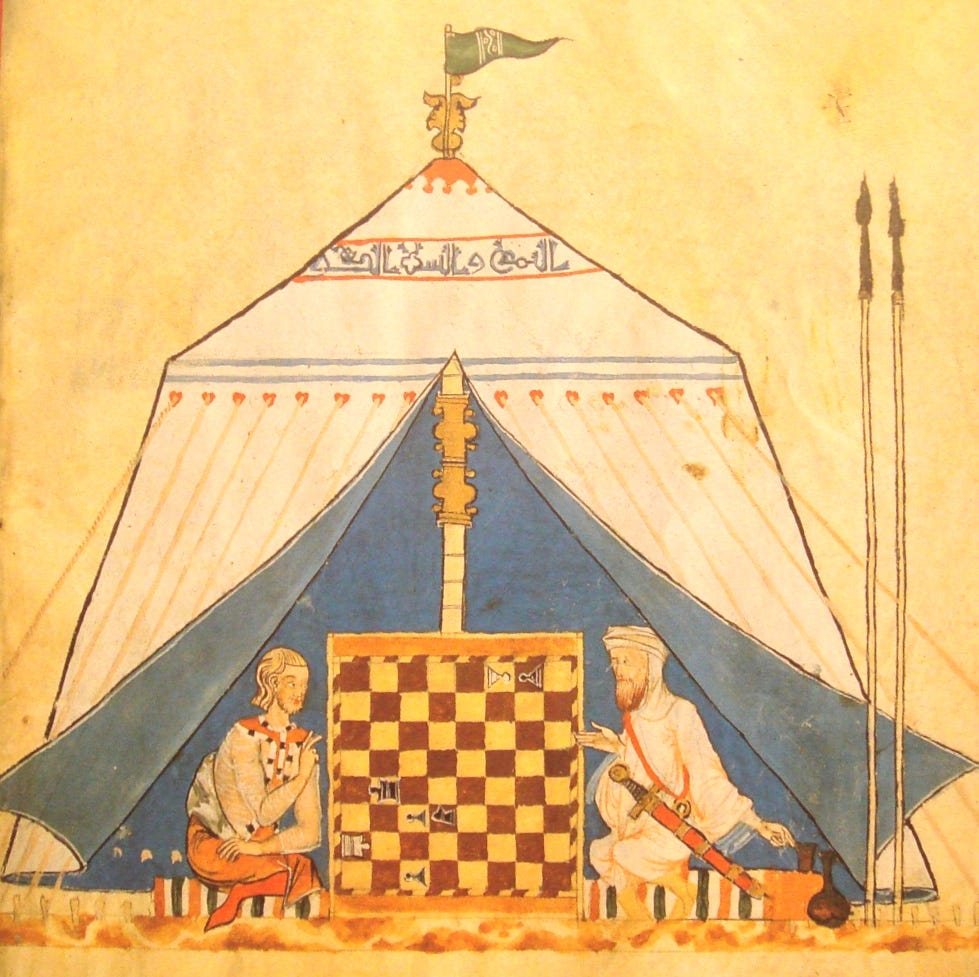
From the 17th century until the 19th century, Europe and the Muslim world were neighbors, trading partners, rivals, military enemies, intellectual competitors, and at times allies. They shaped one another continuously.
You cannot understand medieval Spain without knowing Al-Andalus. You cannot understand the Crusades without Muslim dynasties. You cannot understand the Renaissance without the transmission of Greek philosophy through Arabic scholarship. You cannot understand Ottoman Europe without understanding why Vienna mattered. Nor can you understand European colonialism without understanding the decline of the Ottoman Empire. Islamic history is not a separate story. It is part of European history.
Learning about Roman history, we taught that it fell in 476. This true, but more truth adjacent. While the Western Roman Empire collapsed, Rome didn’t vanish. It continued through the Eastern Roman Empire, centered in Constantinople. This lasted for roughly another thousand years. Today we call it the Byzantine Empire, but they didn’t call themselves that. They referred to themselves as Romans.
The Eastern Roman Empire was still one of the greatest powers of the world. This is where the history of Muslims with Europe begins. The Eastern Roman Empire was still thriving when Islam appeared in Mecca. And quickly things changed. The Muslims were between two great imperial powers. You had the Romans on one side and the Persian on the other. Only a few years after the death of Prophet Muhammad ﷺ did the Muslim armies fighting both of them, and were victorious.
The Romans were defeated at Yarmouk on the year 636. It was a battle that deserved some time in the classroom. European powers lost Syria, Palestine, and shortly after Egypt. These were not small loses, they were vital territories to the Eastern Roman Empire.
From the moment onward, Europe has a powerful Muslims civilization that was growing to their east and their south. That relation would last for more than 1,000 years in a variety of forms. That one battle alone not being shared, makes us miss part of the picture where studying medieval European history.
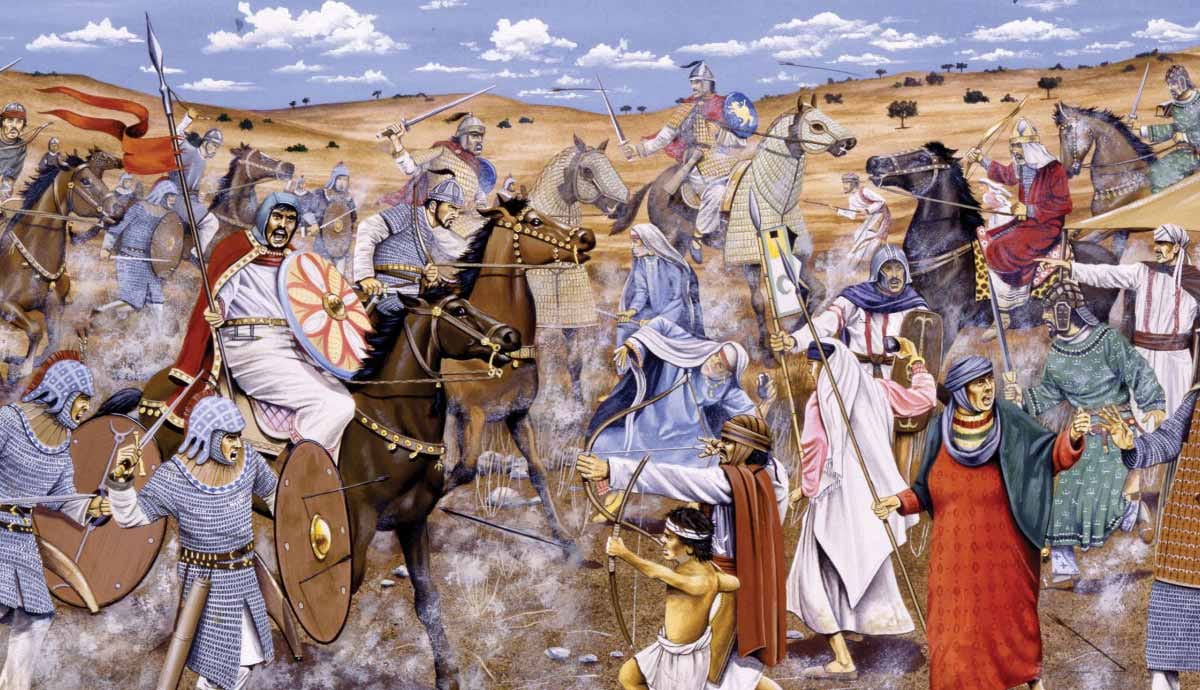
Spain is taught the same way. The average American does not know, or would believe, that Spain was ruled by Muslims for 700 years. For those that “taught” about Al-Anadalus, it is more of an interruption. Muslims crossed into Iberia 711, Muslims ruled for 700+ years, Then the Reconquista happened. Then finally Grenada fell in 1492. Then we quickly move on to Columbus sailing across the Atlantic. 700 years of history skipped or rushed to get to the discovery of the New World. Al- Andalusia became deeply connected to the political, cultural and intellectual history of the Mediterranean region. Making it both a deeply woven history between Europe and Muslims.
What we saw in this 700 years under Muslim rule, that is not taught in schools, is Córdoba becoming one of the greatest cities of its era. We saw Arabic scholarship flourish. The flourishing of scholarship wasn’t just theological, it was also in the biology, navigation, mathematics, and so on.
Muslims, Jews, and Christians lived under changing political arrangements that could range from cooperation to discrimination to outright violence, depending on the period and ruler. The history should not be romanticized. But it should not be flattened either.
More important for understanding Europe, enormous amounts of knowledge moved through the Arabic-speaking world.
Greek philosophy had been translated into Arabic.
Muslim scholars studied it, argued with it, criticized it, and expanded upon it.
Medicine, astronomy, mathematics, optics, philosophy, and other fields developed through generations of scholars working across the Muslim world.
Later, many of these texts entered Latin Europe through translation centers in places such as Toledo and Sicily.
Ibn Sina became Avicenna.
Ibn Rushd became Averroes.
Al-Khwarizmi’s name became associated with the word algorithm.
This does not mean, as Muslims sometimes like to claim online, that “Muslims created the Renaissance.”
History does not work that neatly.
The Renaissance had many causes, many intellectual streams, and many specifically European developments.
But it is equally inaccurate to tell the story as if Europe rediscovered the intellectual inheritance of antiquity in isolation.
The Muslim world was part of that transmission.
That should not be controversial.
It is simply history.
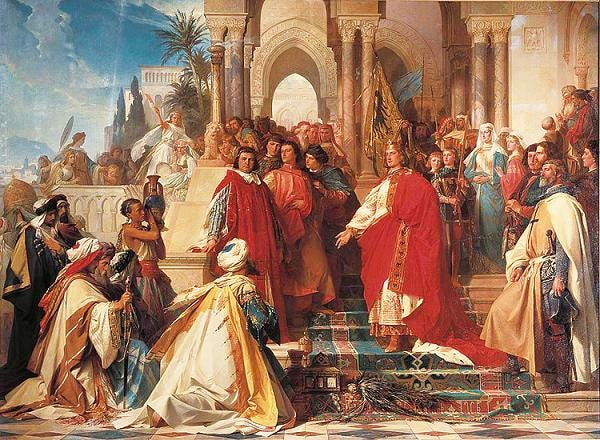
Then we enter the age of the Ottoman empire, and that division between European history and Muslim history becomes almost non-existent. At their peak, the Ottomans were literally ruling parts of Europe,
Greece, Bulgaria, Serbia, Bosnia, Albania, Macedonia, and other parts of southeastern Europe spent centuries under Ottoman rule. on two separate occasions Ottoman armies reached Vienna. European alliances and policies were formed around the question of Ottoman power.
Despite the worrying of Ottoman power, European merchants traded in Ottoman ports and markets. European ambassadors lived at the Ottoman court. Negotiations between Ottoman official and European monarchies happened.
France, a Catholic kingdom, famously allied with the Ottoman Empire against the Catholic Habsburgs. That tells us, that the world was’t an us vs them. it wasn’t Muslims on one side and Christians on the other. It was far more complicated than that. was religion a central factor? Absolutely. But sometimes dynastic interests mattered more. And other times, trade mattered more. Sometimes a Christian king saw a Muslim sultan more useful than a fellow Christian king, and the same for the Muslim sultan. Our history was complex, it was messy, it was human.
This is exactly the kind of complexity that disappears when Islamic history is taught as a separate civilization rather than as part of the world in which Europe itself was developing. By the 19th century, the weakening Ottoman Empire had become one of the central problems of European diplomacy.
The British, Russians, Austrians, French, and others constantly argued over what should happen to Ottoman territories. European diplomats and authorities called it the Eastern Question. It was the largest geopolitical matter of 19th century Europe. Every country had an interest in the outcome of this question. Yet, it is something not discussed. Did schools feel it was too complicated?
Muhammad Ali Pasha is one of the figures who made me realize how much history falls between the cracks. Most Muslims know something about Ottoman decline. Many know Egypt was eventually occupied by Britain. But the story in between is extraordinary.
After the French occupation of Egypt collapsed, Muhammad Ali rose to power and began transforming the country. He built a new army, he reorganized the state, he expanded agricultural production, he attempted to build industries capable of supporting military independence for Egypt. His forces even expanded south into Sudan. They deep went into Arabia and destroyed the First Saudi State after a long war against the Wahhabi movement. Egyptian forces regained the Hijaz, including Makkah and Madinah, for the Ottoman Sultan. They even ruled and administered it.
Then Muhammad Ali turned against the Ottomans themselves. Under his son Ibrahim Pasha, Egypts army quickly conquered Syria and defeated Ottoman forces so badly that they threatened the survival of the entire Ottoman government.
This is where the story becomes particularly important for Europe and those studying European history. European powers felt it was necessary to intervene. It wasn’t because they loved the Ottoman Empire or were loyal to them. They had spent centuries fighting the Ottoman Empire, one would think “good riddance”.
The reason they intervened was because they did not want Muhammad Ali to become too powerful and upset the balance of power that was in their favor. A weak Muslim Empire is better for European expansion into Africa and Asia.
Britain, Austria, Russia, and Prussia supported arrangements that forced Muhammad Ali to retreat from much of what he had conquered. This was a bunch of Christian nations helping a Muslim Empire against another rising Muslim power. Because it wasn’t and “us vs them” mentality, it was preservation of interest. That was the 19th century, it wasn’t islam vs Christianity, it wasn’t Muslims vs Europeans. It was basic simple power politics.
Then came European loans.
Infrastructure.
The Suez Canal.
Egyptian debt.
European financial control.
British intervention.
And finally the British occupation of Egypt in 1882.
If you begin the story in 1882, you see Britain conquering Egypt.
If you begin several decades earlier, you see something much bigger: a Muslim state trying to industrialize and become independent at exactly the moment European power was becoming overwhelming.
That is an entirely different way of understanding colonialism.
This gap also exists in the United States. When we think of America’s early wars, we tend to look back to the Revolution against the British, the war of 1812, and the Civil War. But between the American Revolution and the War of 1812 American engaged in its first overseas war in 1801. This was called the Barbary War, it was military campaigns fought against the Barbary States of North Africa.
Naval vessels belonging to America fought in the Mediterranean. The fought at Derna, present day Libya, this war helped shape the U.S. Navy and Marine Corps. This wasn’t a war against islam, simplifying it to that isn’t helpful. It was a war of interests. America would fight one Muslim country and have pleasant relationships with another. Again, history is more interesting than the slogan.
The list goes on and on from American imperialism in the Philippines to WW2 to the fall of the USSR and beyond.
Once you begin looking for these connections, they appear everywhere.
The European conquest of Algeria.
The British occupation of Egypt.
Russian expansion into Muslim lands in the Caucasus and Central Asia.
French expansion in North and West Africa.
The Dutch in Indonesia.
British India and its enormous Muslim population.
American imperial expansion into the Philippines and the long resistance of Muslim communities in Mindanao and Sulu.
Then World War I. How can we possible properly understand World War I without the Ottoman Empire?
The Gallipoli campaign.
The Arab Revolt.
The Caucasus front.
British campaigns in Iraq and Palestine.
The Sykes-Picot Agreement.
The British entry into Jerusalem.
The eventual dismantling of Ottoman territories.
These were not peripheral events.
They helped create the modern Middle East.
Then came the mandates.
European colonial rule.
Nationalism.
Decolonization.
The creation of new states.
The Cold War.
Afghanistan.
Iran.
The Soviet invasion.
American involvement.
The collapse of the Soviet Union.
And eventually the conflicts, wars, and hostility towards Muslim nations that enter the media today.
Our present time makes much more sense when you understand what came before it and who was involved.
Without knowing that history, Muslims seem to suddenly appear in Western consciousness in the late twentieth century. But, by understanding history you realize that the relationship the West has with Muslim is centuries old.
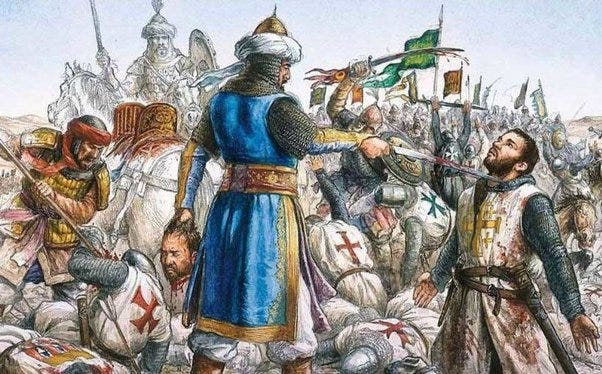
There is another perspective to what is being discussed here, and that Muslims in the West need to talk about. Once Muslims realize how much of their history was left out, there can be a willingness at times to overcorrect. We begin to look for Muslim clues everywhere. Someone might find Arabic inscription on an old map from a text book or internet article and come to a conclusion that Muslims discovered America before Columbus.
Someone notices similarities between a political idea and an Islamic concept and suddenly the American Constitution came from Islam.
Every scientific discipline becomes a “Muslim invention.”
Every major European thinker supposedly borrowed from Muslims.
I understand why this happens.
A community that has been made to feel historically insignificant naturally wants to recover its history.
But we do not need to manufacture importance.
Islamic civilization was already important.
Muslim states controlled some of the most important trade routes and cities in the world.
Muslim scholars produced extraordinary intellectual traditions.
Muslim empires shaped the political development of Europe, Africa, and Asia.
Muslim merchants built networks stretching from West Africa to China.
Muslim armies defeated some of the greatest powers of their age and were later defeated by other rising powers.
There is enough real history.
We do not need myths.
In fact, exaggeration does the opposite of what Muslims hope it will do.
Once someone discovers that one dramatic claim is false, they begin doubting the claims that are actually true.
I think this is especially important for Muslims growing up in Europe and North America to realize that we are taught one historical world, and it is incomplete. At school there is “History class”, then when we are at home, or at the masjid, or through books, we realize there is “Islamic history.” And the two rarely meet, and this creates confusion and more questions. We learn about great historical figures like Napoleon, but not learn how his invasion of Egypt impacted it. We learn about European colonization, but not learn what is did to Muslims states and the institutions that Europeans were dismantling and replacing. We learn about the Renaissance, but not about the movement of knowledge from Muslim intellectuals. We learn about WWI, but leave out a major player like the Ottomans and the Ottoman Caliphate. We learn about the Cold War and Afghanistan as if Afghanistan and other neighboring areas formerly occupied by Russia became important in 1979.
Then Muslims ourselves begin thinking of Islamic history as something that happened “over there.”
Baghdad.
Damascus.
Cairo.
Istanbul.
Andalusia.
We believe these places are disconnected from the Western world in which we now live. But they were never disconnected. The Mediterranean was not a wall that divided Europe from Africa. It was a highway used my merchants, crossed by armies, connected diplomates, allowed books to spread. It helped knowledge, religion, ideas, technology, languages, crops, and custom cross between worlds. Europe and the Muslim world spent centuries looking at one another across the same sea.
They looked with curiosity, admiration, fear, and at times with weapons in their hands. But they never looked at each other as strangers.
This is probably my most important point to make in this article. I am NOT saying that Islamic history and civilization should replace the European historical story and be at the center of it. That would repeat the same mistake but in the opposite direction. I am also NOT saying that western students need to be experts in Islamic history and make every connection possible. My point is simple, we need to stop pretending the histories developed independently, as of they were happening on different planets. Europe profoundly shaped the Muslims world, and the Muslims did the same to Europe. The relationship changed over time, in some centuries Muslims were the dominant military and economic power, and some centuries (especially with industrialization) it was Europe. Today’s world is shaped by both realities, it is a combination of both histories.
If we want to understand how we arrived here, then we need the entire story. not just parts of it tailored to a certain audience.
For Muslims in the West, that begins with recognizing something many of us were never really taught:
We were already there.
Not necessarily our individual ancestors.
Not in some mythical sense.
But Muslims were part of the political and intellectual world that produced modern Europe.
They were neighbors, enemies, allies, scholars, merchants, rulers, captives, translators, soldiers, and diplomats.
They were not watching European history from another planet.
They were participating in the same history.
And I think that is the correction we actually need.
Not “Muslims invented everything.”
Not “Europe stole everything.”
Not another civilizational fairy tale designed to make us feel better.
Just a fuller history.
Because once you see it, it becomes difficult to unsee.
The Muslim world was never missing from Western history.
It was missing from the way many of us were taught to remember it.
Thanks for reading The Muslim Observer! This post is public so feel free to share it.
No posts
Comments
Nothing yet. Say the first thing.
Sign in to join the conversation.