
Among the most emotionally powerful events in Islamic history is the martyrdom of Husayn ibn Ali, the grandson of the Prophet Muhammad ﷺ, at Karbala in 680 CE (61 AH).
For many Muslims, Karbala is not merely a historical battle. It is a story of loyalty and betrayal, principle and power, religion and politics. It is also one of the events that most profoundly shaped the Sunni-Shia divide that exists today.
Yet the day upon which Husayn was martyred, the 10th of Muharram known as Ashura, carried religious significance long before Karbala. Understanding Ashura requires understanding both its prophetic origins and its later historical associations.
When many Muslims hear the word “Ashura,” they immediately think of Karbala.
Historically, however, Ashura was already a sacred day before the tragedy of Husayn.
When the Prophet Muhammad ﷺ arrived in Medina, he found the Jewish community fasting on the 10th of Muharram. They explained that it was the day Allah saved Musa (Moses) and the Children of Israel from Pharaoh.
The Prophet ﷺ responded:
“We have more right to Musa than they do.”
He then fasted the day and encouraged the Muslims to fast it as well.
This narration is found in both Sahih al-Bukhari and Sahih Muslim.
The Prophet ﷺ taught that fasting Ashura expiates the minor sins of the previous year.
For Sunni Muslims especially, Ashura remains primarily a day of worship, fasting, gratitude, repentance, and remembering Allah’s salvation of His prophets and righteous servants.
Thus, Ashura represents multiple themes simultaneously:
The salvation of Musa and the Children of Israel.
Gratitude for Allah’s mercy.
Expiation of sins through fasting.
The importance of prophetic history.
The martyrdom of Husayn ibn Ali.
The struggle between justice and oppression.
These meanings are not mutually exclusive. Rather, they became layered upon one another throughout Islamic history.
Numerous narrations appear in early Islamic sources stating that the Prophet ﷺ was informed of Husayn’s future martyrdom.
One famous narration reports that Jibril informed the Prophet ﷺ that a group from his own community would kill his grandson. The Prophet ﷺ was then shown the land where Husayn would be killed and was given soil from that place.
Versions of this narration appear in Musnad Ahmad, al-Tabarani, al-Hakim, and other collections. The authenticity of individual chains is debated, but many Sunni scholars accepted that the Prophet ﷺ was informed of Husayn’s future martyrdom through multiple narrations.
from Musnad Ahmad and other collections is reported from Umm Salamah:
Jibril came to the Messenger of Allah ﷺ and said: “Do you love him?” meaning Husayn.
The Prophet ﷺ replied: “How could I not love him? He is part of me.”
Jibril then said: “Your Ummah will kill him after you.”
He then showed him the land where Husayn would be killed and brought him a handful of its soil.
In another wording:
“This son of yours will be killed in a land called Karbala.”
The Prophet ﷺ then wept, and the soil was given to Umm Salamah. According to some narrations, he told her that when the soil changed appearance, it would be a sign that Husayn had been martyred.
The phrase “How could I not love him? He is part of me” echoes other authentic narrations regarding his family, such as:
“Husayn is from me and I am from Husayn. Allah loves whoever loves Husayn.”
(Jami’ al-Tirmidhi)
For Muslims, this is a sobering reality.
The Prophet ﷺ was not warning of an attack by Byzantines, Persians, or idolaters.
The killers would come from within the Muslim community itself.
To understand Karbala, one must understand what happened after the death of Mu’awiyah ibn Abi Sufyan.
Mu’awiyah had ruled the Muslim empire for nearly twenty years. Before his death, he arranged for his son Yazid to succeed him.
This was controversial.
Many prominent companions and their children viewed this as transforming the caliphate into a hereditary monarchy.
Among those who refused immediate allegiance were:
Husayn ibn Ali
Abdullah ibn al-Zubayr
Abdullah ibn Umar
Abdullah ibn Abbas (with reservations)
Husayn’s opposition was not merely personal.
Many Muslims believed leadership should be based on merit, consultation (shura), and justice rather than dynastic succession.
The people of Kufa in Iraq sent hundreds of letters to Husayn. They promised support. They pledged loyalty. They invited him to come and challenge Yazid’s authority. Believing that a substantial movement existed, Husayn dispatched his cousin Muslim ibn Aqil to assess the situation. Initially, the reports were encouraging. Thousands pledged support. Everything appeared favorable. Then the political machinery of the Umayyad state began to move.
Yazid appointed Ubayd Allah ibn Ziyad as governor. Ibn Ziyad used a combination of intimidation, arrests, threats, tribal pressure, and force. The Kufans who had enthusiastically pledged support began abandoning the movement. Muslim ibn Aqil was captured and executed.
When Husayn was traveling toward Iraq, he was largely unaware that the political situation had completely collapsed. By the time he arrived, the thousands who had invited him were gone. Some historians describe this as one of the greatest betrayals in Islamic history. The very people who begged him to come abandoned him when the cost became real.
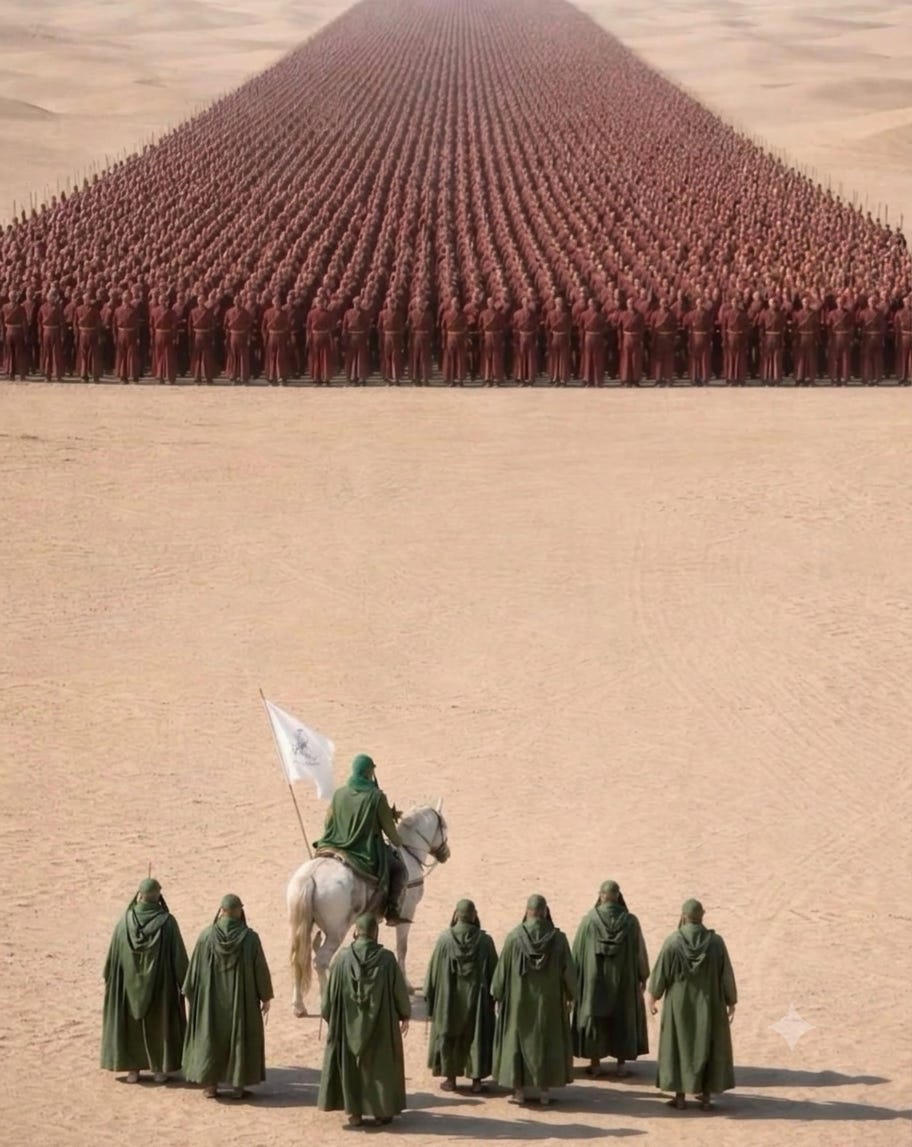
Husayn arrived with a small group. Estimates vary, but his camp consisted of roughly seventy to one hundred people, including family members, companions, women, and children. Opposing them was a force numbering in the thousands. Negotiations occurred.
Husayn reportedly offered several solutions:
Allow him to return.
Allow him to go to a frontier region.
Allow him to speak directly with Yazid.
The reports differ regarding exactly what was proposed and rejected. What is generally agreed upon is that no peaceful resolution was reached. On the 10th of Muharram, Ashura, the battle began. One by one, Husayn’s companions fell. Family members were killed. His half-brother Abbas was killed. His son Ali al-Akbar was killed. Many accounts also record the death of his infant son.
Eventually Husayn himself was surrounded and killed. His head was severed. His body was left on the battlefield. The grandson of the Prophet ﷺ was dead
.
The martyrdom of Husayn permanently altered how Muslims remembered Ashura.
For Sunni Muslims, Ashura remained primarily a day of fasting and worship while also serving as a reminder of Husayn’s martyrdom and the dangers of political injustice.
For Shia Muslims, Karbala became inseparable from Ashura itself.
The day transformed into a powerful annual remembrance of sacrifice, loyalty, resistance to oppression, and devotion to the family of the Prophet ﷺ.
As a result, Muslims today may observe Ashura in different ways while attaching different emotional meanings to the day.
Yet all agree that Husayn’s death remains one of the greatest tragedies in Islamic history.
Sunni Muslims universally regard Husayn as:
A righteous leader
The beloved grandson of the Prophet ﷺ
A martyr
One of the greatest people of this Ummah
Classical Sunni scholars strongly condemned his killers.
Figures such as Ibn Kathir, Al-Dhahabi, and Ibn Hajar al-Asqalani viewed Husayn’s death as a catastrophe for the Muslim community.
Where Sunni scholars differ is over Yazid himself.
Some Sunni scholars held Yazid morally and politically responsible because the killing occurred under his authority.
Others argued that Ibn Ziyad and local commanders bore primary responsibility.
A third group preferred not to extensively discuss Yazid and instead focused on condemning the crime itself.
Despite these differences, Sunni scholarship overwhelmingly agrees that Husayn was wronged and martyred.
For Shia Muslims, Karbala occupies a central place in religious identity.
Husayn is not simply a martyr.
He is an Imam appointed by God.
His stand at Karbala represents the eternal struggle between truth and tyranny.
In Shia thought:
Yazid represents illegitimate power.
Husayn represents divinely guided leadership.
Karbala represents the sacrifice necessary to preserve authentic Islam.
The annual commemorations of Muharram and Ashura emerged from this understanding.
Many Shia scholars argue that Husayn knowingly accepted martyrdom because preserving truth was more important than political victory.
Not originally. The labels “Sunni” and “Shia” did not yet exist in the form they do today. The people who killed Husayn were Muslims. Many prayed. Many fasted. Many considered themselves followers of Islam. This uncomfortable reality is important.
Karbala was not a battle between Muslims and non-Muslims. It was a political conflict inside the Muslim community. That is precisely why it remains so painful.
The tragedy of Karbala demonstrates that religious identity alone does not guarantee moral courage. The people of Kufa loved Husayn when supporting him was easy. When supporting him became dangerous, most disappeared.
This is why many scholars throughout history emphasized that the real lesson of Karbala is not simply mourning the event.
It is asking:
Would we stand for justice when it costs us?
Would we support truth when it is unpopular?
Would we remain loyal when fear enters the equation?
The betrayal of Karbala was not carried out by people who hated Islam. It was carried out by people whose political calculations, tribal loyalties, fear, and personal interests became stronger than their principles.
One of the often overlooked dimensions of Muharram and Ashura is that they provide an opportunity to reconnect with the family of the Prophet Muhammad ﷺ (Ahl al-Bayt).
Discussions about Karbala can sometimes become dominated by politics, sectarian debates, or arguments over historical details. Yet before Husayn ibn Ali was a political figure, he was the beloved grandson of the Messenger of Allah ﷺ.
The Prophet ﷺ openly expressed his love for his family and repeatedly instructed the Muslim community to honor them.
Among the women of his household were two of the most honored women in Islamic history: his wife Khadijah bint Khuwaylid and his daughter Fatimah al-Zahra.
The Prophet ﷺ said:
“Many men attained perfection, but among women none attained perfection except Maryam the daughter of Imran, Asiyah the wife of Pharaoh, Khadijah bint Khuwaylid, and Fatimah bint Muhammad.”
While scholars discussed the wording and implications of this narration, it remains one of the clearest indications of the extraordinary rank of both Khadijah and Fatimah.
Khadijah was the first believer, the Prophet’s greatest supporter during the earliest years of Islam, and the mother of Fatimah.
Fatimah was described by the Prophet ﷺ as:
“Fatimah is a part of me. Whoever hurts her hurts me.”
(Sahih al-Bukhari and Sahih Muslim)
From Fatimah came Hasan and Husayn, the grandsons whom the Prophet ﷺ loved deeply.
Numerous authentic narrations describe the affection he showed them.
The Prophet ﷺ would carry them, embrace them, and publicly express his love for them.
Regarding Hasan and Husayn, he said:
“Hasan and Husayn are the leaders of the youth of Paradise.”
(Sunan al-Tirmidhi)
In another narration, while holding Hasan, the Prophet ﷺ said:
“O Allah, I love him, so love him and love those who love him.”
(Sahih al-Bukhari)
He also famously declared:
“Husayn is from me and I am from Husayn. Allah loves whoever loves Husayn.”
(Sunan al-Tirmidhi)
The statement “Husayn is from me” reflects their family relationship. But scholars noted that the phrase “and I am from Husayn” points to something deeper. Through Husayn’s sacrifice, courage, and steadfastness, the message of the Prophet ﷺ would continue to be preserved and remembered by future generations.
For this reason, Muharram should not be reduced solely to political history. Nor should Ashura be reduced solely to debates over mourning or commemoration.
Rather, this month can serve as a reminder to learn about the household of the Prophet ﷺ, their sacrifices, their virtues, and their contributions to Islam.
Many Muslims know surprisingly little about Khadijah, Fatimah, Hasan, Husayn, Zaynab, and the other members of the Prophet’s family despite frequently sending blessings upon them in prayer.
Ashura therefore offers an opportunity not only to fast and seek Allah’s forgiveness, not only to remember the salvation of Musa عليه السلام, and not only to reflect upon Karbala, but also to renew our love for the Prophet ﷺ by learning about and honoring those whom he loved most.
Ashura is often remembered today either as the day of fasting commemorating the salvation of Musa عليه السلام or as the day of Husayn ibn Ali’s martyrdom at Karbala.
Yet throughout Islamic history, scholars, preachers, and historians also associated Ashura with a number of other important events involving the prophets of Allah.
The most authentic narration concerns Musa عليه السلام and the deliverance of the Children of Israel from Pharaoh. This is the event directly mentioned in Sahih al-Bukhari and Sahih Muslim and forms the basis for the Sunnah of fasting on Ashura.
However, later Islamic sources and historical traditions mention that Ashura was also associated with:
The repentance of Adam عليه السلام being accepted.
The Ark of Nuh (Noah) عليه السلام coming to rest after the Flood.
The salvation of Ibrahim (Abraham) عليه السلام from the fire.
The relief of Ayyub (Job) عليه السلام from his suffering.
The release of Yusuf (Joseph) عليه السلام from hardship.
The deliverance of Yunus (Jonah) عليه السلام from the belly of the great fish.
Scholars differed regarding the authenticity of these reports. Many of the individual narrations are weak when examined independently. For this reason, the established Sunnah connected to Ashura remains the fasting mentioned in the authentic hadith concerning Musa عليه السلام.
Nevertheless, the persistence of these traditions throughout centuries of Islamic literature reveals how Muslims came to view Ashura as a day symbolizing a broader theme found throughout the stories of the prophets:
Allah’s mercy after hardship.
Adam was forgiven after repentance.
Nuh was saved after the flood.
Ibrahim was saved from the fire.
Musa was saved from Pharaoh.
Yunus was rescued from darkness.
Ayyub was relieved after suffering.
Again and again, the stories of the prophets teach that trials do not last forever and that Allah ultimately grants victory, relief, forgiveness, or salvation to His righteous servants.
Viewed through this lens, Ashura becomes more than a historical date. It becomes a reminder of the recurring pattern of sacred history: faith tested, patience maintained, and Allah’s help arriving at the appointed time.
It is perhaps fitting that Husayn ibn Ali’s martyrdom also occurred on this day. While the circumstances were vastly different, his story likewise became one of steadfastness in the face of overwhelming hardship. Thus, Ashura came to embody both divine deliverance and human sacrifice, connecting the legacy of the prophets with the legacy of the Prophet Muhammad’s ﷺ own family.
The connection between Ashura and the salvation of Musa عليه السلام is established through rigorously authentic narrations in Sahih al-Bukhari and Sahih Muslim. Reports linking Ashura to Adam, Nuh, Ibrahim, Ayyub, Yusuf, and Yunus appear in later historical, exegetical, and devotional literature. Scholars differed regarding the authenticity of these reports, and they do not carry the same evidentiary weight as the narrations concerning Musa and the fasting of Ashura.
Musa (Moses) and Ashura
Ibn Abbas reported: The Prophet ﷺ came to Madinah and saw the Jews fasting on the day of Ashura. They said: “This is a righteous day. It is the day Allah saved Musa and the Children of Israel from their enemy, so Musa fasted it.” The Prophet ﷺ said: “We have more right to Musa than them,” and he fasted it and commanded that it be fasted.
Sahih al-Bukhari, no. 2004; Sahih Muslim, no. 1130
Expiation of sins through fasting Ashura
“Fasting the day of Ashura, I hope from Allah, expiates the sins of the previous year.”
Sahih Muslim, no. 1162
The reports connecting Ashura to Adam, Nuh, Ibrahim, Ayyub, Yusuf, and Yunus are generally found in historical and exegetical works rather than in the strongest hadith collections.
You can cite them as follows:
Imam al-Tabari
Muhammad ibn Jarir al-Tabari
Tarikh al-Rusul wa al-Muluk (History of Prophets and Kings)
Imam al-Qurtubi
Al-Qurtubi
Al-Jami’ li Ahkam al-Qur’an
Discussion under verses related to fasting and sacred days.
Ibn Kathir
Ibn Kathir
Al-Bidayah wa al-Nihayah (The Beginning and the End)
Tafsir Ibn Kathir
Al-Suyuti
Jalal al-Din al-Suyuti
Al-Durr al-Manthur
Collects numerous narrations regarding Ashura and earlier prophets.
Ashura is one of the most layered days in the Islamic calendar.
It commemorates Allah’s salvation of Musa and the Children of Israel. It is a day of fasting, gratitude, repentance, and worship. It is also the day upon which Husayn ibn Ali was martyred at Karbala.
For Sunni Muslims, Ashura remains a prophetic fast and a day to remember both divine mercy and human failure.
For Shia Muslims, Ashura is the ultimate symbol of sacrifice, resistance to oppression, and loyalty to the family of the Prophet ﷺ.
Both perspectives agree on one thing:
The killing of Husayn ibn Ali was not merely the death of a man. It was a moral failure of a community that knew who he was, knew what he represented, and yet allowed politics, fear, and ambition to triumph over loyalty and justice.
Perhaps that is why Ashura continues to endure in Muslim memory. It reminds believers not only of how Allah saves the righteous, but also of how easily a community can lose its moral compass when power becomes more important than principle.
Thanks for reading The Muslim Observer! This post is public so feel free to share it.
No posts
Comments
Nothing yet. Say the first thing.
Sign in to join the conversation.