
We have all experienced mid-February’s red blur: that specific window of time where pharmacy aisles are choked with crimson cellophane, overpriced floristry, and the distinct pressure to perform romantic excellence. It is easy, and perhaps fashionable, to dismiss Valentine’s Day as a Hallmark holiday. I know I do. But this year, I decided to do a bit of research into the holiday to try to change my mind.
A pragmatic look at the data and the history suggests the holiday can be more ritualistic than a simple purchase. Valentine’s Day isn’t just a marketing ploy; it is a cultural artifact that has evolved over two millennia to help humans navigate the high-stakes risk of intimacy.
RQ 1: What are the Origin Stories of Valentine’s Day?
The Bloody Roots of Romance
To understand why we exchange heart-shaped boxes today, we have to look back as far as Pagan Rome. The holiday has enumerable alleged beginnings, but today we will be focusing on a tripartite blend of Roman ritual, Christian martyrdom, and the 14th-century literary flair of Geoffrey Chaucer.
Lupercalia: In ancient Rome, the days between February 13th and 15th were anything but sweet. This was Lupercalia, a festival of purification and fertility. The Romans matched eligible men and women through a lottery system, evidently to remind citizens to view one another as marriage partners rather than prey (Dyk, 2013; The Italian Tribune, 2021).
From my perspective, the details paint a different picture. The festival begins with a wolf and a male goat sacrifice, before the men take off to chase the women while wielding their whips. It was a communal survival strategy disguised as a feast orchestrated by Juno, the Roman Queen of the Gods and Goddesses (Kabir, 2025) and Lupercus, Roman god of shepherds and fertility (A&E Television Networks, 2026). It was said if the men acted too savage, Lupercus would protect and remove the man from the woman. I am trying not to judge, but I have an icky feeling about this celebration… too Babylonian for my soul to want to participate.
The Saints Named Valentine: The holiday gained its namesake from the third century. Legend tells of a priest (sources say there are at least three different possible Saint Valentines) who defied Emperor Claudius II’s ban on marriage (the Emperor believed single men made superior soldiers). Valentine secretly wed young couples until his capture. While imprisoned, he allegedly healed his jailer's blind daughter and left her a final note signed, "From your Valentine." (Dyk, 2013) Whether it was the same priest or separate men is unclear.
Chaucer’s Mating Birds: The transition from bloody rituals to romance occurred in 1382. Poet Geoffrey Chaucer was the first to link the feast day to the natural world, suggesting that on February 14th, "every foul cometh ther to choose his mate" (Singh, 2024).
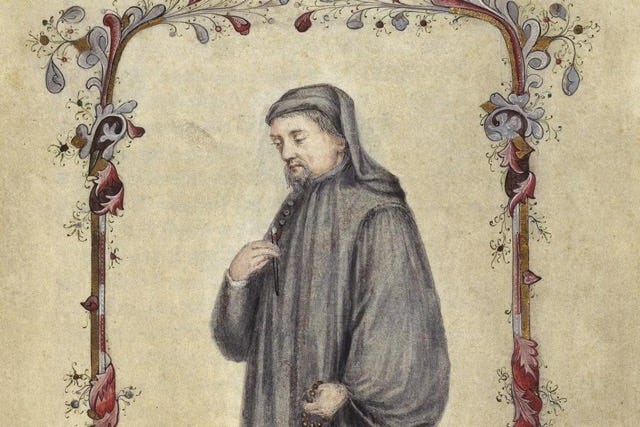
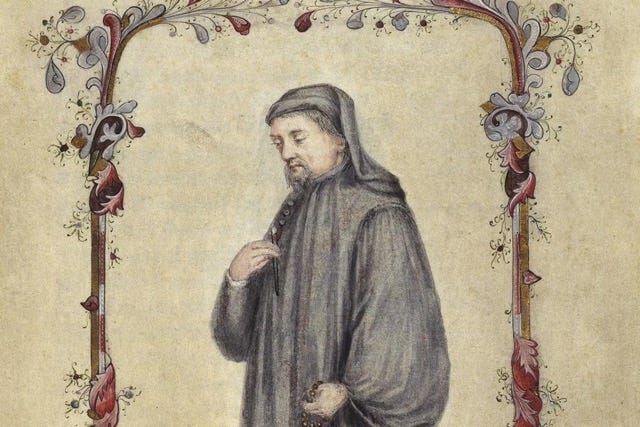
Colored full-figure portrait of Geoffrey Chaucer. Held and digitized by the British Library.
This progression represents an attempt at civilizing raw human desire. We moved from the communal fertility of Lupercalia to the individual sacrifice of St. Valentine, finally landing on Chaucer’s romanticized symbolism of nature. We didn't just start celebrating love — we began using the holiday to structure it.
RQ 2: How did We Celebrate in the Past?
The Commodification of Desire
Before it was an industry, Valentine’s Day was a form of nuptial divination. In 17th- and 18th-century Britain, the holiday was defined by “drawing lots.” Names were placed in a vessel, and the name drawn was considered a “good omen” of a future spouse.
Women, in particular, utilized the day for future fortune seeking (Schmidt, 1993). This included:
Venturing to churchyards at midnight for omens.
Placing hemp seeds or bay leaves under pillows to induce prophetic dreams of a betrothed.
By the 1840s, the United States saw a massive pivot. The valentine became a commercial product—a piece of merchandise. By 1847, producers were selling over three million valentines annually. Esther Howland’s handcrafted Valentine’s allowed the everyday lover to express themselves at a reasonable price (Terrell, 2016).
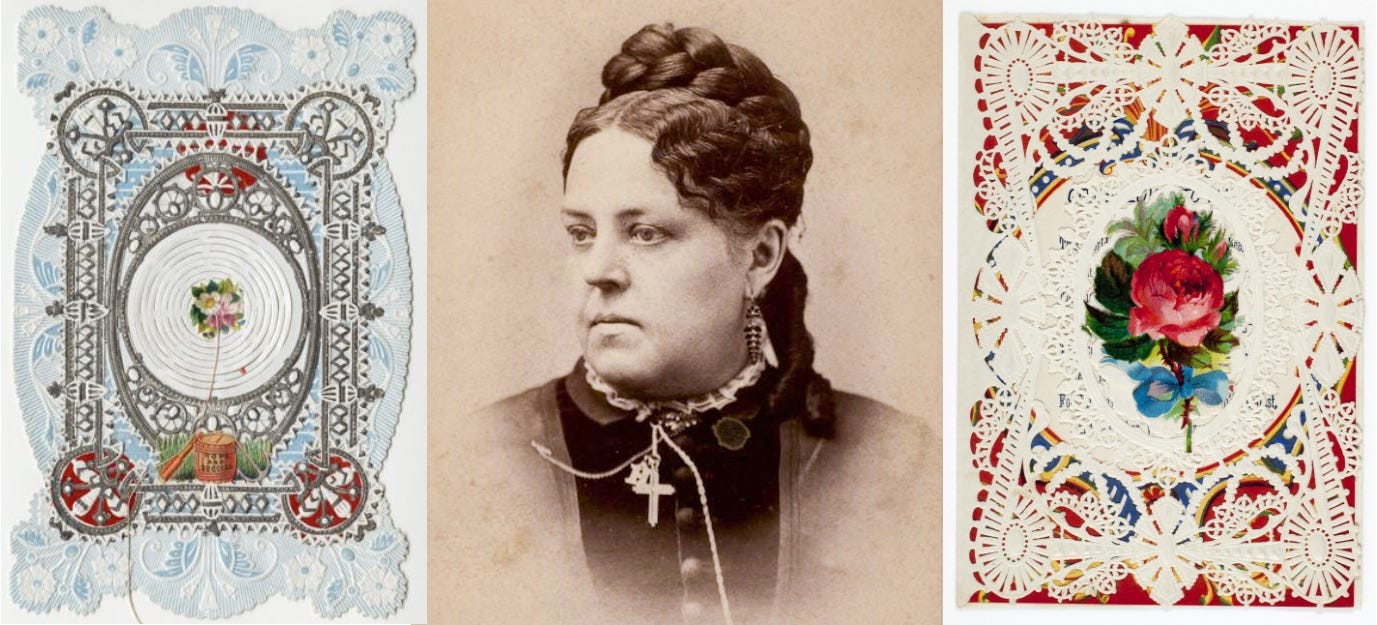
I struggle with open vulnerability, so my favorite perspective of the commercialization of valentine’s day is the shield of anonymity offered through a printed (or, preferably, a handwritten) romantic card. The cards or secret flower deliveries offered the ability to “negotiate awkward social relationships,” (Dyk, 2013). If the feeling wasn’t mutual, the anonymity of a mass-produced card provided a graceful exit for both parties.
RQ 3: How are We Celebrating in Today & Beyond
The Digital Pivot and the Future of Connection
Today, the holiday is a titan of the experience economy. According to the National Retail Federation, spending reached $23.9 billion in 2023, with online shopping (41%) surpassing all other channels. While candy and cards remain staples, jewelry expenditure has surged to $6.2 billion (Konye & Bassey, 2023).
However, the how is changing. Social media and mobile devices have actually lowered the barrier to entry (Konye & Bassey, 2023). We can now distribute valentines (via calls, DMs, or digital gifts) to a wider circle like our friends, parents, and Galentines — using the budget once reserved for a single extravagant gift. Our love can spread further. Of course, this has its own repercussions, but we just have to hope for the ones we love to respect and love us as we deserve.

Where should we go? As we look toward the future, I believe we need to enter a “Post-Commercial” era. It’s our role to create commercial art (marketing materials, etc., because artists have to eat, too) that shifts us away from gendered, rigid marketing toward more intimate, handmade and/or digital sincerity.
Intimacy over Consumption: Encourage individuals to love themselves, their partner(s), friends, and chosen family uniquely. Stay away from assuming one demographic should be one specific way… that is taking the easy way out of creativity. Learn to speak with varying audiences, find their connections outside of the normative stereotypes. It’s time to broaden our horizons on what love means to each of us.
The Return to Sincerity: The next trend is a return to the analog using the digital realm as a bridge back to reality — using our devices to facilitate IRL interactions rather than replacing it with a FaceTime call. Does anyone else remember ooVoo, or am I aging myself? Anyway, start calling for in-person events again. Arcade bars: throw date night competitions. Museums: create “Date Night at the Museum” experiences (like Mad Arts in South Florida and The Met in New York). Where are the speed-dating comedy show experiences? Sign me up. Digital marketing can get the word out, but the real power will be in harnessing human connection.
Conclusion
Valentine’s Day is a mirror of our current state of compassion as a collective. In the Roman era, it reflected a need for fertility and protection; in the Victorian era, it reflected a need for social safety; today, it reflects our struggle to find “real” connection in a saturated digital marketplace. I don’t know that an algorithm is going to find you the love of your life… you might have to do that one for yourself.
We shouldn’t view the holiday as a chore, but as a periodic recalibration of our closest connections. Whether you are drawing lots in a churchyard or sending a “thinking of you” text from your couch, the intent remains the same: the human need to be loved, connected, and accepted.
If you’re like me you’re probably choosing yourself this year. Maybe we’re really alike, and although we’ve been single awhile now, you’re choosing yourself for the first time this year. No matter who you are, you deserve love, handwritten professions of passion (but, pls don’t be as insane as Napoleon), a dance under the moonlight, and a fat smooch on your forehead. Give it to yourself, until you have so much love in there, the abundance spills on to others.
WHERE MY REAL LOVERS AT? LET ME HEAR YOU.
From Your Valentine,
Kalecia
Works Cited
Dyk, N. V. (2013). The reconceptualization of Valentine’s Day in the United States: Valentine’s day as a phenomenon of popular culture. Scholars Commons @ Laurier. http://scholars.wlu.ca/bridges_contemporary_connections/vol1/iss1/4
The Italian Tribune. (2021, February 8). Origin of the month of Love: Deeply rooted in Italy. https://italiantribune.com/origin-of-the-month-of-love-deeply-rooted-in-italy/
Kabir, S. R. (2025, May 19). Juno: The roman queen of the gods and goddesses. History Cooperative. https://historycooperative.org/juno-goddess/
A&E Television Networks. (2026, January 16). Lupercalia: The roman festival’s meaning and rituals. History.com. https://www.history.com/articles/lupercalia
Singh, P. (2024, December 7). The age of chaucer & his works - critical analysis. Literatureandcriticism.com. https://www.literatureandcriticism.com/the-age-of-chaucer/
Terrell, E. (2016, March 23). Esther Howland and The Business of Love: Inside adams. The Library of Congress. https://blogs.loc.gov/inside_adams/2016/03/esther-howland-and-the-business-of-love/
Konye IKEMS, Ph.D, C., & Bassey UDOM, Ph.D, S. (2023). The influence of social media on a valentine day. https://www.globalacademicstar.com/download/article/the-influence-of-social-media-on-a-valentine-day-a-review-of-the-views-of-the-people-on-relationship.pdf
No posts
Comments
Nothing yet. Say the first thing.
Sign in to join the conversation.