
“I should have got home at that time unharmed had not the North wind and the currents been against me as I was doubling Cape Malea, and set me off my course.”
— Homer, The Odyssey, Book IX

This is a story about warriors. Warriors who, like Odysseus, face the challenging journey of returning home from military service. However, this adventure does not take place in the lair of a mythical beast or on the rocky cliffs of sirens. That would be too easy. This story unfolds in a far more distant land: the inner shores of a man’s soul. Only there, is he truly home. Only there, does he cease to drift.
Before every Rites of Passage program, I take time in the evenings to study the intake forms. Every man who’s coming has answered the same questions. What are you hoping to get out of this. Where are you at right now in life. What crossroads are you standing at. I read through them one at a time to get a feel for the group and to figure out how to structure the days ahead. After enough cohorts, a pattern emerged to reveal a common story.
(The men who come through these cohorts aren’t only veterans. I’ve run this work with first responders, athletes, and those who never served. The pattern shows up nearly the same across all of them. For this piece, I only focus on the veteran experience to share their story.)
Different words, yet the same handful of sentences. I just don’t feel like myself again. I need to get my edge back. I’m not being the dad I know I should be. It doesn’t matter whether the man writing it spent four years or twenty-four years in the military. By most accounts, they were successful, intelligent, driven and yet each found himself somewhere he didn’t recognize.
Of the forty-six questions asked in the intake, two of them keep telling me the same thing every single cohort. “I have confidence in my ability to overcome obstacles and learn from them” scores among the highest answers on the entire survey. Conversely, “I have a clear sense of direction in my life” scores among the lowest. It was those two questions that kept me up the longest.
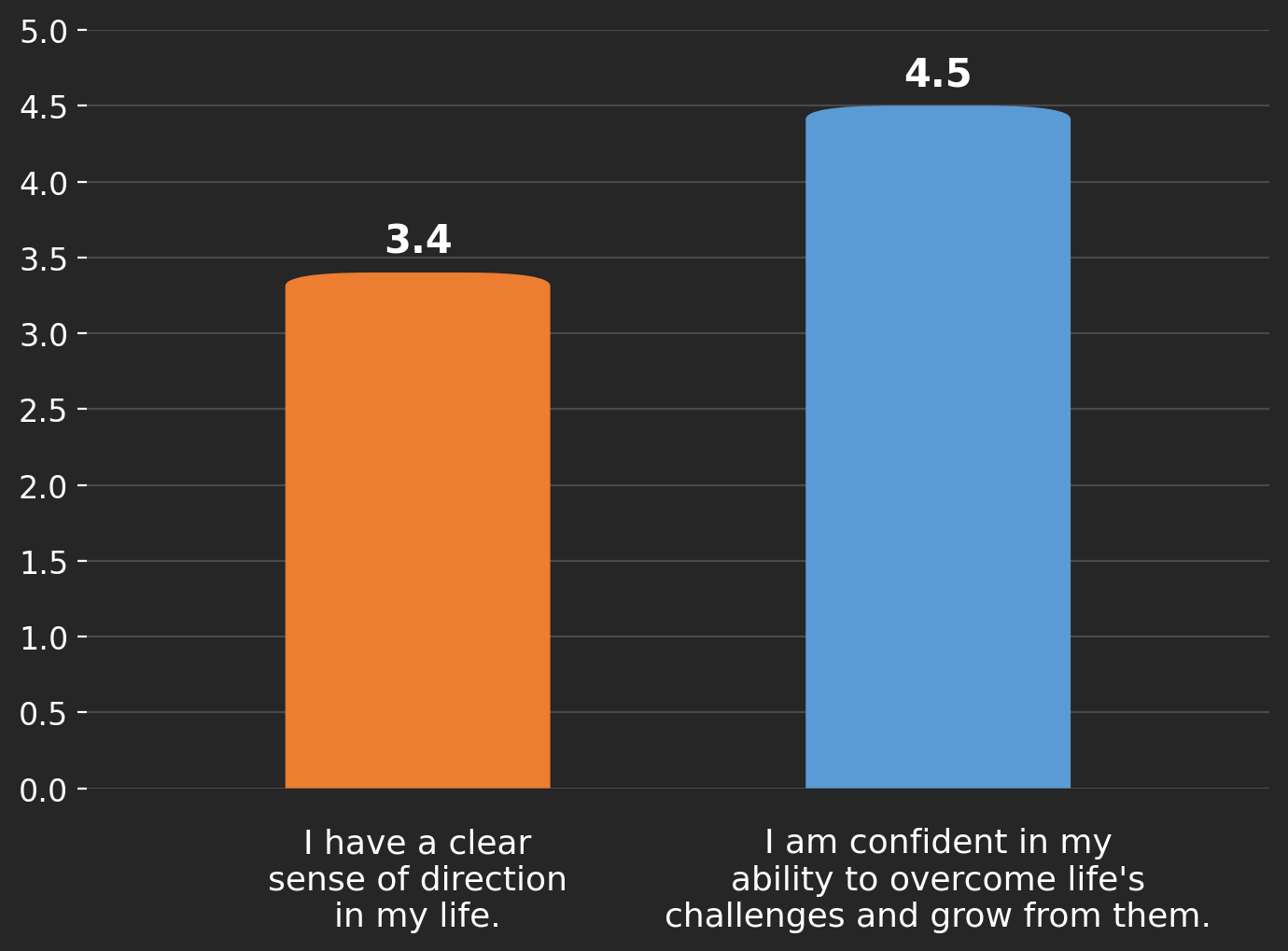
I stared at the screen long enough until I didn’t see the data and the charts and the fancy colors. I saw a mirror. Like the men in these cohorts, I have an unfailing belief in myself. To my core, I believe almost anything is possible. And yet, there are definitely times, more than I’d like to admit, when I ask, “What the heck am I doing with myself?”
I knew, at that moment, that what others were experiencing, I had as well. And it was far more common than I ever expected.
Over the last few years of Rites of Passage cohorts, I kept seeing the same picture. Powerful, confident men, entirely capable, and yet somehow not under their own power. Many carried an internal frustration at their inability to navigate life.
Perhaps owing to my naval history, or perhaps to appease Poseidon himself, I called it Drift.

Men Adrift
Drift is the distance between a man and his true self.
It is the gradual surrender of authorship over one’s life. It happens through the slow, consistent accumulation of living a life separate from the one you’d actually choose if you were present enough, and conscious enough, to choose it on purpose.
A man can be the most capable vessel in the world and still drift. It comes down to whether he’s navigating by his own internal compass or letting the winds and currents make that decision for him. I argue that the currents of today are far more insidious than those Odysseus contended with: grind culture, material distractions, comfort, other people’s expectations, isolation, identity loss.
The dangerous part is that it doesn’t happen overnight. Therefore, a man doesn’t usually catch drift by noticing it directly. He catches it the way you’d notice you’ve passed an exit on the freeway. Typically summed up by, “How did I get here?”
Currents of Drift: Comfort and Achievement
Military service holds one accountable and provides identity, direction, and belonging by default. Today, a lot of men lose that structure when they leave the service. Often, the vacuum left behind is filled by either a pursuit of comfort or material achievement.
Comfort is the more dangerous of the two precisely because it doesn’t hurt. There’s rarely a real pain point forcing a correction. The current of cultural, societal, and technological forces just quietly moves a strong, capable man off course, mostly through distraction and a slow reorientation toward the false promise of fulfillment through external means.
Here’s the part most men don’t expect: the opposite of comfort drift isn’t the answer either. Chasing external validation, the hustle, the grind, the next achievement that’s supposed to finally make you feel like you’ve arrived, is its own version of the same condition. You’re just sweating more on your way off course. Both directions are still someone else’s current instead of your own.
Comfort drift and achievement drift look like opposites, but they do the same thing. They keep your attention pointed outward while the inner fulfillment quietly leaks out from underneath.
When the Institution Disappears

From my own experience, I spent twenty-two years in the SEAL Teams, completely immersed in that world, and when that chapter ended, I felt something I wasn’t prepared for: the harsh reality of not knowing who I was. I’d handed over more of my identity to that institution than I realized, and once the institution stopped supplying it, I had to go find out what was actually mine.
Initially, I suffered but the pain of my suffering ultimately became my salvation. It was the catalyst to search beyond myself for answers. It ultimately led me to serve others, and that provided the direction I needed.
Other men describe it almost the same way, in their own words:
• “Looking for a sense of purpose and meaning outside of the SEAL Teams... A lot of frustration. Trying to fill a trident sized void in my chest.”
• “I wasn’t a SEAL anymore, but I lost sight of being better. I wasn’t as good of a father and husband as I should’ve been.”
The Experience of Drift
Drift shows up first as a lack of presence. A man is sitting at his own kitchen table, physically there, mentally somewhere else entirely, searching, uncertain. He’s not being the father or husband he knows he’s capable of being, and that gap creates a quiet frustration, because some part of him knows this isn’t who he actually is.
• “I was tolerating a subpar existence. Like I was just going through the motions. I was going through the motions of life. Not really living.”
• “I was operating more in survival mode than actually living with intention. There was a constant underlying tension...like I couldn’t fully relax or be present...and I didn’t fully understand why at the time. Even when things looked ‘fine’ from the outside, something internally didn’t feel aligned.”
• “I didn’t have clarity in my priorities and that really impacted how I spent my time. My days felt chaotic and I was treading water. It felt stressful in a low stress environment.”
Awareness
Most men don’t catch drift by noticing it directly. They catch it by noticing a phrase creeping into their own thinking. I used to.
I used to love this. I used to have more fun. I used to be more adventurous.
That phrase is evidence that a man still has an internal reference point for what it felt like to be fully alive, immersed, competitive, and engaged. He’s becoming aware of the distance between his previous, aligned self and where he’s currently standing. He’s remembering something he once had. Within that gap, the drift stops being invisible.
Slowly, he awakens and finds himself at the crossroads of choice. He must decide to continue his drift or journey home.
The Return Home
“The road that stretches before the feet of a man is a challenge to his heart long before it tests the strength of his legs.”
— Walter Farrell and Martin J. Healy

A man cannot return home by trying harder inside the same current that’s carrying him. The first requirement is removal, stepping far enough outside the noise, the roles, the routine, to hear himself think again.
What happens next starts with other men. Genuine, unguarded conversation with people carrying the same weight does something a solitary decision never can. A man learns he isn’t the only one, and in that, he finds a kind of grace he would never extend himself alone.
“I self-isolated and was avoiding contact with the outside world thinking that I was the only person to shoulder my burden.”
“The brotherhood/camaraderie reminded me that I am not alone in my struggles. Being vulnerable around like-minded people, from similar backgrounds without all of the ego/judgement involved was instrumental in helping me come out of my hole of self-isolation.”
Then comes the harder work of cleansing. Setting down what’s been carried in silence, guilt, shame, old failures, the version of himself he’s been performing instead of living. This is rarely comfortable but also the most cathartic.
Alongside it, a direct confrontation with mortality. Writing a eulogy. Standing, in a manner of speaking, at his own grave. Nothing clarifies what actually matters like remembering that none of this is permanent. Men leave that reckoning talking a lot less about achievement and a lot more about the people they’ve been neglecting.
What follows is a reorientation of personal intention. Virtue, grounded in service to other people, gives a man’s actions weight again. It doesn’t have to be dramatic. A running joke in a previous cohort was: Before enlightenment, chop wood, carry water. After enlightenment, chop wood, carry water. The point being that the task doesn’t change, but our relationship with it does. Whether he’s pulling weeds in his own yard or taking his kids camping, applying virtue to what the day actually asks is where the meaning comes from.
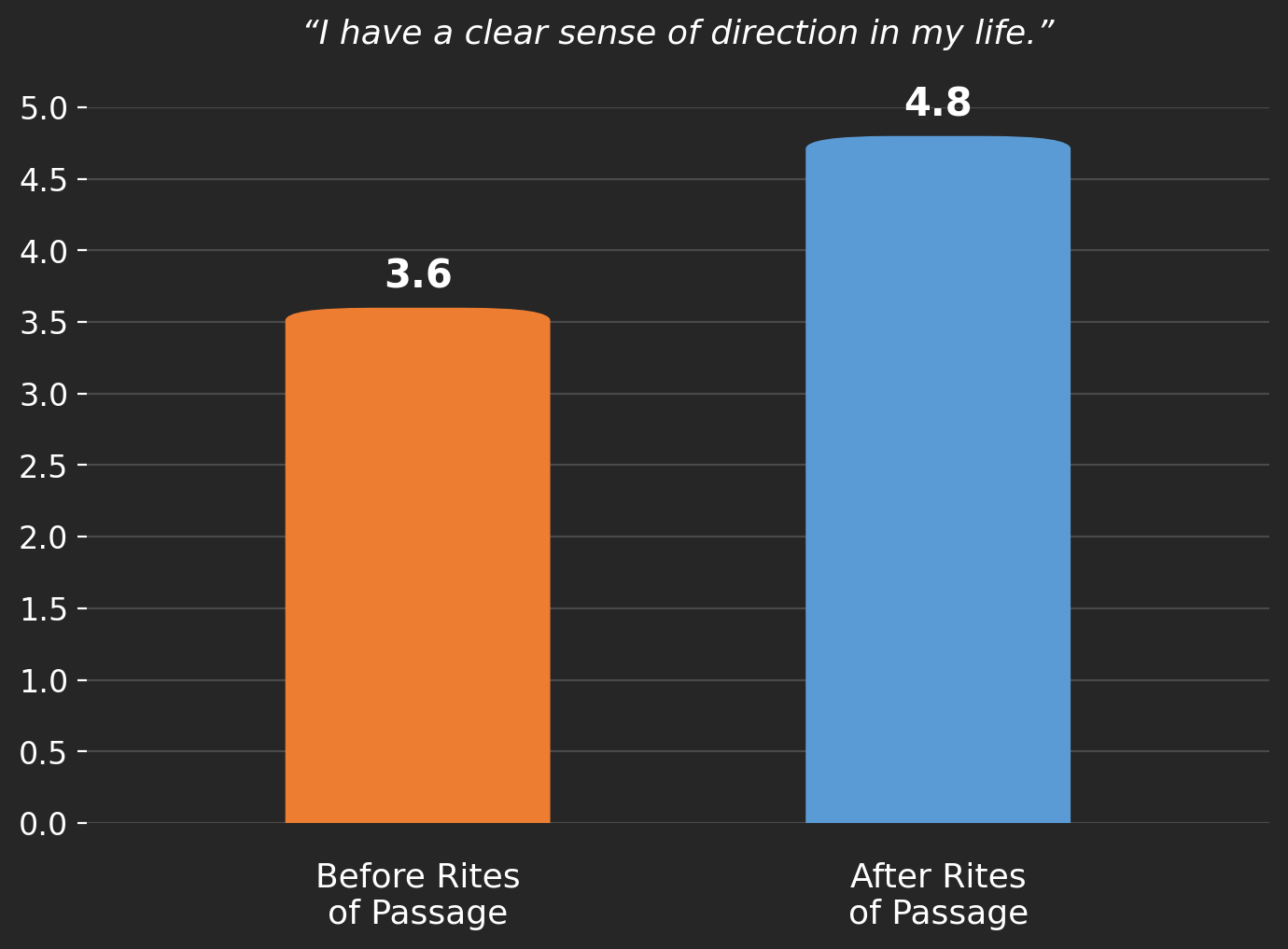
To be clear, drift doesn’t end in a single weekend, a single conversation, or a single moment of clarity. It takes time to get back on track. Like any journey worth endeavoring for, there are starts, stops, ups, and downs. And yet, if we trust in ourselves and our tribe to take step after step, we make progress. Humility and courage give us the grace to continue our journey.
One Life to Steward
You get one opportunity to live. One opportunity to connect with the people around you, to be a spark for your family, your friends, your community. Your life creates ripples whether you’re paying attention to it or not. People are always watching how you engage with your own existence, whether you know it or not. Today, more than ever, you are the example people need.
Of all the truths discovered on this journey, one stands paramount to the rest: the answers a man seeks are within. It is here, not on the currents of the world’s surface, that the voice of the soul speaks.
That’s what brings a man back home.

No posts
Comments
Nothing yet. Say the first thing.
Sign in to join the conversation.