

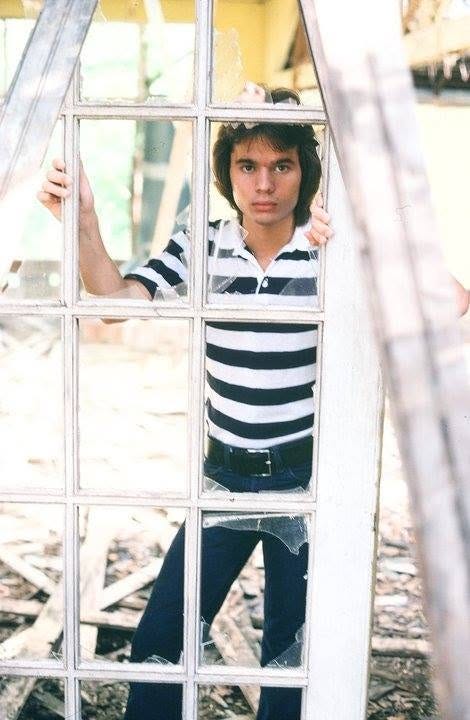
(Above and below: Photos taken of me in 1975 when I was 19 by a friend, Carl Davis, about 30 miles or so outside Jackson, Mississippi, in the burnt-out ruins of the now legendary Alison’s Wells, an arts community and spa that was destroyed by fire in 1963.)
1. *
Fifty-one years ago today on August 19, 1975, I drove through the Holland Tunnel as a nineteen-year-old boy from Mississippi in a rented Ryder truck to attend The Juilliard School’s Drama Division and begin my life in New York City. In many ways, I measure my life by this date even more than I do my birthday for it was on this day that my life really began. My friend Ted Hannah – who later died of AIDS – drove up with me. He already lived in New York back then but had been visiting his mother in our hometown of Forest and was taking some of her antiques back to his apartment in Murray Hill where he kindly let me sleep on his sofa for a few weeks until I found my first apartment on 78th Street and Broadway.
Ted and I didn’t know such a thing as AIDS was on the horizon as we drove out of the tunnel and marveled at the urban one before us, the tall twin towers of the World Trade Center hovering over this place that had always beckoned me because I sensed it was where I would finally feel welcome in a way that Mississippi could never conceive of doing. And yet Mississippi conceived Ted and me – we were southerners to our core – just as such states conceive so many boys like us, ones who are lost and not accepted and set off for New York City to find both ourselves and that acceptance through the discovery of accepting finally who we mostly are. By teaching me to accept most of myself, the city also taught me how to say “Fuck you” and “Fuck off” for the first time and, fearing neither the word as part of such imprecations nor the action it alone denotes as an impartation of identity, truly mean it, feel it, own every bit of it if still not quite all that was myself. New York taught me the importance of difference even within the concept of “we’re all the same.” It taught me, moreover, that such conundrums and contradictions are what make life a bit less dreary. I learned the importance of irony in New York. I learned empathy.
The towers of the World Trade Center are no longer with us. So many Teds are not. I have lost many friends over the intervening years to AIDS and addiction and other illnesses, that steady, rocky toll of life’s wearing itself away, the smoothing of its pebbles. But many of those friends I made in my first few years in New York are still around. I cherish them as a bridge to that time, to that nineteen-year-old boy brave enough to set off that summer of 1975. It is a setting off that still continues more than half a century later. And more than this half a century later, I think of that boy on this day and feel such tenderness for his tenacity because I, now 70, tenaciously hold on to whatever tenderness is left in me there in the part of me I’m still trying to understand and get to know.
I often think of my maternal grandparents, Mom and Pop, on this date each year and how much love it took for them to let me go at such a young age, how brave they too were. I guess they knew they couldn’t stop me. I had been planning to make the move since I was eight years old and my parents had died consecutive deaths which had led my younger brother and sister and me to that little modernist country tan-bricked, flat-roofed house where Mom and Pop Iived and to its gravel drive on which they, crying and waving and clutching each other, stood that day Ted and I backed that Ryder truck out of it to head to New York City, all of us listening to the growl of gravel, those first rough pebbles in my life that needed smoothing. That growl - the sound I came to give to my garbled grief as much as to what it actually was, our driveway’s drift of rocks driven over by the wheels of the latest Plymouth Pop had purchased - was what I heard each time I pulled into that drive during my life lived on that Mississippi country road and there it was again sending me off as I pulled away and toward another kind of life and all the grief yet to come for a gay man in New York City, and all the hope, too. I felt hope for the first time that day I left for New York. It is a hope lately I’ve been trying once more to find.
During my early years in New York, I had two important mentors, Henry Geldzahler and Howard Moss, men much younger than I am now, who would reflect on New York’s past and tell me I should have been there in the 1950s when New York was really New York, grittier, cheaper, artsier, truer to itself. I hear myself now telling young people they should have been in New York back in the 1970s when it was, you know, grittier, cheaper, artsier, truer to itself. What Henry and Howard were telling me back then and what I am telling others now is that they should have been there when we were young. It is our youth we miss as much as any earlier version of the city.
When I awoke here in Tangier this morning on this August 19th, my first thought was of that nineteen-year-old Mississippi boy in that Ryder truck, that earlier version of myself. I wondered what he would make of me now, a “me” who sets off daily to live a life in recovery, a journey that also started in some profound way on that August 19th in 1975 when I drove into New York City, detoured through addiction, and found, through lots of growling, through lots of grace, a road to this daily setting off that has not been as smooth as I had hoped it would be but one that is paved instead with that gravelled grief of my youth. I hope that boy still full of grit would tell me to “Fuck off” when I get sentimental about “him” and “me” – about us – and our recovery together and my use of graveled metaphors for grace and grief. But I also trust he would feel empathy for this sentimental old coot who has earned the right to feel sentimental about these last 51 years.
2.
I have told people that one of the reasons that I set off to live life as a pilgrim mostly outside of America is because I was beginning to feel like that little boy again living in Mississippi during the 1960s and wanting to set off to live a life in New York City when the state was erupting from the Civil Rights movement and the white racists had such agency still to arrest and even murder Civil Rights workers. America with the ascendancy of Trump was beginning to feel like 1960s Mississippi writ large. The conflation of “anti-Woke” rhetoric and the demonisation of DEI by the MAGA crowd and those who not only sympathise with it but attempt to co-opt it by co-opting its ideas in nicer packaging as they are the ones alas being co-opted has reminded me of the racists with agency around whom I grew up and those who went along with them to get along. We had another word for such folks back then: segregationists. I consider the anti-Woke, anti-DEI crowd now nothing but Neo-segregationists. The result of their policies is certainly the same: white power. The retrenchment of it.
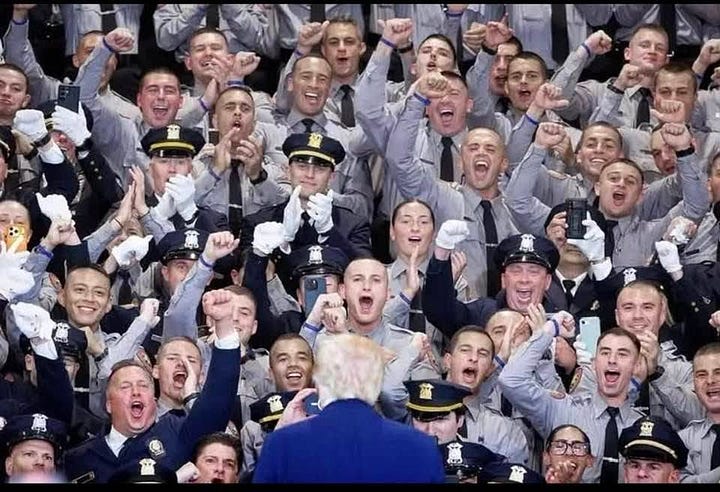
At the rally that Trump held on Long Island this past week he looked back at the rabid almost entirely white, almost entirely male throng of police officers behind him and told them that he had essentially killed DEI and that they looked like they were a crowd that certainly hadn’t liked it and they all looked like they were no fans of it. They screamed “No!” on cue like white supremacists at the political rallies of my youth screamed it about integration over in neighbouring Neshoba County where the three Civil Rights workers Chaney and Goodman and Schwerner were murdered and buried in an earthen dam.
To prove my bona fides about knowing racists when I see racists, I had a great uncle who lived over in Neshoba or Lauderdale County who bragged he knew where the bodies of those Civil Rights workers were and it was debated between his bother, my grandfather who raised me, and his sister who lived down that country road from us, quietly in our kitchen one night whether they should report such knowledge to the police. They decided not to do it and a few days later the bodies were found exactly where my uncle said they were. He ended up shooting himself some time later while lying in his bathtub. He wasn’t buried in an earthen dam.
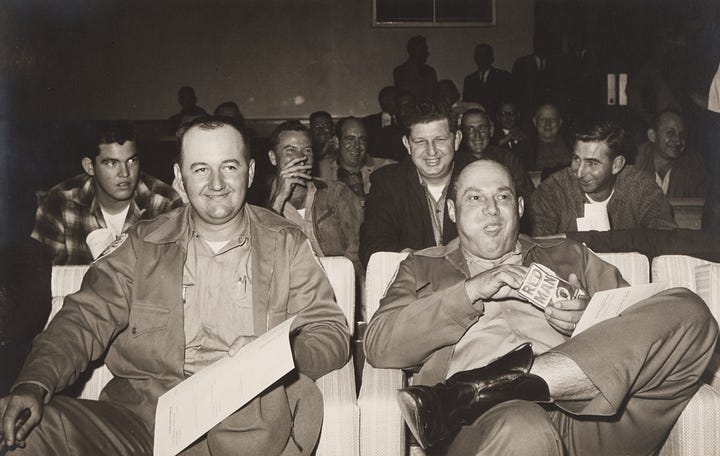
The second photo up there was taken by Bill Reed. It is of Neshoba County Deputy Sheriff Cecil Price and Sheriff Lawrence Rainey during their arraignment in Mississippi as two of the 21 men implicated in the murder of Chaney, Goodman, and Schwerner. Neither was charged with the murder. Rainey, there with the chewing tobacco, never served a day in prison. Price, who was a member of the KKK and who turned the three young men over to the Klan to be murdered after having arrested them, only served 4 1/2 years of a six-year sentence for violating their Civil Rights. There is no doubt in my mind that Price and Rainey, if they had lived long enough, would be two of Trump’s biggest MAGA supporters because their political descendants are. A lot for them are there in that first photograph and residing uniformly on Long Island.
My whole life has been lived as a kind of political amends for growing up in such a racist place. It too has been a pilgrimage.
3.

Some of us have been thinking a lot about Homer’s The Odyssey and Odysseus this summer along with the I Am Christopher Nolan IMAX version. The usual, yes, chorus - more Groyper than Greek - has complained about the film being too woke in its casting - i.e. not uniformly white enough - but in their predictable and tiresome bigotries they missed a larger aesthetic and even philosophical point I sensed in what Nolan was up to in his purposefully miscasting every role so that a kind of narrative friction caught traction regarding the ancient text that told us the timeless tale that is itself all about “post-ness,” to use the Greek scholar Daniel Mendelsohn’s term for the story’s essence. He has stated that maybe the story is “not just postwar, but maybe post-ideological. It’s about a world in which all the old certainties have crumbled.” That “post-ness” of The Odyssey is, he says, “not just that the Trojan war is over, but that everything everyone counted on during the war, including the model of heroism that made the war possible, is now over.”
Daniel in an interview with New York Review of Books: “It’s obviously a postwar poem, but it’s also a sort of post-everything poem.
“The old order has disappeared. The gods have receded. They’re almost not present at all, except in a couple of crucial moments, and certainly not in the way they’re present in the Iliad, where they’re all over the action and fighting in the battles. You feel the gods have withdrawn.
“Odysseus is a lone guy in a strange world with no familiar landmarks. The whole poem is haunted by a feeling that the old world order has come to an end, and now we’re just on our own, making our way as best we can. That may be what’s speaking to people.
“One of the things the Odyssey is about is time, and how people change over time. I mean, that’s the whole problem, right? When he gets home to Ithaca, he has to somehow prove he’s the same guy who left. The whole plot hangs on that question. And yet, how could you be the same person after twenty years?”
And after fifty-one of them. So much of living life at this stage of it is all about how one navigates a post-ness, especially if one is also living it as only a navigation, a pilgrimage. I mentioned that I mostly accepted myself once I arrived in New York on this date in 1975. It is now only in the post-ness of both my youth and middle-age as I enter this older Odysseus-like phase that I have become grateful for that part of me that is unknowable.
What I am now looking for is all that is not me.
And yet it is not so much a selflessness I seek but the wholeness of the One Self that cannot be summoned or sought or seen.
I travel within it, my stops way stations within that within.
It exists.
This pilgrimage is my being a part of its existence, not mine.
“I am Nobody,” said Odysseus.
4.
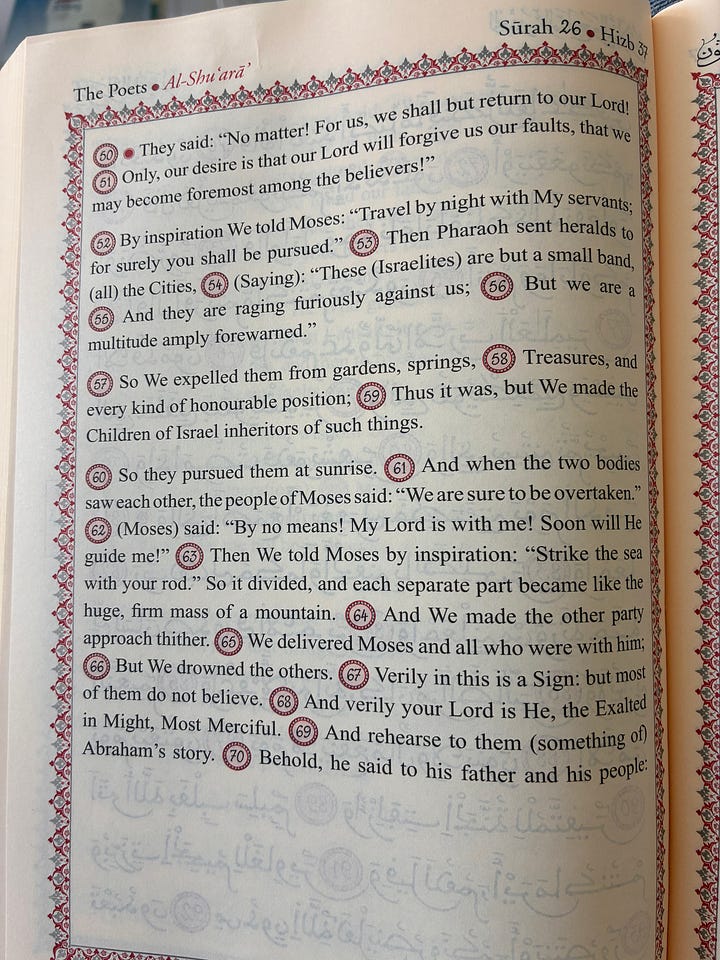
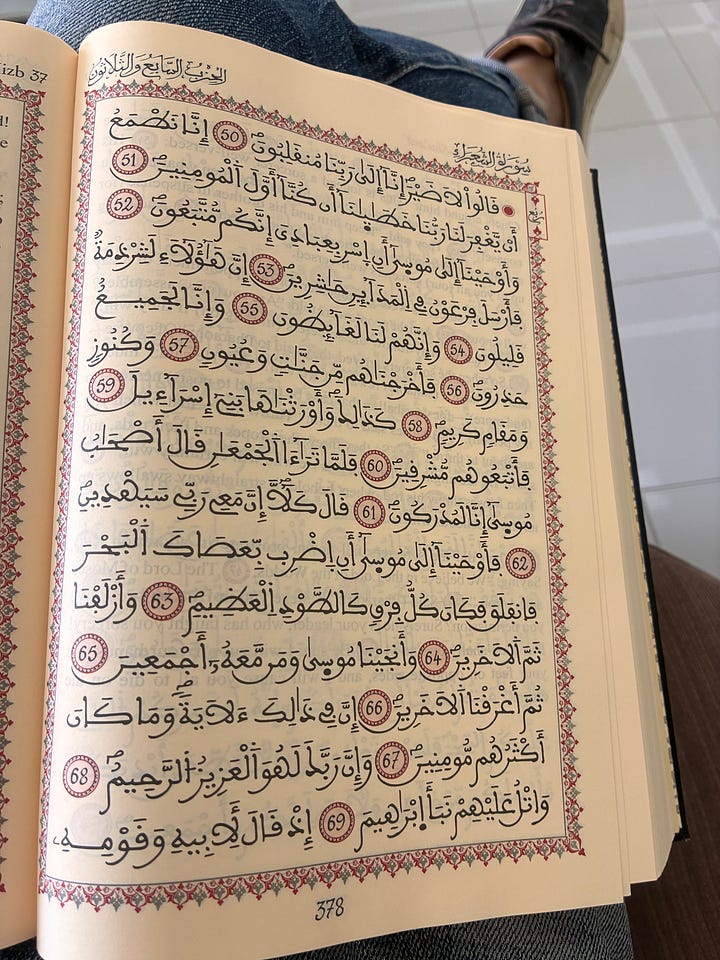
I read the Koran for the first time on Tuesday in my dentist’s office. I have been having lots of dental work done - six root canals, four crowns, a bridge put in, some rebonding. So I have been spending lots of time in her office but I had never seen copies of the Koran there before. She had an English and a French translation on a coffee table in the waiting room this week upon my arrival. I opened the one above to a random page and saw that it was the narrative about Moses. I had no idea it was contained in the Koran.
I mentioned it to her when I sat down in the chair. Before she began my sixth root canal we talked about the Sufi interpretation of that story. She told me she prefers the mystical meaning it offers rather than the literal one. According to her, in Sufism the Pharaoh represents the ego and Moses one’s spiritual heart, a more divine truth, an inner guide.
As I waited for the Novocain and swelling to go down when I got back to my apartment in the Kasbah, I read up a bit more on Sufism. It seems instead of the One Self, it contains Seven of them.
And then there are the many visitors cited by the Sufi poet Mewlana Jalaluddin Rumi, their odysseys, their setting off daily, coming to us.
The Guest House
This being human is a guest house.
Every morning a new arrival.
A joy, a depression, a meanness,
some momentary awareness comes
As an unexpected visitor.
Welcome and entertain them all!
Even if they're a crowd of sorrows,
who violently sweep your house
empty of its furniture,
still treat each guest honorably.
He may be clearing you out
for some new delight.
The dark thought, the shame, the malice,
meet them at the door laughing,
and invite them in.
Be grateful for whoever comes,
because each has been sent
as a guide from beyond.
5.
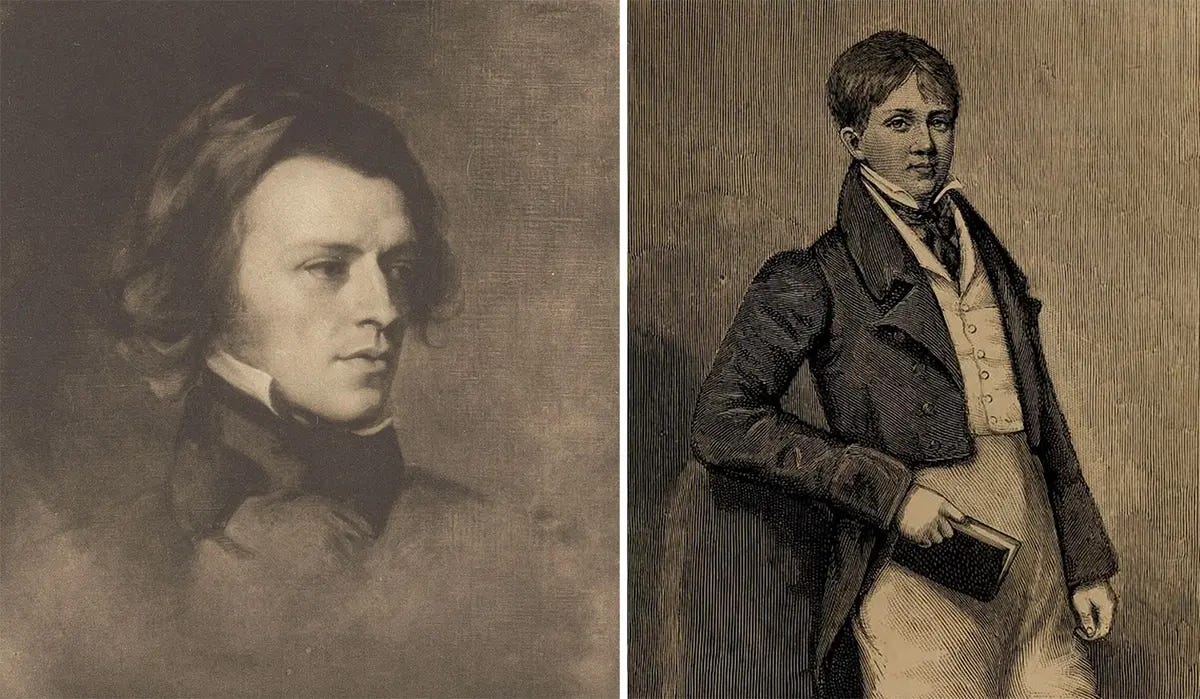
(Above: Alfred Lord Tennyson and Arthur Henry Hallam.)
When I saw Nolan’s take on The Odyssey earlier this summer at Cinema Rif here in Tangier, I remembered one of the most romantic mornings of my life in New York City and thought of another poem, Alfred Lord Tennyson’s “Ulysses.” I once met a longhaired, dashingly handsome, deeply poetic soul at the Spike, a gay bar over by the Westside Highway back-in-the-day around 20th Street. I invited him to my loft where we had amazing sex. The next morning I awoke to find him sitting by me naked on my bed and looking through Volume 2 of the Norton Anthology of English Literature I had left on the nightstand. It was from my college days. In those years before streaming and computers came into our lives, I would still dip into it as I was falling off to sleep.
“This is my favourite poem,” he said looking down at the Tennyson and then began to read “Ulysses” but put the book down only a few lines in and recited the rest of the poem from memory. By the time he got to the words “and not to yield,” I had fallen in love with him. But I wasn’t evolved enough to understand how to feel such love. I’m still not, or I don’t think I am. I’m working daily still however on understanding how surrendering is a way not to yield, the only way forward.
Tennyson wrote the poem when he was 24 and deep in grief after the sudden death of his close friend and Cambridge classmate, the poet Arthur Henry Hallam, at the age of 22. Hallam was known as the jeune homme fatal - "deadly seductive young man" - of his generation. Perhaps this poem was a way for Tennyson to try to understand the love he felt for Hallam and the growl of grief that overwhelmed him because of it.
Below the poem, is a recording of my reciting an edited version of it. I skipped a word here or there, transposed a couple, but I refused to stop and carried on because I wanted to do it in one take and for the special man who sat naked on my bed and recited to it to an unready me so long ago. He later wrote me a letter telling me he had only honourable intentions toward me and quoted Jane Austen in doing so. He is, yes, the one who got away, he and his honourable intent.
ULYSSES
by Alfred Lord Tennyson
It little profits that an idle king,
By this still hearth, among these barren crags,
Match’d with an aged wife, I mete and dole
Unequal laws unto a savage race,
That hoard, and sleep, and feed, and know not me.
I cannot rest from travel: I will drink
Life to the lees: All times I have enjoy’d
Greatly, have suffer’d greatly, both with those
That loved me, and alone, on shore, and when
Thro’ scudding drifts the rainy Hyades
Vext the dim sea: I am become a name;
For always roaming with a hungry heart
Much have I seen and known; cities of men
And manners, climates, councils, governments,
Myself not least, but honour’d of them all;
And drunk delight of battle with my peers,
Far on the ringing plains of windy Troy.
I am a part of all that I have met;
Yet all experience is an arch wherethro’
Gleams that untravell’d world whose margin fades
For ever and forever when I move.
How dull it is to pause, to make an end,
To rust unburnish’d, not to shine in use!
As tho’ to breathe were life! Life piled on life
Were all too little, and of one to me
Little remains: but every hour is saved
From that eternal silence, something more,
A bringer of new things; and vile it were
For some three suns to store and hoard myself,
And this gray spirit yearning in desire
To follow knowledge like a sinking star,
Beyond the utmost bound of human thought.
#
This is my son, mine own Telemachus,
To whom I leave the sceptre and the isle,—
Well-loved of me, discerning to fulfil
This labour, by slow prudence to make mild
A rugged people, and thro’ soft degrees
Subdue them to the useful and the good.
Most blameless is he, centred in the sphere
Of common duties, decent not to fail
In offices of tenderness, and pay
Meet adoration to my household gods,
When I am gone. He works his work, I mine.
#
There lies the port; the vessel puffs her sail:
There gloom the dark, broad seas. My mariners,
Souls that have toil’d, and wrought, and thought with me—
That ever with a frolic welcome took
The thunder and the sunshine, and opposed
Free hearts, free foreheads—you and I are old;
Old age hath yet his honour and his toil;
Death closes all: but something ere the end,
Some work of noble note, may yet be done,
Not unbecoming men that strove with Gods.
The lights begin to twinkle from the rocks:
The long day wanes: the slow moon climbs: the deep
Moans round with many voices. Come, my friends,
‘T is not too late to seek a newer world.
Push off, and sitting well in order smite
The sounding furrows; for my purpose holds
To sail beyond the sunset, and the baths
Of all the western stars, until I die.
It may be that the gulfs will wash us down:
It may be we shall touch the Happy Isles,
And see the great Achilles, whom we knew.
Tho’ much is taken, much abides; and tho’
We are not now that strength which in old days
Moved earth and heaven, that which we are, we are;
One equal temper of heroic hearts,
Made weak by time and fate, but strong in will
To strive, to seek, to find, and not to yield.
0:00
-4:29
Everything connects.
Onward …
*Each year on this date, I post a version of this first section
No posts
Comments
Nothing yet. Say the first thing.
Sign in to join the conversation.