
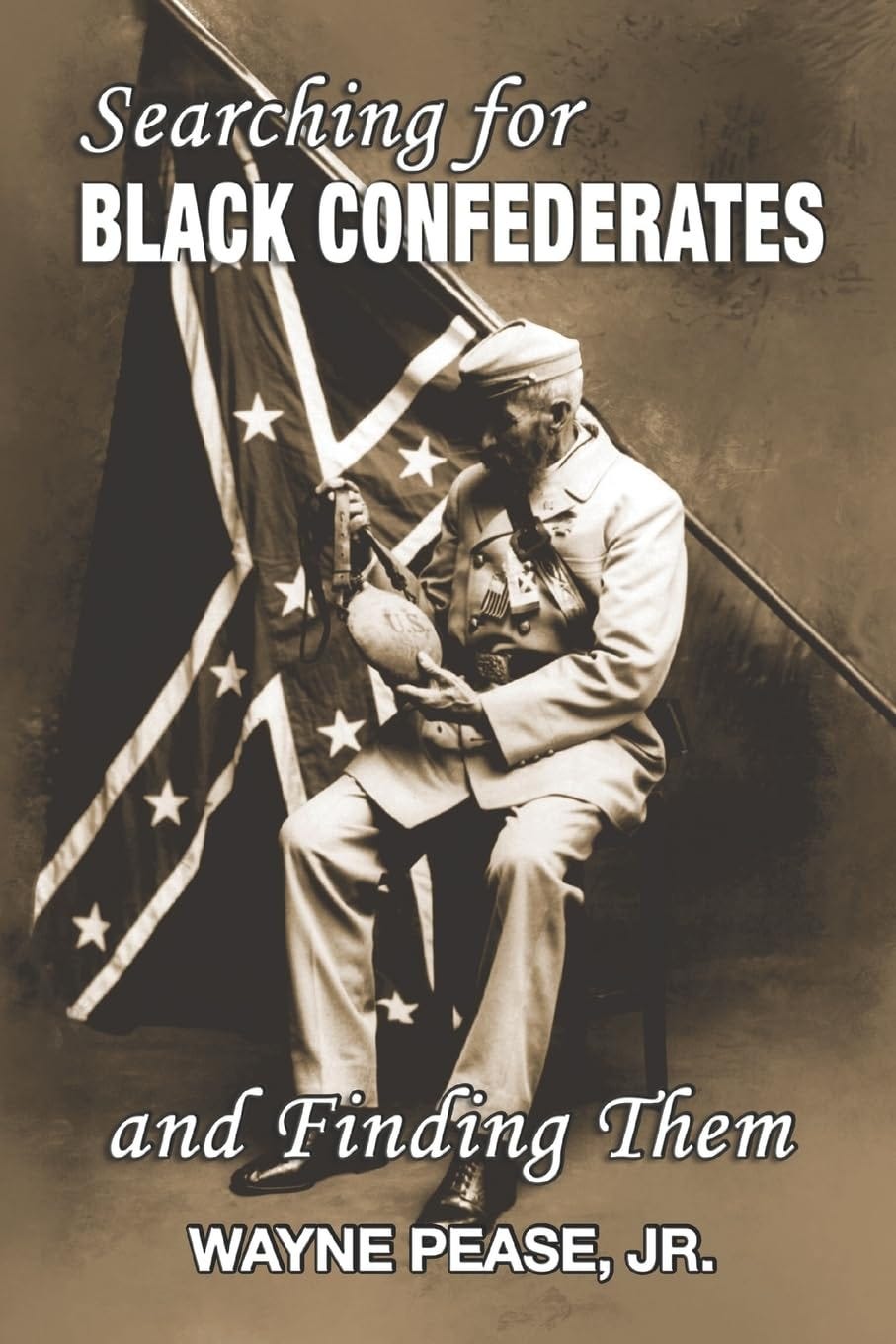
My curiosity got the best of me, so I went ahead and purchased a copy of Wayne Pease, Jr’s book Searching for Black Confederates and Finding Them. I mean, how many writers are recipients of a book-length rebuttal of one of their own books? By the way, did you notice that Mr. Pease uses the same font for his cover as you will find on my own?
I wasn’t that optimistic about what the book would offer after having already read and shared an online preview. Having done so, I am downright disappointed by the overall sloppiness of the narrative. Clearly, the book was never proofread. At times, I am referred to as “Levin” and at other times “Levine.” But the much larger problem is the lack of any overall interpretation of this subject.
In fact, from beginning to end, Pease does little more than list various sources without any attempt at interpretation. Chapter 2 for example focuses on “Black Confederate Sharpshooters.” It includes ten pages of accounts, all published in Northern newspapers or pulled from Union soldiers at various stages of the war. No attempt is made at contextualizing these sources An account from 1863 sits next to one from 1861 and 1864. The sources themselves go unquestioned.
Even more problematic is his inability to follow up on anything he finds. It’s as if the reader is supposed to read these primary sources and nod in agreement even if it is unclear as to exactly what they prove. Corroboration be damned. Finally, Pease makes no attempt to examine what Confederates said about these men. Surely, there must be something among Confederate wartime accounts that sheds light on these men.
Let me be clear, at no time in my book do I deny that African Americans may have, on occasion, picked up a rifle and fired it at Union soldiers. In fact, I include an entire chapter about such accounts and just about all of them are from Confederates, who, as I argue, were clearly ambivalent about the sight of armed Black men.
What occurred to me as I was reading through this book is how uninterested Pease is in the history of the Confederacy. Not only does Pease fail to reference a single wartime Confederate source in this particular chapter, he also completely ignores Confederate policy surrounding the place of enslaved and free Black men in the Confederate army. These government and military sources are easily accessible.
The next chapter, which explores accounts of Black men in Confederate ranks from the Official Records, follows the same approach. All Union accounts. Pease makes no attempt to follow up with any additional sources to confirm or contextualize specific accounts.
Let me offer one.
There were few people who had a better grasp of what was happening in the Confederate army on the racial front than John B. Jones. Jones, who worked in the Confederate War Department throughout the war, wrote and read reams of correspondence every day, met with the secretary of war nearly every day, and frequently spoke with Jefferson Davis. In his diary entry for March 20, 1863, Jones denied reports in Northern newspapers that the Confederacy had recruited black soldiers: “This is utterly untrue. We have no armed slaves to fight for us, nor do we fear a servile insurrection.”
Jones had already commented on the Emancipation Proclamation and the Union’s own recently approved policy to allow blacks to serve, both of which he understood as dastardly attempts to stimulate a Southern slave uprising. According to Jones, these reports were nothing more than lies. The United States may have stooped to such nefarious tactics, but the Confederacy had not. Jones closed his diary entry for the day by questioning the “value the negro regiments employed against us will be to the invader.”
What are we to make of Jones’s not only denial of the presence of Black soldiers, but his disgust at even the suggestion that the Confederacy had recruited such men? Pease not only ignores this account, he is entirely incapable of acknowledging it in any form.
The first two chapters of my book attempt to answer the question of how the Confederate military utilized enslaved labor, arguably the most important resource for a slave-holding nation at war. Confederate policy underwent significant shifts throughout the course of the war, most notably during the final year when it debated—along with much of the rest of the nation—whether to recruit Black men as soldiers.
Once again, Pease has nothing to say about this very public and decisive moment in the history of the Confederacy. He cannot answer the question of why not a single Confederate civilian, soldier, or politician made the case that African Americans were already serving as soldiers or engaged in actively fighting side-by-side with their white comrades. No one mentioned any so-called sharpshooters.
Along the way, Pease dredges up the same tired accounts that have been floating around the Internet now for decades. There is Frederick Douglass’s second-hand account of uniformed Black men published in his newspaper in 1861 and Lewis Steiner’s observation of African Americans in the Army of Northern Virginia during the Antietam Campaign. Pease also surveys a handful of historians and writers, going back to the beginning of the twentieth century, who have commented on some aspect of this subject. He treats them as carefully as he does the rest of the evidence presented in this book.
Not surprisingly, he completely brushes to the side the many published op-eds from the military and civilian population that expressed decades of long-standing fear of slave rebellions and the consequences of what would happen if the Confederacy armed Black men as soldiers.
No mention of Confederate general Patrick Cleburne’s proposal to arm slaves in 1864. No mention of Howell Cobb’s public statement at the height of the Confederate debate over Black enlistment in January 1865:
It is to me a source of deep mortification and regret to see the name of that good and great man and soldier, General R. E. Lee, given as authority for such a policy. My first hour of despondency will be the one in which that policy shall be adopted. You cannot make soldiers of slaves, nor slaves of soldiers. The moment you resort to negro soldiers your white soldiers will be lost to you; and one secret of the favor with which the proposition is received in portions of the Army is the hope that when negroes go into the Army they will be permitted to retire. It is simply a proposition to fight the balance of the war with negro troops. You can’t keep white and black troops together, and you can’t trust negroes by themselves. It is difficult to get negroes enough for the purpose indicated in the President‘s message, much less enough for an Army. Use all the negroes you can get, for all the purposes for which you need them, but don’t arm them. The day you make soldiers of them is the beginning of the end of the revolution. If slaves will make good soldiers our whole theory of slavery is wrong but they won’t make soldiers. As a class they are wanting in every qualification of a soldier. Better by far to yield to the demands of England and France and abolish slavery, and thereby purchase their aid, than to resort to this policy, which leads as certainly to ruin and subjugation as it is adopted; you want more soldiers, and hence the proposition to take negroes into the Army. Before resorting to it, at least try every reasonable mode of getting white soldiers. I do not entertain a doubt that you can by the volunteering policy get more men into the service than you can arm. I have more fears about arms than about men. For heavens sake try it before you fill with gloom and despondency the hearts of many of our truest and most devoted men by resorting to the suicidal policy of arming our slaves.
Fellow historian Andy Hall once pointed out that the very soldiers described in Lewis Steiner’s report (referenced above) were under Cobb’s command. Did he somehow forget about the very men supposedly under his command between September 1862 and January 1865?
The almost complete absence of Confederate wartime accounts speaks to Pease’s inability or unwillingness to acknowledge what most reasonable students of history understand: The Confederacy was fighting to preserve the institution of slavery. The armies functioned as extensions of this goal and its policies.
I recently pointed out that there is more to be written about this subject and much still to learn. Unfortunately, this book doesn’t get us anywhere. It’s more of the same slop that has come to define the small community of vanity presses that cater to people who don’t have a serious interest in the history of the Confederacy or the history of slavery.
This is the problem with a book that begins with its conclusion. Pease didn’t need to explain what these accounts prove because he never doubted what they proved or understood that primary sources must be interpreted and contextualized. He didn’t need Confederate sources because Confederate sources only complicate the story he began with.
What he produced isn’t a history of Black Confederates. What he produced is a case- study of what happens when a writer goes looking for confirmation and calls it research.
Comments
Nothing yet. Say the first thing.
Sign in to join the conversation.