
More than a birthday
Today is my birthday.
But I didn’t know growing up that it was also (and more importantly) Juneteenth. Because the story of Juneteenth was buried where I was raised, just like the generations of silenced voices.
Now, I’m the proud father of two Black daughters.
They were born into injustice. But they fuel my fight against it, and my belief that storytelling can break its grip.
— Kevin
💪🏽💛
Three insights

I studied 100+ funder websites.
Here’s what most fundraising gets wrong:
They’re not funding your organization.
Nor your impact measurement.
Nor your talented team.
Not at the early stage.
They’re funding you.
The leader(s).
Because when you’re a small nonprofit, there’s rarely enough scale, systems, or long-term data for donors to de-risk the bet.
That’s why most early-stage foundations explicitly say it: they back founders first and models second. Just scroll through this PDF for what many prominent funders say, in their own words.
Then why are you still hiding?
Hiding behind the work?
Hiding behind your fundraising staff?
Hiding behind the organizational brand?
Of course your organizational brand still matters. But in the early days, the leader is the front door (and sometimes ONLY door) to the brand.
“In a sector where many organizations may share similar missions, a founder’s story becomes a differentiator,” says Haley Burns.
Look, I understand the hesitation. ⤵
Visibility feels vulnerable. Especially in our sector, where you’re taught to center the mission and suppress the ego. And look, once you break a certain threshold, your organization and impact measurement and team certainly matter more for funding.
But before then, trust is still highly personal.
I sit on the advisory board for a couple of funders and have always agreed with investor Georges Doriot:
“I’ll take a Grade A individual with a B idea over a Grade B individual with an A idea.”
Then I saw this principle firsthand. When Acumen selected me as a Fellow, they barely asked about my organization. They were betting on me. And that experience changed how I think about fundraising forever.
So here’s what’s non-negotiable:
Your founder story. Your voice. Your visibility. Your own brand — as a human being. Panels. LinkedIn posts. Podcasts. Essays. Interviews. Keynotes. Thought leadership is no longer optional for nonprofit CEOs.
Funders are already Googling you.
The question is: what are they finding?
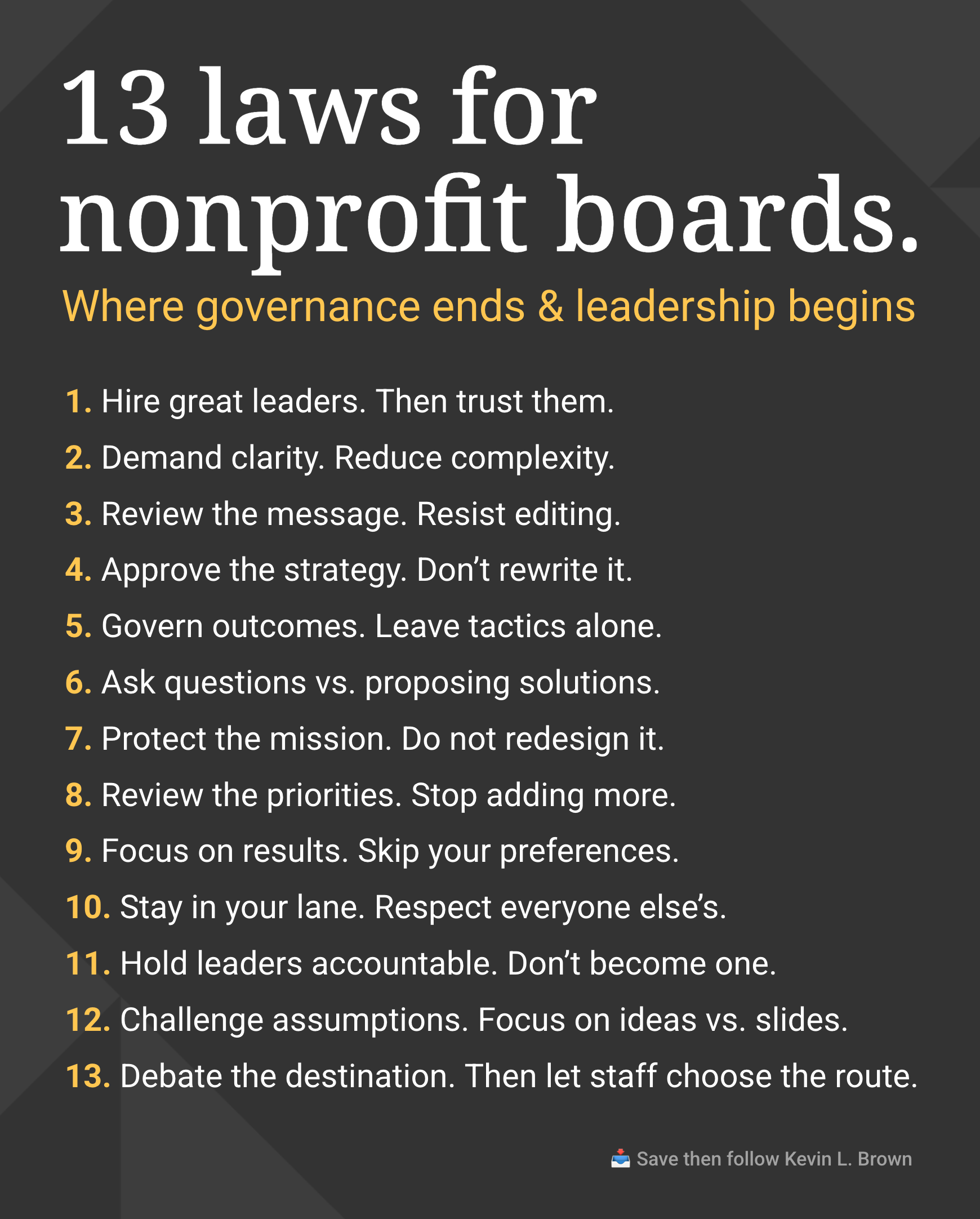
Your board wants to help.
That’s where trouble begins.
I’ve seen it myself as a CEO, spending years presenting to boards and trustees, then luckily not having trouble with our own nonprofit directors. Now I’m about to join a new board of supervisors myself.
So I spent some time refreshing my reading on governance. And what struck me is how often boards drift toward doing leadership’s job.
The board hires the CEO.
The CEO hires the team.
The team does the work.
Simple on paper.
Messy in real life.
Especially when passionate, experienced people gather around a table and care deeply about the mission.
So I put together 13 laws for your nonprofit board.
Because boards shape organizations.
Sometimes a little too much.
Which law would you add?
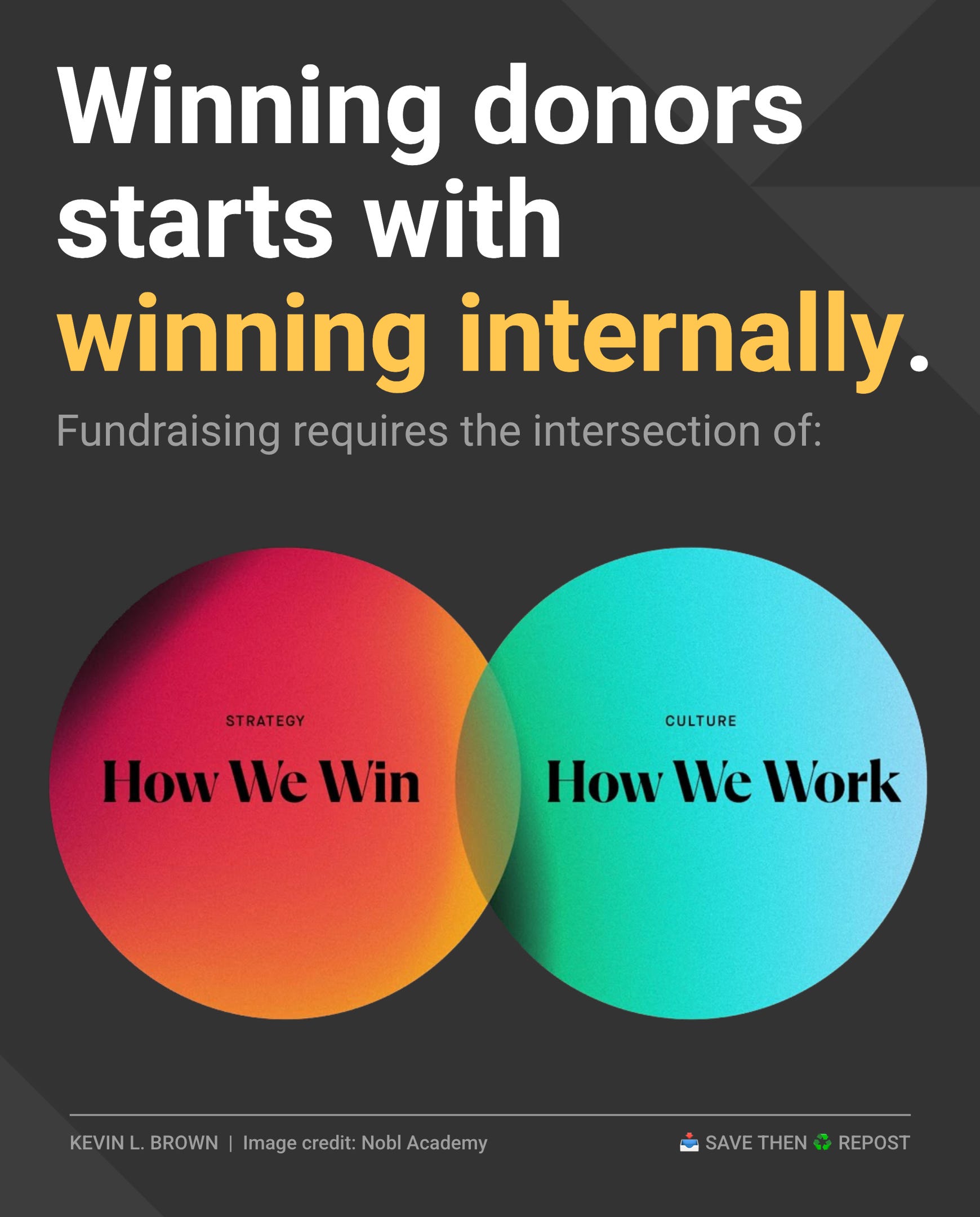
Your fundraising dreams won’t make a difference.
Nor will your fancy new strategy.
Not without establishing internal routines to get it done. Because raising a lot of money requires two things:
➕
But here comes the problem.
70% of employees don’t grasp their company’s vision. And a Big Bang Philanthropy donor once told us the most common reason they don’t invest is that they don’t believe the nonprofit can deliver on (how we win) its strategy.
In other words, the how we work is missing.
So here’s how to align your aims with action. ⤵
Decide on an internal communications rhythm
Document 2–3 most important processes
Get the right team in the right seats
Determine 3–5 quarterly priorities
Set quarterly and weekly KPIs
Establish 3–5 annual goals
Sketch a 3-year picture
Name core values
The bottom line:
Most nonprofits have a vision.
Fewer have the culture to achieve it.
P.S. This newsletter grows when you share it. It’s quick and free for you, but super helpful for me. Because this content is part of our own nonprofit mission. Thank you.
From the book
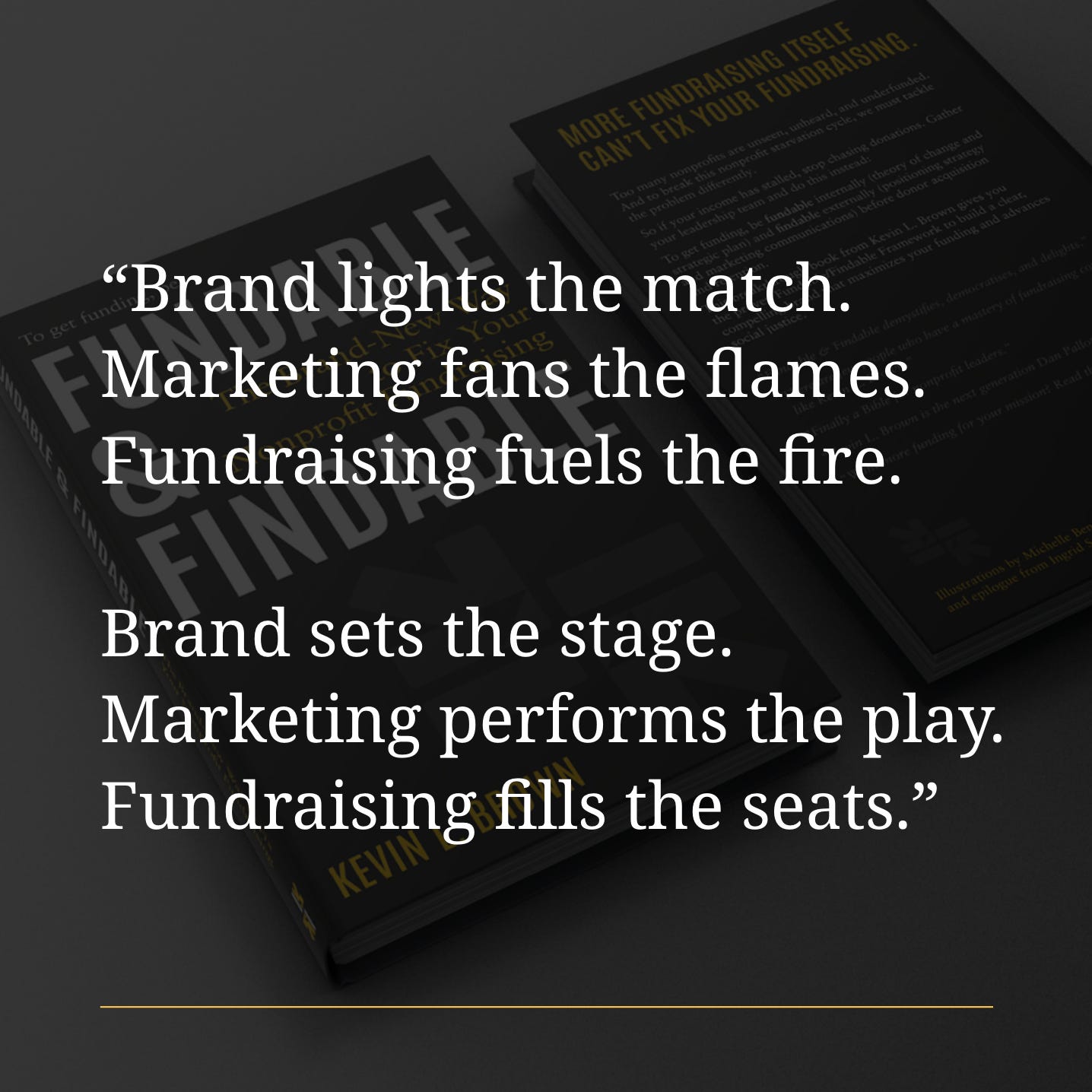
A line worth sitting with, from my four-time bestseller Fundable & Findable: The Brand-New Way to Fix Your Nonprofit Fundraising.
The weekly bonus

What can nonprofits learn from the worst consumer rebrand in history?
For one thing, brands drive income.
In 2008, Tropicana spent months of time and $35 million in fees on its disastrous rebrand. Only to lose $20 million in sales in the first month alone. After 30 days, they fired the agency and reverted to their original design.
Another lesson?
In a rebrand, don’t throw away “visual equities” — valuable design elements that audiences know (and love) about you. Even if it’s just a single color or symbol that bridges the old and new.
In this case, the red and white straw...
P.S.
Like in meditation and fireworks, you need a beginner’s mind for fundraising too.
Comments
Nothing yet. Say the first thing.
Sign in to join the conversation.