
0% is a statistic I think about more than I’d like to admit. That’s exactly how much of my own money I’ve kept over sixteen-plus years of self-publishing comics. Not lost — kept. I don’t say that looking for sympathy. I say it because I don’t think my experience is unusual, and that’s the actual problem.
If you love truly independent comics — if you back Kickstarters, if you’ve got long boxes full of creator-owned work, if you’ve ever fallen for a weird, personal, un-focus-grouped story that no major publisher would have touched — this piece is for you. I’m not writing this to complain about anyone I’ve worked with, and I’m not writing it to talk anyone out of self-publishing. I’m writing it because I think the way we currently fund self-published comics is quietly — but obviously — unsustainable, and I think a lot of genuinely talented writers have already been pushed out of the medium by it — not because they ran out of stories, but because they ran out of runway.
I want to walk through what that funding model actually looks like, why it’s gotten harder rather than easier in the past few years, and where I think there may be room for it to change. Because the alternative — losing more good writers to burnout and debt before we ever get their best work — is a loss for all of us who love this medium.
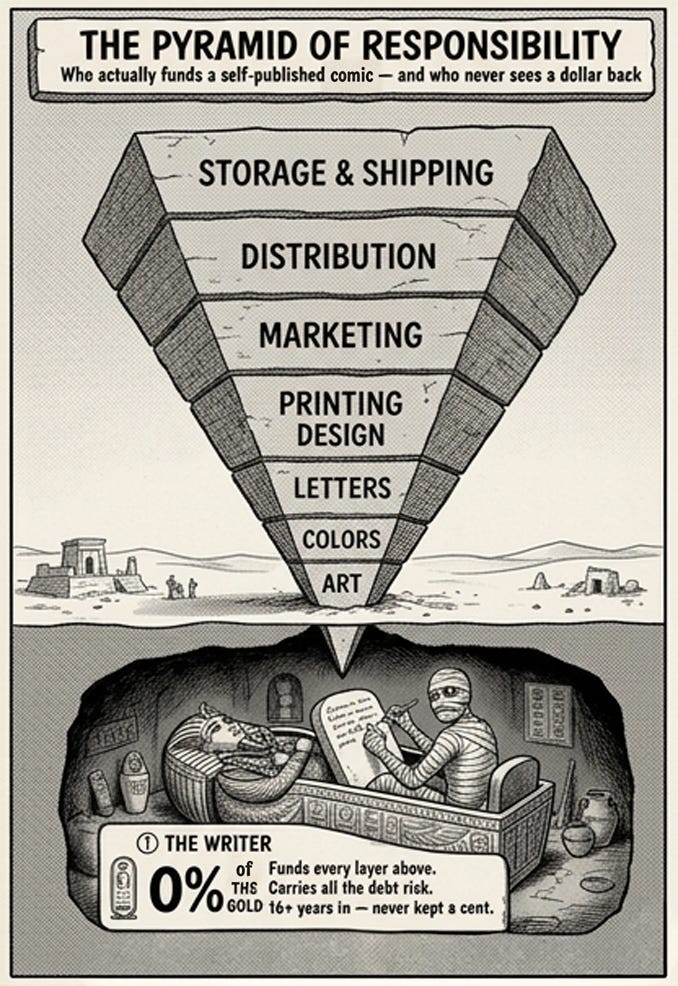
When a comic is billed as “self-published”, here’s what that phrase is quietly asking one person to fund, alone, without a fee, without a salary, without a cushion:
Art
Colors
Letters
Design
Printing
Marketing
Distribution
Storage of inventory
Shipping of inventory
Read that list again. That’s not a list of “extra” costs on top of writing a comic. That is the job of a publisher — every function a corporate publishing house exists to perform — condensed into one person’s bank account and one person’s calendar. The writer isn’t just writing. The writer is the entire company: the accounts payable department, the production manager, the marketing team, the warehouse, and the shipping desk. And unlike everyone else who touches the project, the writer is the only one with no guaranteed payment for any of it.
To be clear, because this is the heart of what I want this piece to be about: I am not arguing that artists, colorists, letterers, or anyone else shouldn’t be paid. Of course, they absolutely should — their talent is undeniable, and their labor is skilled, time-intensive, and essential to the medium existing at all. My point is narrower and, I think, more important: right now, in the self-publishing realm, there’s exactly one funding source for all of that labor, and it’s a single creative person who is more likely to go into debt from the project than to ever see a dollar of profit from it.
And that’s just not a sustainable design. It’s a structure built for failure, dressed up as an opportunity.
I want to ground this in real numbers rather than just my own pessimistic realism, so here’s the current state of the market — and I’m deliberately sticking to data from 2023 onward. The pandemic years threw the entire comics industry into a kind of statistical fever: a temporary sales surge, followed by a correction, layered on top of a direct market that was already being reshaped when DC ended its exclusive distribution deal with Diamond Comic Distributors in 2020, with Marvel and Image soon following. Numbers from that window don’t reflect anything like a stable baseline. And the instability hasn’t fully resolved even now — Diamond itself filed for Chapter 11 bankruptcy in January 2025 and converted to a Chapter 7 liquidation by late 2025, a genuinely wild development for a company that had been the backbone of direct-market distribution for decades.[^1] So: 2023 onward, reflecting the current market, as stable a picture as we can currently get.
Here’s what that picture shows.
The market is shrinking while the cost of participating in it keeps climbing. North American comics and graphic novel sales fell roughly 7% in 2023, to about $1.87 billion, with comic stores down 8% and the broader book channel down 7%.[^2] The pain wasn’t limited to one format — graphic novels fell 7%, and periodicals fell 6%, in roughly the same proportions as before.[^2] At the retail level, it looked even rougher: a 2024 ComicsPRO survey of comic shop owners found sales down at 69% of responding stores compared to the year before, with new periodical sales down at 73% of those shops.[^3]
Crowdfunding hasn’t stepped in to supplement that market so much as it’s absorbed the risk the market used to carry. Even as direct market sales fell in 2023, Kickstarter comics were up over 30% in dollars raised from backers in North America that same year.[^2] I don’t read that as a sign of a thriving alternative channel. I read it as a sign that individual creators are increasingly the ones capitalizing projects that publishers and distributors used to fund — because there’s now (much) less room for those projects in the direct market.
And the budgets creators are working with are thin, often before a single dollar from backers arrives. Guidance aimed at first-time creators suggests aiming for $2,000 or less on a first campaign, or $3,000–4,000 “if you really need it” — explicitly citing the scenario of a writer paying for everything out of pocket.[^4] Even established campaigns tend to land between $5,000 and $20,000, with anything under $5,000 often too thin to cover a quality print run once fees and shipping are factored in.[^5] And whatever a campaign raises gets trimmed further — Kickstarter takes a standard platform fee, on top of payment processing and the creator’s own tax liability, all before a single art page gets paid for.[^6] Meanwhile, the art, lettering, and coloring costs are typically paid out of pocket or committed to before the campaign even opens (those are just best practices) — meaning many writers are already carrying debt before they know whether the public will fund the book at all.[^7]
I can make this even more concrete, because I live inside these numbers every day. Self-publishing a 24-page comic in 2026 costs me between $3,000 and $4,000 for art and colors alone — and that figure includes zero compensation for the writer or the letterer, because both of those roles are filled by me. Printing a quality run — 100lb cover stock and 70lb interior stock — the standards for a book that actually looks and feels professional — runs around $3 per unit in short print runs, roughly 100-250 copies, the only volume range most self-publishers can realistically afford. $3 is more than retail cover price for some comics in the direct market. None of that accounts for the ongoing cost of production software like Adobe Creative Cloud, which is close to a hard requirement for producing a comic at a competitive quality level today, or for design work — a logo, say — done by anyone other than me.
That’s just a glimpse at the arithmetic underneath the pyramid: real skilled labor, real material costs, real software subscriptions, all funded by one person, before that person has earned a cent and despite that person accepting that it’s likely they never will. If I want to pursue direct market distribution in this day and age, I have to pay monthly fees to the new gatekeepers in that arena, Prana or Massive. Pay to play, baby. I wrote a whole-ass post on this state of affairs a few months back.
Read About Direct Market Gatekeepers
Here’s what that arithmetic looks like when it plays out over years, and not just one campaign.
I’ve written before about Last Ride of the 4 Horsemen, a long-form steampunk western horror I’ve been telling for over a decade. Over the life of that 13-issue series, I’ve worked with several different artists — sometimes changing because of circumstances entirely outside anyone’s control, sometimes because of the ordinary difficulty of sustaining a multi-year creative commitment on a schedule that depends on one unbroken income stream, sometimes because they realize making comics is hard. Every transition costs real time and real money: onboarding a new collaborator, absorbing already-paid-for work that won’t be finished, adjusting a release calendar that backers are waiting on.
I want to be careful here, because this isn’t a story about anyone letting me down. Most comics artists are juggling multiple paid assignments — and often part- or full-time non-comics jobs — just to make a sustainable living — a completely reasonable response to an industry that, as the numbers above show, offers vanishingly few full-time positions. The strain I’m describing isn’t people failing each other. It’s what happens when a single, un-backstopped individual is the only financial shock absorber in a system that actually requires many.
In a traditional publishing structure, this kind of disruption gets absorbed by the institution itself. An editor reassigns work. A production budget has contingency built into it. The company’s continuity survives any one person’s departure. In self-publishing, the writer is that institution — without its capital reserves, without its staff, without its ability to spread risk across dozens of titles at once. When something goes wrong on one project, there’s no cushion elsewhere to draw from. The writer absorbs it directly, on top of everything else already being funded.
And because crowdfunding is, for most of us, the only realistic source of production capital, we’re bound to its calendar as much as to our own. Only so many campaigns are viable in a year — realistically, one at a time — so any disruption doesn’t just cost money. It can cost a launch window that doesn’t come back around for months.
None of this is a ledger of what went wrong or who’s to blame. It’s an illustration of what “the writer funds and absorbs everything” actually means when it’s translated into the ordinary, unavoidable friction that every long creative collaboration eventually runs into — illness (and, yes, death), competing obligations, the natural attrition of any multi-year project, apathy, financial desperation, dishonesty. In a healthier model, that friction gets absorbed by shared infrastructure. In this one, it has exactly one place to land, every time.
Here’s the part of this that worries me most, and it’s the part that doesn’t show up in any sales report.

If this is what it costs — financially, logistically, and personally — to keep a single project alive for a decade, then it’s not a stretch (nor is it a surprise) to say we’ve already lost writers to this model. Not writers who ran out of ideas. Writers who ran out of money, or ran out of the kind of stamina that absorbing years of solo financial risk requires. Writers who could have built real careers and produced genuinely great comics, if the cost of trying hadn’t been total personal exposure to debt with no guaranteed floor underneath them. Writers who wanted to tell stories but, instead, spent more time transferring credit card balances.
I don’t have a tidy statistic for this, because by definition, the writers this model pushes out the earliest are the ones we never get the chance to hear from again — no follow-up campaign, no announcement of a new series, just a quiet stop and a welcome abandonment of a once beloved dream. That absence is the cost. It’s a loss of stories, of styles, of whole careers that could have shaped this medium, and it’s the predictable outcome of a funding structure that asks one person to be a publishing house without giving them a publishing house’s resources.
I care about this because I love this medium, and I want it to still exist — thriving, not just surviving — for the next generation of writers who want to tell stories that corporate publishers won’t take a chance on. That’s exactly why this model has to change. Not because self-publishing is a bad idea. Because this specific way of self-publishing asks too much of one link in the creative chain, and quietly costs us writers we need.
In short, no. Not given the way the comics industry is currently configured.
But I don’t think the answer is “stop self-publishing,” and I don’t think it’s realistic to expect traditional publishers to suddenly absorb the entire indie comics ecosystem or, honestly, to entertain it or care at all. But I don’t think the current all-or-nothing structure is the only option, either. A few directions seem to generate discussion — if not serious consideration — not as a finished blueprint, but as places this conversation might likely go:
Shared-risk collectives and studio models. Instead of one writer independently financing one project from scratch every time, small groups of self-publishers could pool resources — shared marketing budgets, shared distribution and fulfillment logistics, shared overhead for tools like production software — so that a single project’s setback doesn’t fall entirely on one person’s shoulders. This wouldn’t require anyone to give up creative ownership; it’s closer to how small presses have always worked, just intentionally built for the crowdfunding era. But, for this to work with regard to self-publishing comics, artists simply must be active and willing participants, but who’s going to sacrifice all or part of a page rate for a stake in a property with miniscule market access?
Advance-style structures within crowdfunding itself. Right now, campaign funds typically arrive as one lump sum after the campaign closes, with production costs often already sunk beforehand. A staged funding model — smaller advances tied to production milestones, more like how traditional publishing advances work — could reduce how much personal debt a writer has to carry before knowing whether a project is viable at all. Admittedly, this scheme is likely to be less popular with crowdfunding backers, simply due to the extended time waiting for the actual end product. Realistically, this approach doesn’t have a chance in Hell.
Cooperative or fractional equity between collaborators. Rather than the writer paying flat fees to every contributor while carrying all the downside risk alone, more self-publishers are experimenting with profit-share or equity-style arrangements, where artists, colorists, and letterers have some stake in a project’s back-end success in exchange for reduced up-front rates. This shifts some of the risk — and some of the potential upside — off the writer alone, without asking any collaborator to work for free. The obvious problem here is that there’s unlikely to be any back-end profits of any measurable significance, again due to the direct market distribution choke point. Delivering that news to starving creatives is not gonna go well. Scratch that.
Making the true cost visible to readers and backers. Part of what keeps this model invisible is that backers rarely see the full financial picture behind a campaign. More transparency about where funding actually goes — not to shame anyone, but to help the people who love this medium understand what it takes to sustain it — could build more support for some of the structural changes above, and more patience with the realities of production timelines. Okay, let’s keep it real. Nobody other than the one holding the bill cares how much any of it costs or who pays for it, and therein lies the ultimate problem.
None of these are silver bullets. They’re not even bandaids. In fact, I favor none of them, and I certainly don’t think any single fix among the above options solves this on its own. But I’d rather discuss some suggested directions than end on nothing but the diagnosis. This medium is worth fighting for, and the people trying to sustain it deserve a system that doesn’t quietly bet against them every time they start a new project.
But if you don’t see how the current state of affairs inevitably pushes the primary funding sources (e.g., writers) in self-published comics toward production resources that are not potentially financially back-breaking and that don’t carry the risk of project abandonment, you haven’t been paying attention. I look at every comics project launched on Kickstarter every single day, and it’s already happening. Sure, there are some for-shit AI-involved comics projects that run through Kickstarter, but there are also some really choice products, too, some by creators who then use a portion of the funds from those campaigns to subsidize non-AI-involved comics. It’s a logical progression and one that will find its equilibrium in time.
I keep coming back to that inverted pyramid. Every layer of what it actually takes to make a comic — art, colors, letters, design, printing, marketing, distribution, storage, shipping — funneling down to one point at the bottom, carrying the full weight of everything above it. That’s the shape of the current model, and it’s not sustainable, no matter how much any of us love the work.
Sixteen-plus years in, I haven’t kept a cent. Ever. There’s never even been a cent to keep. That’s not a complaint aimed at anyone I’ve worked with — every one of those dollars went somewhere it needed to go, into someone else’s talent and skilled labor, into paper and ink, into postage. It’s an observation about the structure itself: a system that asks one creative person to be the entire company, indefinitely, with no floor underneath them.
I’m not writing this because I want out. I’m writing it because I want this medium to still be here — full of strange, personal, un-focus-grouped stories — for a long time to come. That means being honest about what the current model costs the people trying to sustain it, and being willing to imagine what a more durable version could look like. Understanding the shape of the problem is where that starts.
[^1]: Bleeding Cool, “The Diamond Comics Bankruptcy War Is Over, But The Odyssey Is To Come”; Publishers Weekly, “Will the Diamond Bankruptcy Change the Comics Business Forever?,” February 12, 2025, https://www.publishersweekly.com/pw/by-topic/industry-news/comics/article/97080-will-the-diamond-bankruptcy-change-the-comics-business-forever.html.
[^2]: ICv2, “North American Comics and Graphic Novel Market Down 7% in 2023,” July 15, 2024, https://icv2.com/articles/markets/view/57351/north-american-comics-graphic-novel-market-down-7-2023.
[^3]: Publishers Weekly, “Sales Dropped at Comics Shops in 2023, ComicsPRO Survey Finds,” April 17, 2024, https://www.publishersweekly.com/pw/by-topic/industry-news/comics/article/94839-sales-dropped-at-comics-shops-in-2023-comicspro-survey-finds.html.
[^4]: Comic Book Yeti, “10 Things to Know Before You Kickstart Your Comic,” April 27, 2022, https://www.comicbookyeti.com/post/10-things-to-know-before-you-kickstart-your-comic.
[^5]: Dauntless Stories, “Crowdfunding Comic Books in 2026: The Complete Creator’s Guide,” June 25, 2026, https://dauntlessstories.com/crowdfunding-comic-books-2026-guide/.
[^6]: Hireillo, “How to Plan a Kickstarter Comic Crowdfunder,” February 28, 2024, https://www.hireillo.com/blog/kickstarter-crowdfunder/.
[^7]: Dauntless Stories, “Crowdfunding Comic Books in 2026” (as above).
No posts
Comments
Nothing yet. Say the first thing.
Sign in to join the conversation.